

Environmental testing is the foundational quality verification process for modern high-precision industries, including semiconductors, automotive electronics, aerospace, new energy batteries, telecommunications, and medical devices. It accurately simulates complex real-world environmental conditions to validate product reliability, long-term durability, and operational safety. Most testing engineers prioritize core parameters such as temperature range and temperature ramp rate when selecting environmental test chambers. However, temperature uniformity, a key thermal performance indicator, is often overlooked, yet it fundamentally determines the authenticity and credibility of all environmental test data.
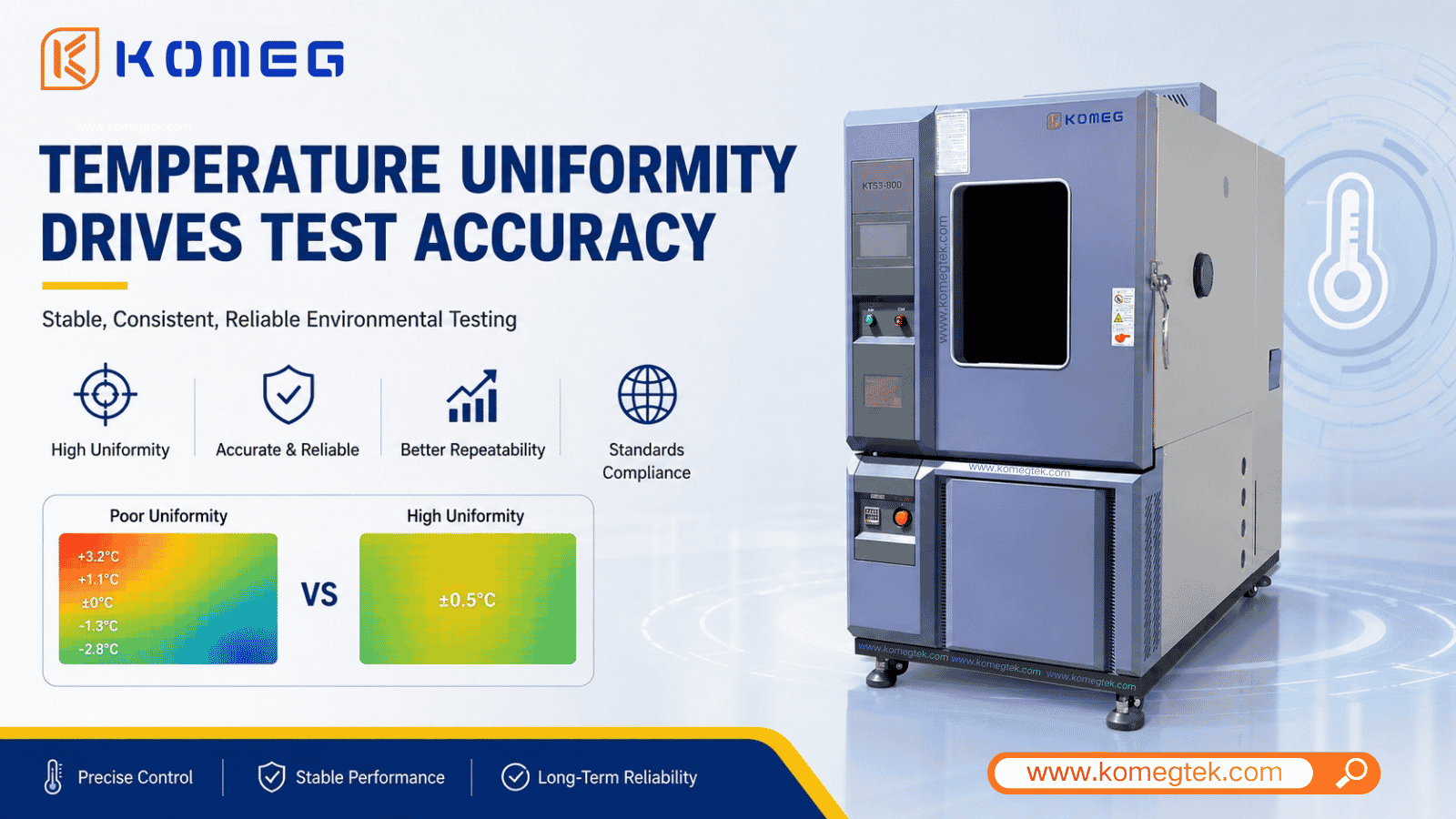
Temperature uniformity is the core factor affecting environmental test accuracy and repeatability. Unstable and inconsistent temperature distribution in the test chamber directly leads to distorted test data, undetected product latent defects, and even non-compliant product certification results. To help enterprises conduct standardized and high-precision environmental reliability tests, this article elaborates on the definition of temperature uniformity, its critical value for environmental testing, key influencing factors, differences between uniformity and temperature stability, advanced optimization technologies of modern test chambers, and industry-standard maintenance best practices.
What Is Temperature Uniformity in Environmental Testing?
Temperature uniformity refers to the consistency of temperature distribution across the entire working space of an environmental test chamber under set test conditions. It reflects the maximum temperature deviation of multiple monitoring points in the chamber workspace during stable testing, and is a core technical index to measure the thermal balance capability of test equipment.
In an ideal high-precision test chamber, all spatial positions of the test area can maintain identical temperature values. Nevertheless, actual industrial test environments inevitably produce minor temperature deviations due to equipment structure, operating conditions, and test load factors. The main causes of uneven temperature distribution include internal airflow patterns, heater layout schemes, refrigeration system design, test sample size and placement, chamber structural design, and temperature sensor positioning. For an intuitive example, when a test chamber is stably set to 85°C for constant temperature testing, the actual temperature of different spatial points may show obvious differences:
- Corner area: 84.2°C
- Workspace center: 85.0°C
- Airflow outlet area: 86.1°C
Although the 1–2°C temperature deviation seems negligible in conventional testing, it will cause irreversible data errors in high-precision reliability tests for semiconductors, automotive-grade electronic components, and aerospace parts, completely invalidating test results.
Why Temperature Uniformity Is Critical for Environmental Test Accuracy
Temperature uniformity is not a secondary parameter but a core prerequisite for compliant, accurate, and repeatable environmental testing. It directly affects product reliability evaluation, test data authenticity, and international standard compliance. The specific core values are reflected in the following three dimensions.
1. Ensures Accurate and Reliable Product Stress Validation
Poor temperature uniformity will lead to differentiated thermal effects on different samples or different positions of a single sample, triggering a series of test anomalies, including uneven material aging, inconsistent thermal expansion and contraction of components, unstable electrical performance parameters, and random failure points.
2. Guarantees Test Repeatability and Data Consistency
3. Meets Strict International Test and Certification Standards
Global mainstream industrial reliability test standards have clear and mandatory tolerance requirements for chamber temperature uniformity. Common compliant standards include IEC 60068, MIL-STD-810H, AEC-Q100, JEDEC series standards, ISO 16753, and ICH pharmaceutical stability test guidelines.
Key Factors Affecting Environmental Chamber Temperature Uniformity
1. Internal Airflow System Design
Unoptimized airflow systems are prone to hot spots, cold spots, internal thermal layering, and airflow stagnation zones, resulting in uneven heat distribution. Modern high-precision environmental test chambers adopt optimized duct structures, high-power, efficient circulating fans, multi-directional circulating airflow systems, and CFD computational fluid dynamics simulation technology in the design stage to eliminate dead airflow zones and achieve overall thermal balance.
2. Test Chamber Load and Sample Configuration
The size, quantity, and placement of test samples (test load) directly change the internal airflow circulation state of the chamber. Overloading the test chamber, dense sample placement, and blocking air outlets and return air ducts will seriously restrict airflow circulation, hinder internal heat exchange, and lead to uneven heat absorption and heat dissipation.
To maintain optimal temperature uniformity, test specifications must be followed: avoid overloading the chamber, maintain uniform airflow gaps between samples, and reasonably place large-volume test products to ensure unobstructed internal air circulation.
3. Heating and Refrigeration System Matching Design
The balance of heating and refrigeration systems is the core hardware guarantee for temperature uniformity. Traditional single heating and cooling structures are prone to local overheating or excessive cooling, resulting in large temperature deviations. High-performance test chambers are equipped with balanced multi-point heater layouts, multi-stage intelligent refrigeration systems, high-precision PID temperature control algorithms, and fast-response temperature sensing components. These configurations effectively suppress temperature overshoot and undershoot, quickly stabilize the internal thermal environment, and narrow the overall temperature deviation of the workspace.
4. Temperature Sensor Calibration Accuracy
Temperature sensors are the data acquisition and feedback core of the test chamber control system. The calibration accuracy, sensitivity, and working state of sensors directly determine the accuracy of temperature regulation. Long-term use without calibration will lead to sensor drift, false temperature readings, and delayed feedback signals. The control system cannot accurately identify the real internal temperature, resulting in continuous temperature deviation and reduced uniformity. Regular sensor calibration is a necessary measure to maintain long-term test accuracy of equipment.
Temperature Uniformity vs Temperature Stability: Core Differences
Most test users easily confuse temperature uniformity and temperature stability, two independent but complementary core thermal indexes of environmental test chambers. Both determine test accuracy, but their detection dimensions and evaluation standards are completely different.
Temperature Uniformity (Spatial Consistency)
It evaluates temperature differences of multiple spatial points in the chamber at the same time, representing the spatial balance of temperature. For example, the industry-standard high-precision index is ±1°C full-workspace uniformity.
Temperature Stability (Time Consistency)
It evaluates the temperature fluctuation of a single fixed point in the chamber over a continuous period of time, representing the long-term stability of temperature. For example, the high-standard stability index is ±0.3°C fluctuation within 30 minutes. It is worth noting that a test chamber may have excellent temperature stability but poor uniformity. This situation is mostly caused by an unreasonable airflow design— the single-point temperature is stable, but the spatial temperature distribution is extremely uneven, which will still lead to invalid test data.
How Modern Environmental Chambers Optimize Temperature Uniformity
- Optimized full-space air circulation system: Adopts a customized fan and duct matching scheme to realize 360° balanced circulating airflow, eliminate thermal dead zones, and ensure consistent heat exchange in all areas of the workspace.
- Intelligent PID precise temperature control: Real-time dynamic adjustment of heating and cooling power output to suppress temperature fluctuation and overshoot, maintaining a constant thermal environment.
- CFD thermal simulation pre-optimization: Conduct fluid dynamics simulation in the equipment design stage, pre-judge and eliminate potential uneven thermal zones, and optimize structural design.
- Multi-point sensor real-time feedback system: Arrange multiple high-precision sensors in the workspace to collect spatial temperature data in real time, realizing regional precise temperature adjustment.
- High-density thermal insulation materials: Isolate external ambient temperature interference, reduce internal and external temperature gradients, and avoid local temperature deviation caused by heat loss.
Core Industries Demanding High Temperature Uniformity Testing
High-precision temperature uniformity is a rigid requirement for high-end manufacturing and precision testing industries, covering multiple key fields:
- Semiconductor Industry: Suitable for chip burn-in testing, thermal cycling testing, component reliability qualification, and CPO photonics device testing, ensuring consistent stress verification of precision electronic components.
- Automotive Electronics & New Energy Vehicles: Applied to automotive ECU performance verification, AEC-Q100 standard testing, EV battery reliability testing, and automotive sensor durability testing, meeting automotive-grade high-reliability requirements.
- Aerospace & Defense: Accurately simulate extreme high and low temperature environmental conditions in flight and service, providing reliable data support for aerospace component environmental adaptability verification.
- Pharmaceutical Stability Testing: Provide constant and uniform temperature conditions for drug shelf-life testing and stability verification, complying with ICH standard specifications.
Best Maintenance Practices to Sustain Long-Term Temperature Uniformity
- Calibrate temperature sensors regularly to eliminate data drift and ensure accurate feedback.
- Clean internal airflow ducts and filter screens frequently to avoid dust blockage affecting airflow circulation.
- Standardize test load placement, strictly prohibit overloading, and maintain smooth air circulation;
- Regularly inspect the operating state of circulating fans to prevent abnormal airflow caused by fan failure.
- Check door seal integrity regularly to avoid cold and hot air leakage, causing temperature deviation.
- Formulate a complete preventive maintenance plan for long-term stable thermal performance of equipment.
Temperature uniformity is an indispensable core parameter of high-precision environmental testing. Small spatial temperature deviations will directly affect product reliability evaluation results, international standard compliance, and long-term durability analysis. For high-end manufacturing industries with strict test thresholds, stable temperature uniformity is the basis for accurate test data, repeatable experimental results, and compliant product certification.
A high-quality environmental test chamber with optimized airflow structure, an intelligent temperature control system, and stable refrigeration and heating performance can effectively reduce test errors, avoid test risks, and improve the efficiency and accuracy of product reliability verification. As semiconductors, new energy vehicles, aerospace, and photonics industries continue to raise higher requirements for product reliability standards, temperature uniformity will become an increasingly key evaluation index for environmental test equipment.
KOMEG professional environmental test chambers adopt advanced balanced airflow systems, precision PID temperature control technology, and mature thermal management solutions. With ultra-high temperature uniformity and stable operating performance, our equipment fully meets the high-standard testing needs of various precision industrial scenarios, helping enterprises complete standardized, accurate, and compliant environmental reliability tests.