

MIL-STD-810 is a widely recognized military standard developed to evaluate the environmental durability and reliability of equipment under extreme conditions. Originally designed for military applications, this standard has become a benchmark for testing products that must perform reliably in harsh environments.
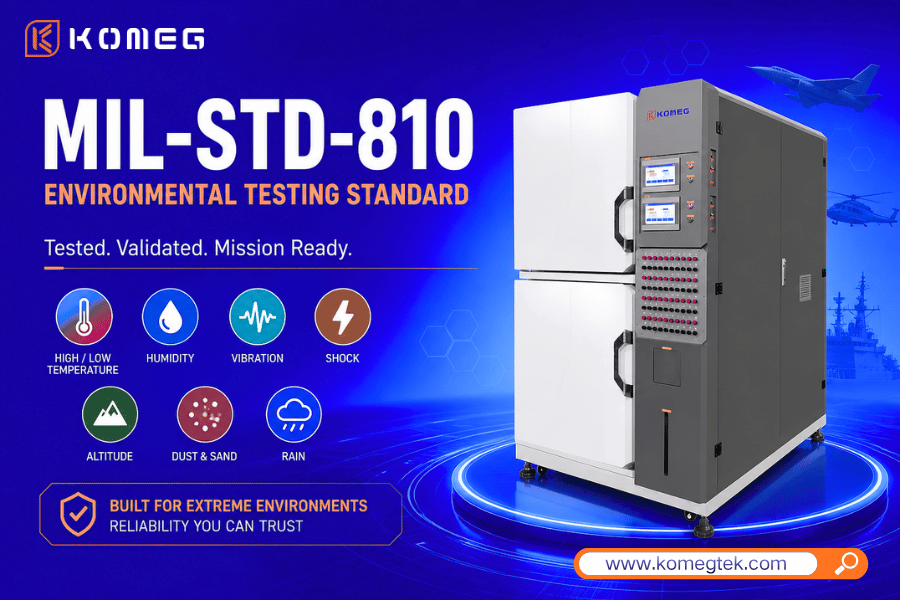
Today, MIL-STD-810 is not only used in defense systems but also widely applied in industries such as aerospace, automotive, electronics, and industrial equipment. Manufacturers rely on this standard to validate product performance under real-world stress conditions, including temperature extremes, humidity, vibration, shock, and more.
As product reliability becomes increasingly critical, understanding MIL-STD-810 is essential for engineers, quality managers, and procurement professionals.
What Is MIL-STD-810?
MIL-STD-810 is a U.S. military standard that defines environmental engineering considerations and laboratory test methods. It is published by the United States Department of Defense and focuses on simulating real-world environmental conditions rather than relying solely on theoretical testing.
Unlike many general testing standards, MIL-STD-810 emphasizes tailoring tests to match specific environmental conditions that a product will encounter during its lifecycle. This approach ensures more realistic and application-specific validation.
The standard includes a wide range of test methods covering environmental factors such as temperature, humidity, vibration, altitude, sand and dust exposure, and mechanical shock.
Why MIL-STD-810 Is Important
Products used in extreme environments must maintain performance and reliability under conditions far beyond normal operating ranges. Failure in such environments can lead to mission-critical issues, safety risks, or costly system breakdowns.
MIL-STD-810 helps manufacturers identify potential failure points before products are deployed. It ensures that equipment can withstand transportation, storage, and operational stresses in real-world scenarios.
For commercial manufacturers, compliance with MIL-STD-810 is often used as a mark of durability and ruggedness. Many companies adopt this standard to demonstrate that their products meet high reliability expectations.
Key Environmental Test Methods in MIL-STD-810
MIL-STD-810 includes numerous test methods, each designed to simulate a specific environmental condition. These tests are not one-size-fits-all but are selected and tailored based on the intended use of the product.
One of the most commonly used methods is temperature testing. Products are exposed to both high and low temperature extremes to evaluate performance under thermal stress. This includes both operational and storage temperature conditions.
Humidity testing is another critical method. It simulates high moisture environments to assess the risk of corrosion, insulation failure, and degradation of materials over time.
Vibration testing evaluates how products respond to continuous mechanical stress caused by transportation or operational movement. This is especially important for equipment used in vehicles, aircraft, or industrial machinery.
Mechanical shock testing simulates sudden impacts or drops that may occur during handling or operation. It helps identify structural weaknesses and potential points of failure.
Altitude testing is used to evaluate product performance under low-pressure conditions, which is essential for aerospace and high-altitude applications.
Additional test methods include exposure to sand and dust, rain, salt fog, and solar radiation. These tests simulate harsh environmental conditions that products may encounter in deserts, coastal regions, or outdoor environments.
How MIL-STD-810 Testing Is Conducted
MIL-STD-810 testing is not simply about running predefined procedures. Instead, it requires careful analysis of the product’s intended operational environment.
Engineers first identify the environmental conditions that the product is likely to encounter. Based on this analysis, they select relevant test methods and define test parameters such as temperature ranges, exposure duration, and stress levels.
Testing is then conducted using specialized environmental simulation equipment. Temperature and humidity chambers are used for climatic testing. Vibration systems simulate mechanical stress. Thermal shock chambers may be used to evaluate rapid temperature transitions.
The goal is to create a realistic simulation of environmental conditions while maintaining repeatability and control in a laboratory setting.
Applications of MIL-STD-810
MIL-STD-810 is widely used across multiple industries that require high reliability under extreme conditions.
In military applications, it is used for testing communication systems, navigation equipment, and field-deployed electronics.
In aerospace, it ensures that components can operate under high altitude, temperature variation, and vibration conditions.
In the automotive industry, especially in off-road and heavy-duty vehicles, MIL-STD-810 is used to validate durability under harsh environmental conditions.
Consumer electronics manufacturers also use MIL-STD-810 to market rugged devices such as smartphones, tablets, and laptops designed for outdoor or industrial use.
Industrial equipment, including control systems and monitoring devices, also benefits from MIL-STD-810 testing to ensure long-term reliability.
Common Failure Modes Identified by MIL-STD-810
MIL-STD-810 testing is particularly effective at identifying hidden weaknesses that may not appear during standard testing procedures.
Thermal stress can cause material expansion and contraction, leading to cracks, warping, or failure of internal components.
Humidity exposure can result in corrosion of metal parts, degradation of insulation, and electrical short circuits.
Vibration can lead to fatigue failure in solder joints, loosening of connectors, and structural damage over time.
Mechanical shock may cause sudden failure of fragile components or misalignment of critical parts.
Environmental exposure, such as dust or salt fog, can accelerate wear and reduce product lifespan.
By identifying these issues early, manufacturers can improve product design and reliability.
Relationship Between MIL-STD-810 and Environmental Test Chambers
Environmental test chambers are essential for performing MIL-STD-810 testing. These systems provide controlled conditions that allow engineers to simulate a wide range of environmental stresses.
Temperature and humidity chambers are used to simulate climatic conditions. Thermal shock chambers are used for rapid temperature transition testing. Vibration systems are used to replicate mechanical stress.
Advanced testing setups may combine multiple environmental factors to create more realistic testing conditions.
Selecting the right testing equipment is critical for achieving accurate and compliant test results.
MIL-STD-810 vs Other Environmental Standards
MIL-STD-810 differs from other environmental testing standards in its focus on real-world environmental simulation.
Compared to general standards such as IEC 60068, MIL-STD-810 provides more detailed guidance on tailoring test conditions based on actual usage scenarios.
Compared to automotive-specific standards such as ISO 16750, MIL-STD-810 covers a broader range of environmental conditions and is often more rigorous in terms of stress levels.
Each standard serves a different purpose, and selecting the appropriate one depends on the application and industry requirements.
MIL-STD-810 is a critical standard for evaluating product reliability under extreme environmental conditions. Its emphasis on real-world simulation and tailored testing makes it a powerful tool for identifying potential failure points and improving product durability.
As industries continue to demand higher reliability and performance, MIL-STD-810 remains a key reference for engineers and manufacturers seeking to validate products for harsh environments.
For accurate and reliable MIL-STD-810 testing, selecting the right environmental testing equipment is essential. Contact our team to explore customized testing solutions for your application.