

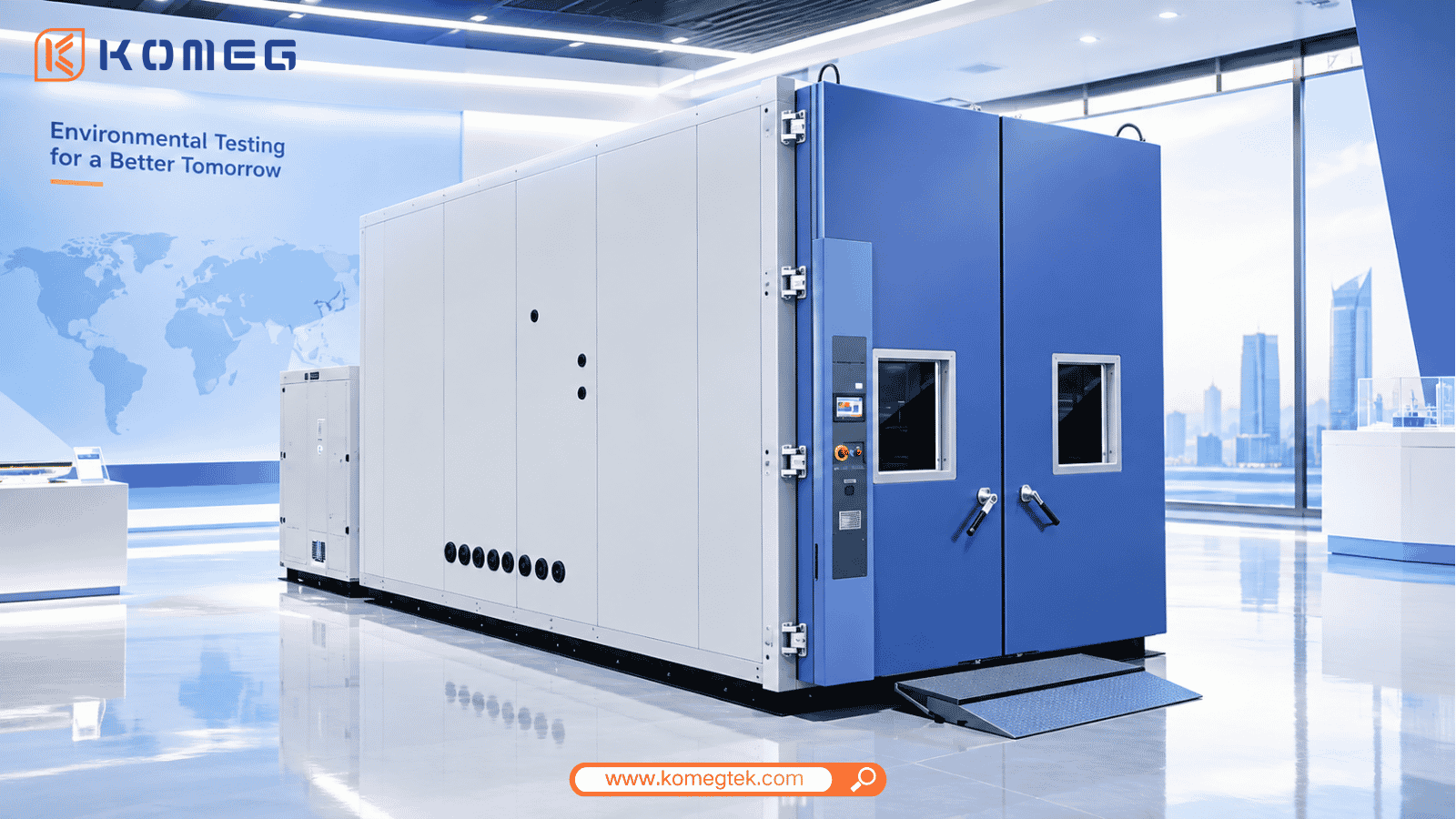
As products become larger and more complex, standard environmental test chambers may not provide enough working space or the configuration required for reliable testing. Electric vehicle battery packs, automotive assemblies, energy storage systems, industrial equipment, and large electronic products may require environmental testing at the component, subsystem, or full-product level.
A customizable large-volume environmental test chamber provides a controlled environment for testing products that exceed the practical capacity of conventional benchtop or reach-in chambers. Its dimensions, temperature range, humidity capability, airflow arrangement, access structure, and control functions can be configured according to the intended application.
However, increasing chamber volume alone does not guarantee suitable test performance. A successful design must account for specimen size, thermal load, environmental uniformity, installation constraints, and the requirements of the test procedure.
Why Choose a Customizable Large Volume Environmental Test Chamber?
Standard chambers are designed around defined dimensions and performance specifications. They work well when the specimen fits within the available workspace and the required test conditions fall within the equipment’s operating capabilities.
Challenges arise when testing large or irregularly shaped products. A specimen may require additional clearance for fixtures, cable connections, handling equipment, or instrumentation. Its thermal mass may also affect temperature recovery and stabilization.
A customized chamber allows these requirements to be considered during the design stage.
Typical applications include:
Electric vehicle battery packs and energy storage assemblies.
Automotive components, interior assemblies, and electrical systems.
Large electronic equipment and industrial control systems.
Aerospace components and equipment requiring environmental qualification.
Materials, assemblies, and products that must be tested in their installed configuration.
The appropriate chamber configuration depends on the product dimensions, required environmental conditions, and applicable test method.
1. Chamber Dimensions and Working Volume
Working volume is one of the first considerations when specifying a large environmental test chamber. The internal dimensions must accommodate the specimen and the space needed for safe loading, airflow circulation, sensor placement, and maintenance access.
The external dimensions also matter. Door openings, ceiling height, corridors, elevators, floor loading, and available installation space can influence the final design.
For particularly large specimens, a walk-in chamber may be more practical than a conventional reach-in model. The design may include wider doors, ramps, loading access, reinforced flooring, or other features according to the installation and specimen requirements.
When discussing a customized chamber, buyers should provide the maximum specimen dimensions, weight, loading method, and expected arrangement inside the working space. These details help engineers determine whether a proposed chamber layout is practical.
2. Temperature and Humidity Requirements
Large volume chambers may be required to simulate high temperatures, low temperatures, humidity conditions, or programmed environmental cycles. The required operating range should be established before selecting the refrigeration, heating, and humidification systems.
Temperature range alone is not enough to determine suitability. Engineers should also consider temperature uniformity, stability, recovery time, and performance under the intended specimen load.
Humidity requirements need similar attention. If the test involves combined temperature and humidity conditions, the chamber must support the required temperature-humidity combinations rather than simply meeting the maximum temperature and maximum relative humidity as separate specifications.
For large or thermally massive specimens, the chamber’s response may differ from its no-load performance. The test plan should define whether the relevant condition is chamber air temperature, specimen surface temperature, or the temperature inside the product.
These distinctions are particularly important when testing battery assemblies, automotive components, and large industrial products.
3. Airflow Design and Temperature Uniformity
Maintaining suitable environmental conditions throughout a large working space can be more challenging than controlling a smaller chamber.
The airflow path must account for chamber dimensions, specimen geometry, fixture placement, and obstructions. Large products can block air circulation or create areas with different heat-transfer characteristics.
A suitable airflow design should therefore be developed around the intended test arrangement. Shelving, internal supports, cable routing, and specimen spacing should be considered before the chamber layout is finalized.
Temperature uniformity should be evaluated according to the manufacturer’s specified test conditions and the applicable measurement method. If the chamber will be used with a substantial thermal load, buyers should discuss the expected loading conditions rather than relying only on an empty-chamber specification.
4. Custom Doors, Loading Access, and Internal Layout
Large products often require more than additional internal space. The chamber must also allow the specimen to be loaded, positioned, connected, and removed efficiently.
Depending on the application, customization may include:
Single or double doors with dimensions suited to the specimen.
Walk-in access for large assemblies.
Cable ports for external instrumentation and electrical connections.
Adjustable shelves or dedicated specimen supports.
Ramps or other loading provisions where appropriate.
Internal layouts designed around fixtures and test equipment.
These features should be coordinated with the chamber’s structural design and environmental performance requirements.
For example, a large battery assembly may require space for power cables, monitoring sensors, and external data acquisition equipment. The position and number of cable ports should be planned early to avoid interference with loading access or airflow.
5. Refrigeration Capacity and Specimen Thermal Load
Large volume does not automatically mean that a chamber can handle every large specimen. The required heating and cooling capacity depends on the working volume, insulation, target temperature range, transition requirements, and thermal characteristics of the load.
A heavy metal assembly may absorb or release considerable heat during temperature transitions. An electrically powered specimen may also generate heat during testing.
These factors can affect temperature recovery and the time required for the specimen to reach the intended condition. If rapid temperature changes are required, the chamber should be evaluated against the specified transition rate and the actual loading conditions.
Buyers should provide information about specimen mass, material, power dissipation, number of specimens, and the required temperature profile. This allows the equipment configuration to be assessed against the real application rather than a nominal chamber volume alone.
6. Control, Monitoring, and Data Collection
Large-scale environmental testing may involve several sensors, multiple test stages, and long operating periods. Control and data collection requirements should therefore be considered as part of the overall chamber specification.
Depending on the application, buyers may need programmable temperature and humidity profiles, data logging, communication interfaces, cable access, alarms, or integration with external test equipment.
The chamber controller manages the specified environmental conditions, while additional instrumentation may be needed to monitor temperatures or other parameters at the specimen itself.
Before ordering, clarify which functions are included in the standard configuration and which require optional equipment or custom integration. This helps prevent misunderstandings about monitoring, automation, and test-data requirements.
7. How to Specify a Custom Large Volume Test Chamber
A clear technical specification helps manufacturers evaluate feasibility and prepare a suitable proposal.
Before requesting a quotation, prepare the following information:
Product and specimen details: Maximum dimensions, weight, materials, quantity, and loading arrangement.
Required environmental conditions: Minimum and maximum temperature, humidity range where applicable, and any programmed cycle requirements.
Performance requirements: Temperature uniformity, stability, transition rate, recovery time, and measurement criteria.
Test setup: Cable ports, internal fixtures, shelves, sensor access, external equipment, and whether the specimen is powered during testing.
Installation constraints: Available floor space, ceiling height, door access, electrical supply, cooling utilities, drainage, and other site requirements.
Applicable standards: The specific standard and edition, test method, and any customer-specific acceptance criteria.
Not every application requires a fully customized design. In some cases, a standard walk-in chamber may meet the requirement with selected options. A technical review can help determine the most practical configuration.
8. Custom Large Volume Chambers from KOMEG
KOMEG provides environmental testing equipment for applications that require controlled temperature and humidity conditions, including walk-in chamber configurations.
When evaluating a large volume environmental test chamber, buyers should consider the complete testing process: specimen dimensions, environmental limits, thermal load, airflow, access requirements, instrumentation, and installation conditions.
Explore KOMEG’s walk-in environmental test chambers to learn more about chamber solutions for larger specimens and environmental testing applications.
For applications involving large battery and energy storage systems, chamber dimensions and environmental performance should be assessed alongside the intended safety provisions, loading arrangement, and test procedure.
The final configuration should be determined through technical discussion and confirmation of the required specifications.
A customizable large volume environmental test chamber can help manufacturers evaluate large products and assemblies under defined environmental conditions. Its effectiveness depends not only on working volume, but also on temperature and humidity performance, airflow, thermal capacity, loading access, control functions, and installation requirements.
Providing clear specimen data and test specifications at the beginning of the design process helps engineers identify a practical chamber configuration and reduce avoidable design changes.
For complex environmental testing applications, the right solution is the one that accommodates the product while maintaining the conditions required by the test procedure.