

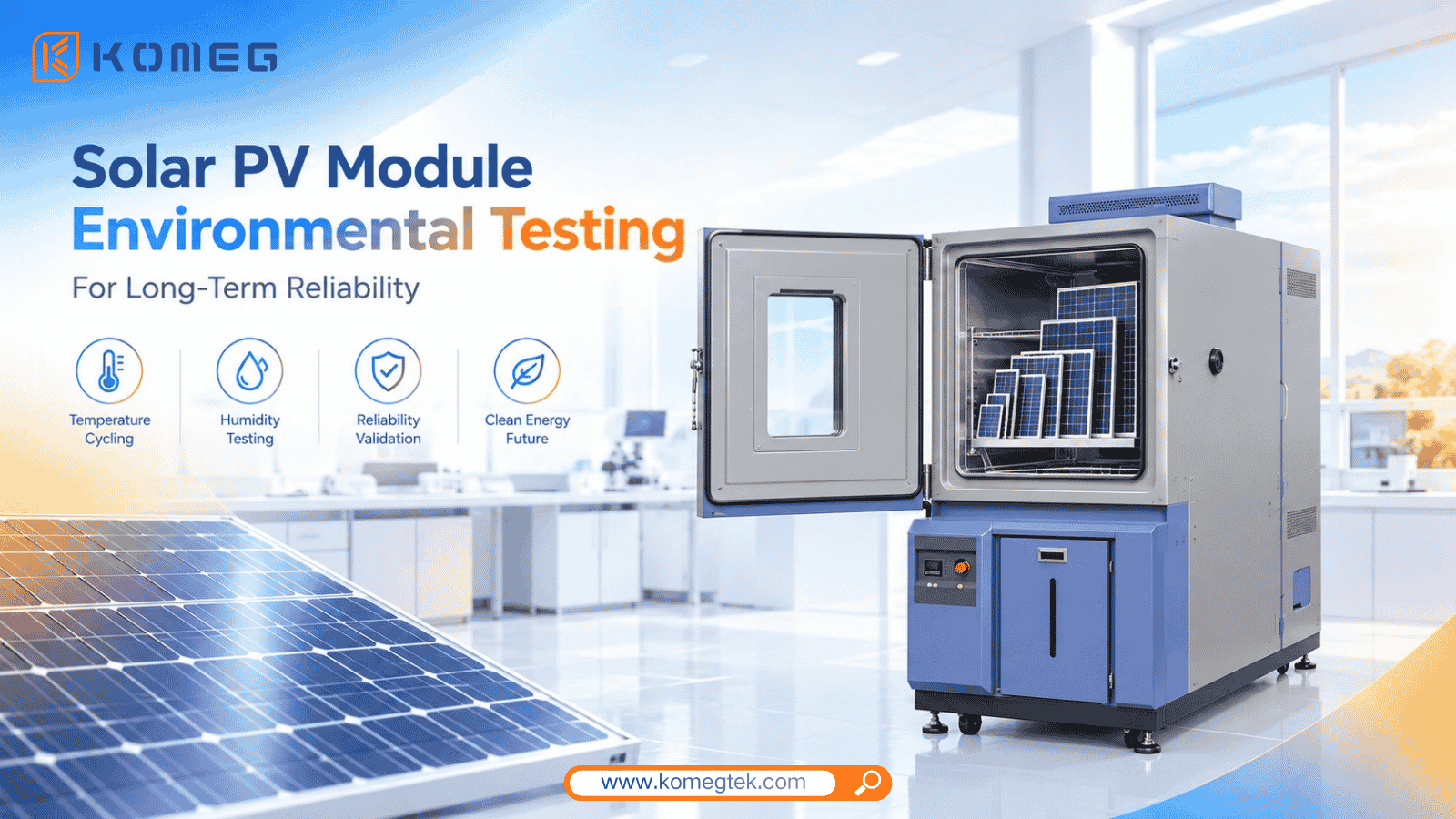
Solar photovoltaic (PV) modules are designed to generate electricity for many years under changing outdoor conditions. During their service life, they may experience high daytime temperatures, low nighttime temperatures, humidity, rain, and repeated thermal expansion and contraction. These environmental stresses can affect module materials, electrical connections, encapsulation systems, and overall performance.
Solar PV module environmental testing helps manufacturers and research laboratories evaluate how modules respond to controlled environmental stress before deployment. By reproducing selected temperature and humidity conditions, engineers can investigate potential weaknesses, compare material designs, and assess whether a module maintains its required performance after exposure.
Choosing the right test equipment depends on the test method, module dimensions, environmental profile, and measurement requirements. Understanding these factors helps laboratories develop a more effective reliability testing program.
Why Environmental Testing Matters for Solar PV Modules
A photovoltaic module contains multiple materials and interconnected components. Glass, encapsulants, backsheets or rear glass, cells, soldered connections, junction boxes, and sealing materials must work together throughout the module’s service life.
These materials may respond differently to environmental changes. Repeated temperature variation can create mechanical stress because different materials expand and contract at different rates. Moisture exposure can contribute to degradation in susceptible materials or interfaces. Changes in electrical connections or insulation properties may also affect module reliability.
Environmental testing allows engineers to investigate these risks under controlled conditions. It can support product development, design comparison, process validation, and reliability qualification.
Laboratory testing does not reproduce every aspect of real-world aging, nor does passing a specific test guarantee a particular service life. Instead, each test provides evidence about performance under its defined conditions and contributes to a broader reliability assessment.
Key Environmental Tests for Photovoltaic Modules
1. Temperature Cycling Tests
Temperature cycling evaluates how a photovoltaic module responds to repeated transitions between high and low temperatures. The changes in temperature can create mechanical stress in materials and interfaces with different coefficients of thermal expansion.
Potential areas of concern include soldered interconnections, cell interconnect ribbons, electrical joints, encapsulant interfaces, and other bonded structures. Repeated cycling may reveal weaknesses that are not immediately apparent during initial inspection.
A temperature cycling program typically defines the required temperature limits, transition profile, dwell periods, and number of cycles. The exact conditions depend on the applicable test standard or qualification procedure.
A programmable temperature test chamber can provide controlled thermal conditions for suitable PV component and module testing applications. Before selecting a chamber, laboratories should confirm that its usable dimensions, temperature range, transition performance, and loading capacity meet the actual test requirements.
2. Damp Heat Testing
Damp heat testing exposes photovoltaic modules or components to controlled elevated temperature and relative humidity for a specified period. The objective is to investigate susceptibility to moisture- and heat-related degradation.
Depending on the module design and materials, relevant concerns may include corrosion, adhesion changes, moisture ingress, insulation degradation, and deterioration of susceptible interfaces.
A temperature and humidity test chamber can support applications requiring controlled temperature and humidity exposure, provided its operating envelope and usable capacity are suitable for the intended procedure.
For PV module testing, chamber selection should account for the complete environmental profile rather than considering the maximum temperature and humidity values independently. The required temperature and humidity combination must be achievable within the equipment’s specified operating range.
3. Humidity Freeze and Related Environmental Sequences
Some photovoltaic qualification procedures combine moisture exposure with subsequent temperature changes. Such sequences can help evaluate how module materials and interfaces respond to different environmental stresses.
The conditions and sequence must follow the relevant test method. A chamber suitable for steady damp heat exposure may not automatically be suitable for a procedure that requires rapid cooling, low-temperature operation, or tightly controlled transitions between environmental conditions.
Where multiple environmental stages are involved, laboratories should review whether one chamber can perform the complete procedure or whether separate equipment is required.
4. Temperature and Humidity Conditioning of Materials
In addition to testing complete modules, manufacturers may evaluate encapsulants, backsheets, sealants, adhesives, connectors, and other materials during product development.
Controlled environmental conditioning can help researchers compare formulations and examine changes in physical or electrical properties after exposure. Small material specimens may require less chamber space than complete modules, but the test method and specimen arrangement still influence the equipment requirements.
For these applications, the chamber should provide the necessary environmental range, suitable specimen placement, and sufficient control for the intended measurements.
How to Select an Environmental Test Chamber for PV Testing
Selecting equipment for photovoltaic testing starts with the test procedure and the dimensions of the specimen.
Module Size and Usable Test Space
Full-size PV modules can be substantially larger than typical laboratory samples. The chamber must accommodate the module, its mounting fixture, sensor placement, and the necessary clearance for airflow.
Check the internal dimensions and usable loading space rather than relying on the external dimensions or nominal chamber volume. The orientation of the module and the number of specimens tested at once can also affect the required capacity.
Temperature Range and Transition Profile
The required temperature limits should come directly from the applicable standard or internal test protocol. Researchers should also confirm the required ramp rates, dwell periods, cycle count, and stabilization criteria.
Chamber air temperature and module temperature may not change at the same rate. The thermal mass of the module, fixture design, and loading configuration can influence how quickly the specimen reaches the intended condition.
If the test requires a specific transition profile, verify the manufacturer’s performance data under conditions representative of the intended load.
Humidity Operating Range
For damp heat and related tests, the chamber must maintain the required temperature and relative humidity combination for the specified exposure period.
Humidity performance can depend on operating temperature, sample loading, and the moisture introduced or absorbed by the test setup. Laboratories should confirm the complete operating envelope and the conditions under which performance specifications apply.
Monitoring and Test Documentation
Reliability testing requires clear records of the environmental conditions applied to each specimen. Depending on the procedure, laboratories may need programmable profiles, alarms, temperature and humidity records, external sensors, and data export functions.
These features can help engineers document test execution and investigate unexpected results. The specific data acquisition and reporting requirements should be defined before equipment procurement.
Installation and Operational Requirements
Before ordering a chamber, assess the available installation area, module transport route, electrical supply, ventilation, and maintenance access.
Large test chambers may require careful planning for delivery, positioning, and specimen loading. Laboratories should also consider the heat generated by the equipment and any cooling-water requirements for water-cooled configurations.
Connecting Environmental Test Results with Module Reliability
Environmental exposure is only one part of photovoltaic reliability evaluation. To interpret the results, laboratories generally need to compare measurements taken before and after testing and investigate any observed changes.
Depending on the test program, assessments may include visual inspection, electrical performance measurements, insulation-related checks, or other examinations specified by the applicable procedure. Some assessments require specialized equipment beyond the environmental chamber itself.
A consistent testing process should define specimen preparation, initial measurements, environmental conditions, post-exposure measurements, and acceptance criteria. Recording these details helps engineers compare samples and distinguish genuine degradation from variations introduced by the test setup.
When a module exhibits a change after exposure, further investigation may be needed to determine the underlying failure mechanism. Environmental testing can reveal a potential weakness, but identifying its root cause may require additional electrical, mechanical, or materials analysis.
Choosing the Right Testing Solution for Your PV Application
The most suitable equipment depends on whether the laboratory is testing complete modules, smaller PV components, or individual materials.
Temperature test chambers can support controlled thermal exposure and cycling. Temperature and humidity chambers are appropriate for applications requiring combined environmental control. The chamber’s usable dimensions, operating range, transition performance, and monitoring capabilities should all be matched to the specified test method.
KOMEG provides environmental testing equipment for temperature, humidity, thermal cycling, and customized testing applications. For photovoltaic projects, the intended specimen size and test profile should be reviewed before confirming the appropriate equipment configuration.
Discuss Your Photovoltaic Testing Requirements with KOMEG
Planning a PV module environmental testing program? Prepare the module dimensions, required temperature and humidity conditions, cycle profile, applicable test standard, and monitoring requirements before requesting a quotation.
KOMEG can use this information to evaluate potential chamber configurations for your laboratory or production testing application.
Contact the KOMEG team to discuss your environmental testing requirements and identify a solution suited to your photovoltaic reliability testing program.