

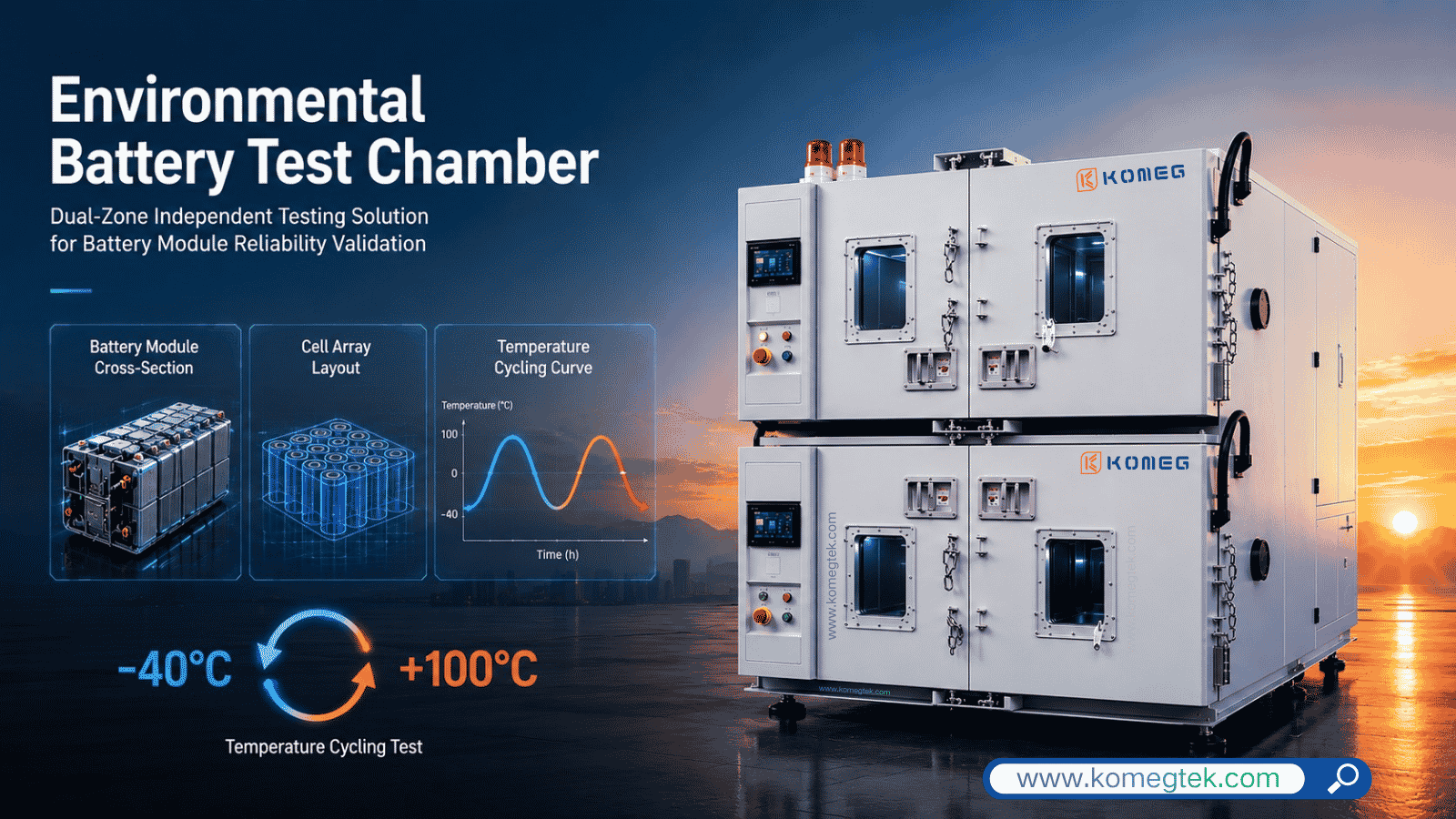
Battery performance and reliability can change significantly with temperature, humidity, and environmental exposure. For lithium-ion batteries and other energy storage technologies, environmental testing helps engineers understand how operating conditions affect electrical performance, structural integrity, material stability, and long-term durability.
Selecting the right battery environmental test chamber requires more than choosing a model with a wide temperature range. The chamber must match the battery’s dimensions, test profile, thermal load, humidity requirements, monitoring needs, and safety controls. The correct configuration also depends on whether the application involves cell characterization, module validation, pack-level testing, production quality control, or research and development.
This guide explains the main factors engineers and purchasing teams should evaluate before selecting a battery environmental test chamber.
1. Define the Battery Testing Application First
The first step is to identify what the chamber needs to test and what the results must demonstrate. Different battery testing applications place different demands on temperature control, chamber volume, airflow, instrumentation, and safety systems.
Battery cell testing
Individual cells are often tested during development, incoming inspection, and reliability evaluation. Because the test specimens may be relatively small, a reach-in chamber may provide sufficient working space. However, the chamber must still accommodate fixtures, electrical connections, temperature sensors, and any required monitoring equipment.
Small specimen size does not automatically mean a low thermal load. The heat generated during testing, the number of cells tested simultaneously, and the electrical test equipment connected to the setup can all affect chamber performance.
Battery module testing
Modules contain multiple interconnected cells and may have greater mass and more complex thermal behavior than individual cells. Testing may require additional clearance for fixtures, wiring, voltage monitoring, and temperature measurement.
Engineers should consider how the module’s geometry and thermal mass influence temperature stabilization. A chamber that performs well with an empty workspace may respond differently when loaded with a substantial battery module.
Battery pack and energy storage system testing
Battery packs and energy storage system components can require significantly more chamber volume and greater consideration of electrical connections, heat dissipation, loading equipment, and test access.
For larger specimens, a walk-in environmental test chamber or a customized chamber may be appropriate. Selection should be based on the dimensions and weight of the test article, the required temperature profile, and the complete test setup rather than the battery enclosure alone.
Where a test involves energized batteries, charging or discharging, or fault conditions, the environmental chamber must be suitable for the intended application and integrated with appropriate protective systems.
2. Choose the Correct Temperature Range
Temperature range is one of the most important specifications when selecting a battery environmental test chamber. Testing may involve cold storage, low-temperature operation, high-temperature exposure, temperature cycling, or accelerated environmental aging.
Before comparing equipment, document the minimum and maximum test temperatures, the duration at each setpoint, the transition sequence, and the number of cycles.
For example, a chamber designed primarily for moderate-temperature conditioning may not meet the requirements of a test program involving extreme cold or high-temperature exposure. Similarly, a chamber capable of reaching a target temperature may not achieve the required transition rate under the actual specimen load.
Consider temperature stability and uniformity
Temperature range describes the operating limits of the equipment, but it does not fully describe its performance.
Temperature stability refers to how consistently the chamber maintains a setpoint over time. Temperature uniformity describes the variation in temperature across specified locations within the working space under defined test conditions.
Both characteristics matter when testing multiple cells or larger assemblies. Excessive temperature variation can make it difficult to distinguish actual differences between specimens from differences caused by their local test environments.
Ask the manufacturer how temperature uniformity and stability are specified, how they are measured, and whether the stated performance applies to an empty chamber or a defined loaded condition.
Evaluate ramp rate under realistic conditions
For temperature cycling or rapid temperature change testing, the required transition rate should be evaluated alongside specimen mass, fixture mass, and the test profile.
A chamber may reach a specified temperature at no load but take longer to bring a heavy battery assembly to thermal equilibrium. The temperature of the chamber air, the surface temperature of the specimen, and the internal temperature of the battery are different measurements.
If the test specification requires the specimen itself to reach a certain temperature within a defined period, confirm how that requirement will be measured and validated.
3. Determine Whether Humidity Control Is Required
Not every battery environmental test requires humidity control. The need for humidity depends on the test objective, the applicable specification, and the materials or components being evaluated.
A temperature-only chamber may be appropriate for tests that do not require controlled relative humidity. A temperature and humidity test chamber is more suitable when the procedure includes humidity exposure, damp heat, or combined temperature-humidity conditioning.
Humidity testing can help evaluate the environmental durability of battery enclosures, seals, connectors, insulation materials, electronic control components, and other assemblies. The specific purpose and acceptance criteria should be defined by the test plan.
Check the humidity operating range
If humidity control is required, confirm the available relative humidity range and the temperatures at which that range can be maintained. Humidity performance is often dependent on temperature, and the equipment may not support every combination of temperature and relative humidity.
Ask for the specified operating envelope rather than relying on a single maximum humidity value.
Consider condensation and moisture management
Condensation can occur when a specimen or chamber surface is colder than the dew point of the surrounding air. Whether condensation is acceptable depends on the test method and the battery or component design.
The chamber configuration and test procedure should account for the intended moisture exposure, specimen temperature, transitions between conditions, and any requirements for post-test inspection.
4. Calculate Chamber Size and Thermal Load
Chamber selection should consider the complete test setup, not just the dimensions of the battery.
The working space must accommodate the specimen, fixtures, shelves, cables, sensors, and other accessories while preserving appropriate airflow. Insufficient clearance can affect temperature distribution and make loading, unloading, and maintenance more difficult.
Before requesting a quotation, prepare the following information:
Maximum specimen dimensions and weight.
Number of specimens tested simultaneously.
Fixture and support dimensions.
Cable routing and feedthrough requirements.
Location and quantity of temperature sensors.
Clearance required for safe access and handling.
Heat generated by the specimen or external test equipment.
Thermal load is especially important when the battery is energized or when multiple specimens are tested together. A high thermal mass can slow temperature changes and increase the time needed to stabilize the specimen.
If the test setup includes external cyclers, power supplies, or electronic loads, determine whether these devices will remain outside the chamber or operate within it. Their heat output, electrical interfaces, and environmental limitations may influence the chamber design.
For large batteries or energy storage assemblies, a walk-in chamber may offer the necessary space and accessibility. KOMEG’s walk-in environmental test chambers can be considered when the specimen size or testing configuration exceeds the practical capacity of a conventional reach-in chamber. The final configuration should be confirmed against the actual test requirements.
5. Evaluate Battery Test Safety Before Selecting Equipment
Battery testing requires a careful distinction between environmental conditioning and tests that involve electrical operation, abuse, or failure conditions.
A standard environmental test chamber should not automatically be assumed suitable for energized battery testing, overcharge, external short circuit, thermal abuse, or other potentially hazardous procedures. These applications may require specialized chamber construction, electrical interfaces, gas management, fire protection, containment, exhaust systems, or other protective measures based on the hazard assessment and applicable requirements.
Identify the test conditions and potential hazards
Before specifying the chamber, clarify whether the battery will be:
Stored or conditioned without electrical operation.
Charged or discharged during temperature exposure.
Connected to external electrical test equipment.
Tested under abnormal or fault conditions.
Subjected to procedures that could produce excessive heat, venting, smoke, or flammable gases.
These scenarios do not have the same equipment requirements. A chamber configured for routine temperature cycling may not be suitable for a test involving deliberate battery failure.
Review protective systems and integration
Depending on the application, the system design may need to address over-temperature protection, electrical isolation, emergency shutdown, gas detection, exhaust, pressure management, fire mitigation, and remote monitoring.
The specific measures must be determined by the test hazards, local regulations, facility arrangements, and relevant test procedure. Not every battery test requires every listed feature, and the presence of an individual safety feature does not by itself establish that a system is safe for all battery tests.
Confirm which protections are integrated into the chamber, which are provided by the battery test system or facility, and how the components interact during an abnormal event.
Confirm the manufacturer’s intended application
Provide the manufacturer with the battery chemistry, specimen format, maximum energy or capacity, operating voltage, test current, test profile, and anticipated failure scenarios where applicable. These details help determine whether a standard configuration is suitable or whether a purpose-designed system is required.
The final equipment specification should clearly define the intended use and its operating limitations.
6. Check Applicable Test Standards and Test Profiles
Battery environmental testing may be part of a wider qualification, reliability, transportation, or product-safety program. The correct test requirements depend on the battery type, intended use, market, and product category.
Possible references include IEC 60068 environmental testing methods, battery-specific standards, transportation requirements such as UN 38.3, and automotive or energy storage requirements where applicable. These standards address different objectives and should not be treated as interchangeable.
For example, an environmental conditioning test and a battery transportation safety test may use different specimen preparation, temperature sequences, monitoring requirements, and acceptance criteria.
Before purchasing equipment, identify the exact standard, revision, test clause, and required procedure. Translate these requirements into measurable chamber specifications, including:
Temperature setpoints and exposure durations.
Required transition sequences or rates.
Humidity conditions, if applicable.
Specimen monitoring and data recording.
Number of cycles and recovery conditions.
Safety and facility requirements.
Calibration, verification, and documentation needs.
The chamber supplier should confirm which environmental conditions the equipment can provide. Compliance with a complete test standard may also depend on external instrumentation, specimen preparation, operating procedures, and the wider test setup. Selecting a chamber alone does not guarantee that a test program or product complies with a standard.
7. Review Airflow, Sensor Placement, and Data Recording
Airflow is an important part of chamber performance because it affects how heat is transferred between the chamber environment and the specimen.
A poorly arranged load can obstruct airflow and create local temperature differences. Large fixtures, closely spaced specimens, cable bundles, and high-density battery assemblies may all influence air circulation.
Check the recommended loading arrangement and confirm that the specimen will not block supply or return air paths. If several battery modules are tested together, consider whether the temperature distribution remains acceptable at each specimen location.
Sensor placement should reflect the test objective. Chamber control sensors measure the chamber environment, while specimen-mounted thermocouples or other sensors can provide information about battery surface temperature or selected internal locations where the design allows.
These measurements answer different questions. The chamber reaching its setpoint does not necessarily mean the battery has reached the same temperature.
Data acquisition should record the parameters required by the test plan. Depending on the application, this may include chamber temperature, relative humidity, specimen temperatures, voltage, current, and event timestamps. Electrical measurements may be managed by an external battery cycler or monitoring system, so compatibility and synchronization should be confirmed before ordering.
8. Consider Installation and Operating Costs
The purchase price is only one part of the total cost of operating a battery environmental test chamber. Installation requirements, utility consumption, maintenance, calibration, and production downtime can also influence the long-term cost.
Check the available installation space, floor loading, door and service clearances, delivery route, and access for future maintenance. Larger chambers may require more substantial facility preparation than compact reach-in units.
Utility requirements should also be reviewed. Depending on the design, these may include electrical power, cooling water, ventilation, drainage, and environmental control for the installation room. Confirm the specified voltage, frequency, current capacity, grounding, and any required circuit protection with the manufacturer and a qualified installer.
For facilities that operate chambers frequently, energy consumption, refrigeration system maintenance, calibration intervals, and spare-part availability may be important selection criteria. Compare equipment on the basis of the intended duty cycle and required performance rather than purchase price alone.
9. Common Mistakes When Selecting a Battery Environmental Test Chamber
Choosing by temperature range alone. A wide temperature range does not guarantee the required stability, uniformity, ramp rate, or loaded performance.
Ignoring specimen thermal mass. Battery packs, fixtures, and multiple specimens can significantly change temperature transition and stabilization behavior.
Assuming a general-purpose chamber is suitable for every battery test. Energized testing and abuse testing may require additional engineering controls and a purpose-built configuration.
Selecting chamber volume based only on the battery dimensions. Cables, sensors, fixtures, airflow clearance, and handling space must also be included.
Confusing chamber temperature with battery temperature. The air may reach the target before the specimen does. Test requirements should define the relevant measurement point.
Treating a standard as a product specification. Standards define procedures and requirements, but the appropriate chamber configuration depends on the specific test clause and the wider test system.
Overlooking future testing needs. If the facility expects to test larger modules, additional specimens, or more complex profiles, it may be worth evaluating expandability and customization before purchase.
10. A Practical Checklist Before Requesting a Quotation
To help a manufacturer recommend a suitable configuration, prepare the following information:
Battery type, chemistry, and specimen format.
Specimen dimensions, weight, and number of units tested simultaneously.
Minimum and maximum test temperatures.
Required temperature transition rate and exposure duration.
Whether humidity control is needed.
Whether the battery will be charged or discharged inside the chamber.
Test standards, procedures, and acceptance criteria.
Required sensors, cable ports, data interfaces, and external equipment.
Identified hazards and required protective measures.
Available installation space, utilities, and expected operating frequency.
A clear test profile helps reduce specification gaps, avoid unnecessary features, and make quotations easier to compare.
Frequently Asked Questions
What is a battery environmental test chamber used for?
A battery environmental test chamber creates controlled temperature and, where supported, humidity conditions to evaluate how batteries and related components respond to environmental exposure. Applications include conditioning, temperature cycling, reliability evaluation, and selected qualification procedures.
Do all battery environmental test chambers require humidity control?
No. Humidity control is needed only when the test procedure specifies humidity exposure or combined temperature-humidity conditions. Temperature-only testing may require a different chamber configuration.
Can a standard environmental test chamber be used for lithium-ion battery testing?
It depends on the test. Some conditioning and temperature cycling applications may be suitable for a properly specified standard chamber. Tests involving energized batteries, abnormal operating conditions, or potential failure hazards require a separate assessment of the chamber design, protective systems, and facility setup.
What temperature range should a battery test chamber have?
There is no single range suitable for every battery test. The minimum and maximum temperatures should be determined from the applicable test procedure, battery operating limits, and qualification objectives. Transition rate, stability, uniformity, and loaded performance should be reviewed as well.
Should I choose a reach-in or walk-in battery environmental test chamber?
A reach-in chamber is often suitable for cells, smaller modules, and compact test setups. A walk-in chamber may be more appropriate for larger battery assemblies or multiple specimens requiring greater working space. The final choice should account for specimen dimensions, thermal load, access, airflow, and safety requirements.
Selecting a battery environmental test chamber starts with the test objective, not the equipment catalog. Temperature range, humidity requirements, specimen size, thermal load, measurement strategy, applicable standards, and safety considerations all affect the final configuration.
For straightforward environmental conditioning, a standard temperature or temperature-humidity chamber may be appropriate. Larger specimens, demanding temperature profiles, or battery tests involving electrical operation and potential hazards may require a more specialized solution.
KOMEG develops environmental testing equipment for temperature, humidity, thermal cycling, and customized testing applications. To discuss a battery testing requirement, provide the specimen dimensions, test profile, applicable standard, and whether charging or discharging will take place during testing. These details help establish a more suitable chamber specification.