

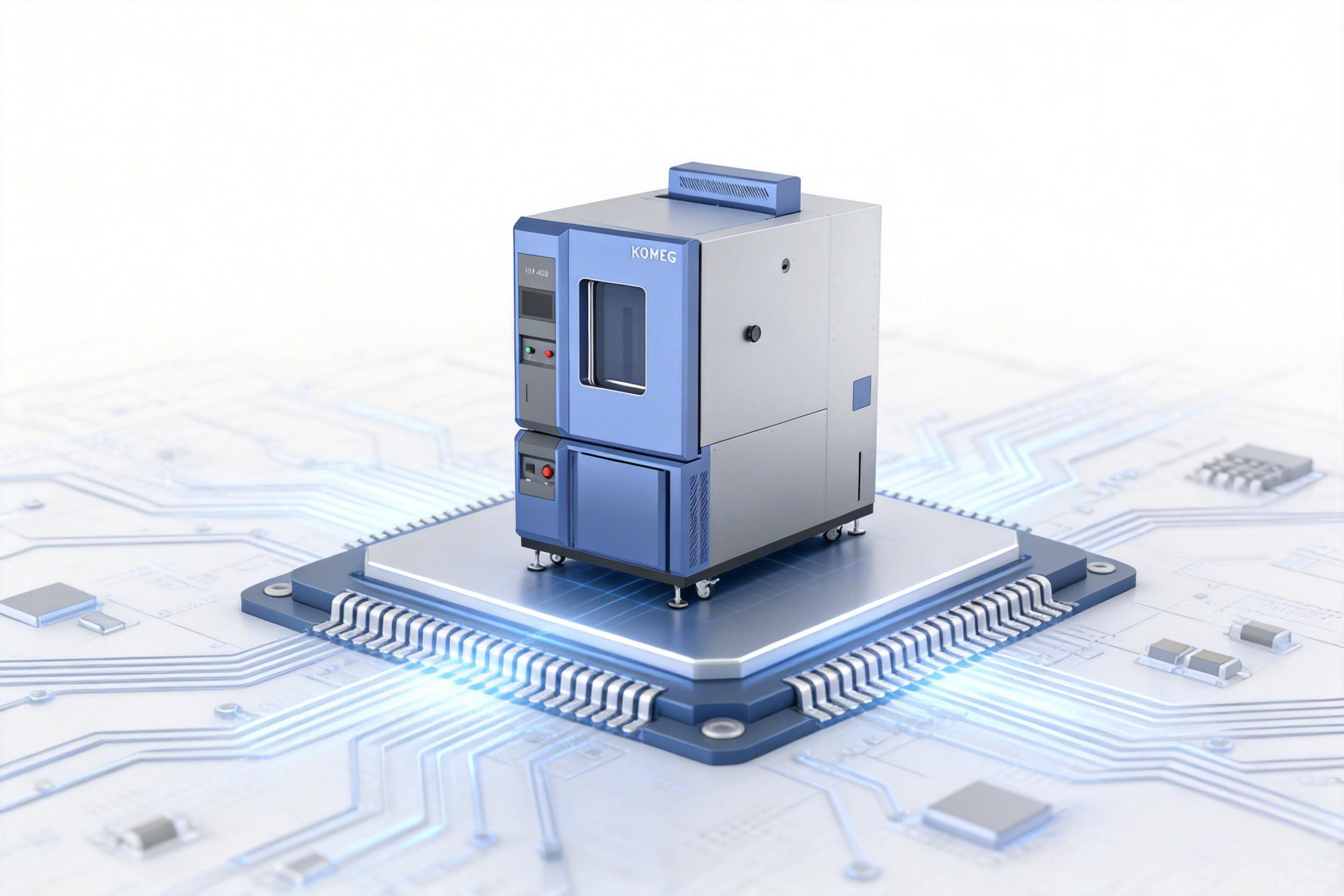
The price of an environmental test chamber depends on more than its size or temperature range. Chamber type, refrigeration capacity, temperature change rate, humidity control, test load, safety features, customization, and installation requirements can all influence the final quotation.
A compact temperature test chamber for routine laboratory testing has very different engineering requirements from a large walk-in environmental chamber designed for automotive components or battery systems. Even two chambers with similar internal volumes may have substantially different prices if one requires rapid temperature transitions, extended low-temperature operation, or integrated humidity control.
For engineers, laboratory managers, and purchasing teams, understanding these cost factors makes it easier to prepare a realistic budget, compare supplier quotations, and avoid paying for features that the application does not require.
This guide explains what affects environmental test chamber prices, which specifications tend to increase costs, and how to request a quotation that accurately reflects your testing needs.
1. Why Do Environmental Test Chamber Prices Vary So Much?
An environmental test chamber is an engineered system designed to create and maintain controlled environmental conditions. Its price reflects the performance requirements, equipment architecture, materials, control functions, and manufacturing complexity needed to achieve those conditions.
A standard temperature chamber may need to maintain a specified temperature over a relatively moderate range. A more demanding application may require very low temperatures, high humidity, fast heating and cooling, continuous operation under a substantial DUT heat load, or a large custom-built test space.
These differences affect the selection and sizing of refrigeration components, heaters, insulation, airflow systems, sensors, controllers, and protective devices.
The first step in evaluating price is therefore to define the test application rather than compare equipment based on its product name alone.
Before requesting quotations, identify the environmental conditions the DUT must experience, the applicable test procedure, the required performance, and the physical configuration of the test setup. These details provide a consistent basis for comparing different chamber designs.
2. Chamber Size and Usable Working Volume
Internal volume is one of the most visible factors affecting environmental test chamber cost. Larger chambers generally require more enclosure material, insulation, heating capacity, refrigeration capacity, and airflow management.
However, the relationship between volume and price is not perfectly linear. Equipment architecture, manufacturing complexity, fixed control-system costs, and the required environmental performance also influence the final cost.
Benchtop, reach-in, and walk-in chambers
Benchtop chambers are suitable for relatively small samples and laboratory applications where a compact footprint is important. Their smaller working volume can reduce the space and energy needed for many routine tests.
Reach-in environmental chambers provide more room for larger components, multiple samples, fixtures, and instrumentation. They are often used for electronics, automotive components, materials, and general product reliability testing.
Walk-in environmental chambers are designed for large assemblies, bulky products, batch testing, or test configurations that cannot fit inside a conventional cabinet. Their construction may involve insulated panels, larger refrigeration systems, specialized doors, reinforced loading arrangements, and on-site installation.
As the chamber becomes larger, buyers should consider not only the enclosure cost but also the infrastructure required to operate it.
How to choose the right capacity
Selecting a chamber that is too small may restrict airflow, complicate sample placement, or prevent future test configurations. Choosing a chamber that is unnecessarily large may increase the initial investment and the energy required to condition the test space.
When determining capacity, consider:
The dimensions and weight of the DUT.
The number of samples tested simultaneously.
The space required for fixtures and mounting structures.
Cable routing and external monitoring equipment.
Airflow clearance around samples.
The thermal load generated by operating products.
Expected changes in sample size or testing throughput.
Nominal chamber volume should not be the only selection criterion. The usable workspace must accommodate the actual test configuration while allowing the equipment to achieve its specified performance.
For larger test setups, explore KOMEG walk-in environmental test chambers to review the available approach to large-volume and customized testing.
3. Temperature Range and Refrigeration System Design
The required temperature range can have a significant effect on the environmental test chamber price because it determines the refrigeration and heating technologies needed to achieve the specified operating conditions.
A chamber operating within a moderate temperature range may use a relatively straightforward refrigeration configuration. A chamber required to reach much lower temperatures may need a more complex refrigeration arrangement, additional components, and more demanding thermal management.
Why lower temperatures can increase cost
As the minimum required temperature decreases, the refrigeration system must remove heat while operating under increasingly demanding conditions.
Depending on the target temperature, cooling capacity, chamber volume, ambient conditions, and required performance, the design may need additional refrigeration stages or other specialized engineering measures.
For example, a chamber designed for a minimum temperature of -40°C may have different refrigeration requirements from a chamber that must reach -70°C under comparable conditions. The exact cost difference depends on the system design and specified performance.
The upper temperature limit also matters. Higher operating temperatures can affect heater sizing, insulation, internal materials, wiring, seals, and other components exposed to heat.
Temperature range is not the same as temperature performance
A chamber’s minimum and maximum temperatures do not fully describe its capability. Buyers should also evaluate:
Temperature fluctuation and uniformity.
Temperature deviation under the specified measurement method.
Heating and cooling rates.
Recovery time after a disturbance.
Performance under the intended test load.
Required dwell periods and repeated temperature cycles.
A system designed for fast transitions may require greater heating and refrigeration capacity than a conventional chamber with the same temperature range.
For this reason, compare refrigeration architecture and measured performance alongside the advertised temperature limits.
4. Temperature Change Rate and Rapid Thermal Cycling
Temperature change rate is an important cost factor when a test requires rapid heating and cooling.
Conventional temperature testing may allow sufficient time for the chamber to move gradually between setpoints. Rapid-rate thermal cycling places greater demands on the heating, refrigeration, airflow, and control systems because the equipment must change temperature more quickly.
The required transition rate can influence component sizing, thermal capacity, control strategy, and overall system design.
Why two chambers with the same temperature range may have different prices
Consider two chambers that operate between -40°C and +150°C.
The first is intended for routine temperature exposure with moderate transition requirements. The second must repeatedly move between specified temperatures at a much faster rate, potentially while containing a substantial thermal load.
Although the nominal temperature ranges are identical, the second application may require a more powerful and carefully engineered thermal system.
When requesting a quotation, specify the required temperature change rate in °C/min, the temperature interval over which it must be achieved, and whether the rate must be linear or non-linear. Also clarify the test load and the measurement method used to verify performance.
A quoted transition rate should not be assumed to apply to every temperature interval or every loading condition.
Rapid-rate thermal cycling versus thermal shock
Rapid-rate thermal cycling and thermal shock testing are related but distinct applications.
Rapid-rate thermal cycle chambers, often associated with environmental stress screening (ESS), execute programmed temperature transitions to apply repeated thermal stress to products and assemblies.
Thermal shock chambers are designed for rapid transitions between hot and cold conditions according to a defined test procedure. Their configuration may include separate temperature zones and a product-transfer mechanism, depending on the design.
These different operating methods can lead to different equipment requirements and costs. Buyers should select the chamber according to the actual test procedure rather than assuming the two categories are interchangeable.
Learn more about KOMEG rapid-rate thermal cycle chambers and the available walk-in thermal cycle chamber configurations.
5. Humidity Control and Environmental Requirements
Adding humidity control generally increases system complexity compared with a temperature-only chamber.
A temperature and humidity chamber needs additional functions for moisture generation, humidity measurement, and control. Depending on the design and operating range, the system may also require specialized moisture-removal and water-management arrangements.
The actual cost depends on the specified temperature and humidity combinations, required stability, operating conditions, and control performance.
What affects the cost of humidity control?
Important considerations include:
Humidity operating range. A broad humidity requirement may demand more sophisticated moisture control than a limited operating range.
Temperature and humidity combinations. Relative humidity capability depends on temperature. The chamber must be designed for the required combinations rather than simply the maximum temperature and maximum humidity considered separately.
Humidity uniformity and fluctuation. Tighter performance requirements can increase the demands on sensing, control, airflow, and verification.
Long-duration operation. Extended testing may place additional demands on system stability, water management, monitoring, and maintenance.
Test load and configuration. Sample placement, product heat generation, fixtures, and airflow restrictions can influence environmental conditions throughout the working space.
Before paying for advanced humidity functions, confirm that the test procedure actually requires them. A temperature-only chamber may be sufficient for tests that do not specify controlled relative humidity.
For applications involving both parameters, review KOMEG temperature and humidity test chambers.
6. Specialized Chamber Types and Their Cost Implications
The type of environmental test chamber is another major factor in the quotation. Different chamber categories are engineered to create different test environments, so their system requirements can vary considerably.
Temperature test chambers
Temperature test chambers are suitable for high- and low-temperature exposure, temperature cycling, and other tests that do not require controlled humidity.
The cost depends on working volume, temperature range, transition requirements, control performance, and optional functions.
Temperature and humidity test chambers
These chambers combine temperature and humidity control for applications such as damp-heat exposure, environmental conditioning, and product reliability testing.
The humidity system adds components and control requirements that are not needed in a temperature-only chamber.
Walk-in environmental test chambers
Walk-in systems are designed for large products, assemblies, or multiple samples. In addition to the environmental-control equipment, cost may include insulated panel construction, large doors, specialized loading arrangements, transportation, and on-site assembly.
The installation environment can be particularly important for large systems because the facility may need suitable power, ventilation, cooling utilities, and access for delivery.
Thermal shock chambers
Thermal shock chambers are intended for rapid transitions between hot and cold conditions. Depending on the configuration, additional zones and product-transfer mechanisms may increase the complexity of the system.
HAST chambers
Highly Accelerated Stress Test chambers use controlled high-temperature and high-pressure conditions, typically with controlled humidity, for specific accelerated stress-testing applications.
Their pressure-rated construction, pressure control, safety provisions, and specialized operating conditions distinguish them from conventional environmental chambers.
Altitude test chambers
Altitude chambers simulate reduced atmospheric pressure and may combine low-pressure conditions with temperature control. Their design can require vacuum equipment, pressure control, and an enclosure suitable for the specified operating conditions.
Combined temperature, humidity, and vibration systems
Combined environmental systems integrate multiple test functions. Their cost depends on the environmental conditions, vibration-system requirements, mechanical integration, control coordination, and DUT configuration.
These examples illustrate why the term “environmental test chamber” covers equipment with very different engineering requirements. A meaningful price comparison must be made between systems designed for comparable tests.
Explore the KOMEG environmental test chamber product range to identify the chamber category that best matches your application.
7. DUT Heat Load, Airflow, and Sample Configuration
The product under test can affect the equipment required to achieve the specified environmental conditions.
A small passive sample may impose a limited thermal load. A large metal assembly or powered electronic product can absorb or generate substantially more heat, changing the demands placed on the chamber’s heating, cooling, and airflow systems.
For demanding applications, specifying the chamber based only on the internal volume and temperature range can lead to an unsuitable quotation.
Information suppliers need to evaluate the load
Provide the dimensions, weight, materials, quantity, and arrangement of the samples. If the products operate during testing, include their expected heat dissipation and any electrical connections required.
Also identify the fixtures, shelves, mounting frames, and cable penetrations that will be used.
These details help the supplier evaluate whether the proposed chamber can maintain the required conditions throughout the test space.
For rapid-rate thermal cycling, the DUT’s thermal mass and heat generation can influence achievable transition performance. For large products, sample placement and airflow clearance may be particularly important for temperature uniformity.
If the application involves batteries or other products that can release heat, gases, or hazardous energy during failure, the specification may also need additional protective features. These should be selected based on the product risk assessment, applicable requirements, and intended test procedure.
8. Customization and Special Features
Standard environmental test chambers can suit many common testing applications. However, some products require non-standard dimensions, specialized performance, or integration with external equipment.
Customization can increase the initial cost because it may involve additional engineering, non-standard components, special construction, or more extensive testing and verification.
Possible requirements include:
Non-standard internal dimensions or chamber layouts.
Extended temperature ranges.
Specialized heating or cooling performance.
Additional cable ports and sample connections.
Custom fixtures, shelves, or loading arrangements.
External monitoring and communication interfaces.
Special safety functions for the DUT.
Integration with vibration equipment or other test systems.
Customized software functions or test sequences.
Not every option is necessary for every application. The best approach is to distinguish essential requirements from convenience features and future possibilities.
For example, if a laboratory must continuously record data through an external monitoring system, the required communication interfaces should be included in the specification. If a special fixture is essential to reproduce the test setup, its dimensions and mounting requirements should be confirmed before manufacturing.
Ask suppliers to identify which functions are standard, which are optional, and which require a customized design. This makes the quotation easier to interpret and helps prevent unexpected costs later in the project.
9. Controller, Data Logging, Calibration, and Documentation
Control and measurement functions can influence both the initial purchase price and the effort required to operate the equipment.
A basic application may need programmable temperature control and standard alarms. More demanding applications may require multi-step test profiles, repeated cycles, external sensors, data export, remote communication, or integration with laboratory information systems.
The appropriate configuration depends on the testing procedure and documentation requirements.
Data and communication functions
Before selecting a controller, determine whether the laboratory needs to store and export test records, monitor the chamber remotely, connect external measurement instruments, or retrieve alarm and operating histories.
Also confirm the supported communication interfaces and data formats rather than assuming every chamber provides the same functions.
Calibration and qualification
Calibration and performance verification requirements should be defined according to the intended use of the chamber.
If a laboratory requires specific calibration documentation, traceability, or qualification activities, clarify the scope and associated costs in the quotation.
For regulated applications, determine whether additional installation or operational qualification documentation is necessary. Do not assume such services are automatically included in the standard equipment price.
A more sophisticated control or documentation package can increase the initial investment, but it may be necessary to support the laboratory’s testing, traceability, and quality-management requirements.
10. Installation, Utilities, Delivery, and Commissioning
The purchase price of the chamber may not represent the total cost of putting it into operation.
Depending on the size and configuration, additional project costs may include transportation, handling, installation, site preparation, utility connections, commissioning, and operator training.
Electrical requirements
Confirm the voltage, phase, frequency, rated current, protective devices, grounding, and wiring requirements for the exact model. A facility may need electrical work before the equipment can be installed.
Cooling and ventilation
Air-cooled systems require sufficient ventilation and heat dissipation. Water-cooled configurations may require a suitable water supply with defined flow and temperature conditions.
These requirements should be checked against the manufacturer’s installation documentation.
Drainage and ambient conditions
Temperature and humidity chambers may require drainage arrangements. The installation area should also meet the specified ambient conditions and avoid environmental factors that could interfere with operation or maintenance.
Delivery access and installation space
Large chambers may need careful transport planning, sufficient door clearance, and on-site assembly. Confirm the delivery route, final location, maintenance access, and any structural limitations before placing the order.
Commissioning and training
Clarify whether commissioning, performance verification, and operator training are included in the quotation or provided as separate services.
Requesting this information in advance helps compare suppliers on the total project scope rather than the equipment price alone.
11. Maintenance, Spare Parts, and Long-Term Operating Costs
The initial purchase price is only one part of the cost of owning an environmental test chamber.
Over the equipment’s service life, the laboratory may also incur costs associated with energy consumption, preventive maintenance, calibration, replacement components, technical support, and downtime.
A chamber that is inexpensive to purchase may not necessarily be the least expensive option over the entire operating period. Conversely, a higher-priced configuration is not automatically more economical. The result depends on the workload, equipment performance, maintenance requirements, and service arrangements.
When evaluating long-term cost, consider:
Energy consumption. Refrigeration capacity, operating conditions, test duration, ambient temperature, and workload can affect energy use.
Preventive maintenance. Ask which inspections, cleaning tasks, and routine service activities are recommended.
Replacement parts. Clarify the availability of commonly replaced components and the process for obtaining spare parts.
Technical support. Review the support scope, response arrangements, warranty terms, and availability of remote or on-site assistance.
Downtime risk. If the chamber supports a critical production or qualification schedule, consider the operational consequences of equipment downtime.
Future service requirements. Check whether calibration, verification, and maintenance services can support the expected operating life of the equipment.
A total cost of ownership assessment should use realistic assumptions about the laboratory’s actual operating schedule and service needs.
12. How to Compare Environmental Test Chamber Quotations
When several suppliers quote for the same general category of equipment, the lowest price is not necessarily the best value.
Differences in specifications, accessories, test conditions, installation scope, and service terms can make apparently similar quotations difficult to compare.
A useful procurement process evaluates each quotation against a common technical specification.
Step 1: Confirm the chamber type
Ensure each supplier is quoting for equipment designed to perform the intended test. A conventional temperature chamber should not be compared directly with a rapid-rate thermal cycle or thermal shock system without accounting for the different requirements.
Step 2: Standardize the technical requirements
Provide the same temperature range, humidity conditions, transition rate, load configuration, and performance criteria to each supplier.
Step 3: Compare performance under defined conditions
Check how temperature uniformity, fluctuation, transition rate, and recovery are specified and measured. Ask whether the quoted performance applies to an empty chamber or a defined test load.
Step 4: Review the equipment scope
Identify which accessories, fixtures, sensors, communication interfaces, software functions, and safety features are included.
Step 5: Compare installation and service terms
Check delivery, installation, commissioning, warranty, maintenance, and spare-parts arrangements.
Step 6: Evaluate application suitability
Confirm that the chamber can support the required test procedure and the actual DUT configuration. If a supplier recommends a different specification, ask for the technical reason and the effect on cost.
This process makes it easier to understand why quotations differ and reduces the risk of selecting a chamber that appears less expensive but does not meet the intended testing requirements.
13. How to Control Environmental Test Chamber Costs Without Compromising Test Quality
Cost optimization should begin with the test requirement, not by removing technical features indiscriminately.
Several practical steps can help control the investment while preserving the required test capability.
Specify the actual operating conditions. Avoid requesting an unnecessarily broad temperature range or humidity capability when the test procedure does not require it.
Select an appropriate working volume. Size the chamber around the DUT, sample quantity, fixtures, airflow clearance, and realistic future needs.
Distinguish essential features from optional functions. Separate mandatory requirements from features that are useful but not necessary for the intended test.
Define performance requirements clearly. Specify the required transition rate, uniformity, fluctuation, and load conditions to reduce uncertainty in supplier quotations.
Plan installation early. Confirm utilities, access, and site requirements before delivery to reduce the risk of additional work.
Consider the expected operating life. Evaluate maintenance, energy, service support, and downtime alongside the purchase price.
Ask for a standard-versus-custom comparison where appropriate. A standard model may meet the application without requiring a more complex customized design. If customization is necessary, request a clear explanation of the additional engineering and features involved.
The objective is to avoid paying for unnecessary capability without under-specifying the equipment needed to produce valid and repeatable test results.
14. Information to Prepare Before Requesting a Price
A general request such as “Please quote an environmental test chamber” does not provide enough information for an accurate technical and commercial proposal.
Preparing a concise application specification helps the supplier identify a suitable configuration and clarify potential cost drivers.
Include the following information:
Product details: DUT dimensions, weight, quantity, materials, and whether the product will operate during testing.
Temperature requirements: Minimum and maximum temperatures, heating and cooling rates, dwell times, and cycle count.
Humidity requirements: Required relative humidity values and the temperature conditions at which they must be maintained.
Test standard: Applicable standard, revision, test method, customer specification, and acceptance criteria.
Performance requirements: Temperature uniformity, fluctuation, deviation, recovery time, and any required loaded performance.
Special functions: Data logging, external monitoring, communication interfaces, fixtures, cable ports, or integrated test systems.
Safety considerations: Relevant DUT hazards and the protective measures required for the application.
Installation information: Available space, power supply, cooling utilities, drainage, and delivery access.
Commercial requirements: Delivery destination, expected schedule, documentation scope, training, warranty, and service expectations.
Not every application requires every item. The purpose of this checklist is to identify the requirements that materially affect equipment selection and quotation.
Conclusion: The Best Environmental Test Chamber Price Starts With the Right Specification
Environmental test chamber prices vary because the equipment must be engineered around different test conditions, sample configurations, and performance requirements.
Working volume, temperature range, refrigeration architecture, temperature change rate, humidity control, specialized functions, customization, installation, and long-term support all contribute to the overall cost.
For purchasing teams, the most effective way to control the investment is to define the test requirements clearly and compare quotations on a consistent technical basis. This helps distinguish genuine cost differences from differences in scope or performance.
KOMEG provides standard and customized environmental testing solutions for applications in electronics, automotive, batteries, semiconductors, pharmaceuticals, and other industries. Available equipment includes temperature test chambers, temperature and humidity test chambers, rapid-rate thermal cycle chambers, walk-in environmental chambers, thermal shock chambers, HAST chambers, altitude chambers, and specialized testing systems.
Explore the KOMEG environmental test chamber product range to review available equipment categories.
For an application-specific quotation, provide the DUT dimensions, required temperature and humidity profile, applicable test standard, performance requirements, and installation conditions. The KOMEG team can then evaluate the requirements and recommend a suitable configuration.
Frequently Asked Questions
How much does an environmental test chamber cost?
There is no single price that applies to all environmental test chambers. Cost depends on chamber type, working volume, temperature range, humidity capability, transition rate, specialized features, customization, and the scope of installation and support. A reliable quotation requires the intended test conditions and equipment configuration.
What is the biggest factor affecting environmental test chamber price?
There is no universal single factor. Chamber type and working volume are important, but temperature extremes, rapid transition requirements, humidity control, test load, and specialized safety or integration features can substantially change the design and cost.
Does a lower minimum temperature always mean a higher price?
A lower minimum temperature often requires a more demanding refrigeration design, which can increase cost. The actual difference depends on the temperature range, working volume, required cooling performance, ambient conditions, and equipment architecture.
Does humidity control make an environmental chamber more expensive?
Generally, yes. Humidity control requires additional components and control functions. The impact on price depends on the required humidity range, temperature and humidity combinations, performance criteria, and chamber design.
Why are rapid-rate thermal cycle chambers more expensive than some standard temperature chambers?
Rapid-rate chambers must achieve specified temperature transitions more quickly, which can require greater heating and refrigeration capacity and more demanding thermal control. The cost depends on the required transition rate, temperature interval, chamber volume, and test load.
Is a walk-in environmental chamber more expensive than a reach-in chamber?
Walk-in chambers generally require more enclosure material, larger environmental-control systems, and more extensive installation planning. Their actual price depends on dimensions, temperature and humidity performance, loading arrangements, construction, and site requirements.
Are customized environmental test chambers more expensive?
Customization can increase cost when it requires non-standard dimensions, specialized temperature performance, additional safety functions, integration with external equipment, or extra engineering. However, the impact varies by project. A customized configuration may be necessary when standard equipment cannot meet the test requirements.
What should I compare when evaluating quotations from different manufacturers?
Compare chamber type, working volume, temperature and humidity conditions, transition rate, uniformity, test-load assumptions, control functions, accessories, installation scope, warranty, maintenance, and technical support. Make sure each quotation addresses the same test requirements before comparing prices.
Can I request an environmental test chamber quotation without a complete technical specification?
Yes, an initial inquiry can begin with the information available. However, the supplier may need additional details before confirming a suitable configuration and price. At minimum, provide the DUT type and dimensions, required temperature conditions, test purpose, and any known standard or performance requirement.