

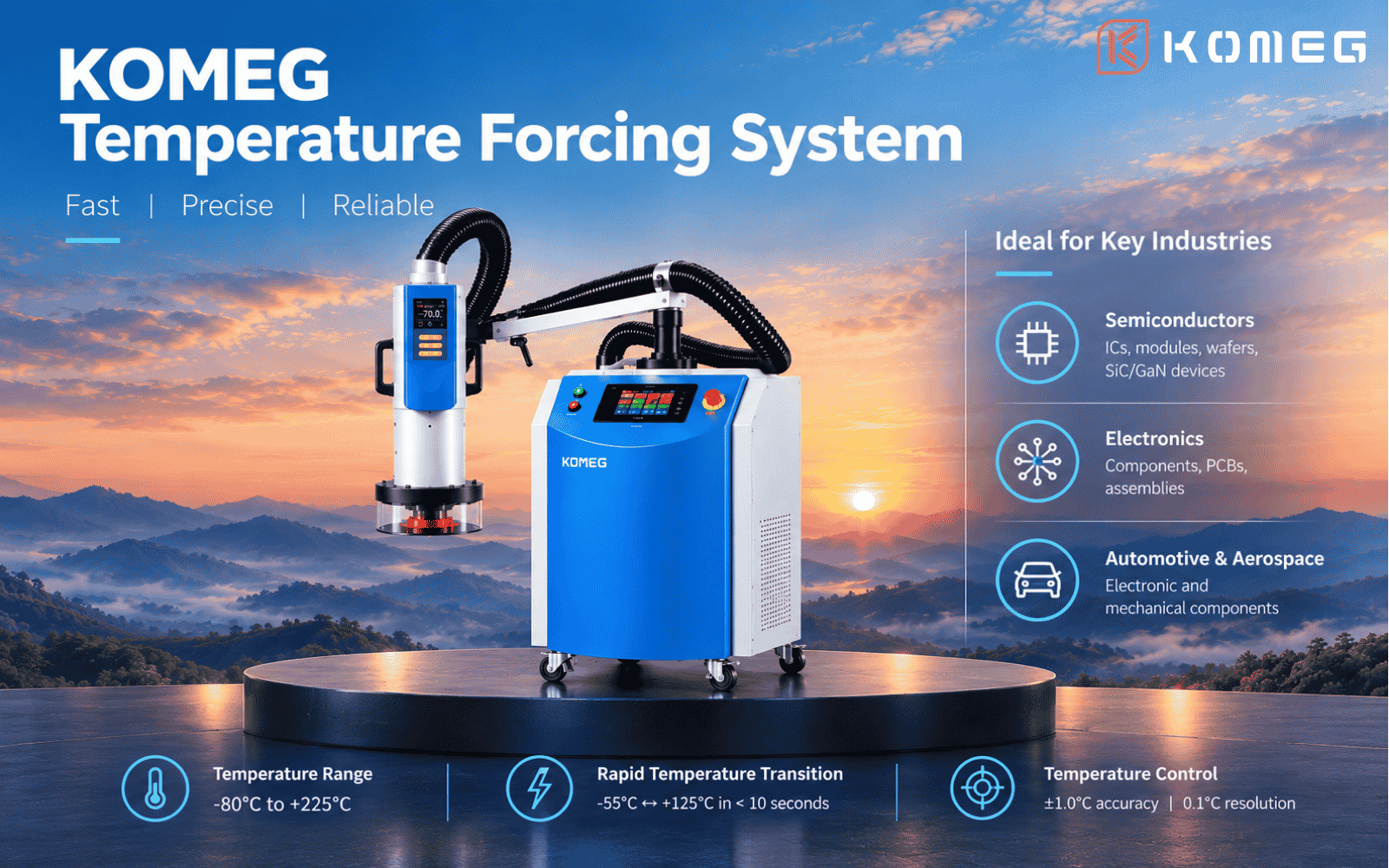
What Is a Temperature Forcing System?
As semiconductor devices become more complex and electronic components operate across increasingly demanding temperature conditions, engineers need effective ways to evaluate device performance under controlled thermal stress. A Temperature Forcing System provides a localized thermal environment by delivering controlled hot or cold airflow directly to the device under test (DUT).
Unlike conventional environmental test chambers, which regulate the temperature of an entire enclosed space, a Temperature Forcing System focuses on a specific component or test area. This makes it useful for semiconductor characterization, IC temperature testing, electronic component evaluation, and thermal-related failure analysis.
The KOMEG Temperature Forcing System combines a wide temperature range, rapid temperature transitions, adjustable airflow, and flexible nozzle positioning to support targeted thermal testing in laboratory and production environments.
Key Features of the KOMEG Temperature Forcing System
Wide Temperature Range from -80°C to +225°C
The KOMEG Temperature Forcing System offers an operating temperature range of -80°C to +225°C, supporting thermal characterization across a broad range of test conditions. Engineers can evaluate temperature-dependent electrical behavior and investigate how components respond to different thermal environments.
The appropriate temperature profile should be selected according to the DUT specifications, application requirements, and relevant test procedures.
Rapid Bidirectional Temperature Transitions
The system supports temperature transitions between -55°C and +125°C in under 10 seconds in both directions. Rapid thermal transitions help engineers investigate changes in device behavior as temperature conditions shift.
This capability is particularly relevant to IC characterization, electronic component testing, and investigations into temperature-sensitive or intermittent faults. The specified transition time applies to the stated temperature interval; it should not be interpreted as the time required for every DUT to reach its target temperature.
Precise Temperature Control and Adjustable Airflow
The system provides temperature control accuracy of ±1.0°C and a setpoint resolution of 0.1°C. Its continuously adjustable airflow rate of 5–24 SCFM (2.4–11.3 L/s) allows the airflow to be configured for different test requirements.
Actual temperature response depends on factors such as DUT thermal mass, package design, nozzle position, airflow conditions, and sensor placement. These factors should be considered when developing a repeatable test procedure.
Flexible Positioning and External Sensor Feedback
A movable articulated arm and interchangeable nozzles allow controlled airflow to be directed toward the target component. The system supports T-type and K-type thermocouples and RTD sensors for external temperature feedback, helping engineers monitor selected measurement points during testing.
The system also operates without requiring liquid nitrogen or CO₂ auxiliary cooling and has an average operating noise level below 49 dBA.
Applications in Semiconductor and Electronic Testing
Semiconductor ICs and Modules
Temperature forcing allows engineers to evaluate temperature-dependent electrical characteristics, monitor parametric drift, and investigate potential thermal-related defects. It can support device characterization, functional testing, and semiconductor failure analysis.
SiC and GaN Power Devices
Silicon carbide (SiC) and gallium nitride (GaN) devices are used in power electronics and other demanding applications. Localized thermal stimulation can help engineers investigate their temperature-dependent performance and identify potential issues under defined test conditions.
Electronic Components and PCB Assemblies
For electronic components, sensors, printed circuit boards (PCBs), and assemblies, targeted airflow can be used to investigate temperature-sensitive performance without exposing an entire test setup to the same thermal conditions.
Automotive and Aerospace Electronics
Electronic devices used in automotive and aerospace applications may need to operate across wide temperature ranges. A Temperature Forcing System can support component-level characterization and thermal evaluation as part of a broader reliability testing program.
The system can also be considered for suitable consumer electronics, medical devices, and environmental stress screening (ESS) applications, depending on the DUT configuration and test requirements.
Temperature Forcing System vs. Environmental Test Chamber
A Temperature Forcing System and a conventional environmental test chamber serve different testing needs.
A Temperature Forcing System delivers hot or cold airflow directly to a selected component. It is well suited to localized temperature characterization, electrical testing, and troubleshooting when engineers need to investigate a specific DUT.
An environmental test chamber conditions a larger enclosed volume and is generally more appropriate when the complete product or assembly must be exposed to controlled temperature or humidity conditions. Temperature and humidity chambers can also support environmental cycling and broader product reliability evaluations.
The appropriate solution depends on whether the test requires localized thermal stimulation or environmental conditioning of the entire product.
Supporting Semiconductor Reliability Verification
Temperature forcing can support semiconductor characterization and reliability programs associated with applicable JEDEC procedures and AEC-Q100 requirements. Engineers may use localized thermal testing to investigate parametric drift, temperature-dependent electrical behavior, and potential thermal-related package defects.
The applicable test profile, transition requirements, dwell time, measurement method, and acceptance criteria must be established according to the relevant procedure. Using a Temperature Forcing System alone does not establish compliance with a particular standard.
Explore the KOMEG Temperature Forcing System
KOMEG develops environmental testing equipment for semiconductor, electronics, automotive, and industrial applications. The Temperature Forcing System extends localized thermal testing capabilities beyond conventional chamber-based testing, helping engineers evaluate individual devices and components under controlled hot and cold airflow.
To review the product configuration and technical details, visit the KOMEG Temperature Forcing System product page.
When evaluating a system for a specific application, consider the required temperature range, transition time, airflow rate, sensor arrangement, DUT dimensions, nozzle configuration, and integration requirements. Matching these factors to the actual test objective helps establish a more suitable and repeatable thermal testing setup.
Frequently Asked Questions
What is a Temperature Forcing System used for?
A Temperature Forcing System delivers controlled hot or cold airflow directly to a DUT. Typical applications include semiconductor characterization, IC temperature testing, electronic component evaluation, and thermal-related failure analysis.
How fast can the KOMEG Temperature Forcing System change temperature?
The system supports transitions between -55°C and +125°C in under 10 seconds in both directions. This specification describes the stated equipment temperature transition and does not guarantee that every DUT reaches its target temperature within the same period.
Does a Temperature Forcing System replace an environmental test chamber?
Not in every application. Temperature forcing is designed for localized thermal stimulation, while an environmental chamber conditions a larger test volume. The choice depends on the DUT, test profile, and whether localized or whole-product exposure is required.