

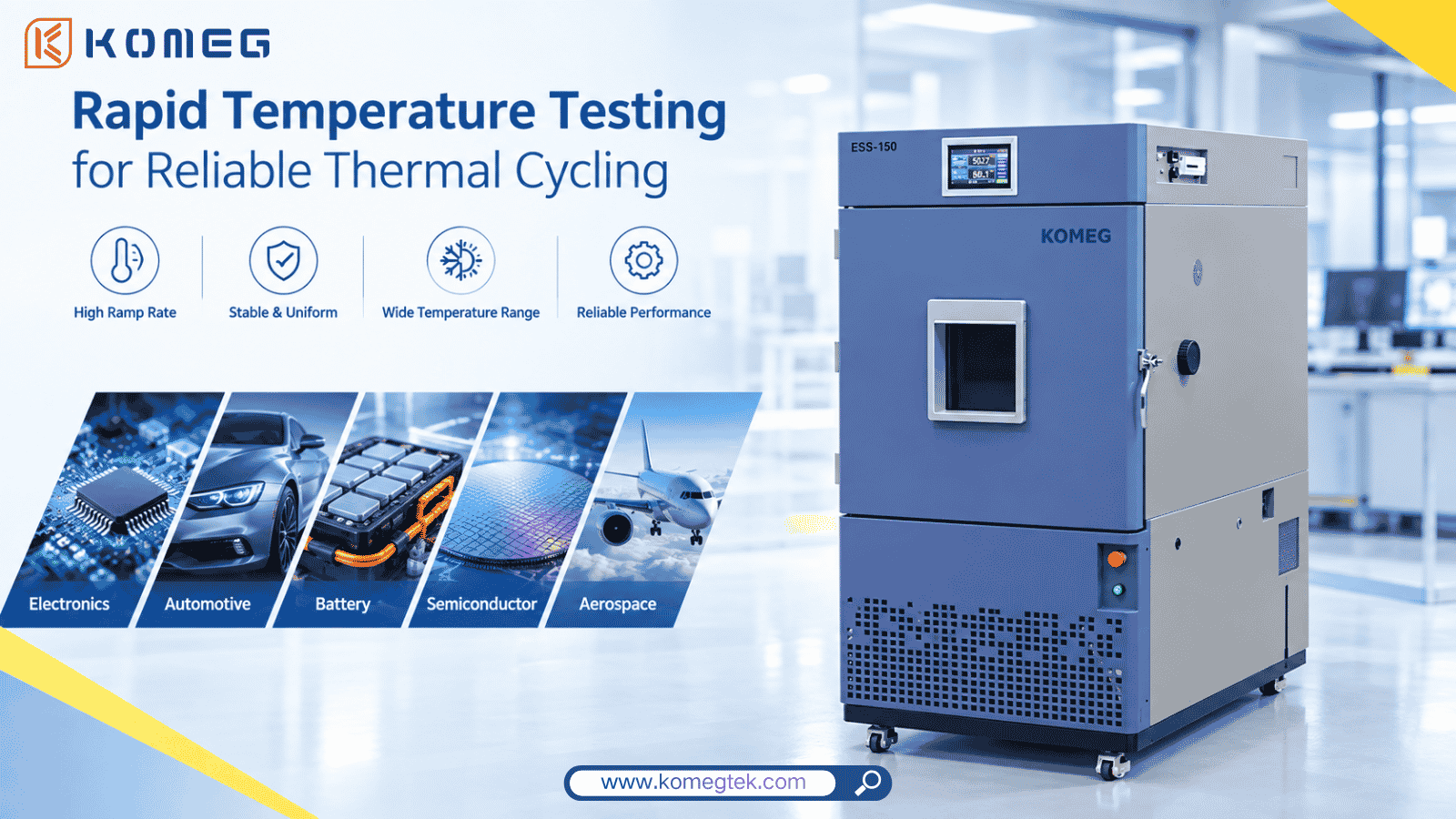
When selecting a rapid temperature test chamber, engineers often begin by comparing temperature range and ramp rate. These specifications are important, but they do not provide a complete picture of chamber performance.
A chamber rated at 10°C/min is not necessarily more suitable than one rated at 5°C/min, while a higher ramp rate does not automatically mean better testing. The more important question is whether the chamber can reproduce the required thermal profile accurately, consistently, and under the actual DUT load.
For reliability testing, this distinction matters. The difference between an empty-chamber specification and real-world performance can directly affect test duration, thermal stress, and repeatability.
Start With the Actual Test Profile
The first step in selecting a rapid temperature test chamber is to define the complete thermal profile rather than focusing on a single specification.
Consider the required minimum and maximum temperatures, heating and cooling rates, dwell time, number of cycles, and expected DUT loading. A test may require a transition between -40°C and +85°C, while another application may require -55°C to +125°C or -70°C to +150°C.
The required ramp rate also needs to be clearly defined. A test requiring 5°C/min has very different equipment requirements from one requiring 15°C/min or 25°C/min.
This distinction is also important when comparing rapid temperature change testing with conventional temperature exposure testing. For a basic introduction to the technology and its applications, see KOMEG’s article What Is a Rapid Temperature Change Test Chamber Used For?. This guide focuses specifically on the engineering factors that matter when selecting equipment.
5°C/min 10°C/min or 25°C/min
There is no universal ramp rate that is suitable for every application.
A 5°C/min rate may be sufficient for many conventional reliability programs. A 10°C/min system provides faster thermal cycling when repeated temperature transitions and shorter test cycles are required.
For advanced electronics, semiconductor components, automotive electronics, and accelerated thermal cycling, engineers may require 15°C/min, 20°C/min, 25°C/min or higher, depending on the test profile.
The highest number should not automatically be considered the best choice. A rapid temperature test chamber should be selected according to the required test method, DUT characteristics, and overall test cycle rather than simply choosing the fastest available equipment.
Check the Ramp Rate Under Load
One of the most important considerations when comparing rapid temperature test chambers is whether the specified ramp rate can be achieved with the actual DUT inside the chamber.
An empty chamber behaves very differently from one containing a large or thermally dense product. A battery module, automotive component, metal assembly, or electronic enclosure absorbs and releases heat during temperature transitions. As the DUT mass increases, the actual thermal response can become slower.
For this reason, engineers should ask manufacturers whether the stated ramp rate is based on empty-chamber conditions or a defined DUT load. It is also useful to confirm the starting and target temperatures, whether the rate refers to heating or cooling, and whether the specification represents an average ramp rate or the actual transition time.
Providing the manufacturer with the DUT dimensions, weight, material, quantity, and required temperature profile allows the chamber configuration to be evaluated against the actual application.
Temperature Uniformity Still Matters
Fast temperature change does not eliminate the need for good temperature uniformity.
During rapid heating or cooling, different areas of the working space can respond differently if airflow and thermal distribution are not properly designed. This can result in different samples experiencing slightly different thermal conditions during the same cycle.
For reliability testing, this can become a problem when multiple samples need to be compared.
A well-designed rapid temperature test chamber should therefore combine fast thermal response with effective airflow and temperature distribution. Speed without uniformity does not necessarily produce reliable test data.
Cooling Performance Can Be the Limiting Factor
In many rapid temperature applications, cooling is more challenging than heating.
Heating capacity can generally be increased through electrical heating power, while rapid cooling requires the refrigeration system to remove a significant amount of heat from both the chamber and the DUT.
The challenge becomes greater when the chamber must transition from a high temperature to a low temperature within a short period. Refrigeration capacity, heat exchanger performance, airflow, and control strategy all contribute to the actual cooling rate.
For this reason, engineers should evaluate both heating and cooling performance rather than focusing on the maximum heating ramp rate alone.
A chamber may have an impressive heating specification but still struggle to achieve the required overall cycle time if its cooling performance is insufficient.
Recovery Time Affects Testing Efficiency
Ramp rate is not the only factor that determines how quickly a test can be completed.
Recovery time is equally important in many laboratory applications.
Opening the chamber door to install or remove samples disturbs the internal environment. A chamber with good recovery performance can return to the programmed condition quickly and continue the test with minimal interruption.
For laboratories running large numbers of cycles or multiple test programs, faster recovery can significantly improve equipment utilization and overall testing efficiency.
This is particularly relevant for production reliability testing, where throughput can be as important as the basic temperature specification.
Chamber Size Should Match the DUT
A larger chamber is not always a better chamber.
An oversized working space can increase thermal load, energy consumption, and recovery time. On the other hand, insufficient space can restrict airflow around the DUT and make proper sample placement difficult.
The chamber should provide enough working volume for the required samples while maintaining appropriate airflow and clearance around the test products.
For larger or unusual DUTs, engineers should also consider whether the chamber can accommodate customized shelves, cable ports, fixtures, access openings, or other internal configurations.
Consider the Complete Thermal Cycle
A rapid temperature test chamber should be evaluated according to the complete test cycle, rather than one isolated temperature transition.
A typical program may include:
Low temperature → dwell → rapid heating → high temperature → dwell → rapid cooling → repeat
The overall testing efficiency depends on the entire sequence.
A chamber with a slightly lower ramp rate but excellent stability, recovery, uniformity, and refrigeration performance may complete a test program more efficiently than a chamber with a higher advertised ramp rate but poor recovery characteristics.
This is why engineers should compare complete cycle performance whenever possible.
Which Industries Require Rapid Temperature Testing
Rapid temperature testing is particularly relevant when products experience repeated thermal stress during operation.
In automotive electronics, rapid cycling can be used to evaluate ECUs, sensors, connectors, power electronics, and other components exposed to changing vehicle environments.
In semiconductor and electronics testing, thermal cycling can help identify solder fatigue, package defects, delamination, interconnect problems, and failures caused by differences in thermal expansion.
For battery applications, controlled temperature cycling can be used to evaluate cells, modules, and related components under changing environmental conditions.
In aerospace, electronic and mechanical components may experience substantial temperature changes between storage, ground operation, and flight, making controlled thermal cycling an important part of reliability validation.
How to Select the Right Rapid Temperature Test Chamber
A practical selection process should begin with the test requirement rather than the equipment catalog.
First, define the temperature range and required ramp rate. Then determine the DUT size, weight, quantity, and expected chamber loading.
Next, evaluate temperature uniformity, stability, cooling capacity, recovery performance, airflow, controller functionality, and data recording capabilities. Most importantly, confirm that the required ramp rate can be achieved under the expected DUT load.
This approach helps prevent two common purchasing mistakes: paying for performance that the application does not need, or selecting a chamber that looks suitable on paper but cannot reproduce the required thermal profile during actual testing.
KOMEG Rapid Temperature Cycle Test Chambers
KOMEG develops Rapid Temperature Cycle Test Chambers for applications requiring fast, controlled, and repeatable thermal transitions. Depending on the configuration, KOMEG systems can provide temperature ranges such as -70°C to +150°C with temperature change rates from approximately 5°C/min to 25°C/min.
Different chamber capacities and configurations can be selected according to DUT size, thermal profile, ramp-rate requirements, and testing volume. Programmable temperature profiles, communication interfaces, cable ports, shelves, and customized configurations can also be incorporated for specific testing applications.
For engineers evaluating equipment for rapid thermal cycling, the KOMEG Rapid Temperature Cycle Test Chamber provides further information about product specifications and available configurations.
Selecting a rapid temperature test chamber should not come down to finding the highest ramp-rate specification.
A more reliable approach is to evaluate how the chamber performs under the actual test profile and DUT load. Ramp rate, temperature uniformity, cooling capacity, recovery time, airflow, chamber size, and control stability all contribute to the quality and repeatability of the final test.
Whether the requirement is 5°C/min, 10°C/min, or 25°C/min, the best rapid temperature test chamber is the one that can consistently reproduce the required thermal profile under real testing conditions.
For this reason, ramp rate under load should be one of the first questions engineers ask when evaluating rapid temperature testing equipment.