

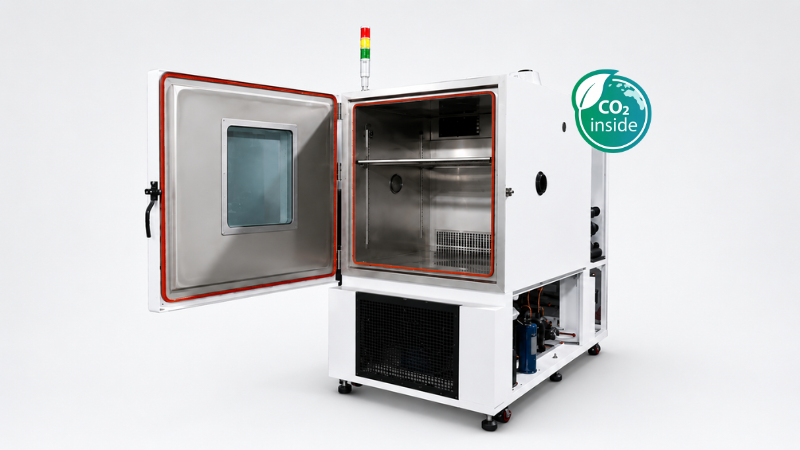
Environmental test chambers are designed to maintain controlled conditions for evaluating product reliability under different temperatures and humidity levels. However, reaching a target temperature is only part of the performance equation. How quickly the chamber returns to the required conditions after a disturbance can also affect testing efficiency and result consistency.
Temperature recovery time is therefore an important consideration when evaluating an environmental test chamber, particularly in laboratories that conduct frequent sample loading, repeated test cycles, or temperature-sensitive measurements.
Understanding what recovery time means, how it is measured, and which factors influence it helps engineers evaluate chamber performance under realistic operating conditions.
What Is Temperature Recovery Time in an Environmental Test Chamber?
Temperature recovery time is the time required for a chamber to return to a defined temperature condition after a specified disturbance.
Depending on the test procedure, the disturbance may involve opening the chamber door, introducing a sample, changing the thermal load, or switching between test stages.
For meaningful evaluation, the starting point, disturbance, measurement location, and recovery endpoint must be clearly defined. For example, a test procedure might measure the time between closing the chamber door and the point at which the monitored temperature returns to a specified range around the setpoint.
The exact acceptance range should be established by the applicable test method or laboratory procedure. Returning to the setpoint at one sensor location does not necessarily mean that every location inside the chamber has recovered.
This distinction becomes especially important when testing large samples, densely loaded fixtures, or products with substantial thermal mass.
Why Temperature Recovery Time Matters
Maintaining Consistent Test Conditions
When chamber conditions temporarily deviate from the target temperature, samples may experience additional thermal exposure. Depending on the material, product design, and test procedure, these deviations can influence the interpretation of test results.
A chamber with predictable recovery behavior helps laboratories establish repeatable procedures and determine when the next test stage can begin.
Improving Laboratory Throughput
Frequent door openings and repeated sample changes can interrupt testing. If the chamber takes a long time to recover, the waiting period may extend the overall test schedule.
Recovery performance can therefore affect laboratory productivity, particularly in production quality control and reliability laboratories that process multiple samples each day.
Supporting Temperature-Sensitive Testing
Electronic components, battery assemblies, automotive parts, polymers, and other temperature-sensitive products may respond differently to short-term temperature deviations.
For these applications, engineers should consider not only the chamber setpoint but also the actual temperature experienced by the sample throughout the test sequence.
Temperature Recovery Time vs. Ramp Rate and Temperature Stability
These three performance characteristics are related, but they describe different aspects of chamber behavior.
Temperature recovery time describes how long the chamber takes to return to a defined condition after a specified disturbance.
Temperature ramp rate describes how quickly the temperature changes between two conditions during a programmed transition. Depending on the specification, ramp rate may be expressed as an average or evaluated over a defined temperature interval.
Temperature stability describes how consistently the temperature is maintained over time under specified conditions. Temperature uniformity, by contrast, concerns temperature differences between locations within the working space.
A chamber may provide a high ramp rate but still require significant time to recover after a large thermal load is introduced. Similarly, a chamber may maintain excellent stability under steady-state conditions without recovering quickly after a door opening.
For this reason, engineers should evaluate these characteristics separately rather than using one specification as a substitute for another.
What Affects Environmental Chamber Temperature Recovery Time?
1. Thermal Load and Sample Mass
The sample’s mass, material properties, initial temperature, and heat capacity can significantly affect recovery behavior.
A small electronic component and a large metal assembly create very different thermal loads. When a relatively warm sample is introduced into a cold chamber, the refrigeration system must remove the additional heat while maintaining the required conditions.
For large or heavy samples, the chamber’s nominal performance under no-load conditions may not represent its behavior during actual testing.
2. Chamber Volume and Working Space
Chamber volume influences the amount of air that must be conditioned, but volume alone does not determine recovery performance.
The refrigeration or heating capacity, internal airflow, insulation, sample configuration, and distribution of thermal load also play important roles.
A larger chamber may be necessary for bulky products, battery packs, automotive assemblies, or multiple samples. In these cases, recovery behavior should be evaluated using a representative loading arrangement rather than relying solely on the chamber’s empty-space specifications.
3. Airflow and Sample Placement
Air circulation helps transfer heat between the chamber air and the samples. Poorly positioned samples, blocked air outlets, tightly packed fixtures, or excessive loading can restrict circulation and create local temperature differences.
Even when the control sensor indicates that the setpoint has been restored, areas around large samples may recover at a different rate.
Engineers should therefore consider sample spacing, fixture design, airflow paths, and sensor placement when establishing a recovery test.
4. Temperature Difference and Operating Conditions
Recovery behavior depends on the temperature difference between the chamber and the introduced sample, as well as the chamber’s current operating point.
Recovering from a brief door opening is not equivalent to recovering after introducing a large sample at room temperature into a chamber operating at a very low temperature.
Ambient conditions, the duration of the disturbance, and the thermal state of the refrigeration system may also influence the result.
5. Heating and Refrigeration System Capacity
The chamber must supply or remove enough heat to restore the required conditions. System capacity, compressor operation, heater output, control logic, and the condition of key components all contribute to the recovery process.
For applications requiring frequent temperature transitions or repeated sample handling, engineers should assess the chamber under the intended operating profile rather than selecting equipment based on temperature range alone.
How to Evaluate Temperature Recovery Time
A useful recovery evaluation starts with a clearly defined and repeatable procedure.
First, establish the required chamber temperature and allow the chamber to stabilize under the specified conditions. Record the monitored temperature before introducing the disturbance.
Next, define the disturbance. This may include a controlled door-opening duration, a specified sample mass, a known sample temperature, or a representative loading arrangement.
After the disturbance, record the temperature response using appropriate sensors and data acquisition. Sensor locations should reflect the purpose of the evaluation, and the measurement system should have suitable accuracy and response characteristics.
Finally, define the recovery endpoint before testing begins. This might be the time at which the monitored temperature re-enters a specified tolerance band and remains within it for a defined period.
For a more complete assessment, consider monitoring multiple locations or measuring sample temperature directly. Chamber-air temperature and sample temperature do not necessarily recover at the same rate.
Repeat the procedure under comparable conditions and document the chamber setpoint, sample load, door-opening duration, sensor positions, ambient conditions, and recovery criterion. These details make results more useful for comparing equipment or tracking performance over time.
There is no single recovery-time value that applies to every environmental test chamber. Meaningful comparisons require equivalent test conditions and clearly stated measurement criteria.
How to Choose a Chamber for Better Recovery Performance
When evaluating environmental test chambers, start with the actual testing requirements rather than a single headline specification.
Consider the size and thermal mass of the samples, the required temperature range, humidity requirements, frequency of sample changes, programmed temperature transitions, and expected daily workload.
For general temperature testing, explore KOMEG Temperature Test Chambers.
For applications that require controlled temperature and humidity, see Temperature and Humidity Test Chambers.
For large products, assemblies, or multiple samples, Walk-in Environmental Chambers may provide the necessary working space.
When testing requires rapid programmed temperature transitions, a Temperature Forcing System may be appropriate for device-level evaluation. Its operating characteristics should be assessed against the required temperature range, device interface, and test profile.
The best choice depends on the intended application and the performance requirements under actual loading conditions. Requesting recovery data under representative conditions can provide a more useful basis for comparison than relying on unloaded specifications alone.
How to Maintain Consistent Recovery Performance
Recovery performance can change over time if the chamber is poorly maintained or operated outside its intended conditions.
Keep air inlets and outlets clear, avoid overloading the working space, inspect door seals, and follow the manufacturer’s maintenance recommendations for refrigeration, heating, airflow, and control systems.
If recovery time increases noticeably, record the operating conditions and compare them with previous results. Check whether the sample load, ambient temperature, door-opening duration, or test procedure has changed before assuming that the chamber has developed a fault.
Periodic performance verification under defined conditions can help identify changes early and support consistent laboratory operation.
Temperature recovery time is an important part of environmental test chamber performance, but it must be evaluated in context. Sample mass, airflow, chamber capacity, operating temperature, and the definition of the recovery endpoint all influence the result.
For reliable equipment comparisons, engineers should distinguish recovery time from ramp rate, temperature stability, and uniformity, then evaluate the chamber under conditions that represent the intended application.
KOMEG provides environmental testing solutions for electronics, automotive components, materials, batteries, and other reliability-testing applications. To identify a suitable configuration, share your required temperature range, sample dimensions, thermal load, and test procedure with the KOMEG team.