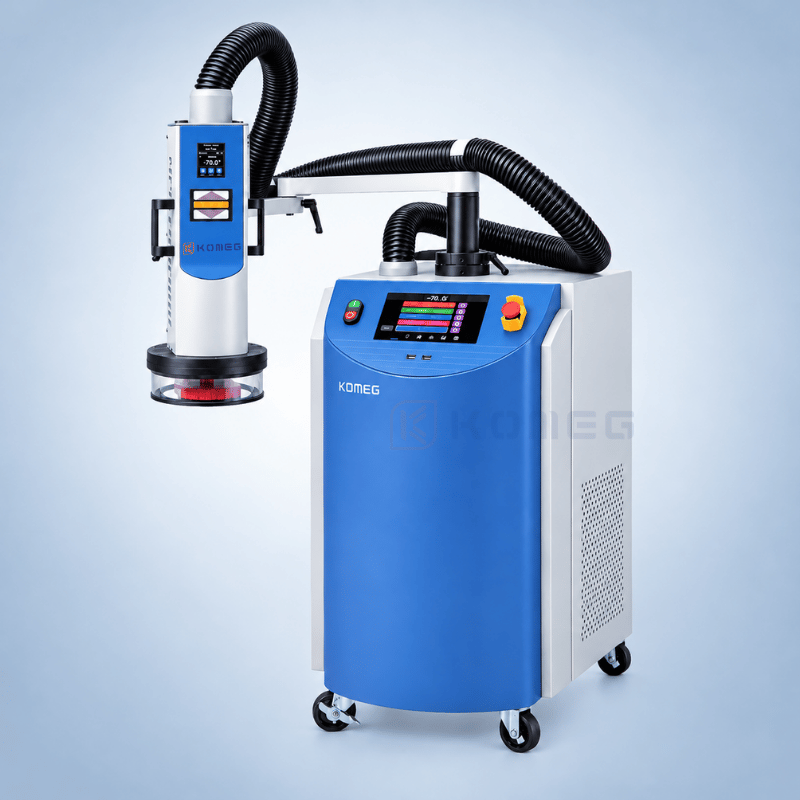
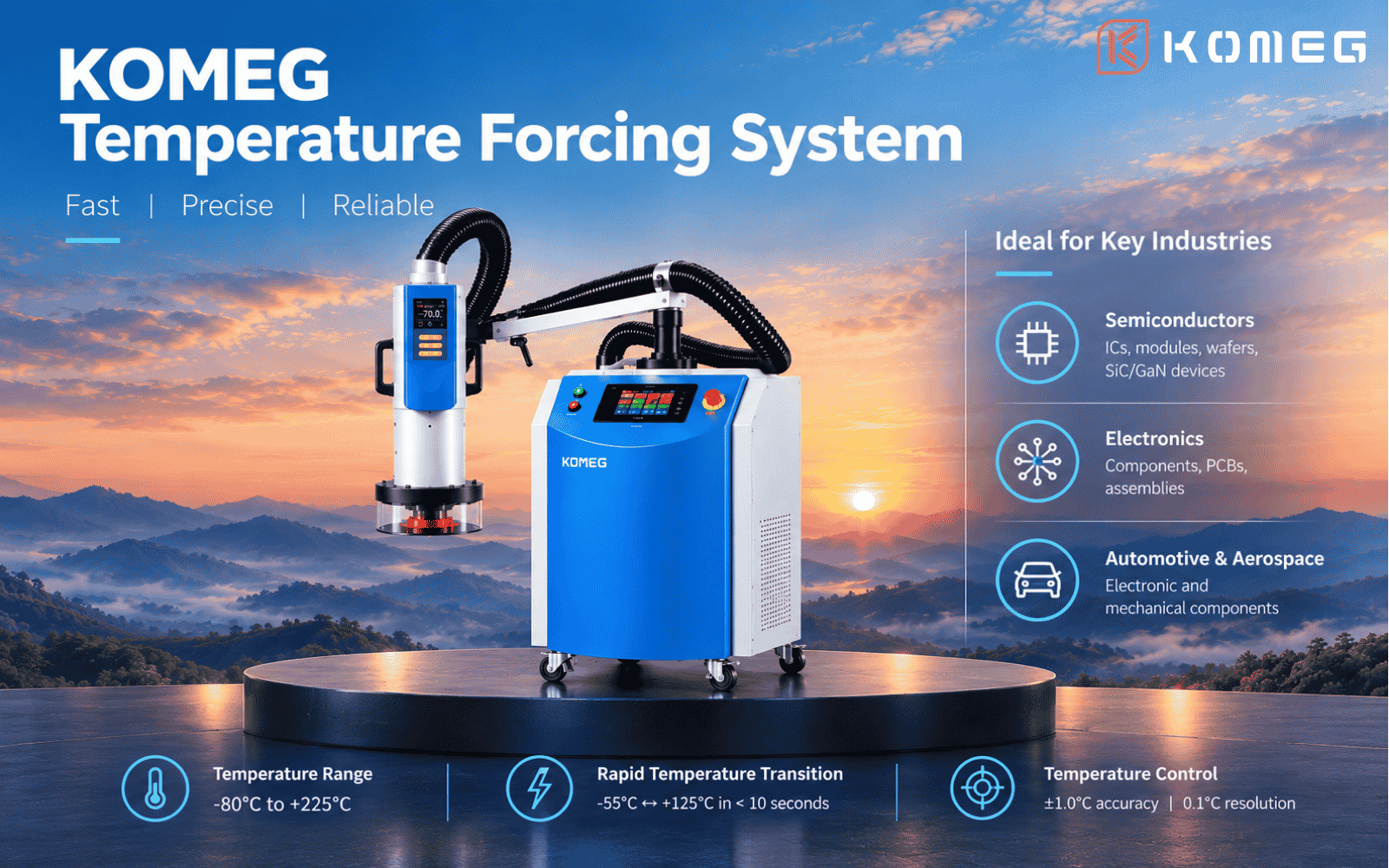
The KOMEG Temperature Forcing System delivers high-velocity, localized hot and cold airflow directly to the device under test (DUT), enabling rapid temperature testing without conditioning an entire environmental chamber. Designed for semiconductor characterization and electronic component reliability testing, it helps engineers evaluate temperature-dependent performance, investigate potential thermal faults, and conduct targeted thermal stress testing.
With temperature transitions between -55°C and +125°C in under 10 seconds, the system provides rapid thermal stimulation for applications requiring fast temperature changes. Actual DUT temperature response depends on device thermal mass, package design, airflow conditions, nozzle positioning, and test setup.
Key Features
Rapid Temperature Transition: Transitions between -55°C and +125°C in under 10 seconds.
External Sensor Feedback: Supports T-type and K-type thermocouples and RTD sensors for temperature monitoring and feedback.
Localized Thermal Stimulation: Directs controlled hot and cold airflow toward specific components, reducing the need to condition a large chamber volume.
Flexible Positioning: A movable articulated arm enables convenient nozzle positioning near the DUT.
Interchangeable Nozzles: Supports different component sizes and test configurations.
Simplified Cooling Setup: No liquid nitrogen or CO₂ auxiliary cooling is required.
ATE Integration: Can be configured for suitable automated test equipment (ATE) environments, depending on interface and application requirements.
Working Principle
The system generates controlled hot or cold airflow and delivers it through a nozzle directly to the DUT. External sensor feedback helps monitor temperature at selected measurement points, allowing engineers to correlate thermal conditions with electrical parameters or functional performance. This localized approach is particularly useful for component-level characterization and troubleshooting temperature-sensitive failures.
Applications
The KOMEG Temperature Forcing System supports temperature testing, thermal cycling, and targeted thermal stress evaluation across multiple industries:
Semiconductors: ICs, semiconductor modules, wafer-level characterization, and SiC/GaN device evaluation.
Electronics: Electronic components, PCBs, and assemblies.
Automotive and Aerospace: Temperature-sensitive electronic devices and selected mechanical components.
Consumer Electronics and Medical Devices: Thermal response and functional stability evaluation.
Batteries and Energy Storage: Selected component-level temperature-response studies, subject to application and safety requirements.
Environmental Stress Screening (ESS): Localized thermal stress testing for suitable components and assemblies.
Semiconductor Reliability Testing
The system can support semiconductor characterization and reliability programs associated with applicable JEDEC procedures and AEC-Q100 requirements. Engineers can investigate parametric drift, temperature-dependent electrical behavior, intermittent faults, and potential IC package thermal defects. Applicable test profiles and acceptance criteria should be established according to the relevant test procedure; equipment use alone does not guarantee compliance with a particular standard.