

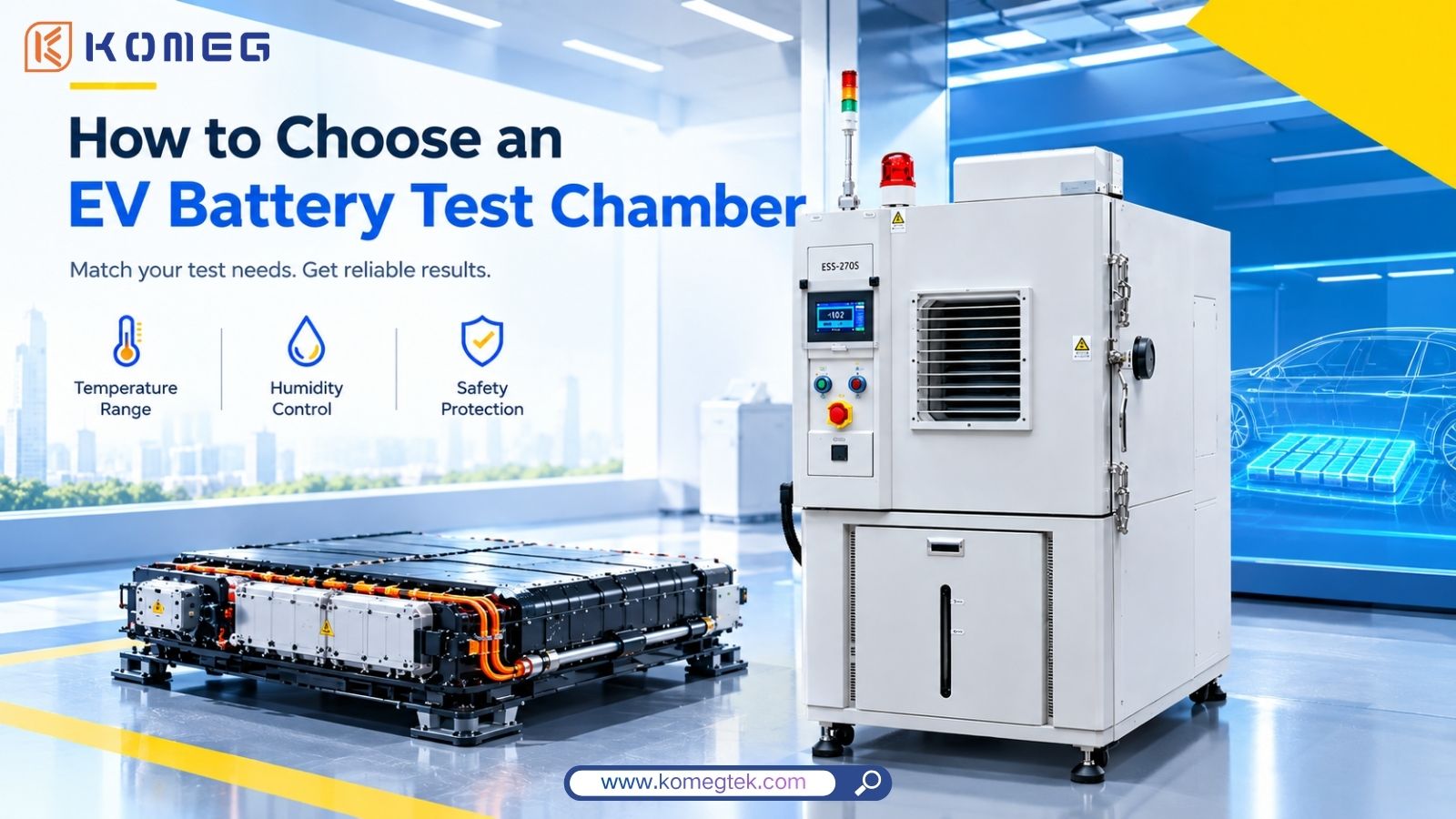
Choosing an EV battery test chamber is not simply a matter of selecting the widest temperature range. For battery cells, modules, and packs, chamber performance must be evaluated according to the actual test profile, thermal load, DUT size, temperature transition requirements, and safety conditions.
As EV battery systems become larger and more powerful, environmental testing is also becoming more demanding. A battery pack may need to operate or remain in storage under extreme temperatures while being charged, discharged, or subjected to other environmental stresses.
The right test chamber should therefore reproduce the required environmental conditions while maintaining stable and repeatable performance under the actual battery load.
1. Start With the Battery Test Profile
The test profile should determine the chamber configuration rather than the other way around.
Before selecting an EV battery test chamber, engineers should define the main testing requirements, including:
- Cell, module, or battery pack
- Operating or storage testing
- Minimum and maximum temperature
- Temperature cycling profile
- Temperature ramp rate
- Humidity requirements
- Test duration
- Charging and discharging conditions
- Battery heat generation
- Cable and electrical connection requirements
A small battery cell and a complete EV battery pack can have very different thermal and physical requirements. The chamber that works well for one application may not be suitable for another.
For this reason, chamber selection should begin with the DUT and test profile rather than a standard equipment specification.
2. Temperature Range Is Only the Starting Point
Temperature range is one of the first specifications engineers normally check, but it should not be the only selection criterion.
An EV battery test may require exposure to both low and high temperatures. Low-temperature testing can evaluate cold-start behavior, available power, charging performance, and changes in electrical characteristics. High-temperature testing can be used to study thermal performance, aging, material stability, and long-term reliability.
However, a chamber with a wide nominal temperature range does not automatically provide better battery testing performance.
Temperature uniformity, stability, recovery time, and refrigeration capacity can have a direct effect on the test result.
The important question is not only:
Can the chamber reach the required temperature?
It is also:
Can the chamber maintain that temperature uniformly while the battery is inside and operating under the required test conditions?
3. Evaluate Ramp Rate Under Battery Load
Temperature ramp rate becomes particularly important when the test requires rapid transitions between hot and cold conditions.
A chamber may achieve a certain temperature change rate under empty-chamber conditions, but the actual performance can be different when a large battery pack is placed inside.
The battery itself can represent a significant thermal load, especially during charging and discharging. The chamber must remove or supply this heat while continuing to follow the required temperature profile.
Therefore, engineers should evaluate:
- Ramp rate with the actual DUT
- Heating capacity
- Cooling capacity
- Airflow around the battery
- Temperature uniformity during transitions
- Recovery time after temperature changes
A high ramp rate is useful only when it can be maintained under realistic test conditions.
For applications requiring rapid and repeatable thermal transitions, KOMEG offers the Rapid Temperature Cycle Test Chamber for accelerated thermal cycling and reliability testing.
4. Chamber Size and Battery Pack Dimensions
Chamber volume becomes increasingly important as battery systems become larger.
The battery pack needs to fit inside the chamber with sufficient clearance for proper airflow, instrumentation, cable routing, fixtures, and safe operation.
Simply having enough physical space is not sufficient.
Engineers should also consider:
- Battery pack dimensions
- DUT weight
- Fixture dimensions
- Air circulation
- Cable routing
- Charging and discharging connections
- Door opening size
- Loading and unloading method
- Floor load capacity
Poor airflow around a large battery pack can create temperature gradients and reduce test consistency.
For large EV battery systems, a walk-in environmental chamber may provide more practical access and greater flexibility than a conventional reach-in chamber.
5. Heat Load Capacity Matters
One of the most important factors in EV battery chamber selection is heat load capacity.
During charging and discharging, an EV battery pack can generate significant heat. The environmental chamber must remove this heat while maintaining the required temperature condition.
This creates a major difference between conventional environmental testing and active battery testing.
For example, a chamber may easily reach a low temperature with an empty workspace. Once a large battery pack is operating inside, however, the refrigeration system may need to continuously compensate for the heat generated by the DUT.
This is why engineers should ask for chamber performance under the expected battery load rather than relying only on empty-chamber specifications.
A useful evaluation should consider:
Required temperature + DUT heat generation + chamber recovery + test duration
These factors should be evaluated together.
6. Temperature and Humidity Control
Some EV battery validation programs require both temperature and humidity exposure.
Humidity testing can help evaluate potential problems involving battery enclosures, seals, connectors, insulation, corrosion, and moisture penetration.
Temperature and humidity testing may also be combined with temperature transitions to simulate condensation-related conditions.
For battery applications, engineers should pay attention to:
- Humidity range
- Humidity stability
- Temperature-humidity uniformity
- Condensation conditions
- Recovery performance
- Airflow distribution
- Long-duration operation
For applications requiring controlled temperature and humidity exposure, KOMEG provides Battery Temperature and Humidity Test Chamber solutions for battery and automotive component testing.
7. Safety Requirements for EV Battery Testing
Battery testing introduces safety requirements that should be considered during chamber selection.
Depending on the battery chemistry, energy capacity, test conditions, and failure risks, the chamber may need additional safety and monitoring functions.
Potential requirements include:
- Over-temperature protection
- Independent safety shutdown
- Emergency stop
- Smoke or gas monitoring
- Fire protection
- Pressure relief
- Battery failure detection
- Electrical feedthroughs
- Charging and discharging interfaces
The environmental chamber should not be treated as an isolated piece of equipment. The battery, chamber, battery cycler, electrical system, monitoring system, and safety system need to work together as one test environment.
For high-energy battery testing, safety requirements should be defined before the chamber configuration is finalized.
8. When Do You Need a Walk-In Battery Test Chamber?
A conventional reach-in chamber can be suitable for battery cells, modules, and smaller assemblies. However, large EV battery packs can quickly exceed the practical limits of a standard chamber.
A walk-in environmental chamber may be more appropriate when the test involves:
- Large battery packs
- Complete EV battery systems
- Multiple DUTs
- Large fixtures
- Battery charging and discharging equipment
- Complex instrumentation
- Extensive cable routing
- High thermal loads
The larger working space also makes installation, DUT positioning, inspection, and maintenance easier.
For large battery systems, chamber dimensions and refrigeration capacity should be designed together rather than treating the chamber size as a simple enclosure requirement.
9. When Is a Rapid Temperature Cycle Chamber Better?
Different battery tests require different chamber configurations.
If the main objective is fast thermal transition, a rapid temperature cycle chamber is generally more appropriate.
If the main objective is long-term temperature and humidity exposure, a temperature and humidity chamber may be a better choice.
If the DUT is very large, a walk-in environmental chamber can provide the required working space.
If the test requires temperature, humidity, and vibration simultaneously, an integrated environmental test chamber may be more suitable.
The selection can therefore be summarized as:
Fast thermal transitions → Rapid Temperature Cycle Test Chamber
Temperature + humidity exposure → Temperature and Humidity Test Chamber
Large battery packs → Walk-In Environmental Chamber
Temperature + humidity + vibration → Integrated Environmental Test Chamber
The key is to match the chamber architecture with the actual failure risks and test objectives of the battery system.
10. EV Battery Test Chamber Selection Checklist
Before purchasing or specifying an EV battery test chamber, engineers should evaluate the following parameters:
Temperature range
Does the chamber cover the required minimum and maximum temperatures with sufficient margin?
Ramp rate under load
Can the required temperature transition rate be achieved with the actual battery inside?
Temperature uniformity
Can the chamber maintain consistent conditions around a large battery pack?
Heat load capacity
Can the refrigeration and heating systems compensate for battery-generated heat?
Chamber volume
Is there enough space for the battery, fixtures, cables, instrumentation, and airflow?
DUT weight
Can the chamber floor and fixture system safely support the battery?
Humidity control
Does the chamber provide the required humidity range and stability?
Cable ports and electrical interfaces
Can charging, discharging, monitoring, and data acquisition equipment be connected correctly?
Safety system
Does the configuration provide the protection and monitoring required for the battery under test?
Data acquisition
Can critical environmental parameters be recorded throughout the test?
Customization
Can the chamber be modified if the battery size, test profile, or safety requirements change?
EV Battery Testing Requires More Than a Wide Temperature Range
The most common mistake in selecting an EV battery test chamber is focusing too heavily on one specification.
A chamber rated from a very low temperature to a very high temperature may look impressive on paper, but that specification alone does not show how the system will perform with a large battery pack generating heat during operation.
For EV battery testing, engineers should evaluate the complete test system.
Temperature range, ramp rate, heat load, airflow, uniformity, chamber volume, humidity control, safety protection, and data acquisition all contribute to test quality.
The actual battery load should be considered whenever chamber performance is evaluated.
KOMEG Solutions for EV Battery Environmental Testing
KOMEG develops environmental test chambers for battery cells, modules, battery packs, and automotive components. Depending on the application, chamber configurations can support temperature cycling, temperature and humidity testing, rapid temperature changes, thermal shock, altitude testing, and combined environmental testing.
For large battery systems, KOMEG can also develop customized environmental chambers based on chamber dimensions, refrigeration capacity, airflow, cable routing, DUT weight, safety requirements, and specific test profiles.
For battery temperature cycle applications, the KOMEG Battery Temperature Cycle Test Chamber can be configured according to the required temperature range and cycling conditions.
Final Considerations
Choosing an EV battery test chamber should start with the battery and its actual test requirements, not with a standard chamber model.
The most important questions are not simply whether the chamber can reach the required temperature, but whether it can maintain the required environmental conditions under the actual DUT load and test profile.
For EV battery manufacturers and automotive suppliers, evaluating ramp rate under load, heat load capacity, temperature uniformity, chamber size, safety protection, and long-term operating stability can help ensure that environmental testing produces meaningful and repeatable reliability data.
The right chamber is therefore not necessarily the one with the most extreme specifications. It is the one that can reproduce the required environmental conditions accurately and consistently for the battery system being tested.