

Modern electronic and electromechanical products are exposed to more than one environmental stress during operation. Temperature fluctuations, moisture exposure, and mechanical vibration can occur together, particularly in automotive, aerospace, communication, and industrial applications.
Testing these factors separately is useful for evaluating individual weaknesses. However, it may not reveal how different environmental stresses interact.
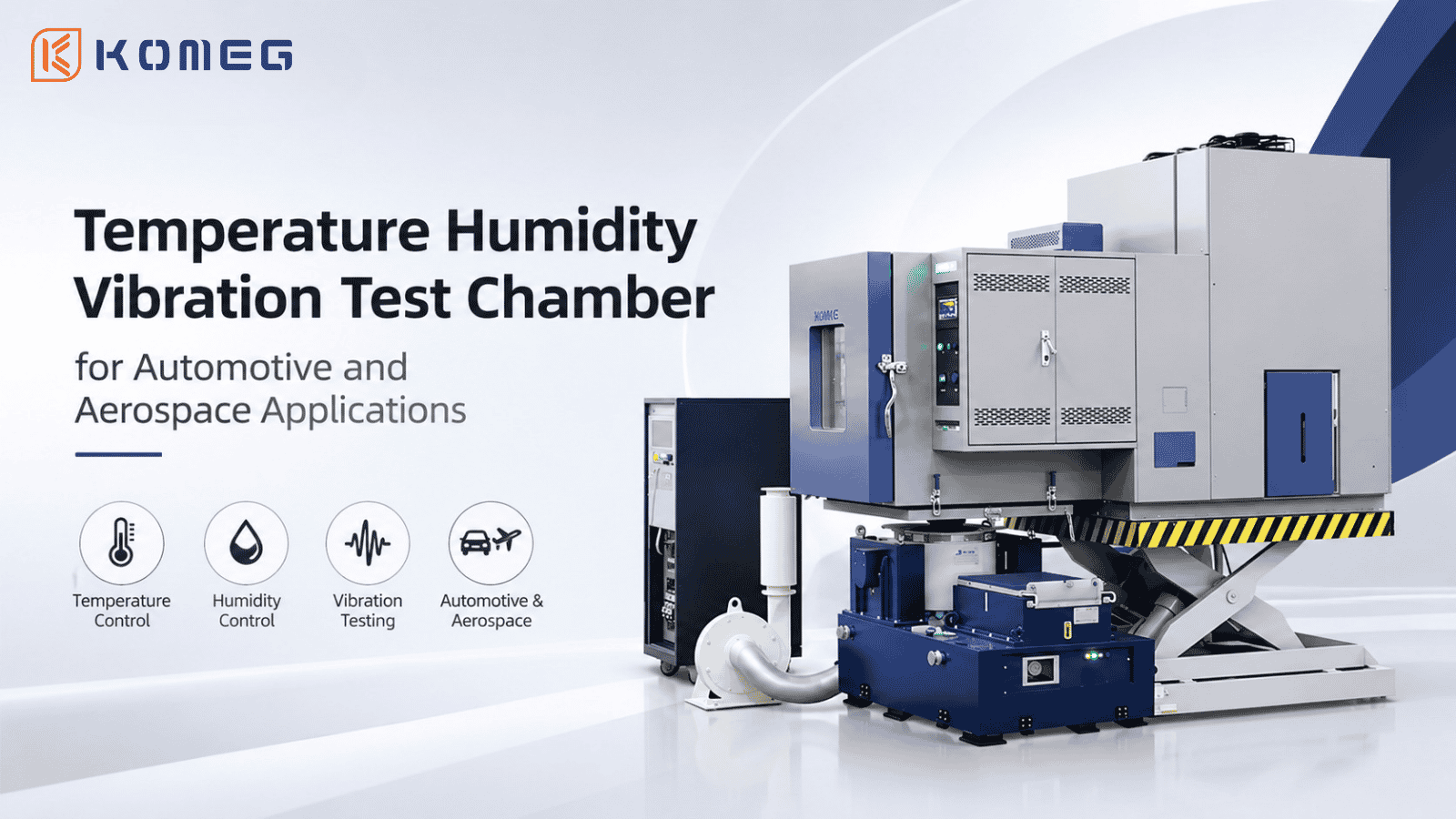
A Temperature Humidity Vibration Test Chamber combines controlled temperature, humidity, and mechanical vibration in one testing system. It allows engineers to evaluate product reliability under coordinated environmental conditions and identify potential weaknesses that may not appear during single-factor testing.
What Is a Temperature Humidity Vibration Test Chamber?
A Temperature Humidity Vibration Test Chamber is an integrated environmental testing system designed to expose test specimens to controlled climatic conditions and mechanical vibration.
The system typically combines three major functions:
Temperature control to simulate high- and low-temperature operating environments.
Humidity control to evaluate the effects of moisture on materials and electronic assemblies.
Mechanical vibration to reproduce dynamic stresses associated with transportation, operation, or installation.
Unlike a conventional temperature and humidity chamber, this system incorporates a vibration table or shaker interface. The test specimen can therefore be evaluated under combined climatic and mechanical stresses without repeatedly transferring it between separate testing environments.
The system is commonly associated with AGREE environmental testing, particularly in applications where multiple environmental factors need to be evaluated within a coordinated test program.
Why Combine Temperature, Humidity, and Vibration Testing?
Each environmental factor can affect product reliability in a different way. Their combined effects can create more complex failure mechanisms.
1. Temperature Changes Affect Material and Component Performance
Temperature variation causes materials to expand and contract at different rates. This is particularly important in electronic assemblies containing materials with different coefficients of thermal expansion.
Repeated temperature changes can contribute to:
Solder joint fatigue
Connector stress
Material deformation
Changes in electrical characteristics
Mechanical loosening at component interfaces
When vibration is applied during temperature exposure, existing mechanical weaknesses may become more apparent.
2. Humidity Can Accelerate Moisture-Related Degradation
Moisture can affect insulation resistance, promote corrosion, and influence the long-term performance of electronic materials.
For products containing circuit boards, connectors, sensors, or exposed metal interfaces, humidity testing helps evaluate potential moisture-related reliability problems.
When humidity and vibration are applied together, engineers can investigate whether moisture exposure and mechanical movement contribute to degradation at the same interfaces.
3. Vibration Introduces Dynamic Mechanical Stress
Vibration can cause repeated mechanical loading on components, fasteners, connectors, solder joints, and structural assemblies.
Depending on the vibration profile, potential failure mechanisms may include:
Connector loosening
Solder joint cracking
Structural fatigue
Resonance-related damage
Intermittent electrical connections
Temperature and humidity conditions may influence how materials respond to these mechanical stresses.
The purpose of combined testing is to evaluate these interactions under controlled and repeatable conditions.
Key Applications of Combined Environmental Testing
Automotive Electronics and Vehicle Components
Automotive electronic systems operate under changing temperatures, moisture exposure, and continuous mechanical excitation.
Electronic control units, sensors, connectors, display modules, and communication components may experience vibration from the vehicle structure while exposed to varying environmental conditions.
A combined temperature, humidity, and vibration test can help evaluate the durability of these assemblies and identify weaknesses in electrical connections, solder joints, and mechanical structures.
Aerospace and Avionics Equipment
Aerospace equipment must maintain reliable performance under demanding environmental conditions.
Avionics, communication modules, electronic control systems, and other airborne equipment may be exposed to temperature variations and mechanical vibration during transportation and operation.
Combined environmental testing provides a controlled way to investigate product performance under coordinated climatic and mechanical stresses.
Electronic Components and Communication Equipment
Electronic assemblies used in communication infrastructure and industrial systems may experience temperature changes, humidity exposure, and vibration during installation, transportation, or operation.
Combined testing can help identify potential weaknesses in circuit connections, packaging structures, and mechanical interfaces before products enter service.
Important Parameters When Selecting a Temperature, Humidity, and Vibration Test Chamber
Selecting a suitable system requires more than checking its temperature range. The chamber, vibration system, specimen, and test profile must work together.
Temperature Range and Control Accuracy
The required temperature range should be determined by the product’s operating environment and applicable test procedure.
For example, KOMEG AGREE chamber configurations offer different temperature ranges:
R configuration: -20°C to +150°C
L configuration: -40°C to +150°C
S configuration: -70°C to +150°C, with +180°C optional
The standard product specifications also list temperature fluctuation of ±0.5°C and temperature uniformity of ≤2.0°C.
These values should be evaluated together with the actual specimen load and test conditions.
Humidity Control
Humidity requirements depend on the materials, electronic components, and environmental conditions being evaluated.
KOMEG AGREE chambers specify a humidity range of 20% RH to 98% RH, with humidity fluctuation of ±2.0% RH.
Engineers should also consider humidity uniformity, specimen loading, airflow, and whether the required humidity conditions are compatible with the selected temperature and vibration profile.
Vibration Frequency and Table Configuration
Vibration performance is one of the most important considerations when selecting an AGREE system.
The required vibration profile may involve sinusoidal or random vibration, depending on the test objective and applicable procedure.
Important parameters include:
Frequency range
Acceleration
Displacement
Test specimen weight
Vertical or horizontal vibration requirements
Fixture design and mounting conditions
The vibration table should be selected according to the specimen and test requirements. An unsuitable fixture or mounting arrangement can influence the vibration transmitted to the test specimen and affect test results.
Chamber Volume and Specimen Dimensions
The chamber must provide sufficient space for the specimen, fixtures, and required airflow.
KOMEG standard AGREE chamber models include 408L, 700L, and 1000L configurations. Larger testing requirements can be addressed by the 2250L KMVH-2250 model.
For larger or irregular specimens, engineers should consider the total assembly dimensions, mounting method, vibration table arrangement, and access requirements before selecting a chamber.
KOMEG AGREE Chambers for Combined Environmental Testing
KOMEG develops AGREE environmental test chambers for applications requiring temperature, humidity, and vibration testing.
The product range includes standard chamber configurations from 408L to 1000L, as well as the 2250L KMVH-2250 model.
Depending on the selected configuration, key specifications include:
Temperature ranges from -20°C to +150°C, -40°C to +150°C, or -70°C to +150°C
Optional maximum temperature of +180°C
Humidity range of 20% RH to 98% RH
Temperature fluctuation of ±0.5°C
Temperature uniformity of ≤2.0°C
Vibration frequency range of 3–3000 Hz
Vertical and horizontal vibration table configurations
The vibration table can be selected according to customer requirements. The system also supports different lifting methods, including self-lifting, hydraulic lifting, and gantry lifting, depending on the model and configuration.
For detailed product information, visit KOMEG’s AGREE Environmental Test Chambers and the KMVH-2250 Large AGREE Chamber.
What Information Is Needed When Configuring an AGREE Test System?
A suitable configuration should be based on the actual test specimen and its required environmental profile.
Before requesting a system, engineers should prepare:
Required temperature range and temperature cycling profile.
Required humidity range and exposure conditions.
Vibration type, frequency, acceleration, and displacement.
Specimen dimensions, weight, and mounting arrangement.
Required vertical or horizontal vibration configuration.
Applicable test standards or customer-specific procedures.
It is also important to confirm whether temperature, humidity, and vibration must be applied simultaneously or in a specified sequence. Not every test procedure requires all three factors to operate at the same time.
A clear test profile helps determine the chamber volume, vibration table, fixture, control configuration, and other system requirements.
Frequently Asked Questions
What is an AGREE environmental test chamber?
An AGREE environmental test chamber is a combined testing system used to evaluate products under multiple environmental stresses, commonly including temperature, humidity, and vibration.
What is the difference between a temperature-humidity chamber and a temperature-humidity-vibration chamber?
A conventional temperature-humidity chamber controls climatic conditions, while a temperature-humidity-vibration chamber also integrates a vibration system. The latter allows engineers to evaluate the effects of mechanical vibration under controlled temperature and humidity conditions.
Which industries use temperature, humidity, and vibration test chambers?
Common applications include automotive electronics, aerospace equipment, communication systems, electronic components, and other products requiring combined environmental reliability evaluation.
Can temperature, humidity, and vibration be tested simultaneously?
Yes, the system is designed to support combined testing. However, whether all three factors operate simultaneously or in a programmed sequence depends on the applicable test procedure and equipment configuration.
How do I select the right chamber size?
The selection should consider specimen dimensions, weight, fixture arrangement, vibration table size, and the required environmental conditions. Chamber volume alone is not sufficient to determine suitability.
A Temperature Humidity Vibration Test Chamber provides a practical solution for evaluating products under combined climatic and mechanical stresses.
For automotive electronics, aerospace equipment, and communication systems, the ability to control temperature, humidity, and vibration within one coordinated testing platform helps engineers investigate environmental interactions and improve reliability validation.
The right system should be selected according to the actual specimen, vibration profile, environmental requirements, and applicable test procedure.