

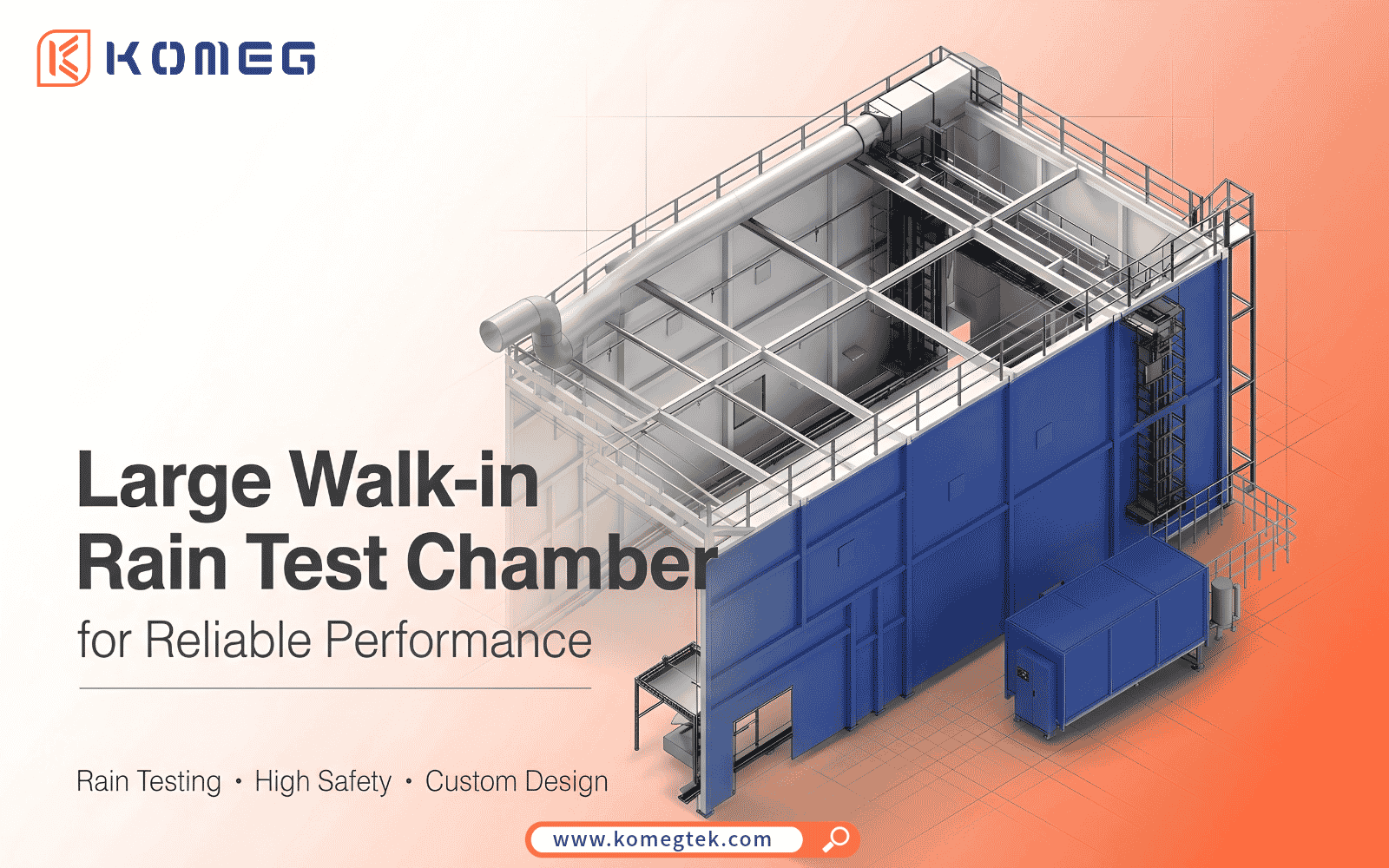
As vehicles, battery systems, and outdoor energy storage installations continue to increase in size and complexity, conventional waterproof testing equipment may no longer provide sufficient testing space for complete products and integrated systems.
A large walk-in rain test chamber provides a controlled environment for evaluating the water resistance of oversized products, enclosures, and complete assemblies. Unlike conventional cabinet-style rain test equipment, a walk-in system can be engineered around the dimensions, weight, access requirements, and water exposure conditions of large test specimens.
KOMEG has completed a large-scale walk-in rain test chamber project with a test volume of 1,100 m³. This project demonstrates the company’s engineering and manufacturing capabilities in customized, large-volume rain testing facilities.
For manufacturers developing electric vehicles, battery systems, energy storage containers, and other outdoor equipment, large-scale rain testing is an important part of environmental reliability evaluation.
What Is a Large Walk-in Rain Test Chamber?
A Large Walk-in Rain Test Chamber is a customized environmental testing facility designed to simulate rainfall and water spray conditions for products that cannot be accommodated by conventional rain test chambers.
The test space can be engineered to accommodate large assemblies, heavy equipment, vehicle components, battery enclosures, and containerized systems.
Depending on the project requirements, the system may incorporate:
Large-format test rooms and reinforced structural frames
Distributed water spray and rainfall systems
Customized nozzle positions and spray coverage
Heavy-duty floors and specimen support structures
Water collection, filtration, and circulation systems
Large access doors and material handling interfaces
Integrated control and monitoring systems
The chamber dimensions, water delivery system, floor loading capacity, and control configuration should be determined according to the specimen and the required test procedure.
A walk-in rain test chamber is therefore not simply an enlarged standard rain test chamber. It is an engineered testing facility designed around the complete test object and its operating requirements.
Why Do Large Products Require Walk-in Rain Testing?
Standard rain test chambers are suitable for individual components and relatively small products. However, testing a complete vehicle, battery cabinet, or energy storage container introduces additional engineering requirements.
1. Testing Complete Assemblies Instead of Individual Components
Testing individual connectors, electrical enclosures, or battery components can help identify localized waterproofing weaknesses. However, these tests may not fully represent the water exposure conditions of an assembled product.
Large walk-in systems allow manufacturers to evaluate complete assemblies and larger structural interfaces.
For example, an energy storage container may contain multiple electrical enclosures, cable connections, cooling interfaces, doors, ventilation structures, and sealing components. These interfaces need to be considered when defining the water exposure test.
2. Accommodating Large Dimensions and Heavy Loads
Large test specimens require sufficient internal clearance for positioning, loading, and water exposure.
The floor structure must also support the specimen’s total weight and the loads generated by handling equipment or test fixtures.
For battery cabinets and containerized energy storage systems, the structural design should consider:
Total specimen weight
Floor load distribution
Loading and unloading methods
Forklift or trolley access
Door dimensions and clearance
Drainage and water collection requirements
These factors directly influence the chamber layout and structural configuration.
3. Evaluating Water Resistance at System Level
Water may enter through different interfaces, including door seals, cable entries, ventilation openings, access panels, and enclosure joints.
Testing a complete system helps engineers examine how these interfaces perform under the specified rainfall or water spray conditions.
The test method should be selected according to the product’s protection requirements and applicable test procedure rather than assuming that one spray configuration covers every waterproofing requirement.
KOMEG’s 1,100 m³ Walk-in Rain Test Chamber Project
KOMEG has completed a walk-in rain test chamber with a test volume of 1,100 m³, representing a large-scale customized environmental testing facility.
This project is designed around the requirements of oversized test specimens and demonstrates KOMEG’s ability to engineer large-volume structures for specialized environmental testing applications.
For projects of this scale, the engineering process involves more than increasing the chamber dimensions. Structural strength, water distribution, drainage, specimen access, control systems, and installation conditions must all be considered together.
Key engineering considerations include:
Large-volume Structural Customization
The chamber structure is designed according to the required test space, installation environment, and specimen dimensions.
For heavy products such as battery cabinets and containerized energy storage systems, the floor structure and support arrangement require particular attention.
The structural design can be adapted to different product sizes and loading requirements, from individual modules to complete system-level assemblies.
Customized Water Spray Distribution
Large test spaces require a carefully planned water distribution arrangement.
The number and position of spray nozzles, water supply capacity, pressure control, rainfall distribution, and drainage arrangement should be determined according to the target surfaces and test procedure.
The objective is to establish controlled and repeatable water exposure conditions across the required test areas.
Installation and Access Planning
A large walk-in rain test chamber must be designed with the complete facility layout in mind.
This includes transportation routes, loading access, door dimensions, maintenance space, water supply, drainage, electrical infrastructure, and installation conditions.
Early coordination between the equipment manufacturer and the customer’s engineering team helps reduce installation difficulties and improve system integration.
Walk-in Rain Testing for Battery and Energy Storage Systems
The expansion of battery energy storage systems has created demand for environmental testing at increasingly larger scales.
Testing requirements may extend from individual battery modules and packs to battery cabinets and containerized energy storage systems.
A customized walk-in rain test chamber can support different levels of water exposure evaluation.
Battery Modules and Packs
At the component level, testing focuses on enclosure sealing, connectors, cable interfaces, and other potential water entry points.
The fixture and specimen positioning should ensure that the required surfaces receive the specified water exposure.
Battery Cabinets
Battery cabinets contain multiple electrical and mechanical interfaces. Doors, ventilation openings, cable connections, and sealing structures may all influence water ingress performance.
A larger testing space allows the cabinet to be evaluated as an assembled product rather than testing only selected components.
Containerized Energy Storage Systems
Containerized energy storage systems present a different challenge because of their overall dimensions, weight, and integrated structure.
The test facility must accommodate the complete container or the specified system assembly, while providing sufficient access for loading, testing, inspection, and unloading.
KOMEG’s 1,100 m³ completed walk-in rain test chamber project demonstrates its capability to deliver large-volume testing facilities for this type of engineering requirement.
The final chamber layout and water exposure conditions should be developed according to the customer’s product dimensions, test objectives, and applicable requirements.
Multi-Environmental Testing Beyond Rain Exposure
Some products must withstand more than rainfall during outdoor operation.
For example, energy storage systems may be exposed to temperature extremes, humidity, dust, rain, and mechanical vibration during their service life.
Depending on the project, KOMEG can customize integrated environmental testing facilities that combine multiple environmental stress factors.
Possible configurations include:
Rain testing: Simulate specified rainfall and water spray conditions.
Dust and sand testing: Evaluate the resistance of enclosures and structures to dust and sand exposure.
Temperature testing: Reproduce selected high- and low-temperature environmental conditions.
Humidity testing: Evaluate product performance under controlled moisture conditions.
Vibration testing: Apply mechanical vibration according to the required test profile.
Not every project requires all environmental factors to operate simultaneously. The system architecture, operating sequence, and compatibility between test functions should be determined by the actual test program.
For large energy storage products, integrated testing can help manufacturers evaluate environmental performance within a more coordinated testing process.
Safety Protection for Battery Testing Applications
When testing battery systems, equipment safety must be considered during the initial engineering stage.
Depending on the battery type, test conditions, and potential hazards, a customized facility may incorporate several safety-related functions.
Possible safety configurations include:
Explosion isolation and protective structures
Pressure relief arrangements
Smoke extraction and exhaust systems
Electrical leakage protection
Over-temperature monitoring and shutdown
Emergency stop and alarm systems
These functions should be selected through project-specific risk assessment and engineering review.
For battery testing applications involving energized products or potential thermal runaway hazards, the chamber’s safety architecture must be coordinated with the battery test system, charging and discharging equipment, ventilation arrangements, and emergency response procedures.
No single safety configuration is suitable for every battery project. The required protection level depends on the tested product, energy capacity, test profile, and applicable safety requirements.
Automation and Laboratory System Integration
For customers operating large testing facilities or conducting repeated test programs, automation can improve testing efficiency and process consistency.
KOMEG can customize the integration of equipment and laboratory systems according to project requirements.
Possible automation functions include:
Automatic Loading and Unloading
Material handling systems can be designed to support the movement of large specimens into and out of the testing area.
Automatic Door Operation
Large access doors can be integrated with the control system to support programmed operation and safety interlocks.
Multi-station Switching
For projects involving multiple test positions, customized multi-station arrangements can help organize different testing operations.
MES and Laboratory Platform Integration
The system can be designed to interface with Manufacturing Execution Systems (MES), battery charging and discharging cabinets, and laboratory management platforms.
Depending on the integration scope, functions may include test program transfer, operating status monitoring, and remote data communication.
The final automation architecture should be defined according to the customer’s existing equipment, communication protocols, and laboratory workflow.
How to Select a Large Walk-in Rain Test Chamber
Selecting a large rain test chamber requires a project-based engineering assessment. Chamber volume alone is not enough to determine whether a system is suitable.
Before requesting a customized solution, manufacturers should prepare the following information.
1. Test Specimen Dimensions
Provide the length, width, and height of the largest specimen, including any external accessories or connected components.
2. Total Weight and Floor Loading
Specify the specimen weight, weight distribution, loading method, and any additional loads from fixtures or handling equipment.
3. Required Rainfall or Water Spray Conditions
Identify the applicable test standards, required spray directions, water flow, pressure, exposure duration, and target surfaces.
4. Water Supply and Drainage Requirements
Large-volume rain testing can involve substantial water circulation and drainage requirements. These should be included in the facility design.
5. Additional Environmental Test Requirements
If the project also requires temperature, humidity, dust, sand, or vibration testing, these functions should be identified before the system layout is finalized.
6. Automation and Safety Requirements
Clarify whether the system needs automatic loading, door operation, multi-station switching, MES communication, battery charging and discharging integration, or additional safety protection.
Providing this information allows engineers to develop a more suitable chamber structure, water system, control architecture, and installation plan.
KOMEG Custom Large Walk-in Rain Test Chamber Solutions
KOMEG develops standard and customized environmental testing equipment for different product dimensions, test conditions, and industrial applications.
Its large walk-in rain test chamber engineering capabilities are supported by a completed 1,100 m³ project, demonstrating experience in the design and delivery of oversized testing facilities.
For large-scale projects, KOMEG can work with customers on:
Customized chamber dimensions and structural design
Reinforced floor and specimen support arrangements
Water spray system configuration
Integrated rain, dust, and temperature testing solutions
Battery testing safety protection
Automated material handling and door operation
MES and laboratory system integration
Modular design and provisions for future expansion
The engineering solution is developed according to the actual specimen, test procedure, facility conditions, and integration requirements.
To learn more about KOMEG’s environmental testing equipment, visit the Rain Test Chamber and Walk-in Environmental Chambers product pages.
For a customized large walk-in rain test chamber, customers can provide their specimen dimensions, total weight, required test conditions, and facility layout for engineering evaluation.
Frequently Asked Questions
What is the largest walk-in rain test chamber KOMEG has delivered?
KOMEG’s largest completed walk-in rain test chamber project has a test volume of 1,100 m³. It demonstrates the company’s capability in large-scale customized rain testing facility engineering.
What products can be tested in a large walk-in rain test chamber?
Depending on the chamber design and test requirements, applications can include large electrical enclosures, vehicle assemblies, battery packs, battery cabinets, containerized energy storage systems, and other oversized industrial products.
Can a walk-in rain test chamber be customized for containerized energy storage systems?
Yes. The chamber dimensions, floor structure, access doors, water spray arrangement, drainage system, and safety interfaces can be customized according to the container dimensions, total weight, and required test conditions.
Can rain testing be combined with dust and temperature testing?
Multi-environment configurations can be developed according to project requirements. Rain, dust, sand, and temperature testing functions may be integrated into a customized facility. Whether they operate simultaneously or in separate test stages depends on the test procedure and system design.
What information is needed for a customized walk-in rain test chamber?
The most important information includes specimen dimensions, total weight, floor loading requirements, water exposure conditions, applicable test standards, loading method, drainage requirements, and any additional environmental or automation functions.
Does a large walk-in rain test chamber automatically meet every IP waterproof rating?
No. Chamber size alone does not determine compliance with a waterproof protection rating. The water exposure method, nozzle arrangement, flow rate, pressure, test duration, specimen configuration, and applicable standard must all be considered. The specific test capability needs to be confirmed for each project.
Large products require more than simply increasing the size of a conventional rain test chamber. Their testing facilities must account for structural loading, water distribution, specimen access, drainage, safety, and system integration.
KOMEG’s completed 1,100 m³ walk-in rain test chamber project demonstrates its ability to engineer and deliver customized large-volume rain testing facilities.
For battery energy storage systems, vehicle assemblies, and oversized industrial products, a project-specific walk-in rain test solution can provide the testing space and system configuration needed for large-scale environmental validation.