

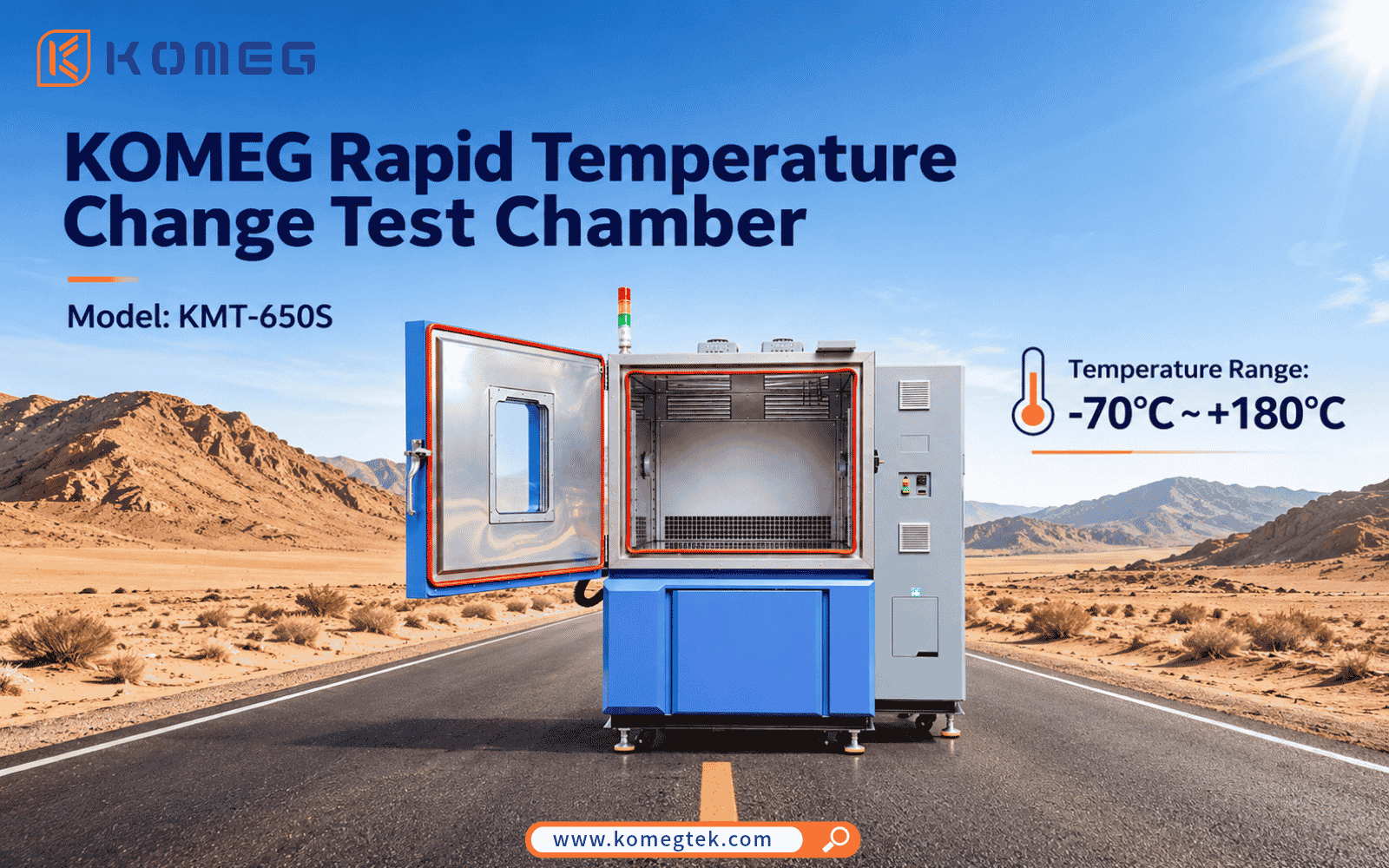
When selecting a rapid temperature change test chamber, engineers often focus on the temperature range and ramp rate. However, another important factor deserves attention: how the chamber controls the temperature transition.
Two commonly used control approaches are linear and non-linear temperature change control. They determine how temperature changes over time and how the programmed thermal profile is implemented.
For manufacturers testing electronic components, automotive electronics, semiconductor devices, and other products, understanding these differences helps ensure that the selected chamber matches the actual test requirements.
This article explains the differences between linear and non-linear temperature change control, the role of ramp rates, and the key factors to consider when selecting a rapid temperature change test chamber.
What Is a Rapid Temperature Change Test Chamber?
A Rapid Temperature Change Test Chamber is an environmental testing system designed to expose products to repeated temperature transitions at controlled rates.
Unlike conventional temperature chambers primarily used for maintaining a specific high or low temperature, rapid temperature change chambers are designed to create repeated thermal transitions within a defined temperature range.
These transitions generate thermal stress as different materials and components expand and contract at different rates.
The resulting mechanical stress can help engineers identify potential weaknesses, including:
Solder joint fatigue
Material expansion mismatch
Connector and interface degradation
Electronic component failures
Structural weaknesses caused by repeated thermal cycling
Rapid temperature change testing is widely used in electronics manufacturing, automotive electronics, semiconductor reliability evaluation, and environmental stress screening (ESS).
What Is Linear Temperature Change Control?
Linear temperature change control is designed to follow a specified temperature change rate over the defined transition interval.
For example, if a test profile requires a temperature increase from -40°C to +85°C at a specified rate, the controller aims to maintain the programmed temperature slope during that transition.
A linear temperature profile can be useful when the test procedure requires a defined rate of temperature change rather than simply reaching a target temperature within a given period.
Its main characteristics include:
A defined temperature change slope
Controlled heating and cooling transitions
Easier comparison with specified linear temperature profiles
Suitability for tests requiring a controlled rate of temperature change
For engineering applications where the temperature transition profile itself is important, linear control provides a way to define and reproduce the intended temperature slope.
However, the actual temperature profile should always be verified under the specified measurement conditions and test load.
What Is Non-linear Temperature Change Control?
Non-linear temperature change control allows the temperature transition to follow a non-constant rate profile.
Instead of maintaining one constant temperature slope throughout the entire transition, the temperature change rate may vary at different stages.
This approach can be suitable for test procedures that specify an average temperature change rate or allow a non-linear transition profile.
Important characteristics include:
Variable temperature change rate during the transition
Control based on the programmed temperature profile
Suitability for test procedures specifying non-linear or average transition rates
Flexibility in defining temperature cycling conditions
A non-linear profile does not necessarily mean that the chamber performs less effectively. Its suitability depends on the test objective and the temperature profile required by the application.
The key is to determine whether the test standard specifies a linear rate, an average rate, or another defined transition method.
Linear vs. Non-linear Temperature Change Control
Although both approaches are used in rapid temperature change testing, they are not interchangeable in every application.
The main difference is how the temperature transition is controlled.
Linear control
The controller aims to follow a defined temperature slope during the specified transition.
It is particularly relevant when the test procedure requires a controlled linear temperature change rate.
Non-linear control
The temperature transition follows a variable-rate profile.
It may be appropriate when the test procedure specifies an average rate or allows a non-linear temperature transition.
Neither approach is universally better. The correct choice depends on the test profile, product characteristics, and applicable testing requirements.
Engineers should therefore review the required temperature-time curve before selecting the control mode.
Why Does Temperature Change Rate Matter?
Temperature change rate is one of the most important parameters in a rapid temperature change test chamber.
Common configurations include:
5°C/min
10°C/min
15°C/min
Higher rates create faster temperature transitions, potentially increasing the frequency and intensity of thermal stress within a given test schedule.
However, a higher ramp rate is not automatically better.
If the selected rate is too aggressive for the product or exceeds the test specification, the test may produce failure mechanisms that do not represent the intended operating environment.
The appropriate rate should be determined according to the applicable standard, product design, material properties, and reliability evaluation objectives.
5°C/min
A 5°C/min configuration may be suitable for conventional temperature cycling and environmental reliability testing where moderate temperature transition rates are specified.
10°C/min
A 10°C/min configuration provides faster thermal transitions and may be selected for more demanding temperature cycling programs.
15°C/min
A 15°C/min configuration supports more aggressive temperature change profiles when required by the test procedure or product qualification program.
It is important to distinguish the specified chamber ramp rate from the actual temperature response of the test specimen. Product mass, fixture design, specimen placement, and airflow can all influence the temperature experienced by the sample.
How to Choose Between Linear and Non-linear Temperature Change Control
The selection should begin with the test procedure rather than the equipment model.
1. Check the Required Temperature-Time Profile
Review whether the applicable test standard specifies a linear temperature change rate, an average temperature change rate, or a particular transition time.
This is the most important step because the chamber control mode must be compatible with the required test profile.
2. Confirm Heating and Cooling Rates Separately
Some applications require different heating and cooling rates.
For example, a product may need to reach a high-temperature condition quickly but require a different cooling rate during the return transition.
Both rates should be confirmed in the equipment specification.
3. Consider the Test Specimen and Load
An empty chamber and a chamber containing a loaded specimen do not necessarily exhibit the same temperature response.
A large specimen or a dense fixture may affect heat transfer and temperature recovery.
Therefore, engineers should clarify whether the specified ramp rate is measured under no-load conditions or with a defined test load.
4. Verify Temperature Uniformity
A rapid transition rate alone does not guarantee that all locations inside the chamber experience the same temperature.
Temperature uniformity and fluctuation should also be considered, particularly when testing multiple specimens or products with different thermal masses.
5. Match the Equipment to the Test Standard
Different test procedures may specify different temperature ranges, ramp rates, exposure periods, and transition requirements.
The chamber should be configured to meet the actual test procedure rather than selected solely according to its maximum advertised ramp rate.
KOMEG KST Series Rapid Temperature Change Test Chambers
KOMEG develops rapid temperature change test chambers for electronic components, automotive electronics, semiconductor products, and other reliability testing applications.
The KST Series offers both linear and non-linear temperature change control configurations.
Depending on the selected model and configuration, the main specifications include:
Temperature range: -70°C to +150°C
Optional maximum temperature: +180°C
Temperature change rates: 5°C/min, 10°C/min, and 15°C/min
Temperature fluctuation: ±0.5°C
Temperature uniformity: ≤2.0°C
Linear and non-linear control options
Available chamber volumes: 150L, 225L, 370L, 504L, 720L, and 1000L
The listed temperature change rates are based on empty-load conditions. Actual performance under a specific specimen load should be confirmed according to the selected model and test requirements.
The KST Series can be configured for different product dimensions, temperature cycling profiles, and testing requirements.
For detailed specifications, visit the KOMEG Rapid-Rate Thermal Cycle Chambers product page.
For larger testing requirements, KOMEG also provides Rapid-Rate Temperature Change Chambers (ESS), including customized and walk-in configurations.
Frequently Asked Questions
Is linear temperature change control better than non-linear control?
Not necessarily. Linear control is suitable when a defined temperature slope is required, while non-linear control can be appropriate for test profiles specifying variable or average temperature change rates. The test procedure should determine the selection.
What is the difference between a 5°C/min and a 15°C/min test chamber?
The main difference is the specified temperature transition rate. A 15°C/min configuration can achieve faster temperature transitions than a 5°C/min configuration under comparable measurement conditions. However, the appropriate rate depends on the product and required test profile.
Does a higher temperature change rate always improve reliability testing?
No. A higher rate increases the severity of thermal transitions, but it may not represent the intended test conditions. The rate must match the applicable test procedure and product requirements.
Are rapid temperature change chambers and thermal shock chambers the same?
No. Rapid temperature change chambers typically use controlled heating and cooling within one test space. Traditional two-zone or three-zone thermal shock chambers transfer specimens between separate hot and cold zones to create rapid temperature transitions. Their operating principles and test applications differ.
Can rapid temperature change chambers perform ESS testing?
Yes. Rapid temperature change chambers are commonly used for environmental stress screening. The selected temperature profile, cycling frequency, and test duration should be based on the product’s design and applicable ESS procedure.
Linear and non-linear temperature change control provide different ways to implement rapid temperature transitions.
The correct choice depends on the required temperature-time profile, ramp rate, specimen characteristics, and test standard.
When selecting a rapid temperature change test chamber, engineers should evaluate not only the maximum temperature change rate but also the control method, temperature uniformity, load conditions, and overall testing requirements.
KOMEG KST Series offers linear and non-linear control configurations to support different temperature cycling and reliability testing applications.