

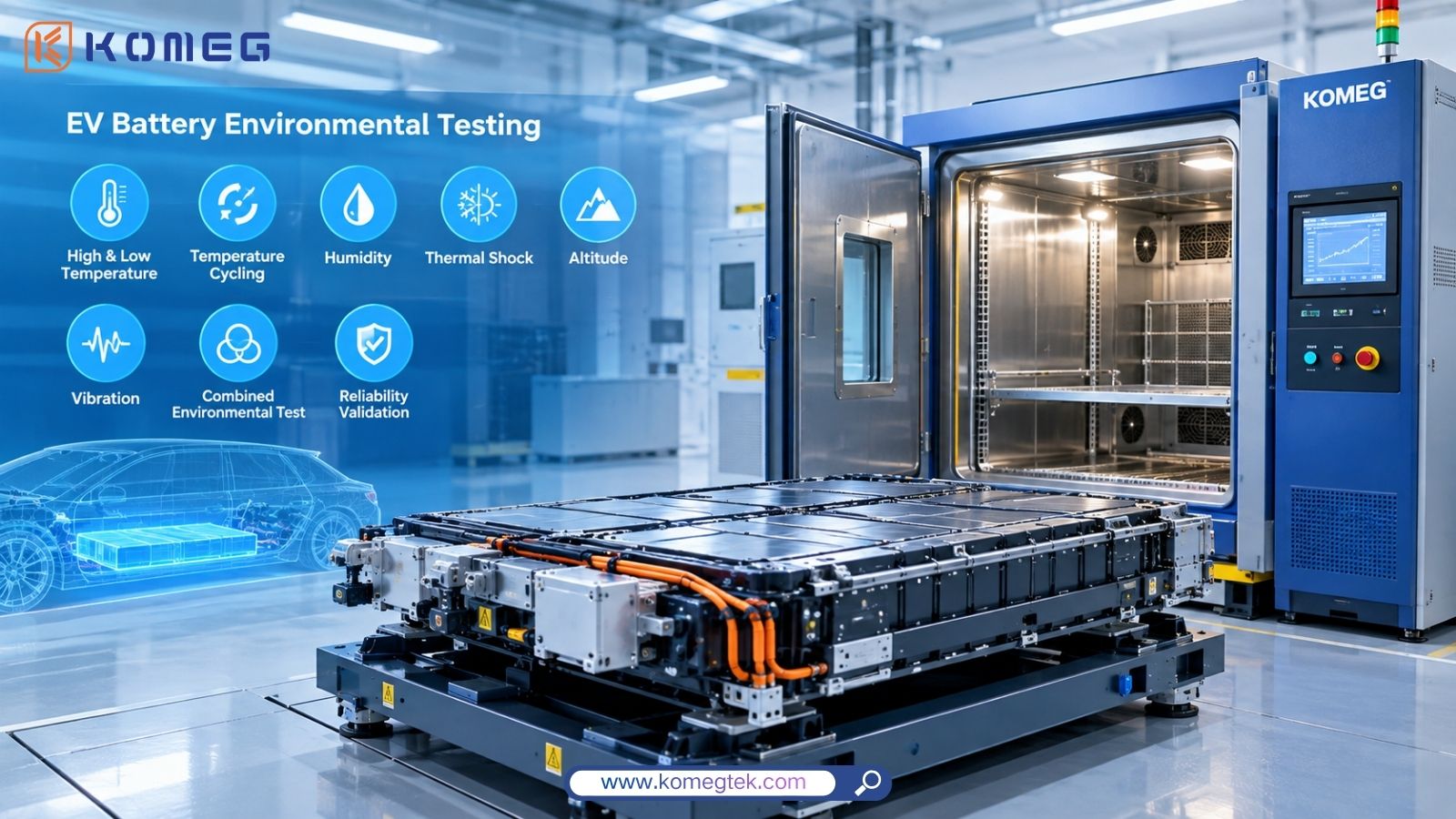
Electric vehicle batteries operate under conditions that can change dramatically during their service life. A battery pack may experience freezing temperatures during winter operation, high temperatures during charging, rapid temperature changes, humidity, vibration, and pressure variations at high altitude.
For this reason, EV battery validation cannot rely on electrical performance testing alone. Environmental testing is needed to determine whether battery cells, modules, packs, enclosures, seals, electrical connections, and thermal management systems can maintain their required performance under realistic environmental conditions.
The specific test program depends on battery chemistry, vehicle application, pack design, and applicable standards. However, several environmental tests are commonly used when evaluating EV battery reliability.
1. High and Low Temperature Testing
Temperature is one of the most important environmental factors affecting EV battery performance.
Low temperatures can reduce available power, increase internal resistance, slow charging, and affect electrolyte behavior. High temperatures can accelerate material degradation, increase aging mechanisms, and place additional demands on the battery thermal management system.
Environmental chambers are therefore used to expose battery cells, modules, or packs to controlled high- and low-temperature conditions.
Typical evaluations may include:
- Capacity retention
- Charge and discharge performance
- Electrical resistance
- Thermal management performance
- Startup behavior at low temperature
- High-temperature operating stability
- Component and enclosure integrity
The temperature range and dwell time should be selected according to the battery design and applicable test requirements rather than using a generic temperature profile.
2. Battery Temperature Cycling Tests
EV batteries rarely operate at a constant temperature in real-world applications. They can experience repeated transitions between cold and hot conditions during driving, charging, parking, and environmental exposure.
A temperature cycling test applies controlled temperature changes repeatedly to evaluate how the battery responds to thermal stress.
The test can reveal problems such as:
- Material expansion and contraction
- Seal degradation
- Housing deformation
- Electrical connection problems
- Solder or weld fatigue
- Internal component stress
- Cooling system performance issues
For batteries, the temperature transition profile is just as important as the maximum and minimum temperature. A chamber that can reproduce the required ramp rate and maintain temperature uniformity under battery load is often more useful than one that simply has a wide temperature range.
For applications requiring fast thermal transitions, a Rapid Temperature Cycle Test Chamber can provide controlled and repeatable temperature changes for accelerated reliability testing.
3. Temperature and Humidity Testing
Humidity is another important factor for EV battery systems, particularly when the battery enclosure, connectors, seals, or other components may be exposed to humid environments.
Temperature and humidity testing evaluates how battery components behave under controlled combinations of temperature and relative humidity.
Potential failure mechanisms include:
- Corrosion
- Condensation
- Insulation degradation
- Connector deterioration
- Seal performance problems
- Moisture penetration
- Changes in electrical resistance
Temperature-humidity testing is especially useful for evaluating the long-term environmental durability of battery enclosures and electrical interfaces.
For general environmental reliability testing, a Temperature and Humidity Test Chamber can be configured according to the required temperature, humidity, test duration, and DUT conditions.
4. Thermal Shock Testing
Temperature cycling and thermal shock are related, but they are not identical.
Thermal shock testing exposes the test specimen to rapid transitions between significantly different temperature zones. The objective is to create a more severe thermal stress condition and evaluate whether the battery system can withstand abrupt environmental changes.
This can be important for battery components containing materials with different coefficients of thermal expansion.
Repeated thermal shock may expose weaknesses in:
- Battery housing
- Sealing systems
- Busbars and electrical connections
- Insulation materials
- Adhesive joints
- Electronic components
- Internal structural components
For battery systems where rapid temperature transitions are part of the reliability requirement, thermal shock testing can complement conventional temperature cycling.
5. High-Temperature and Low-Temperature Storage
Not every battery environmental test needs to be performed while the battery is actively operating.
Storage testing evaluates what happens when a battery or battery component remains at an extreme temperature for an extended period.
High-temperature storage can accelerate aging and reveal long-term material or sealing problems. Low-temperature storage can identify changes in materials, mechanical components, seals, and electrical characteristics after exposure to cold conditions.
After environmental exposure, the battery may be returned to a specified operating condition and evaluated for changes in performance.
This approach is particularly useful when engineers need to distinguish between temporary performance changes and permanent degradation.
6. Humidity and Condensation Testing
Battery systems may experience condensation when a cold battery is exposed to warmer and more humid air.
This creates a different environmental challenge from simply maintaining a high relative humidity.
Condensation can potentially affect electrical insulation, connectors, sensors, control electronics, and metallic components. Therefore, environmental test programs may include humidity exposure combined with temperature transitions to reproduce realistic moisture-related conditions.
The test chamber needs to provide stable temperature and humidity control, sufficient airflow, and repeatable test conditions. Poor humidity distribution can lead to inconsistent results between different areas of a large battery pack.
7. Altitude Testing
Electric vehicles may operate at significantly different elevations, which means battery systems can experience changes in atmospheric pressure.
Altitude testing uses reduced atmospheric pressure, often combined with temperature conditions, to evaluate battery performance and structural integrity.
Depending on the test objective, engineers may examine:
- Battery electrical performance
- Enclosure sealing
- Pressure-related deformation
- Insulation performance
- Cooling system behavior
- Connector and component reliability
For battery packs with sealed enclosures, pressure changes can be particularly important because differences between internal and external pressure may place additional stress on seals and housing structures.
8. Combined Environmental Testing
Real-world battery conditions rarely involve only one environmental factor.
A battery may simultaneously experience temperature, humidity, vibration, and other mechanical or environmental stresses.
This is why some EV battery validation programs use combined environmental testing rather than evaluating each factor independently.
For example, a battery system may be exposed to:
Temperature + Humidity + Vibration
This type of combined test can help identify interactions that may not appear during individual environmental tests.
For automotive applications, KOMEG also develops temperature, humidity, and vibration integrated chambers, allowing these environmental stresses to be applied within one test system.
9. Vibration and Environmental Stress
Although vibration is primarily a mechanical test, it becomes particularly important when combined with environmental conditions.
An EV battery pack is exposed to continuous vibration and mechanical shock during vehicle operation. Temperature changes can alter material properties, while vibration can place additional stress on electrical connections, structural components, cooling systems, and mounting interfaces.
Combined temperature-humidity-vibration testing can therefore provide a more realistic assessment of battery durability than isolated environmental exposure.
This is especially relevant for:
- Battery packs
- Battery modules
- Automotive electronic components
- Cooling system components
- High-voltage connectors
- Battery management system components
10. Why EV Battery Testing Needs the Right Test Chamber
Selecting an environmental test chamber for EV battery testing is not simply a matter of choosing the widest temperature range.
The actual battery test profile should determine the chamber configuration.
Important factors include:
Temperature range:
The chamber must cover the required minimum and maximum temperatures with sufficient margin.
Ramp rate:
If the test requires rapid temperature changes, verify the actual temperature change rate under the expected battery load.
Chamber volume:
The chamber must accommodate the battery while providing sufficient airflow around the DUT.
Temperature uniformity:
Large battery packs can create significant thermal loads. Uniformity should be evaluated under realistic DUT conditions.
Humidity control:
For temperature-humidity testing, humidity stability and recovery performance are important in addition to the nominal RH range.
A large battery pack can release or absorb significant amounts of heat. The refrigeration system must be capable of maintaining the required profile under load.
Safety protection:
Battery testing may require additional safety measures depending on battery chemistry, energy capacity, test temperature, and failure mode.
Data recording:
Temperature, humidity, electrical parameters, and other test data may need to be recorded continuously for reliability analysis and traceability.
Environmental Test Selection Should Follow the Battery’s Failure Risks
There is no single environmental test that can fully validate an EV battery.
A practical test program should begin with the potential failure mechanisms and then select the environmental conditions capable of reproducing them.
For example:
- Cold-weather performance → Low-temperature testing
- High-temperature aging → High-temperature exposure
- Repeated seasonal temperature changes → Temperature cycling
- Rapid environmental transitions → Thermal shock or rapid temperature cycling
- Moisture-related reliability → Temperature and humidity testing
- Condensation risk → Humidity and temperature transition testing
- High-altitude operation → Altitude testing
- Road vibration durability → Vibration testing
- Multiple environmental stresses → Combined environmental testing
This approach is more effective than selecting a chamber based only on its maximum temperature range or chamber size.
EV Battery Environmental Testing Is Becoming More Demanding
As EV battery capacity increases and battery packs become more integrated with vehicle platforms, environmental testing is becoming increasingly demanding.
Large battery systems create higher thermal loads, while faster charging, higher power density, new cell chemistries, and more compact packaging can introduce additional reliability challenges.
Testing equipment therefore needs to reproduce environmental conditions accurately while also handling the physical size, heat load, and safety requirements of the battery under test.
For this reason, engineers should evaluate chamber performance under actual battery test conditions, rather than relying only on empty-chamber specifications.
How KOMEG Supports EV Battery Environmental Testing
KOMEG develops environmental test chambers for battery cells, modules, packs, and related automotive components. Depending on the application, configurations can support temperature cycling, temperature and humidity testing, rapid temperature changes, thermal shock, altitude testing, and combined environmental testing.
KOMEG also provides customized chamber configurations for large battery systems where chamber dimensions, refrigeration capacity, airflow, cable routing, safety protection, and test profiles need to be considered together.
For battery temperature cycle applications, the KOMEG Battery Temperature Cycle Test Chamber can be selected according to the required temperature range and cycling conditions.
Final Considerations
EV battery environmental testing should be treated as a reliability engineering process rather than a simple chamber exposure test.
Temperature, humidity, thermal cycling, thermal shock, altitude, vibration, and combined environmental stresses each reveal different potential failure mechanisms. The most effective test program connects these environmental conditions with the actual operating profile and expected failure risks of the battery system.
When selecting an EV battery test chamber, engineers should therefore look beyond the nominal temperature range. Ramp rate under load, temperature uniformity, cooling capacity, chamber volume, humidity control, safety protection, and data acquisition can all directly affect the quality of the test results.
For EV battery manufacturers and automotive suppliers, the right environmental testing strategy can help identify weaknesses earlier, improve battery reliability, and reduce the risk of failures during real-world operation.