

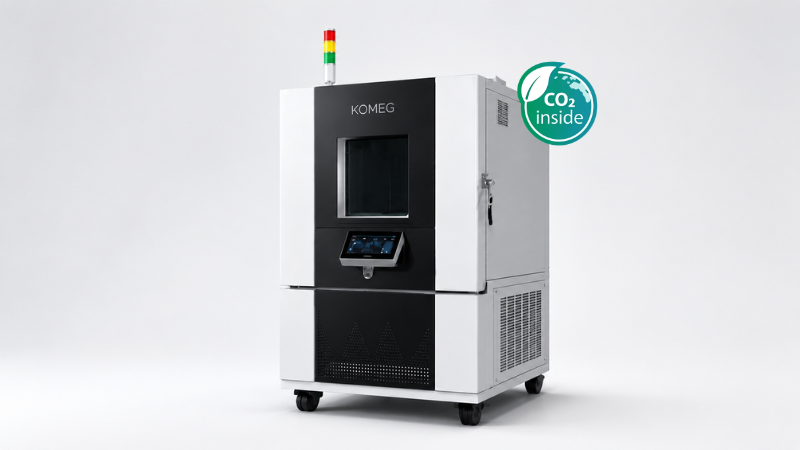
Environmental test chambers are essential for evaluating product performance under controlled temperature and humidity conditions. However, selecting a chamber involves more than comparing temperature ranges, working volumes, and control accuracy.
Refrigeration technology is another important consideration, particularly for laboratories and manufacturers reviewing the environmental impact of their equipment.
Carbon dioxide, commonly designated as R744, is a natural refrigerant with a global warming potential (GWP) of 1 under the commonly used 100-year assessment convention. It has become an important option for refrigeration systems designed to reduce reliance on high-GWP refrigerants.
For environmental testing applications, however, refrigerant selection must be considered alongside temperature performance, humidity requirements, refrigeration architecture, operating conditions, and maintenance capabilities.
This guide explains how to evaluate a CO₂ refrigerant environmental test chamber and what engineers and purchasing teams should confirm before selecting a system.
1. What Is a CO₂ Refrigerant Environmental Test Chamber?
A CO₂ refrigerant environmental test chamber is an environmental simulation system that uses carbon dioxide as a refrigerant in its refrigeration circuit.
The chamber controls environmental conditions within an enclosed working space so that products, components, and materials can be evaluated under specified temperature or temperature and humidity profiles.
Depending on the configuration, these chambers can support applications such as:
Temperature-dependent performance testing
High- and low-temperature exposure
Temperature cycling
Temperature and humidity testing
Electronic component reliability evaluation
Automotive component validation
Semiconductor and industrial product testing
The specific capabilities depend on the chamber design. Not every CO₂ refrigeration system supports the same temperature range, humidity range, transition rate, or specimen loading conditions.
For this reason, the refrigerant type should be treated as one part of the equipment specification rather than a complete indicator of chamber performance.
2. Why Consider R744 for Environmental Testing?
R744 is the refrigerant designation for carbon dioxide.
One of its principal environmental characteristics is its low GWP of 1. This makes CO₂ an option for manufacturers seeking to reduce the climate impact associated with refrigerant selection.
The European Union’s F-gas Regulation, Regulation (EU) 2024/573, establishes requirements and restrictions affecting fluorinated greenhouse gases and certain equipment that contains or relies on them. The specific provisions applicable to a product depend on its equipment category, refrigerant, configuration, and intended market.
For companies purchasing environmental testing equipment, these developments make it useful to evaluate refrigerant choice during the initial equipment-selection process.
Potential reasons to consider a CO₂ refrigeration system include:
Lower refrigerant GWP
CO₂ has a GWP of 1, making its direct climate impact potential significantly lower than that of many commonly used high-GWP refrigerants.
A natural refrigerant option
CO₂ is a naturally occurring substance and provides an alternative to synthetic fluorinated refrigerants in appropriately designed systems.
Long-term equipment planning
Organizations that expect to operate testing equipment for many years may wish to assess how refrigerant selection aligns with their environmental objectives, purchasing policies, and applicable regulatory requirements.
Integration into sustainability programs
For manufacturers with formal environmental management goals, the refrigerant used in laboratory equipment may be one factor in their wider sustainability assessment.
Nevertheless, a low-GWP refrigerant does not automatically make an entire chamber environmentally superior in every respect. Total energy consumption, operating conditions, leakage prevention, service requirements, and equipment life cycle should also be considered.
3. Understand the Technical Differences of CO₂ Refrigeration
CO₂ refrigeration requires equipment designed specifically for the properties of carbon dioxide.
A major engineering consideration is operating pressure. Depending on the system design and operating conditions, CO₂ refrigeration circuits can operate at substantially higher pressures than many conventional refrigeration systems.
This affects the design and selection of pressure-containing components, compressors, piping, valves, heat exchangers, and protective devices.
A CO₂ environmental test chamber should therefore be evaluated as an integrated refrigeration system rather than as a conventional chamber with a different refrigerant added.
Important considerations include:
Pressure-Rated Components
Components exposed to the refrigeration circuit must be suitable for the system’s design pressures and operating conditions.
The manufacturer should be able to explain the refrigeration architecture and the measures used to ensure the integrity of pressure-containing components.
Refrigeration Control
The refrigeration system must respond to changes in chamber temperature and thermal load while maintaining the required operating conditions.
The control strategy should be suitable for the specified temperature range, operating profile, and expected specimen load.
Heat Rejection
The method used to reject heat from the refrigeration system affects installation requirements and operating performance.
Before ordering, confirm the required cooling arrangement, utility connections, ambient operating conditions, and any restrictions associated with the intended installation location.
Serviceability
The availability of trained technicians, suitable service procedures, and compatible replacement components should be considered as part of the long-term ownership assessment.
A well-designed refrigeration system should be evaluated not only by its initial performance but also by the practical requirements for inspection, maintenance, and repair.
4. Check the Required Temperature Range First
Temperature range is one of the most important specifications when selecting an environmental test chamber.
However, the maximum and minimum temperatures that a chamber can reach depend on its refrigeration architecture, system configuration, operating conditions, and intended application.
A CO₂ system should not be assumed to cover every ultra-low-temperature application simply because it uses a natural refrigerant.
For each potential chamber, confirm:
Minimum and maximum operating temperatures
Temperature stability and fluctuation
Temperature uniformity within the working space
Heating and cooling rates
Temperature recovery after loading or door opening
Performance under the intended specimen load
Operating limitations at the temperature extremes
These parameters describe different aspects of chamber performance.
For example, a chamber may be capable of reaching a particular low temperature under no-load conditions but may take longer to reach that temperature when testing a large specimen with substantial thermal mass.
Similarly, a rapid temperature transition specified for one temperature interval should not be assumed to apply across the chamber’s entire operating range.
The most useful comparison is therefore based on the actual test profile and the performance the manufacturer can demonstrate under the relevant operating conditions.
5. Determine Whether Temperature and Humidity Control Are Required
Some environmental tests require temperature control alone. Others require temperature and relative humidity to be controlled together.
If humidity is part of the test procedure, the chamber must have an appropriate humidity-control system in addition to its refrigeration system.
Before choosing a CO₂ temperature and humidity test chamber, define:
Required temperature range
Required relative humidity range
Temperature and humidity stability
Temperature and humidity uniformity
Required operating combinations of temperature and humidity
Specimen dimensions and loading
Exposure duration and test sequence
It is important to verify that the required humidity conditions can be achieved at the temperatures specified by the test procedure. The available temperature and humidity ranges may not support every possible combination.
The specimen itself also affects chamber performance. Large samples, heat-generating products, and dense loading arrangements can influence airflow and the chamber’s ability to maintain the intended conditions.
If humidity is not required, a temperature-only configuration may be sufficient. Avoid selecting additional capabilities that do not contribute to the intended test objective unless they are needed for future applications.
6. Evaluate the Chamber Under Real Test Conditions
Published specifications are important, but they do not always describe how the chamber will perform in a particular laboratory.
A useful equipment evaluation should consider the actual specimen, test sequence, and operating environment.
Specimen Size and Thermal Mass
The working space must accommodate the product and any fixtures, sensors, cables, or supporting equipment.
Large specimens may require more time to reach thermal equilibrium than smaller components. Their dimensions and thermal mass can also affect airflow and temperature recovery.
Heat Generation
If the product operates during the test, it may generate heat that the chamber must remove.
The chamber should be evaluated under the expected thermal load rather than only under empty-chamber conditions.
Temperature Transition Requirements
For temperature cycling or environmental stress screening, the required transition rate may be a critical parameter.
Confirm the temperature interval over which the rate is specified, the measurement method, and whether the performance applies to an unloaded or loaded chamber.
Airflow and Temperature Uniformity
Air circulation affects how conditioned air reaches different parts of the working space.
Shelf arrangement, sample geometry, loading density, and the position of air outlets and returns can influence local temperature conditions.
If the test requires specific temperature uniformity, verify the applicable specification and measurement conditions.
Data Recording and Communication
Laboratories may need to record temperature profiles, monitor test progress, or connect the chamber to an external data system.
Confirm the available communication interfaces, data export functions, alarm capabilities, and compatibility with the laboratory’s monitoring workflow.
7. Consider Energy Consumption and Total Cost of Ownership
The purchase price is only one part of the cost of operating an environmental test chamber.
For equipment expected to run for many years, the total cost of ownership may include:
Initial purchase and installation
Electricity consumption
Cooling-water or other utility requirements, where applicable
Routine maintenance
Replacement parts
Service and repair
Downtime and production impact
Refrigerant handling and end-of-life requirements
CO₂ refrigerant alone does not guarantee lower electricity consumption in every application.
Energy performance depends on the refrigeration architecture, temperature profile, ambient conditions, thermal load, control strategy, and operating schedule.
For a meaningful comparison, request energy or operating data under conditions that resemble the intended application. If two systems are evaluated under different temperature profiles or loading conditions, their reported energy figures may not be directly comparable.
A more complete purchasing decision considers environmental impact, required test performance, operating cost, and maintenance needs together.
8. Understand the Applicable Regulatory Requirements
Organizations purchasing environmental test chambers for international markets should consider the refrigerant-related regulations applicable to the equipment.
In the European Union, Regulation (EU) 2024/573 addresses fluorinated greenhouse gases and includes provisions affecting certain refrigeration equipment and refrigerant uses.
However, the requirements are not identical for every type of equipment. Applicability can depend on the equipment category, refrigerant, system configuration, intended use, and the specific restriction or provision being assessed.
Therefore, a purchasing team should not rely on a general statement that a refrigerant is environmentally friendly or that a chamber is universally compliant.
Before ordering, ask the manufacturer to provide the relevant refrigerant information and supporting documentation for the intended market.
Useful questions include:
Which refrigerant is used in the proposed system?
What is its stated GWP under the applicable assessment convention?
Which regulatory provisions apply to this equipment category?
What technical documentation is available?
What service and refrigerant-handling requirements apply?
Are there installation or operating conditions that must be observed?
For a formal compliance decision, consult the applicable regulation and qualified compliance professionals. Equipment specifications and marketing statements should not be treated as a substitute for a regulatory assessment.
9. CO₂ Refrigerant Environmental Test Chambers from KOMEG
KOMEG offers environmental testing equipment for applications requiring controlled temperature and humidity conditions.
Its CO₂ refrigeration technology uses R744, a natural refrigerant with a GWP of 1.
For the relevant CO₂ temperature and humidity chamber configuration, KOMEG specifies an operating temperature range of -40°C to +180°C and a humidity range of 10% to 98% RH.
These specifications should be confirmed for the exact model and configuration before purchase, including the operating conditions under which the ranges are available.
Potential applications include environmental testing of electronic products, automotive components, communication equipment, industrial products, and other specimens requiring controlled climatic conditions.
When evaluating a KOMEG CO₂ chamber, customers should provide the intended temperature and humidity profile, specimen dimensions, thermal load, transition requirements, and installation conditions.
This information helps determine whether the proposed system is suitable for the application and whether any customization is necessary.
10. A Practical Checklist Before Requesting a Quotation
Before requesting a quotation for a CO₂ refrigerant environmental test chamber, prepare the following information.
Test requirements
Required minimum and maximum temperatures
Required humidity range, if applicable
Temperature transition rate and relevant temperature interval
Temperature stability and uniformity requirements
Dwell times and cycle count
Applicable test standards or customer specifications
Specimen information
Product dimensions and weight
Number of specimens per test
Expected heat generation
Whether the specimen will be powered
Required fixtures, shelves, sensors, and cable access
Laboratory conditions
Available electrical supply
Air-cooled or water-cooled installation requirements
Ambient operating temperature
Available floor space and access route
Utility and drainage requirements, where applicable
Refrigerant and service considerations
Refrigerant type and GWP
Applicable market requirements
Service access and maintenance requirements
Documentation and training needs
A complete specification helps the manufacturer recommend a configuration based on the actual test requirements rather than relying on a general product description.
Frequently Asked Questions
What is the GWP of R744 refrigerant?
R744 is carbon dioxide. Its GWP is 1 under the commonly used 100-year assessment convention, which uses carbon dioxide as the reference gas.
Can a CO₂ refrigerant test chamber reach ultra-low temperatures?
The achievable temperature range depends on the refrigeration architecture and system configuration. A CO₂ system should not automatically be assumed to reach every ultra-low temperature. Confirm the minimum temperature specified for the exact model and application.
Is a CO₂ environmental test chamber always more energy-efficient?
No. Energy consumption depends on the complete refrigeration system, operating conditions, temperature profile, thermal load, and control strategy. Comparisons should be based on equivalent test conditions.
Can a CO₂ chamber perform temperature and humidity testing?
Some configurations are designed for combined temperature and humidity control. Confirm the available humidity range and whether the required temperature and humidity combinations can be achieved for the intended test profile.
Does using R744 automatically guarantee regulatory compliance?
No. Although R744 has a GWP of 1, regulatory compliance depends on the applicable provisions, equipment category, system configuration, intended market, and supporting documentation. The specific equipment and market requirements should be reviewed before purchase.
Choosing a CO₂ refrigerant environmental test chamber requires a balanced assessment of refrigeration technology, temperature performance, humidity capability, thermal load, operating cost, maintenance, and regulatory requirements.
R744 offers a low-GWP refrigerant option, but the most suitable chamber is the one that can reproduce the required test conditions reliably and operate appropriately within the intended laboratory environment.
Before making a purchasing decision, define the test profile, confirm the specimen’s thermal characteristics, evaluate performance under the expected loading conditions, and review the documentation relevant to the target market.
KOMEG’s CO₂ environmental test chamber solutions can be evaluated against these requirements to help identify an appropriate configuration for temperature and humidity testing applications.
Explore KOMEG environmental test chamber solutions and contact the engineering team to discuss your application requirements.