

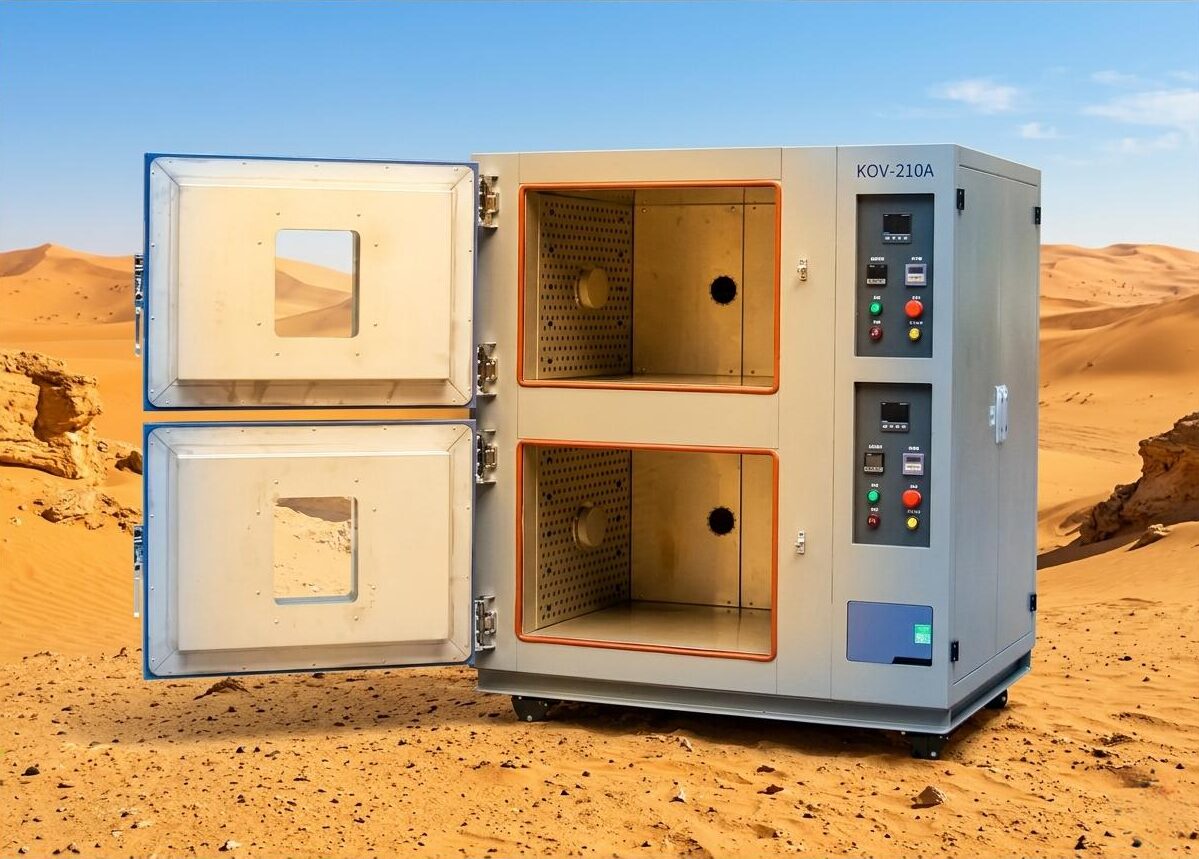
Choosing an environmental test chamber is not simply a matter of selecting a temperature range or chamber size. The right system must reproduce the environmental conditions required by the test procedure, accommodate the product under test, maintain appropriate control and uniformity, and support repeatable testing over time.
For manufacturers of electronic components, automotive parts, batteries, medical devices, industrial equipment, and other engineered products, environmental testing helps identify potential weaknesses before products reach the market. However, an incorrectly specified chamber can lead to unrealistic test conditions, poor temperature distribution, unnecessary operating costs, or difficulties meeting a required test profile.
This guide explains how to select an environmental test chamber for product reliability testing, covering environmental conditions, temperature performance, humidity control, chamber capacity, test standards, safety, utilities, and long-term operating requirements.
1. Define the Purpose of the Reliability Test
Before comparing equipment specifications, identify what the test needs to demonstrate.
Environmental testing can serve several different purposes. A design validation test may investigate whether a new product can withstand specified operating conditions. Qualification testing may verify performance against customer or industry requirements. Environmental stress screening may expose latent manufacturing defects, while durability testing may evaluate how repeated environmental exposure affects product performance over time.
These objectives can require different chamber configurations.
For example, a test intended to evaluate long-term performance under hot and humid conditions may require precise temperature and relative humidity control over extended periods. A test intended to identify defects caused by repeated temperature transitions may place greater emphasis on temperature change rate, cycle programming, and the ability to reproduce the specified thermal profile.
Before requesting a quotation, document the following:
The purpose of the test and the expected outcome.
The applicable test standard, specification, or customer requirement.
The environmental conditions the product must experience.
The required dwell times, transition times, and number of cycles.
Whether the product must operate or be electrically monitored during testing.
The measurement points and acceptance criteria used to evaluate the results.
These details establish the actual testing requirements and help prevent over-specification or the purchase of a chamber that cannot perform the intended test.
2. Select the Required Temperature Range
Temperature range is one of the first specifications buyers compare, but the minimum and maximum temperatures alone do not determine whether a chamber is suitable.
The required range should be based on the test procedure, the product’s intended operating or storage conditions, and any specified qualification limits. Engineers should also consider the temperature at which the test begins, the target temperature, the transition between setpoints, and the duration of each exposure.
For example, an electronic component may need to undergo repeated low- and high-temperature exposure to evaluate material compatibility, solder joints, electrical connections, or package integrity. A different product may require prolonged exposure at elevated temperatures to assess aging or insulation performance.
The chamber should be capable of reaching the required setpoints while maintaining the specified control performance under the intended test conditions.
Temperature range versus operating performance
A chamber’s rated temperature range does not automatically guarantee that it can achieve every temperature transition at the speed required by a particular test.
The following specifications should be evaluated separately:
Temperature range: The minimum and maximum temperatures the chamber is designed to reach.
Temperature fluctuation: The variation around a controlled temperature over a specified period and under defined conditions.
Temperature uniformity: The temperature differences among measurement locations within the test space.
Temperature deviation: The difference between the indicated or controlled temperature and the reference value, as defined by the applicable specification.
Temperature change rate: How quickly the chamber temperature changes between defined points, measured using the stated method and conditions.
These parameters describe different aspects of performance. A chamber may cover a wide temperature range but still be unsuitable for a test that requires rapid transitions or tight temperature uniformity.
When comparing specifications, check whether performance figures are measured under no-load conditions or with a defined thermal load. Product placement, airflow, fixtures, cable penetrations, and the thermal mass of the DUT can all affect actual test performance.
For chamber selection, the objective is not to choose the most extreme temperature range available. It is to select a system that reliably meets the complete test profile.
3. Determine Whether Humidity Control Is Required
Not every environmental reliability test requires humidity control. However, moisture can significantly affect product behavior, particularly when testing materials and assemblies that are sensitive to corrosion, condensation, moisture absorption, or insulation resistance.
A temperature-only chamber may be sufficient when the test procedure specifies temperature exposure without controlled humidity. A temperature and humidity test chamber is more appropriate when both parameters must be regulated.
Typical applications include:
Electronic assemblies exposed to hot and humid conditions.
Automotive components evaluated under changing temperature and humidity.
Plastic, rubber, adhesive, and other moisture-sensitive materials.
Medical devices and industrial products requiring controlled environmental exposure.
Products undergoing environmental conditioning before further mechanical or electrical testing.
Check the humidity operating range carefully
Relative humidity capability varies with temperature. A chamber’s advertised humidity range should not be interpreted as a guarantee that every humidity setpoint is available across the entire temperature range.
At low temperatures, condensation and frost can limit practical operating conditions. At high temperatures, the humidity control system must manage the relationship between temperature, moisture content, and relative humidity.
For this reason, specify the required temperature and humidity combinations rather than requesting only a broad range such as 20% to 98% RH.
It is also important to review humidity fluctuation, humidity uniformity, recovery after door opening, and the stability of the control system during long-duration tests.
If the procedure involves moisture exposure at elevated temperatures and pressures, such as highly accelerated stress testing, a dedicated HAST chamber may be required instead of a conventional temperature and humidity chamber.
4. Choose the Right Chamber Type
Environmental test chambers are available in several configurations. The best choice depends on the product dimensions, test method, required transition performance, environmental conditions, and available laboratory space.
Temperature and humidity test chambers
These chambers provide controlled temperature and humidity conditions for reliability testing, environmental conditioning, and product qualification.
They are commonly used for electronics, electrical products, automotive components, plastics, materials, and other products that need exposure to combined temperature and humidity.
Depending on the application, configurations may include benchtop, reach-in, and larger custom systems.
Explore KOMEG’s temperature and humidity test chambers for available configurations and specifications.
Temperature test chambers
A temperature test chamber is suitable when the required test focuses on temperature exposure and humidity control is not necessary.
These systems can be used for temperature cycling, high- and low-temperature storage, temperature endurance, and other procedures defined by the product specification.
When selecting this type of equipment, evaluate temperature range, transition performance, uniformity, recovery, and the test space required for the DUT.
Rapid-rate thermal cycle chambers
Rapid-rate thermal cycle chambers are designed for tests that require faster temperature transitions than conventional environmental chambers may provide.
They are often used in environmental stress screening and reliability testing of electronic products and assemblies. Repeated temperature changes can help reveal latent defects associated with differences in thermal expansion, interconnections, and material interfaces.
When specifying a rapid-rate chamber, clarify the required temperature change rate, the temperature interval over which that rate is measured, whether the rate must be linear or non-linear, and whether the requirement applies under loaded conditions.
A headline rate should never be compared with another manufacturer’s figure without confirming that both use the same measurement method and test conditions.
Thermal shock chambers
Thermal shock testing exposes a product to rapid transitions between hot and cold environments. Depending on the design, the product may move between separate hot and cold zones, or the system may use another configuration to create the specified thermal shock conditions.
Thermal shock testing is not interchangeable with every form of temperature cycling. The transition method, exposure duration, temperature extremes, and acceptance criteria should follow the applicable test procedure.
Learn more about KOMEG thermal shock chambers.
Walk-in environmental chambers
Walk-in chambers are intended for large products, assemblies, multiple samples, or test setups that cannot be accommodated by a conventional reach-in chamber.
Applications may include vehicle components, solar panels, large electronic assemblies, battery systems, and other products requiring a larger controlled environment.
Capacity is only one consideration. Buyers must also evaluate internal airflow, thermal load, door dimensions, loading arrangements, access for operators, installation space, and the facility’s electrical and cooling utilities.
See KOMEG walk-in environmental chambers for examples of larger and customizable systems.
Specialized environmental test chambers
Some tests require conditions beyond conventional temperature and humidity control. Depending on the procedure, specialized equipment may be needed for altitude, low pressure, highly accelerated stress testing, salt spray exposure, battery safety testing, or integrated temperature and vibration testing.
The equipment should be selected according to the actual test method rather than the general product category alone.
5. Calculate the Required Test Space
Selecting chamber capacity solely by comparing the DUT’s dimensions with the internal chamber dimensions is a common mistake.
The product must fit inside the test space, but the chamber also needs enough room for appropriate airflow, fixtures, sensors, electrical connections, and safe loading.
Before selecting a model, establish:
The dimensions and weight of each DUT.
The number of products tested in one batch.
The required spacing between samples.
The position and size of fixtures or mounting frames.
Cable routing and access for monitoring equipment.
Whether the product needs to be installed on a trolley or dedicated platform.
Whether the test configuration will change in the future.
Why airflow clearance matters
Environmental chambers depend on controlled airflow to distribute heat and, where applicable, moisture throughout the test space.
If samples are packed too closely together, airflow paths may be restricted. Large or tightly arranged products can create local temperature differences, while fixtures and cable bundles may affect air circulation around critical measurement points.
A chamber with a larger nominal volume does not automatically provide better uniformity. The internal layout and loading arrangement must be compatible with the required test conditions.
For larger products, a walk-in chamber may be more practical than multiple smaller units. For routine testing of individual components, a benchtop or reach-in model may reduce the amount of unused space and simplify operation.
The best capacity is the one that accommodates the intended test configuration without compromising environmental performance or creating unnecessary operating expense.
6. Evaluate Temperature Uniformity and Measurement Requirements
Temperature control accuracy and temperature uniformity are often confused, but they describe different characteristics.
Control accuracy concerns how closely the system controls or indicates a specified temperature under defined conditions. Uniformity describes the variation between different locations within the test space.
This distinction matters when testing products with multiple measurement points or when a test specification defines environmental conditions at particular locations.
For example, a controller may indicate that the chamber has reached its target temperature while certain areas of a heavily loaded test space remain warmer or cooler. The resulting exposure may differ from the intended test conditions.
When evaluating a chamber, review the manufacturer’s stated methods for determining fluctuation, deviation, and uniformity. Confirm the number and position of measurement points, the stabilization period, the test load, and any applicable test standard.
Consider the DUT’s actual temperature
Chamber air temperature is not necessarily the same as product temperature.
A large metal assembly may take longer to reach thermal equilibrium than a small electronic component. Materials with different thermal masses and conductivities respond at different rates, even when exposed to the same chamber environment.
If the test requires the DUT itself to reach a specified temperature before timing begins, the test setup may need product-mounted sensors or another approved measurement method.
This is particularly important when defining dwell time, thermal cycling profiles, and acceptance criteria. The required timing basis should be agreed upon before testing begins.
For demanding applications, buyers should also consider data logging, sensor compatibility, calibration requirements, and the ability to export test records for traceability.
7. Match the Chamber to the Required Test Standard
A test standard defines procedures, conditions, and acceptance criteria for a particular application. It should guide equipment selection, but the name of a standard alone does not provide enough information to specify a chamber.
Different standards may contain multiple methods, severities, durations, and test configurations. The applicable edition and the exact method selected can change the equipment requirements.
Depending on the application, relevant documents may include IEC 60068 environmental testing methods, ISO 16750 for road vehicle environmental conditions, AEC-Q100 for integrated circuit qualification, or UN 38.3 requirements for the transport testing of lithium batteries.
These standards address different scopes and should not be treated as interchangeable.
Before ordering equipment, identify the exact standard, revision, test method, temperature limits, transition requirements, dwell periods, number of cycles, humidity conditions, and measurement rules that apply.
Does a chamber automatically guarantee compliance?
No. A chamber’s capabilities can support a test procedure, but compliance depends on more than the equipment model.
The complete setup may include the test profile, DUT configuration, sensors, calibration, loading, monitoring, and the laboratory’s procedures. Some tests also require specialized safety provisions or equipment beyond environmental control.
Ask the supplier to confirm the relevant technical capabilities against the specific test requirements. Where compliance is important, document the agreed configuration and the conditions under which the stated performance is achieved.
8. Consider DUT Heat Load and Test Configuration
The test product can affect chamber performance, particularly when it generates heat, has a large thermal mass, or is tested in large quantities.
A chamber that performs adequately when empty may behave differently when loaded with several powered electronic assemblies or a substantial metal structure.
Relevant factors include:
The quantity and mass of the DUTs.
The heat generated by powered products during testing.
The thermal properties of the products and fixtures.
The placement of samples and the restriction of airflow.
The number and size of cable penetrations.
The required transition rate and recovery time.
The duration of the test and the frequency of door opening.
If products operate during testing, provide the supplier with the expected heat dissipation and electrical connection requirements. The cooling system and airflow design may need to accommodate the additional load.
For fast thermal cycling, thermal load can have a particularly strong influence on the achievable transition rate. The required rate should therefore be defined together with the test conditions rather than treated as an isolated catalog specification.
For battery testing or other applications involving potential fire, gas release, or hazardous failure, the equipment design and protective measures must be selected according to the product risks, applicable procedures, and facility requirements.
9. Check Installation and Utility Requirements Before Ordering
Environmental test chambers are substantial pieces of laboratory equipment, and installation conditions can affect reliability, performance, and maintenance access.
Before confirming the order, review the installation site and the available utilities.
Installation space and access: Check the equipment footprint, door opening, maintenance clearance, ceiling height, and the route from the delivery entrance to the final position. Large chambers may require special handling or installation planning.
Ambient conditions: Confirm the allowable room temperature and ventilation requirements. High ambient temperatures or inadequate heat rejection can affect refrigeration performance.
Electrical supply: Verify voltage, phase, frequency, rated current, protective devices, grounding, and cable requirements against the exact chamber configuration.
Cooling requirements: Water-cooled models may require a defined water supply, flow rate, inlet temperature, and drainage arrangement. Air-cooled models need adequate space and ventilation to dissipate heat.
Drainage: Temperature and humidity chambers may produce condensate or require water drainage during operation or maintenance. The drainage arrangement should be compatible with the equipment design.
Environmental protection: Avoid installation locations exposed to direct sunlight, excessive dust, corrosive substances, flammable materials, significant vibration, or other conditions outside the manufacturer’s permitted limits.
Service access: Ensure that operators can load samples safely and that technicians can access filters, refrigeration components, electrical panels, and other maintenance points.
These requirements should be checked against the selected model’s installation documentation. Resolving them before delivery can help prevent avoidable installation delays and additional site work.
10. Compare Total Cost of Ownership, Not Just Purchase Price
The initial purchase price is only one part of the cost of operating an environmental test chamber.
A lower-priced unit may be suitable for a straightforward test with moderate requirements. However, a demanding application may justify a different configuration if it improves test repeatability, supports the required profile, or reduces operational limitations.
When comparing quotations, consider:
Initial equipment and customization costs.
Installation, transportation, and utility preparation.
Electrical and cooling energy consumption.
Routine maintenance and replacement parts.
Calibration and performance verification.
Service support and expected response time.
Controller functions, data export, and communication interfaces.
The cost of downtime if the chamber becomes unavailable.
Future changes in product size, sample volume, or test requirements.
It is also worth confirming the scope of the quotation. Accessories, sensors, sample fixtures, communication interfaces, installation services, and special safety features may be included in one proposal but offered as options in another.
A useful comparison starts with a common technical specification. Ask each supplier to quote against the same temperature profile, load conditions, performance criteria, and installation requirements. This makes differences between proposals easier to evaluate.
11. Assess Control, Data Logging, and Maintenance Support
Environmental reliability testing often requires traceable records and repeatable test execution. The controller and data management functions should therefore be part of the selection process.
Depending on the application, useful features may include programmable temperature and humidity profiles, multiple test segments, cycle repetition, alarm history, data export, remote communication, and integration with external monitoring equipment.
Before purchasing, clarify how test programs are created, stored, and retrieved. Confirm whether recorded data can be exported in the format required by the laboratory and whether the system supports the intended external sensors or communication interfaces.
Maintenance considerations are equally important. Ask about routine inspection requirements, refrigeration system maintenance, water system cleaning where applicable, calibration, spare parts, and technical support.
A chamber that meets the initial test requirement but is difficult to maintain or verify may create problems over its operating life. The objective is to select equipment that can support the laboratory’s actual workload, documentation requirements, and service expectations.
12. Common Mistakes When Choosing an Environmental Test Chamber
Several avoidable mistakes can lead to an unsuitable specification or unnecessary cost.
Choosing by temperature range alone. A wide temperature range does not establish whether the chamber can meet the required transition rate, uniformity, recovery, or humidity conditions.
Ignoring the actual test load. DUT mass, heat dissipation, fixtures, and sample arrangement can influence performance. Specify the intended load rather than relying exclusively on empty-chamber data.
Confusing chamber temperature with DUT temperature. If the procedure depends on product temperature, define how it will be measured and when the dwell period begins.
Selecting insufficient capacity. A product may fit physically while leaving inadequate clearance for airflow, wiring, fixtures, or safe loading.
Assuming all temperature cycling is the same. Conventional temperature cycling, rapid-rate thermal cycling, and thermal shock have different objectives and operating methods.
Overlooking installation requirements. Electrical supply, cooling water, ventilation, drainage, access, and transportation routes should be verified before the order is finalized.
Comparing quotations with different test conditions. Temperature change rates, uniformity values, and other performance specifications are meaningful only when the measurement methods and conditions are understood.
Failing to plan for future needs. If sample size, throughput, or test profiles are likely to change, discuss those requirements during initial system selection rather than assuming a standard model can accommodate them later.
13. A Practical Checklist Before Requesting a Quotation
To help a supplier recommend an appropriate environmental test chamber, prepare the following information:
Product information: DUT dimensions, weight, quantity, materials, and whether the product operates during testing.
Environmental profile: Required minimum and maximum temperatures, humidity conditions, transition rates, dwell times, and cycle count.
Applicable standards: Standard name, revision, test method, customer specification, and acceptance criteria.
Performance requirements: Temperature fluctuation, uniformity, deviation, recovery time, and any load-specific conditions.
Measurement and data needs: Sensor locations, external monitoring, data logging, export formats, and communication interfaces.
Safety considerations: Potential hazards associated with the DUT, required protective measures, and applicable laboratory procedures.
Installation conditions: Available space, door dimensions, electrical supply, cooling method, drainage, and ambient conditions.
Operating expectations: Test frequency, typical duration, maintenance arrangements, and possible future expansion.
Providing these details at the quotation stage allows the supplier to assess the application more accurately and identify potential design constraints before equipment is manufactured.
Conclusion: Choose the Chamber Around the Test Requirement
The right environmental test chamber is the one that can reproduce the required test conditions consistently, accommodate the intended DUT configuration, and support the laboratory’s measurement, safety, and operating requirements.
Start with the test objective and applicable procedure. Then evaluate temperature and humidity performance, transition rate, uniformity, test space, thermal load, control functions, installation requirements, and total operating cost.
If the application involves rapid temperature changes, thermal shock, large assemblies, battery testing, or other specialized requirements, confirm that the proposed system is designed for the specific test method rather than relying on a general product description.
KOMEG provides a range of environmental testing solutions, including temperature test chambers, temperature and humidity test chambers, rapid-rate thermal cycle chambers, thermal shock chambers, walk-in environmental chambers, and specialized systems. Standard and customized configurations may be available depending on the application.
Visit the KOMEG environmental test chamber product range to explore available equipment. For a more application-specific recommendation, share your DUT dimensions, required test profile, applicable standard, and key performance criteria with the KOMEG engineering team.
Frequently Asked Questions
What is the most important factor when choosing an environmental test chamber?
The most important starting point is the actual test requirement. Temperature range, humidity capability, transition rate, uniformity, chamber capacity, and safety provisions should all be evaluated against the intended test procedure and DUT configuration.
How do I know whether I need a temperature chamber or a temperature and humidity chamber?
Choose a temperature chamber when the procedure requires controlled temperature without regulated humidity. Choose a temperature and humidity chamber when both temperature and relative humidity must be controlled. The final choice should follow the specified test conditions.
What is the difference between temperature cycling and thermal shock testing?
Temperature cycling generally involves programmed temperature changes over defined intervals. Thermal shock testing uses rapid transitions between hot and cold conditions according to a specific test procedure. The required transition method, exposure times, and acceptance criteria determine which chamber type is appropriate.
How much chamber capacity do I need?
Consider the DUT’s dimensions and weight, the number of samples, fixture requirements, cable connections, and airflow clearance. The sample must fit with enough space for the intended test configuration. For large products or batch testing, a walk-in chamber may be more suitable.
Does a wider temperature range mean better chamber performance?
Not necessarily. A wider range may provide more flexibility, but it does not guarantee faster transitions, better uniformity, tighter control, or improved recovery. Select the performance characteristics that match the test requirement.
Can one environmental test chamber perform every reliability test?
No. Different tests may require different environmental conditions, transition methods, pressure ranges, safety provisions, or specialized equipment. A conventional temperature and humidity chamber should not automatically be assumed suitable for thermal shock, altitude, HAST, or every battery safety test.
What information should I send when requesting a quotation?
Provide the DUT dimensions and quantity, required temperature and humidity conditions, test profile, applicable standard, required performance criteria, electrical and monitoring needs, and installation conditions. If the product generates heat or has specific safety risks, include that information as well.
Can an environmental test chamber be customized?
Depending on the application, customization may be possible for chamber dimensions, temperature range, humidity capability, loading arrangements, airflow, control functions, communication interfaces, and safety features. Feasibility should be confirmed against the required test conditions and installation constraints.