

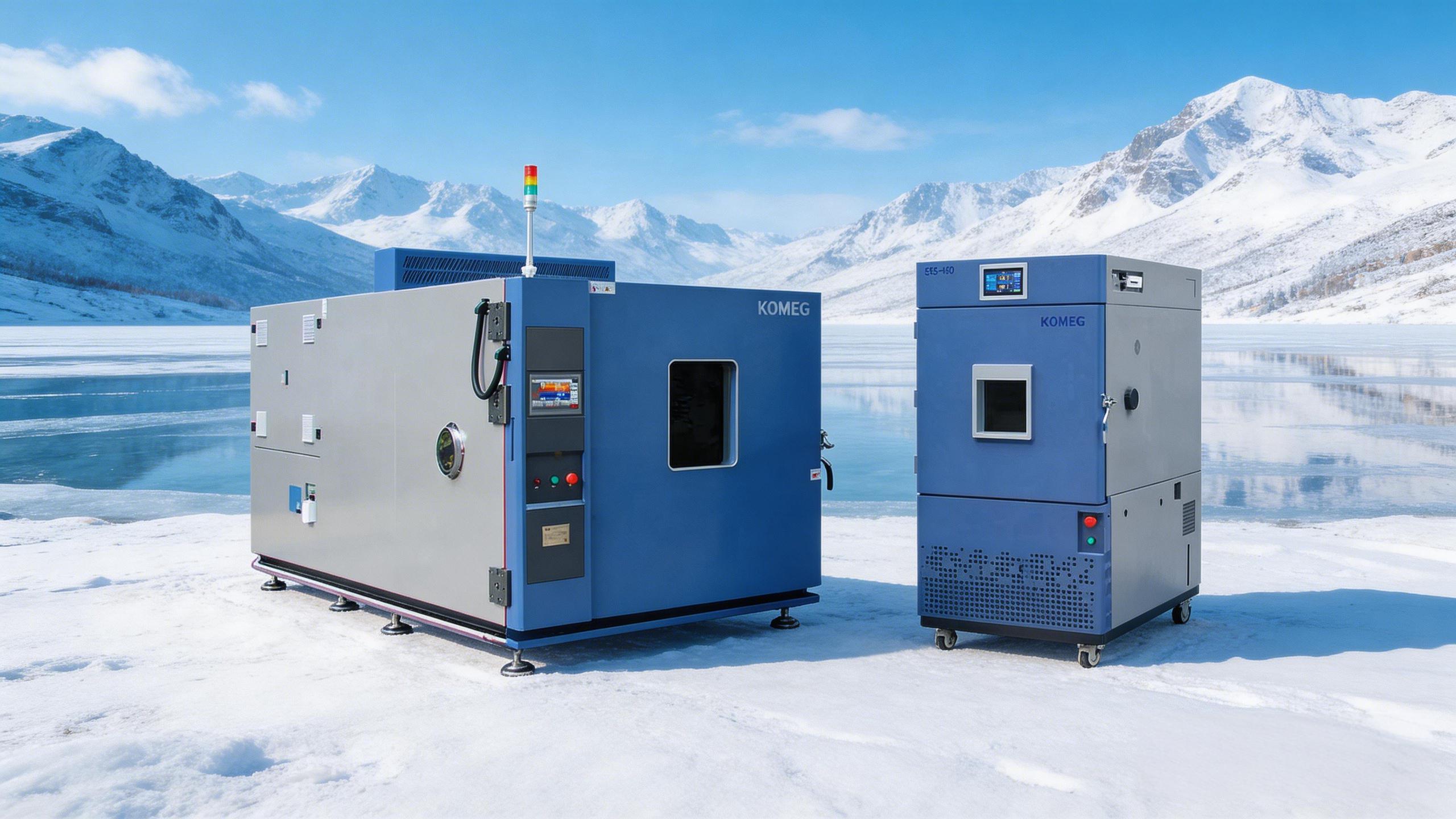
Choosing between a walk-in and a reach-in environmental test chamber depends on more than the size of the product being tested. Both configurations can provide controlled environmental conditions for product reliability testing, but they differ in usable space, loading arrangements, airflow considerations, installation requirements, and overall operating costs.
A reach-in environmental test chamber is generally suitable for small to medium-sized products, individual components, and routine laboratory testing. A walk-in environmental test chamber is often a better choice for large assemblies, multiple products tested in one batch, or applications that require engineers to access the test space directly.
However, a larger chamber is not automatically the better option. The right configuration must accommodate the actual device under test (DUT), reproduce the required temperature and humidity conditions, and support the intended test procedure without unnecessary complexity.
This guide compares walk-in and reach-in environmental test chambers, explains their main engineering differences, and provides a practical framework for selecting the right system for your application.
1. What Is a Reach-In Environmental Test Chamber?
A reach-in environmental test chamber is an enclosed testing cabinet designed to simulate controlled environmental conditions within a relatively compact working space. Operators typically load samples through a front door and arrange them on shelves, racks, or dedicated fixtures.
Depending on the model, a reach-in chamber may provide temperature control, temperature and humidity control, or specialized temperature cycling functions.
These chambers are widely used in electronics manufacturing, automotive component testing, materials research, electrical product qualification, and general laboratory reliability testing.
Typical applications
Reach-in chambers are commonly used for:
Electronic components, printed circuit boards, and small assemblies.
Automotive sensors, connectors, and electrical components.
Plastics, rubber, adhesives, and other engineering materials.
Consumer electronics and electrical products.
Temperature storage, cycling, and endurance tests.
Temperature and humidity conditioning before further testing.
Their relatively compact footprint makes them suitable for laboratories where floor space is limited or where several independent test programs must run simultaneously.
Main advantages
Efficient use of laboratory space. A reach-in chamber can provide a controlled test environment without requiring a dedicated room-sized installation.
Convenient sample loading. Smaller products and fixtures can generally be loaded through the front door without entering the test space.
Practical for routine testing. Laboratories that frequently test individual components or small batches may find a reach-in configuration easier to operate.
Flexible test scheduling. Multiple smaller chambers can allow different test profiles to run independently, depending on the laboratory’s workload.
Lower infrastructure demands in many applications. Compared with a large walk-in system offering similar environmental conditions, a reach-in chamber may require less installation space and simpler site preparation. Actual requirements depend on the model and performance specification.
A reach-in chamber is often the practical choice when the DUT fits comfortably inside the working space and the required environmental conditions can be achieved under the intended loading conditions.
2. What Is a Walk-In Environmental Test Chamber?
A walk-in environmental test chamber provides a larger enclosed space that operators can enter to arrange or inspect samples when the chamber is safely accessible and the operating procedure permits it.
These systems are designed for large products, multiple samples, bulky fixtures, or testing arrangements that cannot be accommodated efficiently in a conventional cabinet.
Walk-in chambers may be constructed using insulated panels and configured with specialized doors, loading systems, internal racks, or other application-specific features.
Depending on the design, they can provide temperature control, temperature and humidity control, or other environmental conditions required by the test procedure.
Typical applications
Walk-in environmental chambers may be used for:
Large automotive components and assemblies.
Battery packs and energy storage system components.
Solar panels and other large-format products.
Multiple electronic assemblies tested in a single batch.
Industrial equipment and mechanical assemblies.
Aerospace components and large test fixtures.
Product qualification programs requiring substantial working space.
The exact suitability of a walk-in chamber depends on its temperature range, humidity capability, internal dimensions, refrigeration system, airflow design, and safety configuration.
Main advantages
Larger usable workspace. Walk-in chambers can accommodate products that are too large or awkwardly shaped for conventional cabinets.
More flexible loading arrangements. Large racks, fixtures, carts, and multiple DUTs may be accommodated when the chamber is designed for them.
Direct access for setup. Operators can arrange large samples and instrumentation inside the chamber before a test begins, subject to the equipment’s safety procedures.
Potentially more efficient batch testing. Testing multiple products together may reduce handling and scheduling overhead when the test conditions and sample arrangements are compatible.
Customizable layouts. Walk-in systems can be engineered around particular product dimensions, access requirements, and testing workflows.
For large products or high-volume testing, a walk-in chamber may provide a more practical solution than trying to fit the application into several smaller cabinets.
3. Walk-In vs. Reach-In Environmental Test Chambers: Main Differences
The most useful comparison focuses on the actual testing application rather than treating one configuration as universally superior.
Working volume and product dimensions
The most obvious difference is the available test space.
Reach-in chambers are suitable when the DUT and its fixtures can be loaded through the cabinet door and positioned with sufficient clearance for airflow and measurement equipment.
Walk-in chambers provide more room for large assemblies, multiple samples, and specialized mounting arrangements. They may also simplify testing when a product must be installed in a particular orientation.
However, chamber capacity should not be selected solely according to the external dimensions of the DUT. Engineers must also consider the sample quantity, fixture size, cable routing, sensor placement, and airflow clearance.
Loading and unloading
Reach-in chambers generally use a front door and internal shelves or racks. This arrangement works well for small samples but can become inconvenient when handling heavy products or large fixtures.
Walk-in chambers can provide wider doors and more flexible loading arrangements. Depending on the design, products may be placed using carts, dedicated handling equipment, or specialized fixtures.
For large or heavy DUTs, the loading method should be reviewed before equipment selection. The door dimensions, threshold, floor loading, lifting arrangements, and available access routes may all affect feasibility.
Temperature and humidity performance
Neither chamber type is automatically more accurate or more uniform than the other.
Environmental performance depends on the system design, refrigeration and heating capacity, airflow distribution, control strategy, insulation, sensor arrangement, and test load.
A well-designed reach-in chamber may be appropriate for demanding laboratory tests involving small components. A properly engineered walk-in chamber may be needed when the same test conditions must be maintained across a much larger workspace.
For either configuration, confirm the required temperature range, humidity conditions, temperature fluctuation, uniformity, and recovery performance under the intended test conditions.
Thermal load
A large DUT can impose a significant thermal load even if the chamber’s nominal volume appears sufficient.
Powered electronic equipment may generate heat during testing. Large metal structures may absorb substantial thermal energy, affecting the time required to reach the target temperature.
Walk-in chambers may require greater heating and refrigeration capacity because of their larger volume or the thermal characteristics of the products being tested. However, the actual requirement depends on the complete test configuration rather than volume alone.
Installation requirements
Reach-in chambers typically require less floor space and may be easier to position in an existing laboratory.
Walk-in chambers can require more extensive site planning, including delivery access, door clearance, panel assembly, power supply, ventilation, cooling utilities, drainage, and maintenance space.
For a walk-in system, installation planning should begin before the equipment order is finalized. A suitable chamber must fit not only in the intended room but also along the route used to deliver and assemble it.
Initial investment and operating costs
A walk-in chamber often involves a larger initial investment because of its enclosure, environmental-control system, construction, and installation requirements.
It may also require more energy to condition a larger test space, although actual consumption depends on the system design, operating temperatures, insulation, test load, and usage pattern.
Reach-in chambers may be more economical for small samples and routine testing. However, if a laboratory needs several reach-in chambers to accommodate a large product or multiple samples, a walk-in system may be worth evaluating.
The correct comparison should consider the full test workload and the total cost of ownership, not simply the purchase price of one chamber.
4. Comparison Table: Which Chamber Type Fits Your Application?
| Selection factor | Reach-In Chamber | Walk-In Chamber |
|---|---|---|
| Working space | Compact to medium-sized | Large or customizable |
| Typical DUT | Components and smaller assemblies | Large products, assemblies, or multiple samples |
| Loading | Front door, shelves, or racks | Larger access opening and application-specific loading |
| Laboratory footprint | Usually smaller | Usually larger |
| Site preparation | Often simpler | May require detailed installation planning |
| Thermal load | Depends on DUT size and operation | May be substantial for large or powered products |
| Batch testing | Suitable for smaller batches | Useful for larger compatible batches |
| Custom fixtures | Possible within cabinet dimensions | More flexibility for large fixtures |
| Initial investment | Often lower for comparable basic applications | Often higher, depending on size and configuration |
| Best fit | Routine testing of smaller products | Testing large products or large sample configurations |
This table provides general guidance rather than a guarantee of performance or cost. Actual capabilities depend on the specific model, environmental conditions, DUT configuration, and test requirements.
5. How Temperature Range Affects the Choice
Temperature range is an important specification for both walk-in and reach-in chambers. The selected system must reach the required temperatures and maintain the specified conditions under the intended test load.
For example, a chamber designed for moderate temperature exposure may require a different refrigeration configuration from one that must operate at very low temperatures. High-temperature requirements can also influence heating capacity, insulation, internal materials, and other design details.
A larger chamber does not necessarily need a wider temperature range. Similarly, a smaller chamber is not necessarily limited to basic testing.
The correct selection starts with the actual test profile:
Minimum and maximum temperature.
Required heating and cooling rates.
Dwell time at each setpoint.
Number of temperature cycles.
Required temperature fluctuation and uniformity.
Thermal mass and heat generation of the DUT.
Whether the specified performance must be maintained under load.
If the application requires rapid transitions, evaluate the required temperature change rate separately from the temperature range. A chamber that reaches the specified minimum and maximum temperatures may not necessarily achieve the required transition rate under the actual test conditions.
For laboratories testing small electronic components with demanding temperature profiles, a reach-in rapid-rate thermal cycle chamber may be suitable. Large products requiring comparable profiles may need a specialized walk-in configuration.
The equipment should be selected according to the complete profile rather than a single catalog specification.
6. When Is Humidity Control Necessary?
Temperature and humidity requirements can influence the choice of chamber type, but the need for humidity control is determined by the test procedure.
A temperature-only chamber may be sufficient for tests involving high- and low-temperature exposure without regulated humidity.
A temperature and humidity chamber is needed when relative humidity must be controlled alongside temperature. Typical applications include damp-heat exposure, moisture-sensitive materials, and reliability testing of electronic assemblies under specified humid conditions.
For both walk-in and reach-in systems, humidity capability must be evaluated across the required temperature and humidity combinations. A stated maximum relative humidity should not be interpreted as being available at every temperature.
When selecting a chamber, clarify:
The required relative humidity range.
The temperatures at which each humidity setpoint is required.
Humidity fluctuation and uniformity requirements.
Test duration and recovery requirements.
Sample loading and airflow restrictions.
Whether condensation must be avoided or is part of the intended test procedure.
For a large batch of electronic assemblies, a walk-in temperature and humidity chamber may be appropriate if the products cannot be accommodated in a cabinet. For small samples, a reach-in temperature and humidity chamber may provide the required conditions with a smaller installation footprint.
The required environmental performance should be confirmed for the proposed configuration and loading conditions.
7. Airflow and Temperature Uniformity in Large Test Spaces
Airflow is a critical consideration when selecting an environmental test chamber. The system must distribute conditioned air throughout the working space while accounting for the position, shape, and thermal properties of the samples.
In a reach-in chamber, shelves, densely arranged products, and cable bundles can restrict airflow. The sample arrangement should leave sufficient clearance for the air to circulate as intended.
In a walk-in chamber, the larger working volume introduces additional design considerations. Air distribution must accommodate the chamber dimensions, sample arrangement, racks, and possible obstructions. Large products may create local airflow restrictions or temperature differences.
A larger internal volume does not automatically mean that temperature uniformity will be worse. Performance depends on the airflow architecture, refrigeration and heating capacity, chamber geometry, loading arrangement, and control system.
When reviewing a quotation, ask how uniformity is specified and measured. Confirm the measurement locations, stabilization period, test load, and applicable method.
If the test requires uniform conditions across a large product or several samples, discuss the intended product arrangement with the supplier. The loading configuration may need to be considered as part of the chamber design.
8. How Product Size and Thermal Mass Influence Chamber Selection
Product size is not the only factor that determines whether a walk-in or reach-in chamber is suitable. Thermal mass and heat generation can also affect the required system performance.
A small sample made from a dense metal may take longer to reach thermal equilibrium than a larger sample made from a material with a different thermal response.
Similarly, a powered electronic assembly may generate heat during operation. The chamber must accommodate that load while maintaining the required environmental conditions.
Before selecting equipment, document:
DUT dimensions and total weight.
Materials and approximate thermal mass.
Number of samples tested at once.
Whether the DUT is powered during testing.
Expected heat dissipation.
Fixture and rack dimensions.
Cable and instrumentation requirements.
Required product temperature measurement points.
If the test requires the DUT itself to reach a target temperature before the dwell period begins, chamber air temperature alone may not be sufficient to determine when the product has reached the required condition.
The measurement method and timing basis should be defined in the test procedure.
For large assemblies, this assessment may reveal that a walk-in chamber is needed for physical access and loading, while the thermal load may require additional consideration when sizing the refrigeration and heating systems.
9. Installation and Facility Requirements
Installation requirements should be considered early, especially when comparing a walk-in chamber with a reach-in system.
A reach-in chamber may fit into an existing laboratory with relatively limited site preparation. Nevertheless, the selected model still requires appropriate electrical supply, ventilation, service clearance, and any specified cooling or drainage connections.
A walk-in chamber may need a more detailed installation assessment because of its dimensions and construction.
Available floor space and maintenance clearance
Check the equipment footprint, door opening, ceiling height, access for maintenance, and the space needed to load samples safely.
Do not evaluate the installation based only on the chamber’s external dimensions. The surrounding area must also accommodate maintenance activities and any loading equipment.
Transportation and access
Large chamber panels or assembled units must be transported from the delivery point to the installation area.
Confirm corridor width, doorway dimensions, turning space, elevator capacity where applicable, and whether on-site assembly is necessary.
Electrical supply and cooling
Verify the required voltage, phase, frequency, current, protective devices, and grounding.
For air-cooled equipment, confirm that the room can dissipate the heat generated during operation. For water-cooled systems, check the specified water flow, inlet temperature, and connection requirements.
Drainage and ambient conditions
Humidity chambers may require drainage arrangements. The installation area must also comply with the manufacturer’s specified ambient conditions and should avoid unsuitable exposure to dust, corrosive substances, excessive vibration, or other environmental hazards.
For a walk-in project, these checks should be completed before the final quotation and delivery schedule are agreed upon.
10. Initial Price vs. Total Cost of Ownership
Walk-in chambers often cost more initially than smaller reach-in systems, but the most economical solution depends on how the equipment will be used.
For example, a laboratory that tests small components in separate test profiles may benefit from several independent reach-in chambers. A facility testing large products or many compatible samples may find a walk-in chamber more practical.
The comparison should include more than the initial purchase price.
Initial equipment cost
Consider the chamber type, working volume, temperature range, humidity requirements, refrigeration design, controller, safety features, and customization.
Installation cost
Include transportation, site preparation, electrical work, cooling utilities, assembly, commissioning, and training where applicable.
Energy consumption
Energy use depends on the operating profile, ambient conditions, refrigeration efficiency, test load, insulation, and operating schedule.
A larger chamber may consume more energy to condition its space, but the comparison should also consider the number of products tested per batch and the total workload.
Maintenance and downtime
Consider routine maintenance, calibration, spare parts, service access, and the consequences of equipment downtime.
For a walk-in chamber, access to internal components and the maintenance arrangements should be reviewed during the design stage.
Testing throughput
If a laboratory must test a large number of samples, compare the time and handling requirements of using several smaller chambers with those of a larger system.
A walk-in chamber may improve workflow when samples can be tested together under compatible conditions. However, combining samples is only appropriate when the test profile, monitoring requirements, and acceptance criteria permit it.
The best choice is the system that meets the testing requirements while supporting an efficient and sustainable operating workflow.
11. Can a Walk-In Chamber Replace Multiple Reach-In Chambers?
Sometimes, but not in every application.
A walk-in chamber may be suitable when several products require the same environmental profile and can be tested together without compromising airflow, measurement, or acceptance criteria.
For example, a manufacturer testing multiple similar assemblies may be able to arrange them in a larger chamber and run one common test program.
However, several independent reach-in chambers may be preferable when products require different temperature profiles, different humidity conditions, or separate schedules.
Independent chambers can also allow one test to continue while another is being prepared or serviced.
Before consolidating equipment, compare:
Whether all products can use the same test profile.
Whether the combined thermal load is within the chamber’s capability.
Whether airflow and sample spacing remain appropriate.
Whether each product can be monitored as required.
Whether independent test scheduling is important.
Whether a chamber outage would affect all test programs.
A larger chamber should not be selected solely because it can physically hold more products. The testing workflow and environmental requirements must also be compatible.
12. Which Chamber Is Better for Battery and Automotive Testing?
Battery and automotive testing cover a broad range of products and test procedures. Neither walk-in nor reach-in chambers are universally better for these industries.
Battery testing
Small battery cells and modules may fit in a reach-in chamber, depending on the required temperature range, test load, and safety provisions.
Large battery packs or energy storage system assemblies may require a walk-in chamber because of their dimensions, weight, and installation requirements.
Battery testing also requires particular attention to the potential hazards of the DUT. Depending on the test objective and product risk, the equipment may need dedicated safety features, monitoring, exhaust arrangements, or other protective measures.
The correct configuration should be selected according to the battery type, test procedure, applicable requirements, and facility risk assessment.
Automotive component testing
Sensors, connectors, electronic control units, and smaller automotive components are often suitable for reach-in testing.
Large assemblies or multiple components tested together may require a walk-in chamber, especially when fixtures or product dimensions exceed the working space of a cabinet.
If the application involves combined temperature, humidity, or vibration testing, the required equipment configuration should be confirmed against the complete test procedure.
Semiconductor and electronics testing
Small semiconductor packages and electronic components may be tested in reach-in chambers or specialized systems, depending on the required profile and instrumentation.
Large electronic assemblies, racks, or multiple units may require more working space. However, for localized temperature stimulation of individual devices, a dedicated temperature forcing system may be more appropriate than conditioning an entire chamber.
The choice should be based on what needs to be exposed to the environmental condition: the entire product or only a specific component.
13. A Practical Checklist for Choosing Between Walk-In and Reach-In
Before requesting a quotation, review the following questions.
Product dimensions: Can the DUT fit through the chamber door and be positioned with sufficient clearance?
Sample quantity: Will the laboratory test one product at a time or multiple products in a batch?
Environmental conditions: What temperature range, humidity conditions, and transition rates are required?
Thermal load: Does the DUT generate heat or have a substantial thermal mass?
Airflow and uniformity: Can the required conditions be maintained throughout the intended sample arrangement?
Loading method: Are shelves sufficient, or are large fixtures, carts, lifting equipment, or specialized loading arrangements needed?
Measurement requirements: Does the test require product-mounted sensors, external monitoring, or detailed data logging?
Safety: Does the DUT introduce risks that require additional protective features or a specialized chamber design?
Installation: Can the facility accommodate the chamber, its utilities, and its maintenance requirements?
Operating costs: What are the expected energy, maintenance, service, and downtime costs?
Future needs: Are larger products, increased sample quantities, or additional test profiles likely to be introduced?
If the DUT is compact, the test volume is moderate, and the required conditions can be achieved in a cabinet, a reach-in chamber is often a sensible starting point.
If the DUT is large, loading is difficult, or the test requires a substantially larger workspace, a walk-in chamber may be more appropriate.
14. Selecting a Walk-In Environmental Test Chamber for Your Application
A walk-in chamber should be specified around the actual product and test profile rather than chosen solely by its internal dimensions.
Before selecting a configuration, define the minimum and maximum temperatures, humidity conditions, transition requirements, sample quantity, thermal load, and measurement criteria.
Next, establish the required internal dimensions and loading arrangement. Consider how the DUT will enter the chamber, where it will be positioned, how sensors and cables will be connected, and how technicians will access the equipment for maintenance.
For large or customized systems, discuss the installation environment with the supplier before finalizing the design. The required utilities, delivery access, panel assembly, and service clearance can influence the overall project.
KOMEG offers walk-in environmental test chamber solutions for applications that require larger working spaces and controlled environmental conditions. Depending on the application, the configuration may be tailored to the required chamber dimensions, temperature and humidity conditions, loading arrangements, and control functions.
Explore KOMEG Walk-In Environmental Test Chambers to review the product range.
Conclusion: Choose the Chamber That Fits the Test, Not Just the Product
Walk-in and reach-in environmental test chambers serve different testing needs.
Reach-in chambers are generally suitable for smaller products, routine laboratory tests, and applications where compact installation and independent test scheduling are important.
Walk-in chambers are often better suited to large assemblies, bulky fixtures, multiple compatible samples, and applications requiring direct access to a larger test space.
The final decision should account for product dimensions, thermal load, temperature and humidity requirements, airflow, measurement needs, installation conditions, and total cost of ownership.
A chamber that is too small may restrict loading and airflow. A chamber that is unnecessarily large may increase the initial investment and operating requirements without providing a meaningful benefit.
The best approach is to define the test profile first and select the chamber configuration that can reproduce the required conditions reliably.
KOMEG provides environmental testing solutions for electronics, automotive, batteries, industrial products, and other reliability-testing applications. For assistance selecting a suitable walk-in or reach-in chamber, provide the DUT dimensions, test profile, applicable standard, and key performance requirements.
Visit the KOMEG environmental test chamber product range or contact the KOMEG team to discuss your application.
Frequently Asked Questions
What is the main difference between a walk-in and a reach-in environmental test chamber?
A reach-in chamber is a cabinet-style system loaded through a front door. A walk-in chamber provides a larger test space that can accommodate larger products, fixtures, or multiple samples. The appropriate choice depends on product dimensions, test requirements, loading arrangements, and installation conditions.
Is a walk-in environmental chamber more expensive than a reach-in chamber?
Walk-in chambers often involve a higher initial investment because of their larger enclosure, environmental-control requirements, and installation needs. However, the actual cost depends on temperature range, humidity capability, performance requirements, customization, and the intended workload.
Can a reach-in chamber test large automotive components?
It can test automotive components that fit within its working space and can be loaded safely while maintaining the required environmental conditions. Large assemblies may require a walk-in chamber if their dimensions, weight, or fixtures exceed the practical limits of a cabinet.
Are walk-in chambers suitable for battery testing?
They may be suitable for large battery packs, modules, and energy storage system components, depending on the test requirements and equipment configuration. Battery testing requires careful evaluation of DUT hazards and the safety provisions required by the applicable procedure.
Does a walk-in chamber provide better temperature uniformity?
Not automatically. Temperature uniformity depends on chamber design, airflow distribution, refrigeration and heating capacity, loading arrangement, and test conditions. The specified performance should be verified for the intended test configuration.
Can a walk-in chamber control both temperature and humidity?
Yes, some walk-in environmental chambers are designed for combined temperature and humidity control. The available operating range and performance depend on the selected configuration and must be confirmed against the required temperature and humidity combinations.
How do I determine the correct chamber size?
Start with the DUT dimensions, quantity, weight, fixtures, cable connections, and airflow clearance. Also consider the required thermal load, loading method, and possible future changes. The usable workspace must accommodate the intended test arrangement rather than just the physical dimensions of the product.
Can one walk-in chamber replace several reach-in chambers?
It may be possible when the products share compatible environmental conditions and can be tested together without compromising measurement or acceptance criteria. If different products require independent profiles or schedules, multiple reach-in chambers may offer greater flexibility.
What information is needed to request a quotation?
Provide the DUT dimensions and quantity, temperature and humidity profile, required transition rates, applicable standard, performance criteria, loading arrangements, and installation conditions. Include any heat generation or product-specific safety concerns so the supplier can evaluate the application appropriately.