

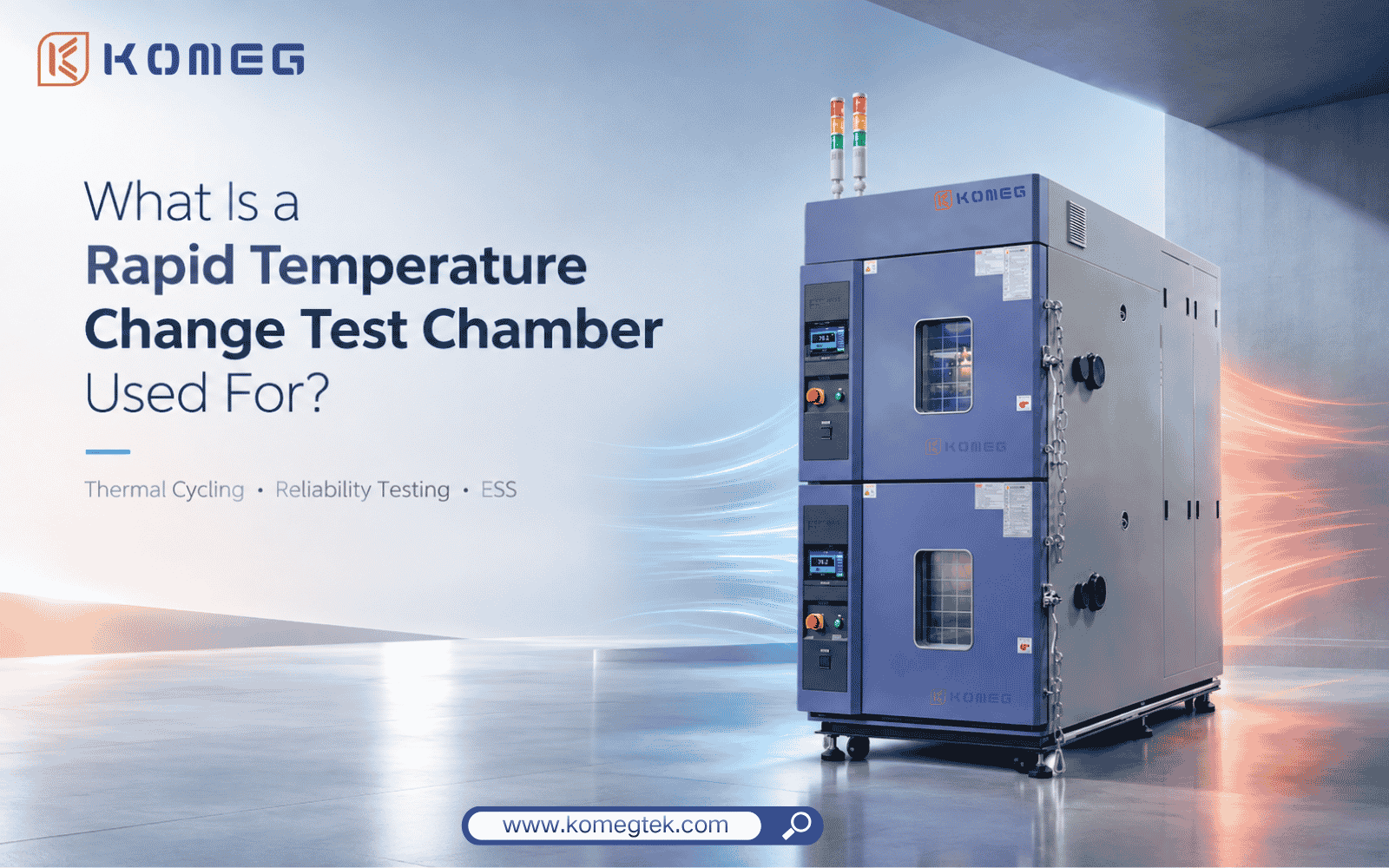
A rapid temperature change test chamber is used to expose products and components to controlled, repeated temperature transitions so engineers can evaluate thermal reliability, identify latent defects, and accelerate environmental testing.
Unlike a conventional temperature test chamber, which is often used to establish and maintain a stable temperature for a specified period, a rapid temperature change chamber places greater emphasis on how quickly the temperature changes. This difference matters because rapid heating and cooling can create thermal gradients, differential expansion, mechanical stress, and fatigue at interfaces within a product.
Rapid temperature change testing is therefore widely used for electronics, automotive components, semiconductor packages, batteries, aerospace equipment, communication products, and other applications where reliability depends not only on surviving extreme temperatures but also on surviving repeated thermal transitions.
Why Use a Rapid Temperature Change Test Chamber?
The most important reason to use a rapid temperature change chamber is not simply to make a test faster. It is to reproduce a more demanding thermal transition profile.
When a product moves from a cold environment to a hot environment, or from hot to cold, different materials do not necessarily respond at the same rate. Metals, plastics, ceramics, solder joints, adhesives, coatings, semiconductor packages, and circuit boards all have different thermal expansion characteristics.
During a rapid temperature transition, these differences can create mechanical stress within the product.
Repeated over many cycles, that stress can reveal weaknesses such as:
Solder joint fatigue
PCB cracking or delamination
Component connection failure
Seal degradation
Adhesive failure
Material interface separation
Connector problems
Coating or encapsulation cracking
Semiconductor package stress
Mechanical deformation
This is why rapid temperature change testing is often more useful for reliability investigation than simply holding a product at a constant high or low temperature.
The test is not just asking:
Can the product survive -40°C or +85°C?
It is also asking:
What happens when the product repeatedly moves between those conditions?
What Is a Rapid Temperature Change Test Chamber?
A rapid temperature change test chamber is an environmental testing system designed to move its internal temperature between programmed setpoints at a relatively high and controlled rate.
The rate is commonly expressed as °C/min.
For example, a test profile might require a chamber to transition between -40°C and +85°C at a specified rate before holding each temperature for a defined dwell period.
The chamber typically combines high-capacity refrigeration, high-response heating, controlled airflow, temperature sensors, and programmable control to achieve repeatable transitions.
KOMEG rapid-rate thermal cycle chambers, for example, are available in multiple working volumes and configurations, with temperature ranges extending from -70°C to +150°C and optional higher temperatures. Depending on the model and test conditions, the KST series offers 5°C/min, 10°C/min, and 15°C/min heating and cooling rates under empty-load conditions.
However, one specification deserves particular attention:
The chamber’s rated ramp rate should not automatically be interpreted as the temperature change rate of the product under test.
This is one of the most commonly misunderstood aspects of rapid thermal testing.
What Does a Rapid Temperature Change Test Actually Test?
Rapid temperature change testing evaluates how a product responds to repeated thermal transitions.
The test can be used to investigate several different aspects of reliability.
1. Thermal Fatigue
Repeated expansion and contraction can gradually weaken materials and interfaces.
For example, a PCB assembly may contain copper traces, solder, semiconductor packages, resin materials, and a fiberglass substrate. These materials have different coefficients of thermal expansion.
When the temperature changes repeatedly, the components do not expand and contract identically.
Over time, this can contribute to mechanical fatigue.
Rapid temperature cycling can make these effects more pronounced and help expose weaknesses earlier in the product development process.
2. Latent Manufacturing Defects
Rapid thermal cycling is also widely associated with Environmental Stress Screening (ESS).
The basic idea behind ESS is straightforward: manufacturing defects that remain hidden under normal operating conditions may become detectable when the product is exposed to controlled environmental stress.
A weak solder joint, marginal connection, material void, poor bond, or manufacturing inconsistency may survive a normal functional test but fail after repeated thermal transitions.
This makes rapid temperature change testing particularly useful for products where early-life failures are expensive or difficult to tolerate.
However, ESS should not be interpreted as a universal accelerated-life test. The screening profile needs to be selected according to the product, manufacturing process, reliability objective, and applicable requirements.
3. Electronics and PCB Reliability
Electronic assemblies are one of the most common applications for rapid temperature cycling.
PCBs and electronic assemblies contain multiple materials with different thermal properties. Repeated temperature changes can place stress on:
Solder joints
BGA packages
Semiconductor devices
PCB laminates
Connectors
Capacitors
Resistors
Adhesive interfaces
Encapsulated components
A rapid temperature change chamber allows engineers to program repeated hot-cold transitions and monitor whether electrical or mechanical performance changes during or after the test.
For high-density electronic assemblies, this can be especially valuable because smaller packages and tighter integration leave less room for manufacturing or material weaknesses.
4. Automotive Electronics and Components
Modern vehicles contain a large number of electronic and electromechanical systems that operate across changing environmental conditions.
Examples include:
Electronic control units
Sensors
Cameras
Radar modules
Power electronics
Inverters
DC-DC converters
Charging components
Connectors
Displays
Lighting systems
Battery-related electronics
An automotive component may experience cold starts, engine or power-electronics heat, outdoor temperature changes, and repeated operating cycles throughout its service life.
Rapid thermal cycling can therefore be used during design validation and reliability testing to investigate whether these components maintain their mechanical and electrical integrity after repeated temperature transitions.
For automotive testing, the exact temperature range, dwell time, ramp rate, cycle count, and acceptance criteria should be based on the applicable product specification or test standard rather than simply selecting the fastest available chamber.
5. Semiconductor Package Reliability
Semiconductor packages are particularly sensitive to thermal-mechanical stress because they combine several materials and interfaces within a relatively small structure.
A package may contain silicon, mold compounds, lead frames, substrates, solder materials, interconnects, and other materials with different thermal expansion behavior.
When temperature changes rapidly, these materials respond differently.
Repeated cycling can therefore contribute to:
Package cracking
Solder fatigue
Interconnect degradation
Delamination
Interface failure
Electrical intermittency
Rapid temperature cycling can be used to investigate these mechanisms during semiconductor qualification and reliability development.
The important point is that the chamber is not merely creating “hot and cold conditions.” It is controlling the thermal transition experienced by the test system.
6. Battery and Energy Storage Testing
Lithium-ion batteries and other energy-storage products may also require temperature cycling under controlled conditions.
Battery cells, modules, and packs can experience significant changes in temperature during charging, discharging, storage, transportation, and operation.
Rapid temperature testing can be used to investigate:
Thermal cycling durability
Performance changes after cold and hot exposure
Battery enclosure and sealing performance
Electrical connection reliability
Thermal management performance
Material compatibility
Module and pack mechanical integrity
For battery applications, however, chamber selection requires more consideration than temperature range and ramp rate.
The thermal mass of a battery module or pack can be substantial. A chamber may change its air temperature rapidly while the battery itself changes temperature much more slowly.
Therefore, battery testing should consider the actual specimen temperature, internal thermal gradients, electrical operating condition, safety requirements, and instrumentation.
A high ramp rate on a datasheet does not automatically mean that a large battery pack will experience the same ramp rate.
7. Aerospace and Defense Electronics
Aerospace and defense equipment may encounter substantial environmental temperature changes during transportation, altitude changes, operation, and storage.
Electronic systems may need to remain functional after repeated exposure to cold and hot conditions.
Rapid temperature change testing can help evaluate:
Avionics
Sensors
Communication equipment
Navigation electronics
Power supplies
Control modules
Aerospace connectors
Electronic assemblies
The exact test profile should be derived from the applicable qualification requirement and expected service environment.
MIL-STD-810, for example, emphasizes environmental tailoring rather than treating every test as a universal fixed procedure. This is an important distinction: the goal of environmental testing is to generate meaningful data for the intended application, not simply to subject every product to the most severe available condition.
8. Communication and Outdoor Equipment
Communication equipment installed outdoors can experience repeated environmental temperature changes throughout its service life.
Examples include:
Base-station equipment
Outdoor communication units
Optical communication equipment
Network cabinets
Sensors
Industrial controllers
Power modules
Rapid thermal cycling can be used to investigate enclosure performance, sealing, connectors, electronic assemblies, and material interfaces.
For outdoor products, thermal cycling may also be combined with other environmental exposures depending on the qualification program.
Rapid Temperature Change vs. Conventional Temperature Testing
One of the easiest ways to understand the purpose of a rapid temperature change chamber is to compare it with a conventional temperature chamber.
A conventional temperature chamber is often used when the primary objective is to maintain a product at a specified temperature.
For example:
85°C for 500 hours
The main question is whether the product can withstand prolonged exposure to that temperature.
A rapid temperature cycling test asks a different question:
What happens when the product repeatedly moves between defined temperature conditions?
This distinction changes the type of stress applied to the product.
Conventional Temperature Exposure
The emphasis is usually on:
Temperature stability
Exposure duration
Temperature uniformity
Long-term operation
High- or low-temperature endurance
Rapid Temperature Cycling
The emphasis is more likely to be on:
Temperature change rate
Thermal transitions
Repeated expansion and contraction
Thermal gradients
Mechanical fatigue
Latent defect detection
Cycle repeatability
Neither approach is universally better.
The correct chamber depends on what you are trying to learn about the product.
Rapid Temperature Change vs. Thermal Shock
These two terms are sometimes used interchangeably, but they describe different testing approaches.
A rapid temperature change chamber normally changes the temperature of the chamber air according to a programmed ramp profile.
A thermal shock chamber generally produces a much more abrupt temperature transition, often by moving the specimen between hot and cold zones.
The resulting thermal exposure can therefore be substantially different.
A useful way to think about the distinction is:
Rapid temperature cycling = controlled temperature transition
Thermal shock = abrupt environmental transition
If the test specification requires a defined ramp rate, a rapid temperature change chamber may be the appropriate solution.
If the objective is to expose a specimen to an extremely abrupt hot-to-cold or cold-to-hot transition, a dedicated thermal shock system may be more appropriate.
The test method should determine the equipment, not the other way around.
Does a Faster Ramp Rate Always Mean a Better Test?
No.
This is one of the most important points when selecting a rapid temperature change test chamber.
A higher ramp rate may sound better on a specification sheet, but maximum speed is not automatically the same as better testing.
Suppose a test procedure requires 5°C/min.
A chamber capable of 15°C/min provides additional capability, but operating at 15°C/min simply because the chamber can do it may produce a test profile that no longer represents the intended qualification condition.
The correct question is not:
How fast can the chamber go?
It is:
What temperature transition does the test actually require?
This distinction can prevent unnecessary equipment cost while improving test validity.
Why the DUT Temperature Matters More Than the Chamber Air Temperature
This is perhaps the most useful engineering consideration in rapid temperature testing.
A chamber sensor measures the chamber environment. It does not necessarily tell you how quickly the test specimen itself is changing temperature.
Consider two specimens:
A small electronic component
A large battery module
Both are placed in a chamber programmed for the same temperature ramp.
The small component may respond relatively quickly because its thermal mass is low.
The battery module, on the other hand, contains considerably more material and may have internal temperature gradients. Its core temperature can lag behind the chamber air significantly.
Thermal mass, fixture design, airflow, material properties, specimen geometry, and heat generation can all influence the actual response.
Therefore, when specifying a rapid temperature change chamber, engineers should ask suppliers how the ramp rate is measured and under what load conditions.
This is often more useful than comparing headline ramp-rate numbers alone.
What Is the Difference Between Linear and Non-Linear Ramp Rates?
Another specification that can be overlooked is the control mode.
A linear ramp attempts to maintain a relatively consistent temperature change rate throughout the programmed transition.
A non-linear or average ramp may describe the overall temperature change over a defined interval without requiring the same instantaneous rate throughout the entire transition.
These approaches can produce different temperature profiles even if the advertised ramp rate appears similar.
For applications where the temperature transition itself is a critical part of the test, engineers should clarify:
Starting temperature
Final temperature
Ramp-rate definition
Measurement location
Empty or loaded condition
Linear or non-linear control
Dwell time
Cycle count
Specimen temperature requirements
This information should be agreed upon before equipment selection.
What Should You Look for When Selecting a Rapid Temperature Change Test Chamber?
Ramp rate is important, but it should not be the only selection criterion.
Temperature Range
Make sure the chamber covers the complete test profile with appropriate operating margin.
Ramp Rate
Select a rate based on the actual test requirement, not simply the highest value available.
Loaded Performance
Ask how the chamber performs with the actual DUT, fixture, and cable configuration.
Temperature Uniformity
Rapid transitions are only useful if the temperature distribution remains sufficiently controlled throughout the working space.
Recovery Performance
After a transition or door opening, the chamber should return to the required condition within the expected time.
Working Volume
The chamber must accommodate the specimen, fixtures, sensors, wiring, and required airflow clearance.
Airflow
Air distribution becomes particularly important when testing large or thermally massive specimens.
Control and Data Recording
A programmable controller, data logging, communication interfaces, and alarm functions can simplify long-duration cycling and reliability analysis.
Safety
For battery testing or other potentially hazardous products, additional protection may be necessary, including over-temperature monitoring, pressure relief, gas detection, fire detection, or suppression systems depending on the test risk.
What Standards Are Related to Rapid Temperature Change Testing?
The applicable standard depends on the product and test objective.
IEC 60068-2-14 is one of the key international references for change-of-temperature testing. Its Test N procedures are intended to analyze the effects of specified ambient temperature changes on specimens. The current 2023 edition revised specimen temperatures, severities, tolerances, and reporting requirements.
Other applications may reference automotive, semiconductor, aerospace, military, or customer-specific qualification requirements.
The important point is that a chamber itself is not “compliant with every standard” simply because it can reach a certain temperature or ramp rate.
The test profile must be evaluated against the requirements of the actual method being used.
When Do You Actually Need a Rapid Temperature Change Chamber?
A rapid temperature change test chamber is usually worth considering when one or more of the following conditions apply:
The product will experience repeated temperature transitions in service.
Thermal cycling is part of the qualification requirement.
You need to identify latent manufacturing defects.
Conventional temperature cycling takes too long for your development schedule.
The product contains multiple materials with different thermal expansion characteristics.
Thermal fatigue is an important reliability concern.
The test program requires a controlled temperature ramp.
You are performing environmental stress screening.
The product is a high-reliability electronic, automotive, aerospace, semiconductor, or battery system.
On the other hand, a rapid-rate chamber may be unnecessary if the primary requirement is simply to hold a product at a constant temperature for an extended period.
That is why the first step should always be to define the test objective, not the chamber specification.
KOMEG Rapid Temperature Change Test Chambers
KOMEG rapid-rate thermal cycle chambers are designed for applications where controlled and repeatable temperature transitions are more important than simple temperature exposure.
The KST series is available in working volumes from approximately 150 L to 1000 L, with configurations covering temperature ranges down to -70°C and up to +150°C, with +180°C available as an option. Depending on the configuration, heating and cooling rates of 5°C/min, 10°C/min, or 15°C/min are available under specified empty-load conditions.
The chambers can be configured for linear or non-linear temperature control, programmable operation, cable access, data communication, and other application-specific requirements.
For ESS and rapid thermal cycling applications, KOMEG also provides customized configurations according to specimen dimensions, thermal mass, required temperature profile, ramp rate, and safety requirements.
The key is to match the chamber to the actual test rather than selecting a system based on the largest temperature range or fastest advertised ramp rate.
Frequently Asked Questions
What is a rapid temperature change test chamber used for?
It is used to expose products to controlled and repeated temperature transitions in order to evaluate thermal reliability, thermal fatigue, latent defects, and performance changes. It is commonly used for electronics, automotive components, semiconductors, batteries, aerospace equipment, communication products, and environmental stress screening.
Is a rapid temperature change chamber the same as a thermal cycling chamber?
The terms are often used similarly, but a rapid temperature change chamber generally emphasizes faster and controlled temperature transitions. A conventional thermal cycling chamber may operate at slower rates depending on the test requirement.
Is a rapid temperature change chamber the same as a thermal shock chamber?
No. Rapid temperature change testing generally uses a programmed temperature ramp within the chamber. Thermal shock testing typically produces a much more abrupt transition, often by transferring the specimen between hot and cold zones.
What ramp rate is considered rapid?
There is no universal definition that applies to every test. Commercial systems may offer rates such as 5°C/min, 10°C/min, 15°C/min, 20°C/min, or higher depending on chamber design and test conditions. The correct value should come from the test specification and DUT requirements.
Does a 10°C/min chamber mean my product changes temperature at 10°C/min?
Not necessarily. The rated chamber ramp rate may refer to chamber-air temperature under a specified measurement condition. The actual DUT temperature response depends on thermal mass, geometry, material properties, airflow, fixture design, and heat generation.
Is a higher ramp rate always better?
No. A higher ramp rate is only beneficial when the test requires it. Using a more aggressive rate than the intended test profile can reduce test relevance and increase equipment cost without providing additional useful information.
Can rapid temperature change chambers be used for ESS?
Yes. Rapid temperature cycling is commonly used as part of Environmental Stress Screening programs to expose latent manufacturing weaknesses. However, the screening profile should be tailored to the product and reliability objective.
What products are commonly tested?
Typical applications include PCBs, electronic components, semiconductor packages, automotive electronics, sensors, connectors, batteries, power electronics, aerospace equipment, communication products, and industrial assemblies.
A rapid temperature change test chamber is used to control and repeat thermal transitions—not simply to make a conventional temperature test run faster.
Its real value comes from applying a defined thermal change rate that can create meaningful and repeatable stress within products and assemblies. This makes rapid temperature cycling particularly useful for thermal fatigue evaluation, ESS, product qualification, and reliability development.
But faster is not automatically better.
The most useful chamber is the one that reproduces the required temperature profile under realistic loading conditions. Temperature range, ramp rate, DUT thermal mass, airflow, uniformity, recovery, cycle count, and safety all need to be considered together.
For engineers selecting a rapid temperature change test chamber, the best starting point is therefore not “What is the fastest chamber available?”
It is:
“What thermal transition does my product actually need to survive?”
Once that question is answered, the appropriate chamber configuration becomes much easier to define.