

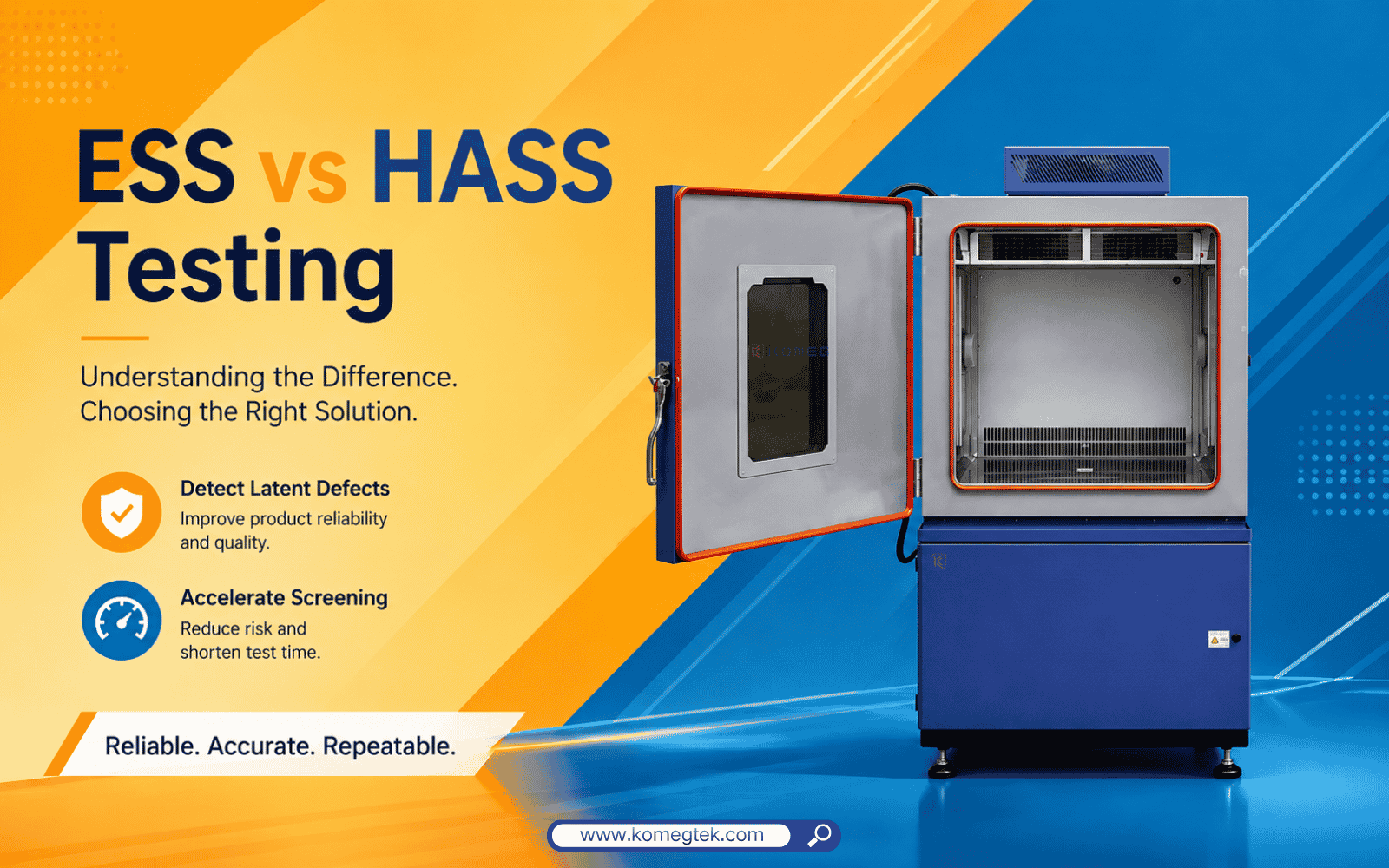
ESS and HASS testing are both environmental stress screening methods used to identify weaknesses in electronic products, components, and assemblies. However, they are not the same test. Environmental Stress Screening (ESS) is generally used to expose latent manufacturing and assembly defects through controlled environmental stresses, while Highly Accelerated Stress Screening (HASS) applies more aggressive conditions after an appropriate screening process has been established.
Understanding the difference between ESS and HASS testing is important when developing a reliability test program. Choosing an unnecessarily severe stress level can damage a product that would otherwise be reliable, while insufficient stress may fail to reveal latent defects. The right approach is to match the screening method, temperature profile, ramp rate, and stress level to the product’s actual design and manufacturing characteristics.
What Is ESS Testing?
Environmental Stress Screening (ESS) is a controlled process used to identify latent defects in products before they reach the customer. The basic idea is relatively straightforward: manufacturing defects or weak components may not cause immediate failure under normal operating conditions, but controlled environmental stress can accelerate the manifestation of those weaknesses.
ESS is commonly applied to electronic assemblies, automotive electronics, communication equipment, aerospace components, power electronics, and other products where field failures can be costly.
Temperature cycling is one of the most widely used ESS methods. A product is repeatedly exposed to high and low temperatures, creating thermal expansion and contraction in different materials. Because materials such as metals, plastics, solder, ceramics, and semiconductor packages have different coefficients of thermal expansion, repeated temperature changes can generate mechanical stress at interfaces and connections.
For general temperature cycling, a suitable Temperature Test Chamber can provide controlled high- and low-temperature conditions for reliability evaluation. The appropriate chamber configuration depends on the required temperature range, test duration, product size, thermal load, and applicable test standard.
ESS is generally designed to remain within a validated stress range. The goal is not to destroy the product, but to expose manufacturing-related weaknesses without significantly reducing the useful life of properly manufactured units.
What Is HASS Testing?
Highly Accelerated Stress Screening (HASS) takes the concept of environmental stress screening further. HASS uses more severe environmental conditions to shorten the time required to reveal latent defects.
The key point is that HASS should not simply be understood as “ESS at a higher temperature or faster ramp rate.” A HASS program normally requires a well-established screening process and a clear understanding of the product’s design limits.
The stress level must be sufficiently aggressive to accelerate defect detection while remaining below the product’s damage or destructive limits. This is why HASS development often involves characterization testing, margin testing, and validation before production screening begins.
For example, a product may first undergo conventional ESS testing to establish which temperature profile can effectively expose manufacturing defects. Once the process is understood, a more aggressive HASS profile may be developed to reduce screening time while maintaining an acceptable level of product risk.
This distinction is particularly important for complex electronic assemblies. If the stress level is too high, HASS can introduce failures that are not representative of normal manufacturing defects. In that situation, the screening process may become counterproductive.
ESS vs HASS Testing: What Is the Main Difference?
The simplest way to understand ESS vs HASS testing is to look at their purpose and stress level.
ESS focuses on controlled defect detection, while HASS focuses on highly accelerated defect detection after the appropriate stress margins have been established.
ESS is often integrated into manufacturing and production quality processes. It can be used to screen large numbers of products and identify units containing latent defects before shipment.
HASS is generally more aggressive and is intended to reduce screening time. Because of the higher stress level, HASS requires more careful development and validation.
Another important difference is the relationship between test severity and product limits. ESS typically operates within a relatively conservative and validated stress range. HASS pushes the product closer to its established stress limits, but should still remain below the level that causes unacceptable degradation or test-induced failures.
In other words, HASS is not simply a stronger version of ESS. It is a more carefully engineered accelerated screening strategy.
ESS and HASS Testing Comparison
Although the two methods have different objectives, they share several important characteristics. Both can use temperature cycling, thermal transitions, vibration, humidity, or other environmental stresses depending on the product and screening strategy.
The main differences can be summarized as follows:
ESS testing:
- Controlled environmental stress
- Commonly used for production screening
- Focuses on latent manufacturing defects
- Generally uses validated and relatively conservative stress levels
- Suitable for screening large quantities of products
HASS testing:
- Uses more aggressive environmental stress
- Designed to accelerate defect detection
- Normally developed from an established screening process
- Requires careful characterization of product stress limits
- Can significantly reduce screening time when properly implemented
The important point is that neither method is universally “better.” The appropriate method depends on the product, manufacturing process, reliability requirements, and available test data.
Why Temperature Cycling Is Important in ESS and HASS
Temperature cycling is particularly effective because many product failures are related to repeated thermal expansion and contraction.
Consider a PCB assembly containing a semiconductor package, solder joints, connectors, and different substrate materials. When the temperature changes, each material expands or contracts at a different rate. Repeated cycling can therefore generate mechanical stress at solder joints, interfaces, leads, and other connection points.
Over time, this stress can reveal defects such as weak solder joints, poor connections, material delamination, component defects, or assembly-related weaknesses.
The effectiveness of the test depends on more than simply reaching a high and low temperature. The temperature transition rate, dwell time, number of cycles, airflow, product thermal mass, and actual temperature reached by the DUT can all affect the result.
This is why selecting an appropriate Rapid-Rate Thermal Cycle Chamber can be important when an ESS or HASS program requires faster and more controlled thermal transitions. KOMEG’s rapid-rate thermal cycle chambers are specifically designed for applications involving rapid temperature changes and environmental stress screening.
Why Does Temperature Ramp Rate Matter?
Temperature ramp rate is one of the most frequently misunderstood parameters in environmental stress testing.
A chamber may be capable of reaching -40°C and +85°C, for example, but that does not necessarily mean two chambers will produce the same thermal stress. If one chamber changes temperature much faster than another, the temperature gradient inside the test specimen can be significantly different.
A faster temperature transition can increase the thermal stress generated between materials with different thermal expansion characteristics. However, faster is not automatically better. Excessively aggressive transitions may produce unrealistic failures or create stresses that are not representative of the intended application.
For ESS and HASS, engineers therefore need to consider the complete thermal profile rather than looking only at the chamber’s maximum ramp-rate specification.
Important parameters include:
- Minimum and maximum temperature
- Heating and cooling rate
- Dwell time
- Number of cycles
- Product thermal mass
- Airflow around the DUT
- Heat generated by powered devices
- Temperature uniformity
- Condensation control
- Chamber recovery performance
These parameters become especially important when testing semiconductor packages, automotive electronics, power modules, optical components, and battery systems.
What Type of Chamber Is Used for ESS and HASS?
The chamber used for ESS or HASS depends heavily on the required environmental stress profile.
For relatively conventional temperature screening, a standard Temperature and Humidity Test Chamber may be suitable when both temperature and humidity conditions are part of the test program.
For temperature-only screening, a dedicated temperature chamber may be sufficient. For more demanding thermal cycling applications, a rapid-rate thermal cycle chamber can provide faster and more controlled temperature transitions.
For large products, assemblies, or production-level screening, a Walk-In Environmental Test Chamber may provide the necessary test volume and access.
The chamber should therefore be selected according to the test profile rather than simply the product name. A chamber marketed as an “ESS chamber” does not automatically make it suitable for every ESS or HASS application.
How to Select a Chamber for ESS or HASS Testing
When selecting an environmental test chamber, engineers should first define the actual screening requirements.
Start with the required temperature range and cycle profile. Then determine how quickly the DUT needs to move between temperature extremes. The thermal mass of the product is also important because a chamber’s unloaded ramp rate may be significantly different from its performance under actual test load.
For HASS applications, stress limits become even more important. The chamber should be capable of delivering the required stress repeatedly and consistently without excessive overshoot, instability, or recovery delays.
The physical size of the DUT, number of samples, cable connections, power feed-throughs, airflow requirements, and safety considerations should also be evaluated before selecting the chamber.
For battery-related products, additional safety features may be required because thermal testing can involve fire, explosion, pressure release, or gas generation. KOMEG offers dedicated Battery Thermal Test Chambers with safety-oriented configurations for battery cells, modules, packs, and related components.
Common Mistakes When Developing ESS and HASS Programs
One of the most common mistakes is assuming that more severe stress always means better screening.
A very high temperature, extremely fast ramp rate, or excessive number of cycles may indeed reveal failures quickly, but those failures may not represent latent manufacturing defects. Instead, the test itself may create damage.
Another common mistake is selecting the chamber based only on its advertised temperature range. A chamber that can reach the required temperature may still be unsuitable if it cannot maintain the required ramp rate under the actual product load.
Engineers should also avoid ignoring the difference between chamber air temperature and DUT temperature. Large or thermally massive products can respond much more slowly than the chamber environment, which can significantly change the actual stress experienced by the product.
Finally, ESS and HASS should not be treated as isolated equipment-selection exercises. The screening process should be connected to product design limits, manufacturing quality, failure analysis, and reliability objectives.
ESS vs HASS: Which One Should You Use?
There is no universal answer to whether ESS or HASS is the better choice.
ESS is generally appropriate when the objective is to establish a controlled production screening process and identify latent manufacturing defects without unnecessarily stressing good products.
HASS is more appropriate when a validated screening process already exists, and the goal is to accelerate defect detection through higher but controlled environmental stress.
For new products or new manufacturing processes, it is often more appropriate to establish the normal operating and environmental limits first, understand the dominant failure mechanisms, and then determine whether a conventional ESS profile or an accelerated HASS profile is justified.
The key is to balance defect detection capability, test time, product stress, and screening cost.
KOMEG Solutions for ESS and HASS Testing
KOMEG develops and manufactures environmental test chambers for temperature cycling, environmental stress screening, reliability testing, and other accelerated testing applications. Its product range includes standard temperature chambers, temperature and humidity chambers, rapid-rate thermal cycle chambers, walk-in chambers, thermal shock chambers, and specialized battery test chambers.
For ESS and HASS applications where thermal transition speed is a critical parameter, KOMEG’s Rapid-Rate Thermal Cycle Chambers can be configured around the required temperature range, ramp rate, test volume, and product thermal load. The company also provides customized environmental chamber solutions when standard configurations do not match the required test profile.
For battery and energy-storage applications, KOMEG also provides environmental chambers with additional safety configurations, including pressure relief, explosion-resistant windows, gas detection, and fire protection options depending on the application.
Rather than selecting a chamber based only on a nominal temperature range or maximum ramp rate, the test requirements should be evaluated as a complete system.
The difference between ESS and HASS testing is mainly related to their purpose, stress severity, and development approach.
ESS uses controlled environmental stresses to identify latent defects, particularly in production and manufacturing processes. HASS applies more aggressive, highly accelerated stresses to reduce screening time, but it requires a clear understanding of product limits and careful validation to prevent test-induced failures.
Temperature cycling is an important part of both approaches, and the performance of the environmental test chamber can directly influence the repeatability and effectiveness of the screening process. Temperature range, ramp rate, thermal load, airflow, dwell time, and DUT temperature should all be considered when developing the test profile.
If you are developing an ESS or HASS testing program, KOMEG can help evaluate the required temperature range, ramp rate, chamber volume, thermal load, safety configuration, and other chamber parameters according to your application.