

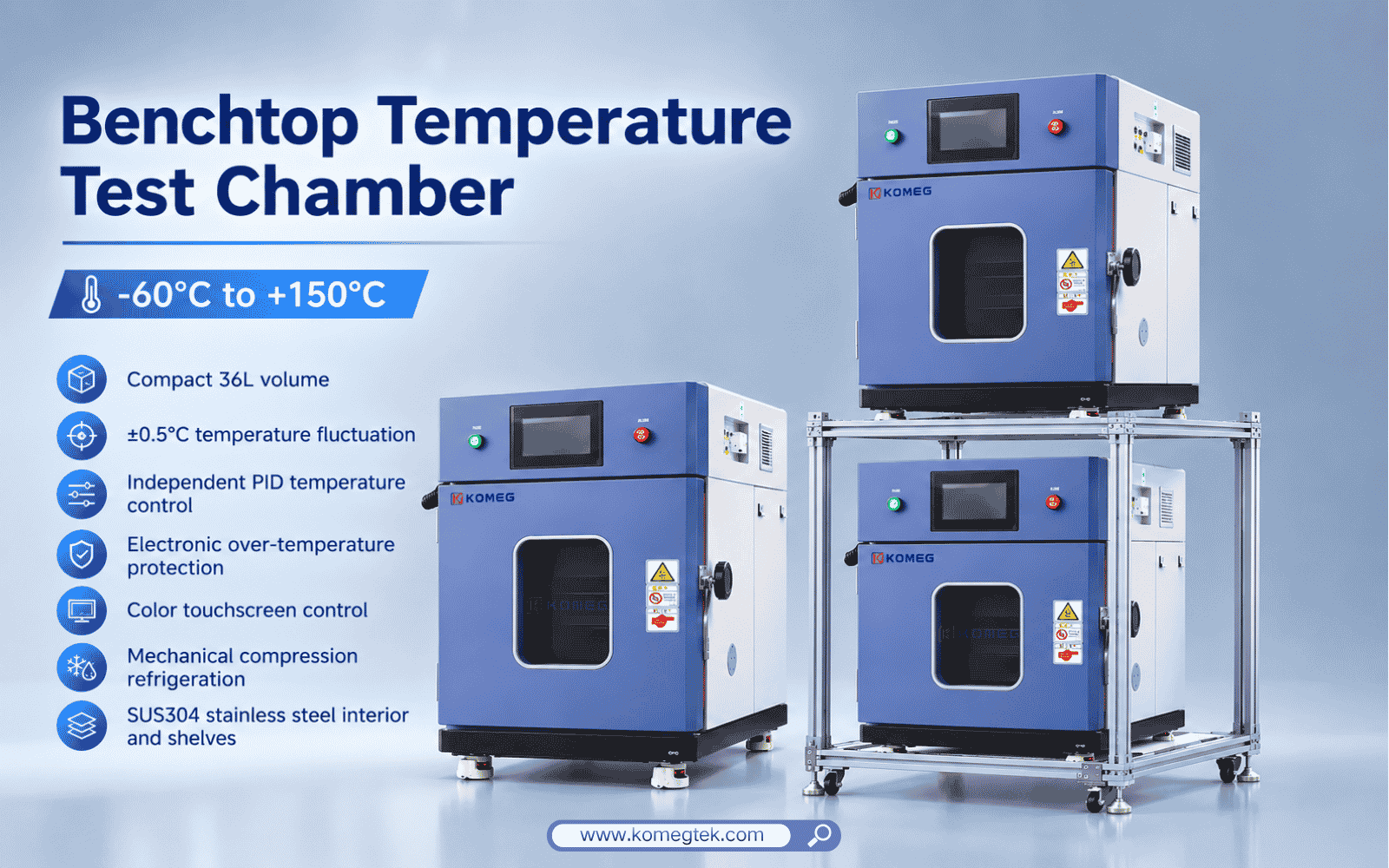
What Is a Benchtop Temperature Test Chamber?
A Benchtop Temperature Test Chamber is a compact environmental testing system designed to expose products, components, materials, and prototypes to controlled temperature conditions. Unlike large floor-standing or walk-in environmental chambers, a benchtop temperature chamber is optimized for relatively small test samples and laboratory environments where space, accessibility, and testing efficiency are important considerations.
The primary purpose of a benchtop chamber is not simply to provide a smaller testing space. It is to create a stable, repeatable, and controlled thermal environment in which engineers can evaluate how a product behaves at specific temperatures or through repeated temperature changes. This makes benchtop chambers particularly useful for component-level reliability testing, research and development, prototype verification, material evaluation, and laboratory testing.
Typical test samples include semiconductor packages, electronic components, PCBs, sensors, optical modules, small mechanical assemblies, materials, and other products that do not require the large working volume of a full-size environmental chamber.
For many R&D and reliability laboratories, the practical advantage is straightforward: a benchtop temperature test chamber provides controlled thermal testing capabilities while occupying significantly less laboratory space than a conventional floor-standing chamber.
Why Use a Benchtop Temperature Test Chamber?
Environmental testing equipment should be selected according to the test object and testing objective, rather than simply choosing the largest chamber available.
When engineers are testing a small electronic component, semiconductor package, sensor, optical module, or prototype, a large environmental chamber may provide considerably more working volume than the application actually requires. That additional space can increase equipment footprint, energy consumption, and operating cost without necessarily improving the quality of the test.
A benchtop temperature test chamber provides a more targeted solution for these applications. Its compact working volume allows the thermal environment to be controlled around relatively small samples, while its laboratory-oriented design makes it easier to position the chamber close to electrical measurement equipment, data acquisition systems, microscopes, optical instruments, or other R&D equipment.
The most important benefits typically include:
Compact footprint for laboratory and R&D environments
Controlled high- and low-temperature testing
Stable and repeatable thermal conditions
Convenient access to small test samples
Suitable for component and prototype testing
Easier integration with external measurement systems
Lower space requirements than large environmental chambers
Flexible solution for research and product development
The key point is that compact size should be viewed as an application advantage rather than simply a limitation. When the test sample is small, a properly designed benchtop chamber can provide the required thermal environment without introducing unnecessary equipment capacity.
How Does a Benchtop Temperature Test Chamber Work?
The operating principle of a benchtop temperature chamber is similar to that of larger temperature and environmental test chambers, although the refrigeration, heating, airflow, and control systems are designed around a smaller working volume.
The chamber uses a heating system and refrigeration system to adjust the internal air temperature according to the programmed setpoint. A temperature sensor continuously monitors the chamber condition, while the controller adjusts heating or cooling output to maintain the target temperature.
For low-temperature testing, the refrigeration system removes heat from the chamber. For high-temperature testing, an electric heating system raises the internal temperature. The controller coordinates these systems to maintain the required thermal conditions and reduce temperature fluctuation during the test.
Air circulation is also important. Even when the chamber reaches the correct average temperature, poor airflow can create temperature differences between different locations inside the workspace. Therefore, chamber design, airflow distribution, sensor positioning, insulation, and control algorithms all contribute to temperature uniformity and repeatability.
This is why evaluating a chamber based only on its minimum and maximum temperature specifications is not enough. Temperature range tells you what the chamber can reach; stability, uniformity, and recovery performance tell you how well it can maintain the test condition.
Key Performance Requirements of a Benchtop Temperature Chamber
Although a benchtop chamber is smaller than a conventional environmental chamber, its reduced size should not be interpreted as reduced technical requirements. For reliability testing, several performance parameters can directly influence the validity and repeatability of test results.
Temperature Range
The required temperature range should be determined from the product specification, internal test procedure, applicable testing standard, and expected operating environment.
For example, electronic components may need to be evaluated at both low and elevated temperatures to determine whether electrical performance changes outside normal operating conditions. A wider temperature range can also provide greater flexibility when the same chamber is used for different R&D projects.
A KOMEG benchtop temperature test chamber configuration, for example, can provide a temperature range of -60°C to +150°C, covering a broad range of component-level and laboratory temperature testing applications.
However, maximum temperature range should not be the only selection criterion. A chamber capable of reaching an extreme temperature may still be unsuitable if its stability, uniformity, recovery time, or thermal load capacity does not meet the requirements of the actual test.
Temperature Stability
Temperature stability describes how consistently the chamber maintains the programmed temperature over time.
This parameter becomes particularly important during long-duration temperature exposure tests or when evaluating temperature-sensitive components. Excessive fluctuation can introduce unwanted variables into the experiment and make it more difficult to determine whether a change in product performance is caused by the sample itself or by the testing environment.
For laboratory testing, stable temperature control helps improve test repeatability and makes results easier to compare across multiple test runs.
The KOMEG benchtop configuration discussed here provides temperature fluctuation of approximately ±0.5°C, supporting controlled thermal conditions for laboratory applications.
Temperature Uniformity
Temperature stability and temperature uniformity are related but different parameters.
Stability describes temperature variation over time at a given point, while uniformity describes the temperature difference between different locations within the working space.
For example, a chamber may maintain an average temperature of 85°C with very little fluctuation while still having several degrees of difference between the front, rear, upper, and lower areas of the workspace.
For component testing, engineers should therefore consider both parameters, especially when multiple samples are tested simultaneously or when sample positioning can influence the result.
Working Volume
Working volume determines how much test material, fixtures, cables, and measurement equipment can be placed inside the chamber.
A 36 L working volume, for example, can be sufficient for many component-level, PCB, sensor, optical, and prototype testing applications while maintaining a relatively compact laboratory footprint.
The correct chamber size should be determined by more than the physical dimensions of the sample. Engineers should also account for fixtures, spacing requirements, airflow around the samples, cable routing, and the thermal mass of the test load.
A common mistake is to select a chamber that is too small because the product itself fits inside. The better approach is to consider the complete test configuration, including the sample, fixture, instrumentation, and required airflow clearance.
Benchtop Temperature Test Chamber vs. Large Environmental Chamber
Choosing between a benchtop chamber and a larger environmental chamber is primarily an application decision.
A benchtop chamber is generally well suited to small samples and component-level testing, including semiconductor packages, electronic components, PCB assemblies, sensors, optical modules, small mechanical parts, material samples, and prototypes.
A larger floor-standing chamber becomes more appropriate when the test involves complete products, large assemblies, automotive components, battery systems, multiple large samples, or products with significant thermal mass.
The difference can be summarized by the relationship between sample size, working volume, thermal load, and test profile.
A large chamber is not automatically better. If a small component occupies only a fraction of a large chamber’s working volume, the additional capacity may provide little practical benefit. Conversely, using a small benchtop chamber for a large or thermally demanding test load can lead to longer recovery times and reduced testing flexibility.
The right question is therefore not:
“Which chamber is larger?”
It is:
“Which chamber provides the required thermal performance for the actual test load and test profile?”
What Tests Can Be Performed in a Benchtop Temperature Test Chamber?
Benchtop temperature chambers can support several types of controlled thermal testing, depending on their temperature range, control performance, and configuration.
Temperature Soak Testing
Temperature soak testing exposes a test sample to a controlled high or low temperature for a specified period.
This type of test is commonly used to evaluate whether a component continues to operate correctly after prolonged thermal exposure. Engineers may monitor electrical characteristics, dimensional changes, optical performance, mechanical behavior, or other product-specific parameters during or after the exposure.
Temperature soak testing is particularly useful during component development because it can reveal temperature-dependent failures that may not appear under normal laboratory conditions.
Temperature Cycling
Temperature cycling repeatedly changes the chamber between defined temperature setpoints.
For example, a test profile may alternate between a low-temperature condition and a high-temperature condition for a specified number of cycles. Repeated expansion and contraction can generate mechanical stress within materials and interfaces, potentially revealing weaknesses in solder joints, bonding structures, coatings, seals, connectors, and other components.
For small products and prototypes, a benchtop temperature chamber provides a practical way to perform controlled temperature cycling without requiring a large environmental testing system.
It is important to distinguish ordinary temperature cycling from rapid temperature change testing. A conventional benchtop chamber may be suitable for controlled temperature cycling, while applications requiring very high ramp rates may require a dedicated rapid-rate thermal cycling or thermal shock chamber.
High- and Low-Temperature Testing
Products may encounter significant temperature variations during manufacturing, transportation, storage, or operation.
High- and low-temperature testing allows engineers to evaluate product performance at defined environmental extremes and determine whether the product continues to meet its functional or reliability requirements.
For electronics, for example, low-temperature exposure can affect material properties, battery performance, displays, connectors, and electronic characteristics, while elevated temperatures can accelerate degradation mechanisms and reveal weaknesses in components or materials.
Material Aging and Thermal Exposure
Temperature can significantly influence the behavior and aging rate of polymers, adhesives, rubber, coatings, plastics, and other materials.
A controlled temperature chamber can be used to expose materials to defined thermal conditions for a specified duration and then evaluate changes in physical, mechanical, chemical, or functional properties.
For accelerated aging studies, temperature is often used as one of the environmental stress factors. However, the appropriate aging methodology depends on the material, failure mechanism, and applicable test procedure; simply increasing temperature does not automatically produce a meaningful accelerated-life test.
Applications of Benchtop Temperature Test Chambers
Semiconductor and Electronics Testing
Semiconductor packages and electronic components frequently require controlled thermal testing during product development and qualification.
A benchtop temperature chamber can be installed close to electrical test instruments, allowing engineers to combine temperature exposure with real-time electrical measurements. This configuration can be particularly useful for evaluating component functionality, thermal drift, startup behavior, and performance changes under controlled temperature conditions.
Optical and Photonic Component Testing
Optical modules and photonic components can be sensitive to temperature-induced dimensional changes, material expansion, alignment shifts, and changes in optical performance.
A controlled benchtop thermal environment allows engineers to investigate how optical components behave across a defined temperature range and determine whether temperature changes affect alignment, output characteristics, or system stability.
Sensor Development
Sensors often need to maintain measurement accuracy across a defined operating temperature range.
Temperature testing can help engineers evaluate measurement drift, response characteristics, sensitivity, and operational stability at different temperatures. Because sensor development frequently involves relatively small prototypes and repeated design iterations, a compact temperature chamber can be particularly useful during the R&D stage.
PCB and Electronic Assembly Testing
Printed circuit boards and small electronic assemblies can be exposed to controlled temperature conditions to evaluate component behavior, solder connections, connectors, materials, and system-level functionality.
When combined with external electrical measurement equipment, a benchtop chamber can become part of a broader automated or semi-automated reliability testing setup.
Prototype Verification
During product development, engineers often need to evaluate several prototype versions before entering formal qualification testing.
A benchtop temperature chamber provides a practical environment for these early-stage experiments because it allows small quantities of prototypes to be tested quickly without allocating a large environmental chamber.
This can make the equipment particularly valuable in R&D laboratories where testing requirements change frequently from one project to another.
Important Features to Consider When Selecting a Benchtop Temperature Test Chamber
Temperature range is only one part of chamber selection. A technically appropriate chamber should also match the laboratory’s operating conditions, test methodology, sample characteristics, and data requirements.
Temperature Controller
The controller determines how engineers interact with the chamber and how temperature profiles are created and maintained.
A modern temperature test chamber should provide accurate temperature control, programmable test sequences, monitoring functions, alarms, and an interface that is practical for daily laboratory use.
KOMEG benchtop chambers use a color touchscreen controller with PID-based temperature control to support programmable laboratory temperature testing.
Interior Construction
The interior chamber material should withstand repeated temperature changes and normal laboratory use.
SUS304 stainless steel is commonly used for environmental test chamber interiors because of its durability, cleanability, and corrosion resistance.
The interior design should also provide sufficient space for sample placement while maintaining appropriate airflow around the test load.
Safety Protection
Temperature chambers operate under heating and refrigeration conditions, so appropriate safety protection is essential.
Features such as electronic over-temperature protection, alarm systems, compressor protection, and other abnormal-condition safeguards can help protect the chamber, test samples, and laboratory personnel.
Safety requirements should be reviewed according to the intended application, local electrical requirements, and the manufacturer’s specifications.
Communication and Data Integration
Modern reliability laboratories increasingly rely on automated measurement and data acquisition.
Communication interfaces such as RS-232, RS-485, Ethernet, or USB, depending on the chamber configuration, can make it easier to integrate the chamber into laboratory monitoring and testing workflows.
This is particularly useful when environmental exposure must be synchronized with electrical, optical, mechanical, or functional measurements.
Thermal Load Capacity
One often-overlooked specification is the thermal load of the test sample.
A chamber may achieve its specified temperature range under an empty or lightly loaded condition, while a large thermal mass introduced into the workspace can increase the time required to reach the target temperature or recover after the door is opened.
Engineers should therefore evaluate chamber performance using the actual or expected test load, especially when testing metal fixtures, multiple samples, powered electronic devices, or other materials with significant heat capacity.
How to Choose the Right Benchtop Temperature Test Chamber
The best way to select a benchtop temperature chamber is to begin with the testing requirement rather than the product catalog.
First, define the required temperature range based on the product specification, test standard, internal qualification procedure, or expected operating environment. The chamber should provide sufficient margin beyond the required test points rather than operating continuously at its absolute limits.
Next, determine the sample dimensions, quantity, fixture arrangement, and thermal load. The nominal chamber volume should not be considered independently from the actual test configuration.
The next step is to define the required temperature stability, uniformity, and cycling characteristics. A simple temperature soak may have different performance requirements from repeated thermal cycling or temperature-sensitive measurement applications.
Engineers should also consider temperature recovery time, particularly if the chamber door will be opened frequently or if samples with high thermal mass are being tested.
Finally, evaluate the practical laboratory requirements, including available bench space, electrical power, ventilation, ambient operating conditions, communication interfaces, noise considerations, maintenance access, and proximity to other test equipment.
A well-selected chamber should fit not only the product being tested but also the entire laboratory workflow.
KOMEG Benchtop Temperature Test Chamber
KOMEG provides benchtop temperature test chamber solutions for laboratories and R&D environments that require controlled thermal testing in a compact format.
The configuration discussed in this article features a 36 L working volume, a temperature range of -60°C to +150°C, and a temperature fluctuation of approximately ±0.5°C. Its compact design is intended for laboratory applications where floor space is limited but stable temperature testing remains essential.
The chamber can be used for a range of component-level applications, including semiconductor packages, electronic components, PCBs, optical modules, sensors, materials, and prototype products.
For applications with different sample dimensions, temperature requirements, or testing profiles, chamber configuration should be selected according to the actual test conditions rather than relying solely on nominal chamber specifications.
Benchtop Temperature Test Chamber: What Matters Most?
A Benchtop Temperature Test Chamber is more than a compact alternative to a large environmental chamber. Its real value comes from providing the appropriate combination of temperature range, stability, uniformity, working volume, thermal capacity, repeatability, and laboratory flexibility for small-scale testing.
For semiconductor, electronics, optical, sensor, material, and prototype applications, a benchtop chamber can provide an efficient way to reproduce controlled thermal conditions while keeping the test system close to other laboratory instruments.
The most important selection principle is therefore simple: choose the chamber according to the test requirement, not simply the chamber size or maximum temperature specification.
Before purchasing a benchtop temperature test chamber, engineers should confirm the required temperature range, sample load, working volume, stability, uniformity, temperature cycling requirements, control functions, safety features, communication capability, and laboratory installation conditions.
When these factors are evaluated together, a compact temperature chamber can become a highly practical tool for product development, reliability engineering, and component-level environmental testing.
Looking for a Benchtop Temperature Test Chamber for your laboratory? Explore KOMEG’s temperature test chamber solutions and select a configuration based on your required temperature range, sample size, thermal load, and testing profile.