

Semiconductor devices are becoming smaller, faster, and more powerful, while their operating environments are becoming increasingly demanding. From conventional IC packages to SiC and GaN power devices, semiconductor products must maintain stable performance through repeated temperature changes during their service life.
This is why temperature testing is an important part of semiconductor reliability validation. However, simply exposing a device to a high or low temperature does not always create enough thermal stress to reveal potential weaknesses. In many applications, engineers need to repeatedly move the device between different temperature conditions at a controlled rate.
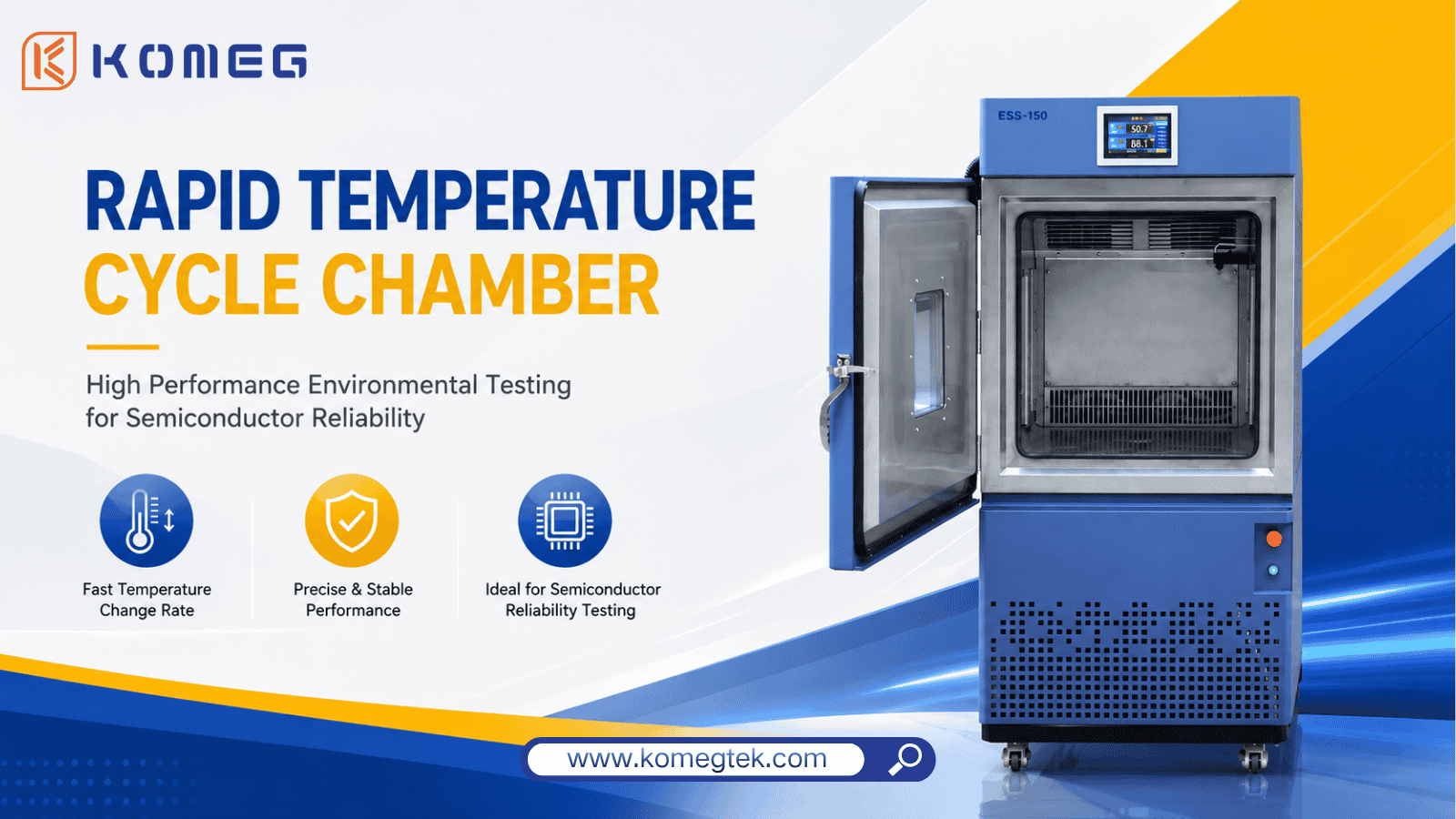
A Rapid Temperature Change Chamber for Semiconductor testing provides a controlled environment for this type of accelerated thermal cycling. By applying repeatable temperature transitions, engineers can evaluate how semiconductor packages, interconnects, materials, and assemblies respond to thermal stress and identify potential reliability issues before products enter large-scale production.
Why Rapid Temperature Change Testing Matters for Semiconductors
A semiconductor package is not made from a single material. Depending on the package structure, it may contain silicon, copper, solder, mold compounds, ceramics, organic substrates, adhesives, and other materials.
These materials can have different coefficients of thermal expansion. When temperature changes, each material responds differently. During repeated heating and cooling, these differences can generate mechanical stress at interfaces and connections.
Over many thermal cycles, this stress may contribute to potential failure mechanisms such as package cracking, delamination, solder joint fatigue, bond wire degradation, and changes in electrical performance.
A rapid temperature change chamber allows engineers to reproduce controlled thermal transitions repeatedly. Instead of waiting for these effects to develop naturally over a long period, accelerated testing can help reveal weaknesses during product development and qualification.
The objective is not simply to reach an extreme temperature. The temperature transition itself is an important part of the reliability test profile.
What Does a Rapid Temperature Change Chamber Do?
A rapid temperature change chamber controls the heating and cooling process to create repeatable temperature profiles inside the test space.
During a typical test, the semiconductor device may be exposed to a low-temperature condition, transitioned toward a high-temperature condition, held for a specified period, and then returned to the low-temperature condition. This sequence can be repeated for a defined number of cycles.
Compared with conventional temperature soaking, rapid temperature cycling places greater emphasis on the transition between temperature conditions.
The chamber therefore requires more than a heating element and a refrigeration system. Heating capacity, refrigeration performance, airflow, temperature control, insulation, and control algorithms all influence how effectively the chamber can reproduce the required thermal profile.
For semiconductor reliability testing, stable and repeatable temperature transitions are particularly important because inconsistent thermal profiles can make test results difficult to compare.
Rapid Temperature Change vs. Standard Temperature Testing
Standard temperature chambers are commonly used for high-temperature exposure, low-temperature exposure, temperature stability testing, and long-term environmental conditioning.
These tests are useful for determining whether a semiconductor device can operate or remain stable under a specific temperature condition.
Rapid temperature change testing has a different emphasis.
Instead of maintaining the DUT at one temperature for an extended period, the test repeatedly exposes the device to changing thermal conditions. The resulting thermal expansion and contraction can create additional mechanical stress within the package and its interfaces.
This makes rapid temperature cycling particularly useful when the reliability objective involves:
Thermal stress evaluation
Package reliability
Interconnect durability
Solder joint fatigue
Material interface reliability
Environmental Stress Screening
Accelerated defect identification
The two test approaches are therefore complementary rather than interchangeable. A semiconductor qualification program may require both thermal soaking and thermal cycling depending on the device and applicable test requirements.
Why Ramp Rate Matters in Semiconductor Testing
One of the most important specifications when selecting a rapid temperature change chamber is the temperature change rate, commonly referred to as the ramp rate.
A chamber may be specified for a certain temperature change rate, but engineers should understand exactly how that value is defined.
For example, an advertised rate of 10°C/min may represent an average temperature change across a specified temperature range. Another chamber may provide a controlled linear ramp over a defined portion of the temperature range.
These two approaches can produce different thermal profiles.
Linear Temperature Change Rate
A linear ramp aims to maintain a relatively consistent temperature change rate throughout the specified test interval.
This can be important when a semiconductor reliability procedure requires a defined thermal transition profile.
Average or Non-Linear Temperature Change Rate
An average ramp rate describes the overall time required to move between two temperature points. The actual rate may vary during the transition, becoming faster in one portion of the cycle and slower as the chamber approaches the target temperature.
For this reason, engineers should not compare ramp-rate numbers without understanding the test conditions behind them.
The key question is not simply:
“How fast can the chamber change temperature?”
It is:
“Can the chamber reproduce the required thermal profile with the actual DUT load?”
Thermal Mass and Active Heat Load
Empty-chamber performance does not necessarily represent actual semiconductor test performance.
A chamber may achieve a high temperature change rate when operating without a load, but the transition rate can change significantly when semiconductor devices, test fixtures, trays, cables, and other materials are placed inside.
Thermal mass is therefore an important factor during equipment selection.
For semiconductor testing, engineers should consider the total mass of:
Devices under test
Test boards
Metal fixtures
Trays and shelves
Cabling and connectors
Additional mounting structures
The materials used in these components also matter. Copper, aluminum, steel, ceramics, and PCB materials absorb and release heat at different rates.
Active electrical loads add another level of complexity.
If semiconductor devices are powered during testing, they generate heat while the chamber is simultaneously trying to change the environmental temperature. The refrigeration system must therefore remove both the heat generated by the DUT and the heat entering the chamber from the surrounding environment.
This is why a chamber should be evaluated based on its expected real test load, rather than its empty-chamber specification alone.
Semiconductor Failure Mechanisms Revealed by Thermal Cycling
Rapid temperature cycling can help engineers investigate several potential semiconductor failure mechanisms.
Package Cracking
Repeated thermal expansion and contraction can create mechanical stress within semiconductor packages. Under sufficiently demanding conditions, this stress may contribute to cracking in package materials or interfaces.
Delamination
Different materials within a semiconductor package can experience different levels of thermal expansion. Repeated cycling may contribute to separation between material interfaces, potentially affecting mechanical and environmental protection.
Solder Joint Fatigue
Solder joints can experience repeated mechanical stress as connected materials expand and contract at different rates. Thermal cycling can therefore be used to evaluate solder joint durability.
Bond Wire and Interconnect Reliability
Internal electrical connections can also be affected by repeated thermal stress. Depending on the package structure and test conditions, thermal cycling may help expose weaknesses in bonding or interconnect structures.
Electrical Performance Drift
Some semiconductor devices may show changes in electrical characteristics after repeated environmental exposure. Monitoring device performance throughout or after thermal cycling can provide additional information about reliability degradation.
These failure mechanisms are influenced by package design, materials, manufacturing processes, thermal profile, and test conditions. Environmental testing should therefore be interpreted together with electrical and physical failure analysis.
Applications of Rapid Temperature Change Chambers in Semiconductor Testing
Rapid temperature change chambers can support reliability testing across a wide range of semiconductor products.
IC Packages
Conventional integrated circuit packages can undergo thermal cycling to evaluate package-level mechanical and electrical reliability.
Power Semiconductors
Power semiconductor devices are exposed to significant thermal loads during operation. Thermal cycling can help evaluate the reliability of packages, interconnects, and material interfaces.
SiC and GaN Devices
The increasing use of silicon carbide and gallium nitride devices in electric vehicles, power conversion, renewable energy, and high-frequency applications is creating new reliability challenges.
High power density and demanding operating conditions make thermal management and reliability validation particularly important for these devices.
Rapid temperature cycling can be incorporated into qualification and reliability programs to evaluate how these advanced semiconductor packages respond to repeated environmental stress.
Semiconductor Modules
Module-level testing can involve larger thermal masses and more complex assemblies than individual semiconductor packages. Chamber capacity, airflow, refrigeration performance, and active heat load must therefore be considered carefully.
Semiconductor and Electronic Assemblies
Semiconductor devices are often integrated into PCBs and larger electronic systems. Environmental testing at the assembly level can help identify interactions between semiconductor packages, circuit boards, connectors, and other components.
Semiconductor Thermal Cycling Standards
The appropriate testing standard depends on the semiconductor device, package structure, application, and qualification program.
Several standards and test methods are commonly associated with semiconductor environmental and reliability testing, including:
JESD22-A104 for temperature cycling of semiconductor devices.
MIL-STD-883 for environmental and reliability testing of microelectronic devices.
IEC 60068-2-14 for change of temperature testing.
These standards should not be treated as interchangeable. Each test method has its own conditions, procedures, and acceptance criteria.
Before selecting a chamber, engineers should identify the specific standard and test procedure applicable to the product. The chamber should then be configured to reproduce the required temperature range, transition rate, dwell conditions, sample load, and monitoring requirements.
How to Select a Rapid Temperature Change Chamber for Semiconductor Testing
Selecting the right chamber starts with the test profile rather than the equipment specification.
Temperature Range
Determine the actual minimum and maximum temperatures required by the reliability test.
A chamber designed for a specific semiconductor application should provide sufficient operating margin beyond the required test range when appropriate.
Temperature Change Rate
Define the required ramp rate and determine whether the test requires a linear or average temperature change rate.
Do not compare ramp-rate specifications without checking the temperature range, load conditions, and measurement method.
DUT Thermal Mass
Calculate the combined thermal mass of the semiconductor devices, fixtures, test boards, trays, and other materials inside the chamber.
This is particularly important when testing larger semiconductor modules or multiple devices simultaneously.
Active Heat Load
If the DUTs are powered during testing, include their electrical heat generation when evaluating chamber performance.
A chamber that performs well with unpowered samples may require a different refrigeration configuration when testing active devices.
Airflow
Fast temperature changes require efficient heat transfer between the chamber air and the DUT.
Air circulation design should therefore provide sufficient airflow across the test area while maintaining temperature uniformity.
Condensation Protection
When the test involves significant temperature transitions, moisture condensation can become a concern, particularly when moving from cold conditions toward warmer environments.
Depending on the test configuration, appropriate condensation-control measures may be required to protect sensitive electronic assemblies.
Monitoring and Communication
Semiconductor reliability testing often involves external measurement systems.
Depending on the laboratory setup, engineers may require communication interfaces, data logging, cable ports, or integration with external electrical measurement equipment.
KOMEG Rapid Temperature Change Chambers for Semiconductor Testing
KOMEG designs and manufactures environmental test chambers for semiconductor, electronics, automotive, optical communication, and other reliability testing applications.
For semiconductor applications requiring rapid thermal transitions, KOMEG Rapid Temperature Change Chambers are designed around the actual testing requirements rather than temperature range alone.
The chamber configuration can be considered according to factors such as required temperature range, temperature change rate, chamber volume, DUT thermal mass, active heat load, airflow requirements, and test profile.
This approach is particularly useful for semiconductor applications where the difference between an empty-chamber specification and actual loaded performance can have a significant impact on test results.
KOMEG also provides different environmental testing solutions for applications requiring conventional temperature and humidity testing, rapid temperature cycling, thermal shock testing, and customized environmental test systems.
For engineers developing semiconductor reliability programs, the appropriate chamber should ultimately be determined by the complete test profile and the physical characteristics of the DUT.
Frequently Asked Questions
What is a rapid temperature change chamber for semiconductor testing?
It is an environmental test chamber designed to create controlled and repeatable temperature transitions for semiconductor devices, packages, modules, and related electronic assemblies.
What ramp rate is required for semiconductor thermal cycling?
There is no single ramp rate suitable for every semiconductor application. The required rate depends on the applicable test standard, device structure, temperature range, thermal mass, active heat load, and reliability objective.
What is the difference between thermal cycling and thermal shock?
Thermal cycling generally uses controlled repeated temperature transitions, while thermal shock is designed to create much more abrupt transitions between temperature environments. The appropriate method depends on the required reliability test.
Can semiconductor devices be tested while powered?
Yes, some reliability programs require powered or operational testing. In this case, the chamber must be evaluated according to the additional heat generated by the DUT and the requirements of the test procedure.
Why does DUT thermal mass affect ramp rate?
The DUT and its fixtures absorb or release thermal energy during temperature transitions. Greater thermal mass increases the amount of energy that the chamber heating and refrigeration systems must manage, which can affect the actual temperature change rate.
Can KOMEG customize a rapid temperature change chamber for semiconductor testing?
Yes. KOMEG can develop environmental testing solutions around application-specific requirements, including temperature range, ramp rate, chamber volume, DUT thermal load, and test configuration.
Semiconductor reliability testing is not simply about determining whether a device can survive a high or low temperature. Repeated temperature changes can create thermal-mechanical stresses that reveal potential weaknesses in packages, interconnects, solder joints, material interfaces, and assemblies.
A properly selected Rapid Temperature Change Chamber for Semiconductor testing provides engineers with a controlled environment for reproducing these thermal profiles consistently.
When selecting equipment, the advertised ramp rate should only be the starting point. Temperature range, linearity, DUT thermal mass, active heat load, airflow, condensation protection, monitoring requirements, and applicable standards all need to be considered together.
For semiconductor manufacturers and reliability laboratories, matching the chamber to the actual test profile is essential for obtaining meaningful, repeatable, and actionable reliability data.