

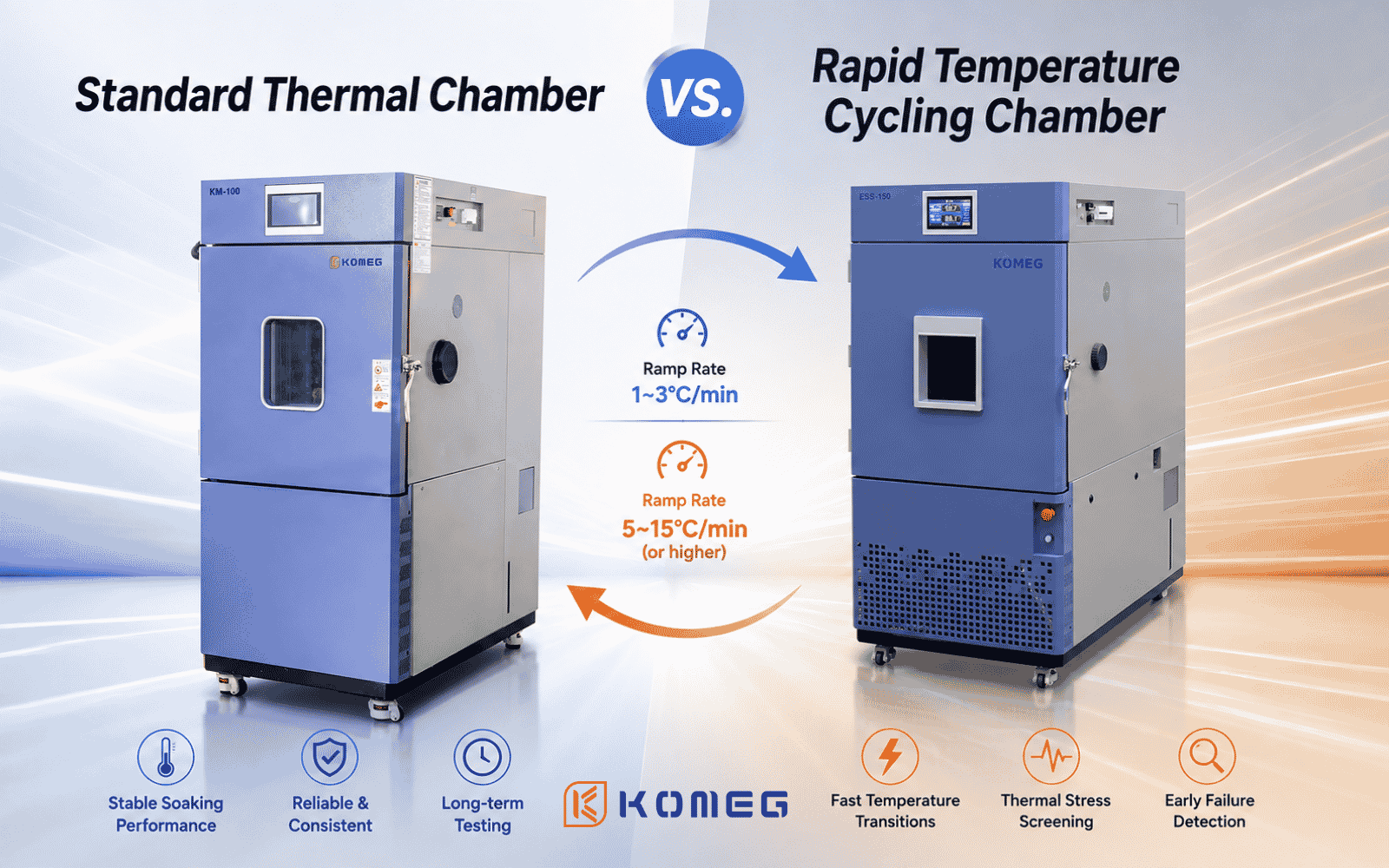
When engineers compare a Rapid Temperature Cycling Chamber with a standard temperature test chamber, the difference is not simply the temperature range. Both systems can expose products to high and low temperatures, but they are designed around different testing objectives.
A standard thermal chamber is primarily used for thermal soak, temperature exposure, and environmental adaptation testing. The product is held at a defined temperature long enough to evaluate its performance, stability, or material behavior. A rapid temperature cycling chamber, in contrast, is designed to create fast and repeated temperature transitions, increasing thermal stress and helping engineers identify weaknesses that may not appear during conventional temperature exposure.
The most important technical difference is therefore the temperature change rate, or ramp rate.
Standard Thermal Chamber vs. Rapid Temperature Cycling Chamber
A standard temperature chamber typically focuses on maintaining stable environmental conditions. Depending on the chamber design, application, sample load, and test profile, temperature transition rates are commonly in the lower range, often around 1°C/min to 3°C/min under specified conditions.
A rapid temperature cycling chamber is engineered for substantially faster transitions. Depending on the model and test configuration, systems may provide ramp rates of 5°C/min, 10°C/min, 15°C/min or higher.
This difference changes how the product is stressed during testing.
With a standard chamber, the main question is often: Can the product continue to perform reliably after being exposed to a specific temperature for a defined period?
With rapid temperature cycling, the question becomes: What happens when the product is repeatedly forced to transition quickly between significantly different temperatures?
That distinction is particularly important for electronics, automotive components, semiconductor devices, batteries, aerospace equipment, and other products containing multiple materials and interfaces.
Why Does Ramp Rate Matter So Much?
Temperature change does not affect every part of a product at exactly the same time. When the chamber temperature changes rapidly, the external surface of a component can respond faster than its internal structure.
This creates temperature gradients within the product.
Different materials also respond differently to temperature because they have different coefficients of thermal expansion (CTE). Metals, ceramics, polymers, solder materials, semiconductor packages, PCB substrates, and adhesives can expand or contract at different rates.
When these materials are bonded or mechanically connected, repeated rapid temperature transitions can create mechanical stress at their interfaces.
This is one reason why a test at 10°C/min cannot simply be treated as a faster version of a conventional temperature test. The refrigeration system, heating capacity, airflow, control algorithm, insulation, and mechanical construction all need to work together to achieve the required transition rate while maintaining repeatable conditions.
What Makes a Rapid Temperature Cycling Chamber Different?
Achieving a high ramp rate requires substantially more than simply increasing the heating power.
The refrigeration system needs enough capacity to remove heat quickly from the working space and from the test load. Depending on the chamber design and required performance, this may involve high-capacity compressors, optimized refrigeration circuits, liquid-injection technologies, or other specialized cooling approaches.
Air circulation is equally important.
A rapid temperature change is only useful if the test sample actually experiences the intended thermal transition. High-performance circulation systems help move conditioned air efficiently around the product and improve heat transfer between the chamber environment and the sample surface.
The control system must also coordinate heating, cooling, airflow, and refrigeration capacity without causing excessive overshoot or instability.
This is why two chambers with the same nominal temperature range can have completely different capabilities when it comes to temperature change rate.
Linear Ramp vs. Average Ramp Rate
This is an important specification that engineers sometimes overlook when comparing chambers.
A chamber may advertise a particular temperature change rate, but the calculation method matters.
A linear ramp rate means that the chamber follows a relatively consistent temperature transition throughout the specified range. For example, a requirement of 10°C/min may mean that the chamber is expected to maintain approximately that rate rather than simply achieving an average speed over the entire transition.
An average ramp rate, on the other hand, is calculated from the total temperature difference divided by the total transition time.
These two specifications should not automatically be considered equivalent.
For demanding applications, engineers should ask the chamber manufacturer how the ramp rate is measured, whether the test is performed under no-load or loaded conditions, what temperature range is used for the calculation, and whether the stated performance complies with the intended test standard.
This becomes particularly important when comparing 5°C/min, 10°C/min, and 15°C/min chambers.
What Can a Standard Thermal Chamber Reveal?
Standard temperature chambers remain extremely useful because not every reliability problem requires aggressive thermal cycling.
A conventional chamber can evaluate how products behave during prolonged exposure to high or low temperatures. Typical concerns include material deformation, electrical parameter drift, insulation performance, battery behavior, thermal aging, and long-term component stability.
For example, an electronic component may need to remain at an elevated temperature for several hundred hours to determine whether its electrical characteristics remain within specification.
In this type of test, maintaining a stable temperature for an extended period may be more important than achieving a very fast temperature transition.
For many quality-control and environmental qualification programs, a standard thermal chamber is therefore the more practical solution.
What Can Rapid Temperature Cycling Reveal?
Rapid temperature cycling introduces another type of stress: thermal fatigue.
Consider an electronic assembly containing a semiconductor package mounted on a PCB. The semiconductor package, solder joints, PCB substrate, and surrounding materials all have different CTE values.
During repeated temperature transitions, these materials expand and contract at different rates. Over many cycles, the resulting mechanical stress can contribute to:
- Solder joint cracking
- Package or interface delamination
- Micro-connection fatigue
- Adhesive separation
- PCB layer delamination
- Connector or interconnect degradation
- Sealing failure
Some of these defects may remain invisible during a conventional temperature soak but become apparent after repeated thermal cycling.
This is why rapid temperature cycling is often used as an accelerated reliability and stress-screening method.
Why Rapid Temperature Cycling Costs More
The higher cost of a rapid temperature cycling chamber is largely related to its engineering requirements.
A chamber designed for 10°C/min or higher must move significantly more thermal energy in a shorter period. That requires greater heating and cooling capacity, stronger airflow management, more sophisticated refrigeration control, and a system architecture designed around rapid transitions.
The chamber also needs to maintain temperature uniformity while changing temperature quickly. Increasing airflow or refrigeration capacity alone does not automatically produce good test performance.
The complete system has to be designed around the required thermal profile.
For this reason, when purchasing a rapid temperature cycling chamber, engineers should evaluate the actual loaded ramp rate, not simply the maximum specification shown on a brochure.
Which Chamber Should You Choose?
The right chamber depends primarily on the purpose of the test.
Choose a Standard Thermal Chamber When:
Your primary objective is temperature exposure, thermal aging, storage testing, or environmental performance evaluation.
Typical applications include consumer electronics quality control, medical equipment storage testing, material evaluation, component qualification, and long-duration thermal exposure.
In these applications, stable temperature control and uniformity may be more important than an extremely fast ramp rate.
Choose a Rapid Temperature Cycling Chamber When:
Your testing program requires rapid and repeated temperature transitions or accelerated thermal stress screening.
This is particularly relevant to automotive electronics, semiconductor devices, aerospace electronics, military equipment, high-reliability PCBs, and products containing multiple materials with different CTE characteristics.
Standards and qualification programs such as IEC 60068-2-14, MIL-STD-883, and JEDEC JESD22-A104 may involve temperature cycling requirements, although the exact test conditions should always be determined from the applicable standard and product qualification plan.
What About Automotive and Semiconductor Testing?
The difference becomes particularly important in industries where reliability margins are tight.
Automotive electronics, for example, may be exposed to repeated temperature changes throughout the vehicle’s service life. Semiconductor packages and electronic modules can also experience thermal stress as operating conditions change.
For qualification programs associated with standards such as AEC-Q100 and AEC-Q200, thermal cycling may be part of a broader reliability validation program.
In aerospace and defense applications, environmental stress screening and qualification programs may similarly use controlled temperature transitions to expose manufacturing or design weaknesses.
The objective is not simply to make the chamber temperature change quickly. The thermal profile must reproduce the intended stress conditions consistently and repeatedly.
How to Compare Rapid Temperature Cycling Chambers
Before selecting equipment, engineers should ask several practical questions.
What ramp rate is actually required?
A requirement for 5°C/min is very different from a requirement for 15°C/min.
Is the ramp rate linear or average?
The calculation method can significantly affect how different chambers compare.
Is the specification based on an empty chamber or an actual product load?
A chamber may reach its advertised ramp rate under no-load conditions but perform differently when testing a large or heat-generating product.
What is the sample’s dynamic heat load?
Powered electronic devices can generate significant heat during testing, which can affect the chamber’s ability to maintain the required profile.
What temperature range is required?
A chamber designed for -40°C to +150°C may have a very different refrigeration architecture from one designed for -70°C to +180°C with a high ramp rate.
Which standard governs the test?
The equipment should be selected according to the actual test method rather than a generic ramp-rate specification.
KOMEG Rapid Temperature Change Chambers
KOMEG develops Rapid Temperature Change Chambers for applications requiring controlled and repeatable thermal transitions.
Depending on the configuration, KOMEG systems can be designed around different temperature ranges, ramp rates, test volumes, sample loads, and communication requirements. The equipment is intended for applications where rapid thermal stress is an important part of product reliability validation.
For engineers evaluating a requirement such as 10°C/min, the key question is not simply whether a chamber can reach that number. The more important consideration is whether it can maintain the required thermal profile with the actual product load while delivering stable and repeatable test conditions.
You can learn more about KOMEG’s Rapid Temperature Change Chambers and their available configurations through the product page.
The Real Difference: Testing Objective, Not Just Speed
A standard thermal chamber and a rapid temperature cycling chamber are not competing versions of the same machine.
A standard chamber is generally optimized for stable temperature exposure, thermal aging, and environmental adaptation. A rapid temperature cycling chamber is optimized for fast thermal transitions and accelerated thermal stress.
The right choice therefore depends on what you are trying to discover.
If the objective is to understand how a product performs after prolonged exposure to a specific temperature, a standard thermal chamber may be sufficient. If the objective is to expose weaknesses caused by repeated thermal expansion and contraction, a rapid temperature cycling chamber may be the better tool.
The ramp rate is the starting point—but sample thermal mass, dynamic heat load, test profile, chamber uniformity, control method, and applicable standard ultimately determine whether the equipment is suitable for the application.
Need Help Selecting a Rapid Temperature Change Chamber?
Not sure whether your dynamic heat load requires 5°C/min or 10°C/min?
Talk to a KOMEG reliability engineer for thermal profile analysis and equipment sizing based on your actual product, test conditions, and reliability requirements.