

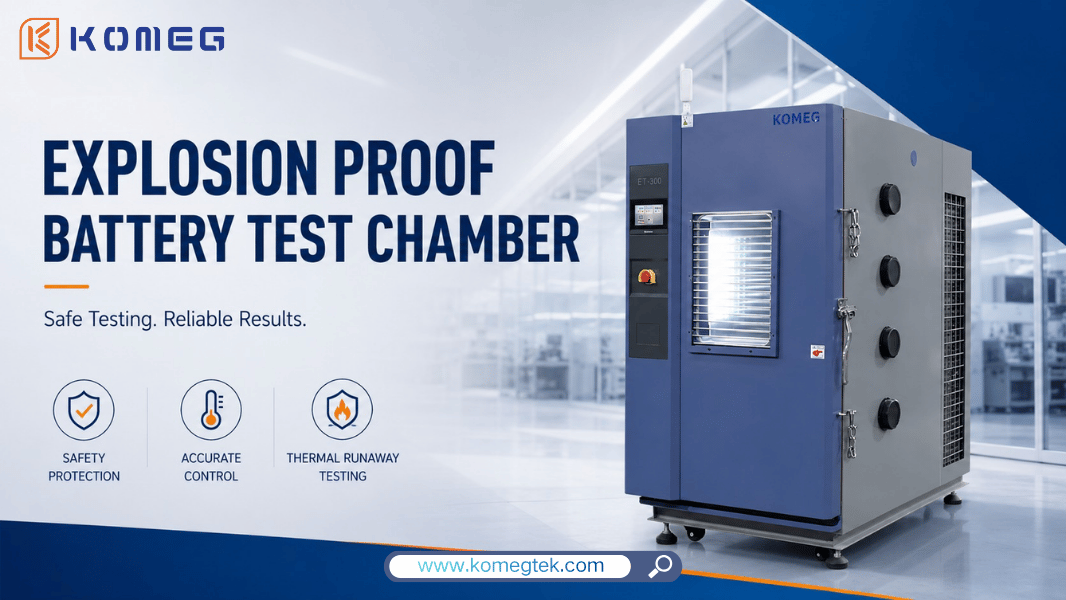
Lithium-ion batteries are now used across electric vehicles, energy storage systems, consumer electronics, telecommunications, and industrial equipment. As battery energy density increases, environmental testing becomes more demanding. A battery may perform normally under standard laboratory conditions but develop internal faults when exposed to extreme temperature, humidity, or repeated thermal cycling.
For this reason, battery manufacturers and test laboratories increasingly use specialized Explosion Proof Battery Test Chambers to evaluate battery performance while maintaining a controlled and protected testing environment.
The purpose of such a chamber is not simply to control temperature. It is to manage the potential hazards associated with battery testing, including thermal runaway, rapid gas release, pressure buildup, fire, and secondary damage to the test equipment.
Why Battery Testing Requires Additional Safety Protection
Battery testing is different from conventional environmental testing because the test specimen itself can become the source of a hazardous event.
A lithium-ion battery subjected to excessive heat, overcharge, internal short circuit, or mechanical damage may enter thermal runaway. During this process, the battery can release heat and flammable gases. If the generated gases accumulate and ignite, the resulting pressure and flame can damage equipment and create significant laboratory safety risks.
Environmental stress can also expose defects that are difficult to detect during normal electrical testing. Repeated temperature changes, for example, can accelerate degradation of battery materials, seals, welds, and internal interfaces.
A properly engineered battery test chamber therefore needs to provide two functions at the same time: accurate environmental simulation and controlled risk management.
What Does an Explosion-Proof Battery Test Chamber Do?
An explosion-proof battery test chamber is a specialized environmental testing system designed for battery cells, modules, packs, and related components. It provides controlled temperature and, depending on the configuration, humidity conditions while incorporating additional safety mechanisms for abnormal battery events.
The exact safety configuration depends on the battery chemistry, energy level, sample size, and intended test procedure. Typical systems may include reinforced chamber construction, explosion-resistant observation windows, pressure relief mechanisms, fire detection and suppression, gas monitoring, temperature limit protection and emergency shutdown functions.
KOMEG’s battery thermal test chambers, for example, can be configured with reinforced structures, additional temperature limiters, anti-spark interior components, pressure-release ports, H₂ and CO detection, inerting systems and fire detection or suppression systems.
This modular approach is important because a chamber used for a small battery cell does not necessarily require the same protection strategy as one used for a high-energy battery module or EV battery pack.
Key Safety Features to Consider
Reinforced Chamber Construction
The chamber structure should be designed according to the potential energy and failure mode of the battery under test. Reinforced construction helps protect the surrounding laboratory environment if a sudden pressure event occurs.
The internal layout is equally important. Components located inside the test space should be selected and positioned to minimize potential ignition sources and withstand the expected thermal conditions.
Pressure Relief
Thermal runaway can generate gases rapidly. If the chamber is completely sealed, uncontrolled pressure accumulation can become a major hazard.
A dedicated pressure-release design allows abnormal pressure to be directed through a controlled path rather than allowing it to build up inside the chamber. The pressure relief strategy should be engineered according to the chamber volume, battery energy, and expected failure scenario.
Gas Detection
Battery failure can release gases such as hydrogen and carbon monoxide, depending on the battery chemistry and failure conditions. Gas monitoring can therefore provide an additional layer of protection.
KOMEG battery testing systems can be configured for high-level H₂ and CO detection, allowing the safety system to respond to abnormal gas conditions.
For larger battery systems, gas detection should be considered together with ventilation, exhaust routing and laboratory safety procedures rather than treated as an isolated component.
Fire Detection and Suppression
Fire detection provides an additional response mechanism when a battery begins to fail. Depending on the application, the chamber can be equipped with a suitable fire suppression system.
KOMEG’s battery test chamber solutions can be configured with fire detection and suppression functions, including CO₂-based suppression options.
The appropriate extinguishing method should always be selected according to the battery chemistry, test procedure, and applicable laboratory safety requirements.
Temperature Control Is Still the Core Testing Function
Safety features do not replace environmental control. A battery test chamber must still provide stable and repeatable temperature conditions throughout the test space.
Battery temperature testing may involve low-temperature storage, high-temperature exposure, temperature cycling and other environmental profiles. Depending on the test standard and battery application, the required temperature range can vary considerably.
For example, KOMEG’s UL 1642 battery temperature cycle chamber is designed for temperature cycling from approximately -70°C to +150°C, with configurations covering test conditions associated with standards such as UN 38.3, UL 1642 and UL 2054.
For battery laboratories, temperature uniformity, control accuracy, recovery time and airflow distribution are therefore just as important as the chamber’s safety system.
Which Battery Standards May Require Environmental Testing?
There is no single battery testing standard that applies to every application. The appropriate test program depends on whether the battery is intended for transportation, consumer products, electric vehicles, industrial applications or stationary energy storage.
UN 38.3 is particularly important for lithium batteries intended for transportation, while UL 1642, UL 2054 and UL 2580 are commonly encountered in battery product safety testing.
For industrial and stationary lithium battery applications, IEC 62619:2022 specifies safety requirements and tests for secondary lithium cells and batteries. Its scope includes applications such as telecommunications, UPS systems, and electrical energy storage systems.
For battery energy storage systems, UL 9540A focuses specifically on evaluating thermal runaway fire propagation. The latest sixth edition was published in March 2026, reflecting the industry’s increasing focus on thermal runaway and large-scale fire behavior.
The important point is that the test chamber should be selected after the required test method has been defined, rather than choosing a chamber first and attempting to adapt the test procedure afterward.
How to Select the Right Explosion-Proof Battery Test Chamber
Several factors should be evaluated before purchasing a battery safety test chamber.
First, determine the maximum battery energy and sample configuration. A chamber for individual cells has very different safety requirements from one designed for modules, packs, or ESS components.
Next, define the required temperature range, humidity range, ramp rate, and test duration. These parameters determine the refrigeration, heating and airflow architecture of the chamber.
The third consideration is the failure scenario. If thermal runaway is part of the expected test program, the chamber may require pressure relief, gas detection, fire suppression, and reinforced construction rather than standard environmental chamber protection.
Finally, consider the laboratory’s exhaust system, electrical supply, emergency shutdown strategy, and integration with external safety equipment. A battery test chamber should be treated as part of the laboratory’s overall safety system, not as an independent piece of equipment.
KOMEG Explosion Proof Battery Test Chamber Solutions
KOMEG develops battery environmental test chambers for applications ranging from battery cells and modules to larger battery systems. Depending on the testing requirements, the equipment can incorporate explosion-resistant construction, pressure relief, temperature limit protection, gas detection, fire suppression and other safety functions.
The chamber configuration can also be customized according to sample dimensions, temperature range, test method and required safety protection. This makes the system suitable for battery R&D, quality validation, automotive battery testing and laboratory reliability programs.
For organizations developing EV batteries, energy storage systems or industrial lithium-ion products, the most suitable chamber is not necessarily the one with the largest temperature range. The better choice is the chamber whose environmental performance and safety architecture match the actual failure risks of the battery being tested.
FAQ
What is an explosion-proof battery test chamber?
It is a battery environmental test chamber equipped with additional safety measures designed to manage risks such as thermal runaway, gas release, pressure buildup, and fire during battery testing.
Is an explosion-proof chamber required for every battery test?
Not necessarily. The required protection level depends on the battery chemistry, energy capacity, test method, and potential failure scenario. High-energy cells, modules and battery packs generally require more comprehensive safety protection than low-energy samples.
What safety features should a battery test chamber have?
Depending on the application, important features may include reinforced construction, pressure relief, explosion-resistant observation windows, temperature limit protection, gas detection, emergency shutdown, and fire detection or suppression.
Can an explosion-proof battery test chamber be customized?
Yes. Chamber size, temperature range, cooling capacity and safety functions can be configured according to the battery sample and testing requirements. KOMEG offers customized battery thermal test chamber solutions for different battery testing applications.