

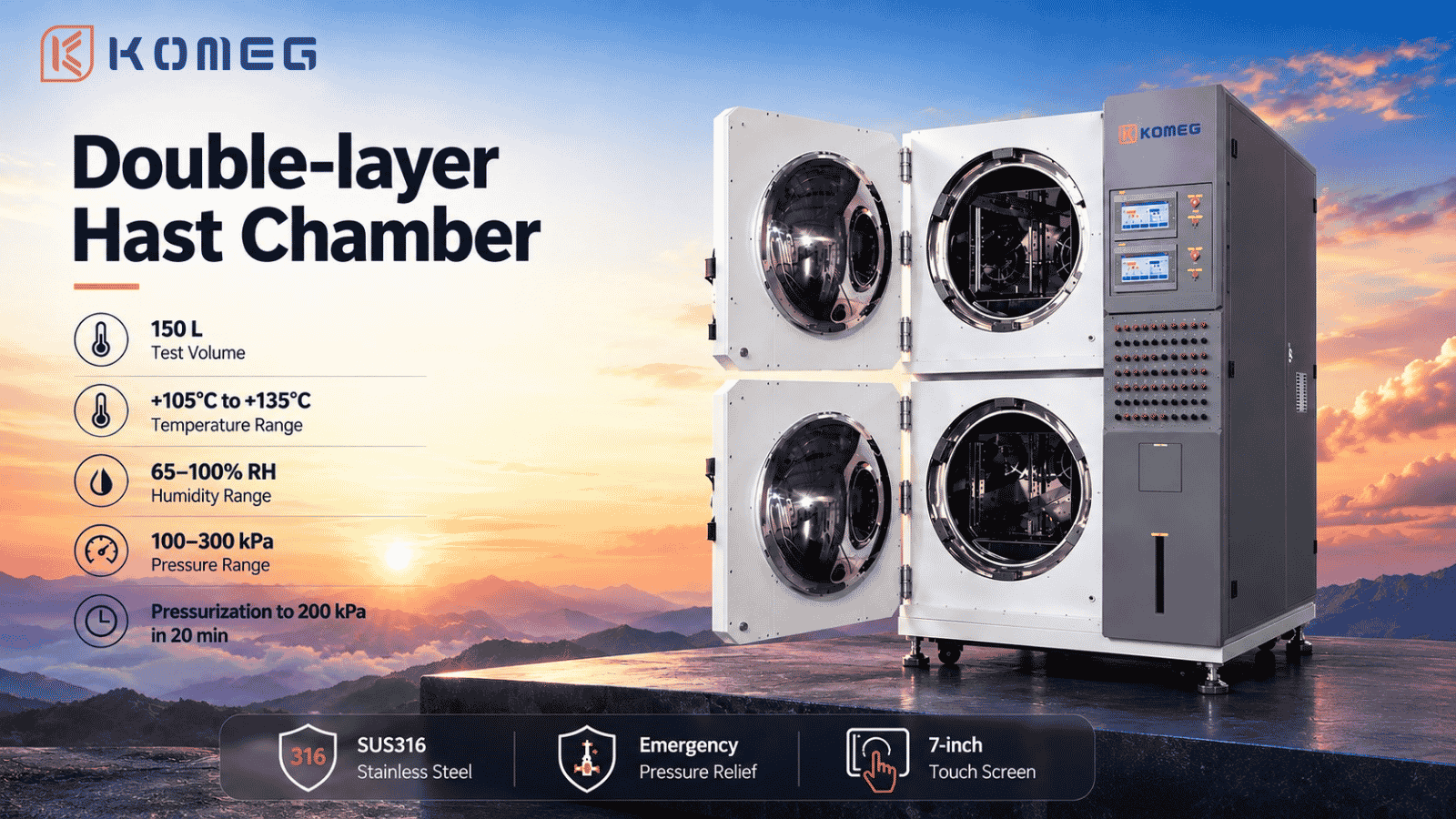
As semiconductor devices become smaller, denser, and more highly integrated, reliability testing has become increasingly important throughout the development and manufacturing process. The same trend is also visible in advanced PCBs, IC packages, power electronics, and high-density electronic assemblies, where moisture-related failures may remain hidden during conventional electrical inspection.
Highly Accelerated Stress Test (HAST) is widely used to expose these latent weaknesses in a relatively short period. By combining elevated temperature, high humidity, and controlled pressure, HAST testing accelerates the mechanisms that can eventually cause corrosion, insulation degradation, delamination, leakage current, and other reliability failures.
For semiconductor and PCB manufacturers, the objective is not simply to make a product survive a chamber test. The real value of HAST testing is to understand how materials, packaging structures, interfaces, and manufacturing processes respond to moisture and thermal stress before these weaknesses become field failures.
Why HAST Testing Matters for Semiconductor and PCB Reliability
Moisture is one of the most difficult environmental factors to control in electronic products. Water molecules can penetrate polymeric materials, packaging interfaces, coatings, and microscopic defects that may not be visible during normal inspection.
When moisture is combined with elevated temperature, the penetration and degradation processes can accelerate significantly. In semiconductor packages, this may affect molding compounds, interfaces, passivation structures, lead frames, bond areas, and other moisture-sensitive regions. In PCBs, moisture can contribute to insulation degradation, surface corrosion, conductive migration, and deterioration of dielectric materials.
These mechanisms are especially important as package dimensions continue to shrink and interconnect density increases. A defect that would have taken months or years to develop under normal operating conditions may become detectable much earlier under controlled accelerated stress.
This is where HAST testing provides value. Instead of waiting for long-term field exposure, engineers can apply controlled environmental stress and monitor whether the device or assembly maintains its required electrical and physical performance.
What Is a Highly Accelerated Stress Test?
Highly Accelerated Stress Test, commonly known as HAST, is an environmental reliability test that exposes electronic products to elevated temperature and high relative humidity under controlled pressure.
Unlike a conventional temperature and humidity chamber, a HAST chamber is designed to create a more aggressive moisture environment. The increased pressure allows the chamber to maintain high humidity at elevated temperatures, producing conditions that accelerate moisture penetration and related failure mechanisms.
Typical HAST conditions may involve temperatures above 100°C and high humidity levels, with chamber pressure controlled according to the selected test method and product requirements. Exact temperature, humidity, pressure, duration, and test configuration should always be determined according to the applicable standard and the qualification plan.
One important point is that HAST should not be treated as a universal test with one fixed temperature or humidity setting. Different semiconductor devices, packages, PCBs, and materials may require different stress conditions.
The test method should therefore be selected based on the failure mechanism being investigated, the product technology, and the applicable reliability standard.
HAST Testing for Semiconductor Devices
Semiconductor reliability is strongly influenced by package construction, material interfaces, moisture sensitivity, and manufacturing quality.
During HAST testing, moisture and thermal stress can accelerate several potential failure mechanisms. These may include corrosion of conductive structures, degradation of insulating materials, leakage current increases, delamination between material interfaces, and electrical instability caused by moisture penetration.
For semiconductor manufacturers, HAST can be incorporated into several stages of the product lifecycle.
During development, it can help engineers compare package materials, molding compounds, die attach materials, coatings, and structural designs. During process qualification, HAST can provide additional evidence that assembly and packaging processes are sufficiently robust. During production qualification, it can be used to verify that manufacturing changes have not introduced new moisture-related reliability risks.
For advanced packages, the interaction between different materials becomes particularly important. Differences in thermal expansion, moisture absorption, adhesion, and mechanical properties can create stress concentrations at interfaces. HAST testing can accelerate these interactions and help reveal weaknesses before products enter demanding applications.
HAST Testing for PCB Reliability
PCBs are also vulnerable to the combined effects of heat and moisture.
During prolonged exposure to elevated temperature and humidity, moisture can penetrate dielectric materials and interfaces. Depending on the board construction and operating conditions, this may contribute to insulation resistance degradation, corrosion, conductive migration, delamination, and changes in dielectric performance.
The risk becomes more significant for multilayer PCBs, high-density interconnect structures, fine-pitch designs, and boards used in demanding environments.
HAST testing can therefore be used as part of a broader PCB reliability program to evaluate materials, surface finishes, solder structures, conformal coatings, and manufacturing processes.
Electrical monitoring is particularly important in these tests. A board may appear physically intact after environmental exposure while its insulation resistance or leakage characteristics have already changed. Combining environmental stressing with appropriate electrical measurements provides a more complete picture of reliability.
HAST vs. Conventional Humidity Testing
HAST should not simply be considered a faster version of a conventional humidity test.
A conventional temperature-humidity test generally uses lower temperatures and atmospheric pressure. It is useful for evaluating long-duration environmental durability under defined operating or storage conditions.
HAST applies a more aggressive combination of temperature, humidity, and pressure. The purpose is to accelerate moisture-related degradation mechanisms and shorten the time required to identify potential weaknesses.
This difference is important when selecting a reliability test strategy.
If the objective is to reproduce a specific field environment, a conventional temperature and humidity test may be more representative. If the objective is to accelerate moisture-related failure mechanisms during design qualification or process validation, HAST may provide a more efficient approach.
In many reliability programs, the two approaches are complementary rather than interchangeable.
Understanding HAST Test Conditions
The performance of a HAST test depends heavily on the stability and accuracy of the environmental conditions.
Temperature Control
Temperature directly affects reaction rates, material behavior, and moisture diffusion. Even relatively small temperature variations can influence accelerated aging results.
For this reason, HAST chambers require stable temperature control and good temperature uniformity throughout the working space. The chamber should be capable of maintaining the specified test condition consistently rather than simply reaching the target temperature.
Humidity Control
High humidity is one of the defining characteristics of HAST testing. Maintaining stable humidity at elevated temperatures requires coordinated control of steam generation, heating, condensation, pressure, and chamber circulation.
Humidity fluctuations can affect the repeatability of the test, particularly when comparing different product lots or qualification runs.
Pressure Control
Pressure is closely related to the high-temperature, high-humidity environment inside the chamber. Reliable pressure measurement and control are therefore essential for maintaining repeatable test conditions.
The pressure system should also include appropriate safety protection because HAST equipment operates under elevated pressure compared with conventional environmental chambers.
Test Duration
HAST is intended to accelerate reliability testing, but test duration should not be selected simply because a shorter test is more convenient.
The appropriate duration depends on the product, materials, stress level, qualification requirements, and failure mechanism under investigation. Engineers should define the test duration based on the applicable test standard and reliability plan.
Common Failure Mechanisms Revealed by HAST
One of the main advantages of HAST testing is its ability to expose failures that may remain undetected during standard inspection.
Moisture penetration can weaken material interfaces and contribute to package delamination. Corrosion can affect conductive structures and electrical contacts. Moisture-assisted ionic movement may lead to conductive migration between electrically biased structures. Insulation resistance can decrease as dielectric materials absorb moisture.
In semiconductor packages, delamination and moisture-related degradation may eventually affect electrical performance or package integrity. In PCBs, similar environmental stress can contribute to insulation resistance degradation, corrosion, conductive migration, and deterioration of solder or coating structures.
The exact failure mechanism depends on the product architecture and test conditions. Therefore, post-test analysis is just as important as the chamber exposure itself.
Why Chamber Performance Matters in HAST Testing
A HAST chamber is not simply a heated enclosure. It is a controlled environmental system that must coordinate temperature, humidity, pressure, water supply, circulation, measurement, and safety functions.
For reliability laboratories, repeatability is particularly important. If the chamber cannot maintain stable conditions, it becomes difficult to determine whether a product difference is caused by the sample itself or by environmental variation during testing.
A suitable HAST chamber should therefore provide stable temperature and humidity control, reliable pressure regulation, uniform environmental conditions, accurate sensors, appropriate data recording, and effective safety protection.
The chamber construction is also important. Stainless steel components are commonly used in areas exposed to high-temperature moisture because they provide suitable resistance to corrosion and repeated environmental stress.
Selecting a HAST Chamber for Semiconductor and PCB Testing
When selecting HAST equipment, engineers should look beyond the nominal temperature and pressure range.
The first consideration should be whether the chamber can reproduce the required test conditions consistently. Temperature stability, humidity stability, pressure control, and uniformity all influence test repeatability.
The chamber volume should also match the size and quantity of the samples. A laboratory qualification program may require a relatively compact chamber, while production-oriented reliability testing may benefit from a larger working volume.
Sample loading is another practical consideration. The internal structure should allow adequate circulation around the specimens while preventing excessive sample density from affecting environmental uniformity.
Data communication and recording functions are also increasingly important. Ethernet, RS485, USB data export, and digital monitoring can simplify test documentation and help laboratories maintain traceable reliability records.
Finally, safety should be treated as a primary engineering requirement. HAST systems operate under elevated temperature, humidity, and pressure, so pressure relief and protection systems should be designed into the equipment rather than treated as optional accessories.
HAST Standards and Reliability Qualification
HAST testing should always be connected to the relevant product and reliability standard.
For semiconductor and electronic components, industry standards such as JESD22-A110 are commonly associated with highly accelerated temperature and humidity stress testing. IEC 60068-2-66 also provides a framework for damp heat, steady-state testing under high vapor pressure conditions.
The appropriate standard depends on the device type, qualification program, customer requirements, and application environment.
Engineers should also distinguish between HAST and related tests such as unbiased HAST, pressure cooker testing, temperature-humidity-bias testing, and conventional damp heat testing. Although these methods share some environmental stress factors, they are not identical and should not be substituted without considering the intended failure mechanism.
For automotive, industrial, telecommunications, and other high-reliability applications, HAST is often one part of a larger environmental and reliability validation program.
From Environmental Stress to Root-Cause Analysis
The most useful HAST programs do more than report pass or fail.
Before testing, engineers should define which failure mechanisms are being investigated and what electrical or physical parameters need to be monitored. During testing, environmental conditions should be recorded to establish traceability. After testing, samples should be inspected and electrically characterized to identify changes.
If a failure occurs, additional analysis may include microscopy, cross-sectioning, material analysis, electrical characterization, or interface inspection. The objective is to connect the observed failure with a specific material, process, design feature, or environmental stress mechanism.
This approach turns HAST from a simple qualification procedure into a development tool.
KOMEG HAST Testing Solutions
KOMEG designs and manufactures environmental test equipment for semiconductor, electronics, PCB, automotive, telecommunications, and other reliability testing applications.
KOMEG HAST chambers are designed to provide controlled high-temperature, high-humidity, and pressure environments for accelerated reliability evaluation. Depending on the application, equipment can be configured for different test volumes, temperature and humidity conditions, pressure requirements, monitoring functions, and sample configurations.
For semiconductor and PCB manufacturers, HAST testing can be integrated into a broader reliability validation process covering material evaluation, package development, process qualification, design verification, and production quality control.
A well-designed test chamber cannot replace good product engineering, but it can provide something equally important during development: controlled evidence of how a product behaves under accelerated environmental stress.
Building a More Reliable Semiconductor and PCB Validation Program
As semiconductor packaging becomes more sophisticated and PCB designs continue to increase in density, environmental reliability is becoming increasingly difficult to evaluate through conventional inspection alone.
HAST testing provides engineers with a controlled way to accelerate moisture and thermal stress, helping identify weaknesses in materials, interfaces, packaging structures, and manufacturing processes before they become costly field failures.
The most effective reliability strategy is not to rely on a single test. Instead, HAST should be selected alongside temperature cycling, thermal shock, temperature-humidity testing, electrical reliability testing, and other application-specific methods according to the product’s expected operating environment.
For semiconductor and PCB manufacturers, the combination of appropriate standards, controlled environmental stress, accurate measurement, and structured failure analysis provides a stronger foundation for long-term product reliability.