

Optical communication has become a critical part of modern digital infrastructure, supporting cloud computing, AI data centers, 5G networks, high-speed interconnects, and increasingly dense data transmission systems. As optical modules and photonic components move toward higher bandwidth and tighter integration, reliability testing is no longer limited to checking whether a device works under normal laboratory conditions.
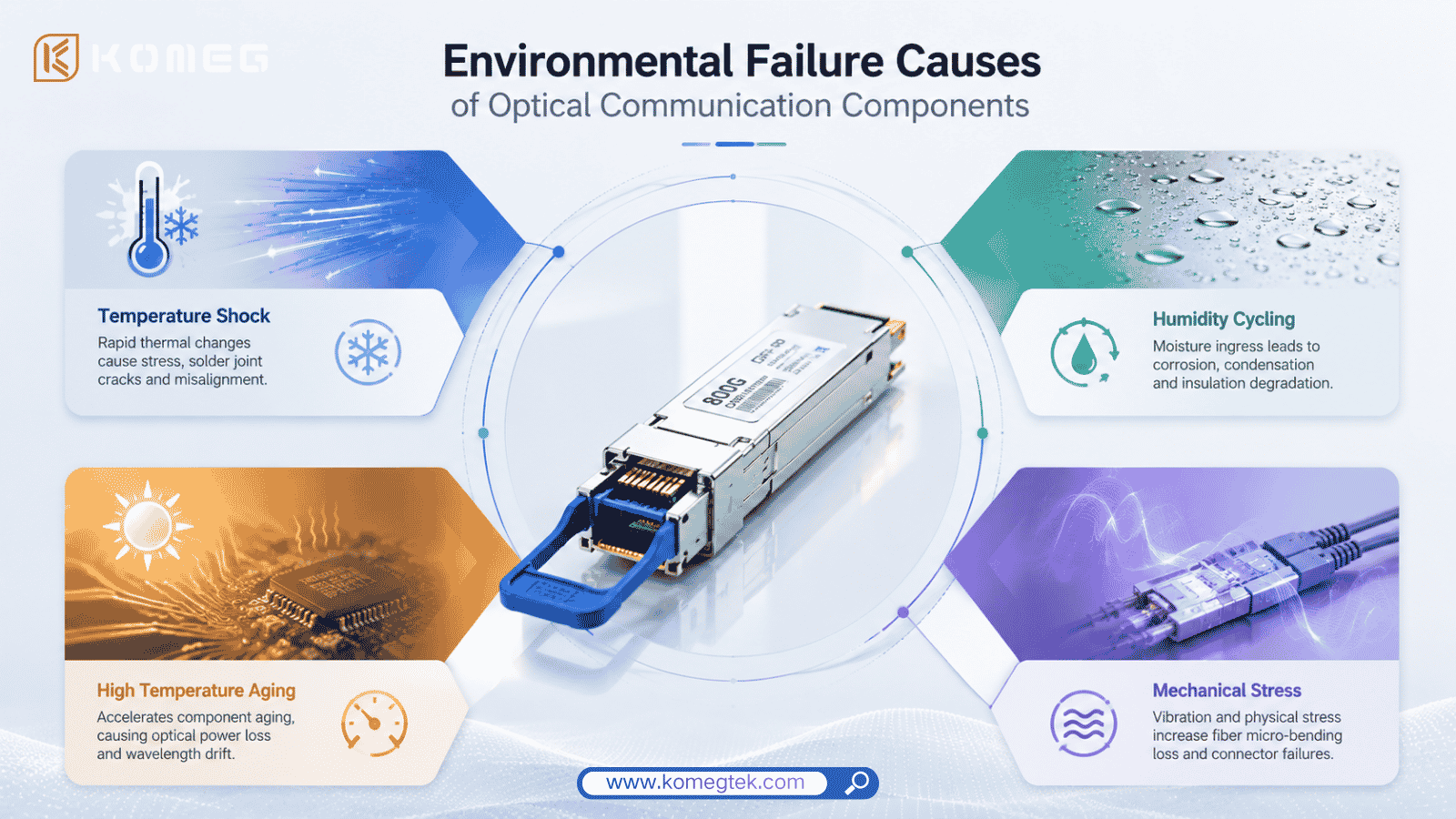
Optical transceivers, laser assemblies, photonic packages, fiber connectors, and related components can be particularly sensitive to temperature, humidity, thermal cycling, and mechanical stress. A module may pass initial functional testing and still contain weaknesses that only become visible after prolonged environmental exposure. Temperature changes can affect optical alignment and wavelength stability, moisture can accelerate corrosion or material degradation, and mechanical stress can increase fiber bending losses. This is where environmental reliability testing becomes an important part of product development and qualification.
Why Optical Modules Can Fail Under Environmental Stress
The reliability of an optical communication product depends on more than the performance of its optical and electrical components. Packaging materials, adhesives, solder joints, fiber interfaces, coatings, connectors, and thermal management structures all contribute to the final reliability of the assembly.
For products deployed in data centers, telecom networks, outdoor cabinets, industrial 5G infrastructure, and vehicle communication systems, environmental conditions can vary significantly. Southeast Asian deployments may face high temperature and humidity for extended periods, while installations in Europe and other regions can experience wide seasonal temperature variations. These real-world conditions make environmental qualification particularly relevant.
Several common failure mechanisms deserve attention.
Thermal Cycling and Temperature Shock
Repeated heating and cooling cause materials with different coefficients of thermal expansion to expand and contract at different rates. Over many cycles, this can place stress on solder joints, optical packages, adhesives, fiber interfaces, and other bonded structures.
In an optical module, this stress may eventually contribute to package deformation, delamination, alignment shifts, or changes in optical attenuation. Rapid temperature transitions can make these mechanisms more apparent by increasing the thermal stress imposed on the assembly.
Humidity and Moisture Exposure
Humidity is another important reliability factor, particularly for equipment installed in hot and humid regions.
Moisture can penetrate vulnerable interfaces, accelerate corrosion of metallic contacts, affect insulation resistance, and contribute to degradation of optical materials or protective coatings. Repeated temperature and humidity changes can also create condensation-related risks when surfaces fall below the local dew point.
For this reason, damp heat and temperature-humidity cycling are often considered alongside temperature testing when evaluating optical communication equipment.
Long-Term High-Temperature Aging
Optoelectronic components are also affected by prolonged exposure to elevated temperatures. Heat can accelerate aging mechanisms in laser devices, detectors, adhesives, packaging materials, and other components.
Depending on the device architecture, long-term thermal exposure may result in changes in optical output, wavelength characteristics, electrical performance, or other parameters that affect system-level transmission stability. Accelerated aging tests help engineers understand these trends without waiting for years of normal field operation.
Mechanical Stress and Fiber Micro-Bending
Optical performance can also be influenced by mechanical conditions. Repeated vibration, handling, thermal expansion, connector movement, or packaging deformation can introduce stress into optical fibers and interfaces.
Fiber micro-bending is particularly important because relatively small physical changes can increase attenuation. For connectorized or tightly packaged optical assemblies, maintaining alignment and mechanical integrity throughout environmental exposure is therefore an important part of reliability validation.
How Environmental Test Chambers Help Reveal Hidden Defects
Environmental testing is essentially a controlled way of reproducing the stresses that optical communication products may encounter during their service life.
Instead of waiting for failures to appear after months or years in the field, engineers can expose samples to defined temperature, humidity, and thermal cycling profiles and monitor changes in their optical, electrical, and mechanical performance.
This approach can help identify weaknesses associated with:
- Material selection
- Optical packaging
- Adhesive bonding
- Soldering processes
- Sealing and protection
- Thermal management
- Fiber and connector interfaces
Common environmental tests for optical communication products may include high- and low-temperature storage, temperature cycling, damp heat exposure, rapid temperature change testing, thermal shock, and 85°C/85% RH damp heat testing.
The environmental chamber itself does not determine whether an optical module passes or fails. Its role is to provide a stable, repeatable, and measurable stress environment so that engineers can evaluate how the product behaves under defined conditions.
Environmental Reliability Tests for Optical Communication Products
High- and Low-Temperature Testing
Temperature storage and cycling tests help evaluate whether optical and mechanical characteristics remain stable across the specified operating or storage range. Engineers may monitor parameters such as optical output, wavelength, receiver sensitivity, attenuation, and other product-specific performance indicators before, during, or after environmental exposure.
Temperature and Humidity Testing
Temperature-humidity testing is particularly important for products intended for humid environments. It can reveal weaknesses in sealing, coatings, connectors, materials, and interfaces that may not be apparent during dry laboratory testing.
For equipment deployed across Southeast Asia and other tropical or subtropical markets, humidity-related reliability can be especially relevant because high ambient temperature and moisture may persist for long periods.
Rapid Temperature Change Testing
Rapid temperature change testing applies controlled temperature transitions at a defined rate. It is useful for evaluating thermal stress caused by repeated temperature changes and can help expose weaknesses in solder joints, optical packages, bonding materials, and interfaces.
This type of testing is particularly relevant to highly integrated optical modules and photonic assemblies where different materials are closely combined.
Thermal Shock Testing
Thermal shock introduces more severe and abrupt temperature transitions than conventional temperature cycling. It is used when the objective is to evaluate a product’s ability to withstand sudden changes between hot and cold conditions.
For optical communication components, the resulting thermal stress can help reveal structural or packaging weaknesses that may remain hidden during slower environmental transitions.
85°C/85% RH Damp Heat Testing
The commonly used 85°C/85% RH condition is an accelerated damp heat environment used to evaluate moisture-related reliability. The test can be relevant to optical and electronic assemblies where moisture ingress, corrosion, insulation degradation, or material aging are concerns.
However, the exact duration, sample configuration, powered/unpowered state, and acceptance criteria should always be determined by the applicable qualification specification rather than treating 85/85 as a universal requirement.
Standards and Reliability Requirements for Optical Communication
Optical communication reliability testing is not simply a matter of selecting an arbitrary temperature and humidity profile. The test conditions should be connected to the product’s application, qualification requirements, and applicable industry standards.
IEC 60068 provides a broad framework for environmental testing of electrotechnical products and components, including methods addressing temperature, humidity, thermal cycling, and other environmental stresses.
For optical fiber cable applications, the IEC 60794 series provides dedicated environmental test methods. In particular, IEC 60794-1-201:2024 defines a temperature cycling method for optical fibre cables and evaluates their ability to withstand temperature changes by observing changes in attenuation.
Other recently published parts address aging, temperature cycling configurations, UV exposure, and additional environmental conditions.
The IEC 61280 series covers fibre-optic communication subsystem test procedures, including optical performance measurements used to characterize communication systems and components. For example, IEC 61280-2-2 addresses optical eye pattern, waveform, and extinction ratio measurements.
For telecommunications optoelectronic devices, Telcordia GR-468-CORE is another important reference for reliability assurance. It covers active optoelectronic devices such as laser diodes, photodetectors, and modulators and includes environmental, mechanical, and aging-related reliability considerations.
It is important to note that these standards should not be treated as a single universal test recipe for every optical module. Qualification requirements can vary according to device architecture, network application, customer specification, and deployment environment. Newer optical technologies, including non-hermetic packages and silicon photonics, may also require additional reliability considerations beyond legacy qualification approaches.
Choosing Environmental Test Equipment for Optical Communication Reliability
For optical communication testing, chamber selection should start with the test objective and failure mechanism, rather than simply choosing the largest temperature range available.
Temperature stability and uniformity are important because uneven chamber conditions can introduce unnecessary variation into test results. Humidity control and dehumidification performance become critical for damp heat testing, while rapid temperature change and thermal shock applications require equipment capable of achieving the specified transition profile consistently.
The chamber working volume should also match the test configuration. Optical modules may be tested individually, in batches, or together with associated assemblies and fixtures. The loading condition can affect airflow and temperature uniformity, so the actual test setup should be considered when defining chamber requirements.
For development laboratories and production environments, data acquisition and communication functions can also be valuable. Recording temperature profiles alongside optical and electrical measurements makes it easier to correlate environmental exposure with changes in product performance.
KOMEG Environmental Test Chambers for Optical Communication Applications
KOMEG provides environmental testing equipment for reliability evaluation across optical communication, semiconductor, electronics, automotive, and new energy applications.
For optical communication products, the available equipment includes temperature test chambers, rapid temperature change test chambers, and thermal shock chambers, supporting different stages of reliability evaluation from early-stage engineering verification to production qualification.
These chambers can be used for testing optical transceivers, photonic components, fiber-optic assemblies, communication modules, and other products where temperature and humidity resistance are important.
A typical reliability program may combine several environmental stresses rather than relying on a single test. For example, temperature cycling can be used to investigate thermal-mechanical stress, damp heat can target moisture-related degradation, and high-temperature aging can help evaluate long-term material and component stability.
The appropriate chamber configuration should ultimately be based on the product’s test profile, sample size, required temperature and humidity conditions, transition rate, cycling requirements, and applicable qualification standards.
Reliability Testing for the Next Generation of Optical Communication
Optical communication is moving toward higher bandwidth, greater integration, and increasingly demanding deployment environments. AI data centers and high-performance computing are driving demand for higher-speed optical interconnects, while 5G infrastructure, cloud networks, and automotive communication systems continue to expand the range of environments in which optical components must operate reliably.
As integration density increases, small weaknesses in packaging, materials, thermal management, or optical alignment can have a greater impact on overall system performance. Environmental reliability testing provides engineers with a practical way to expose these weaknesses before they become field problems.
For optical module manufacturers, the goal is not simply to pass an environmental test. A well-designed reliability program should connect environmental stress, failure physics, optical performance, and product lifetime into one engineering process.
That is where properly selected environmental test chambers become valuable—not as a substitute for product design and process control, but as a controlled tool for finding weaknesses earlier and building greater confidence in optical communication products.