

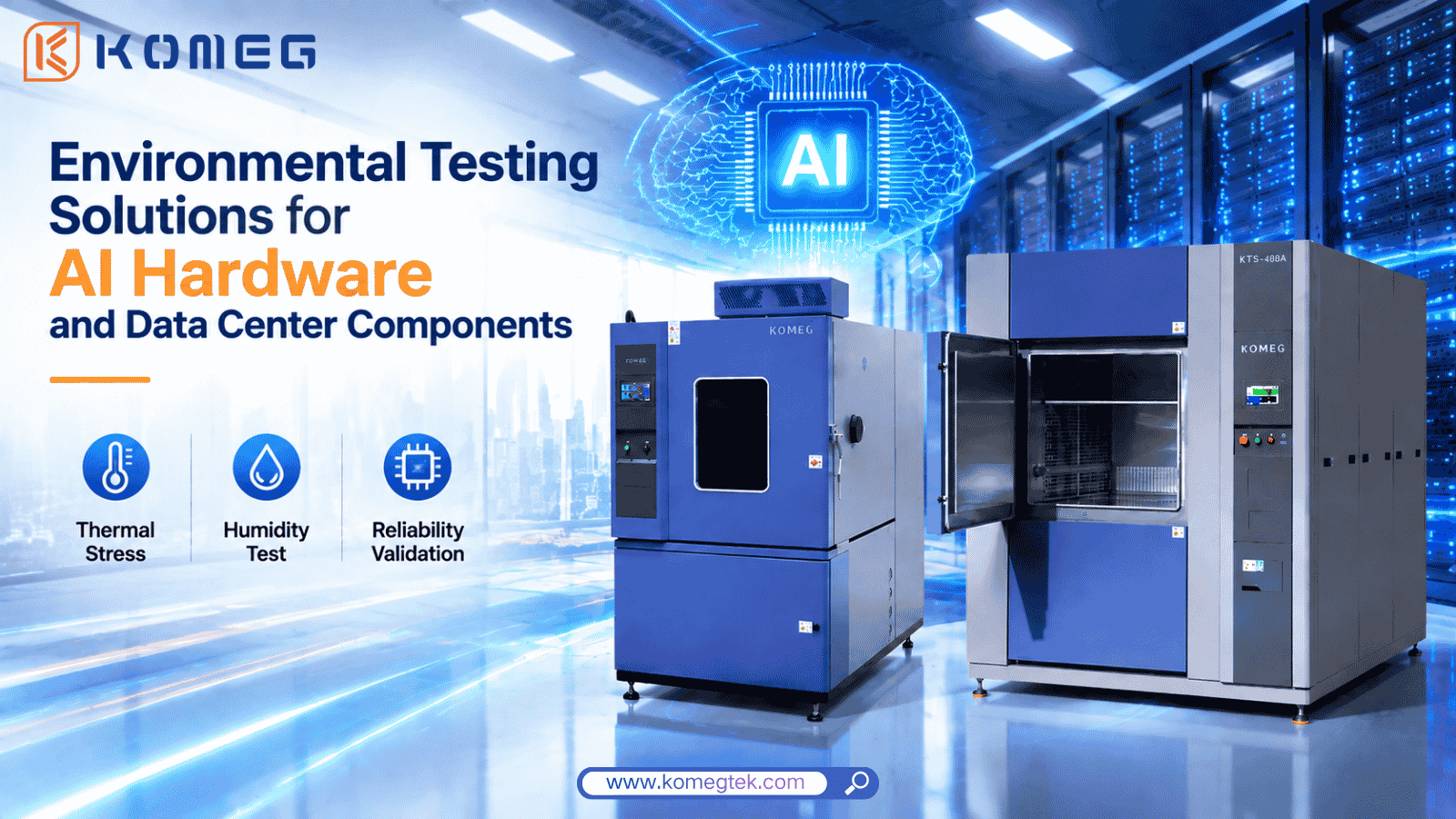
The rapid development of artificial intelligence (AI) infrastructure is driving significant changes in modern computing systems. AI servers, GPUs, high-bandwidth memory (HBM), advanced semiconductor packages, and high-speed optical communication components are becoming increasingly powerful while also creating new reliability challenges.
Unlike traditional electronic devices, AI hardware operates under extremely high processing loads and continuous working conditions. Higher power density, complex packaging structures, and faster data transmission technologies place greater demands on thermal management and long-term reliability.
Before AI hardware and data center components are deployed on a large scale, manufacturers need comprehensive environmental testing to evaluate product durability under different operating conditions. Through temperature cycling, thermal shock, humidity testing, and environmental stress screening (ESS), potential design weaknesses can be identified earlier, helping improve product reliability and reduce field failures.
Why AI Hardware Requires Environmental Reliability Testing
AI computing systems contain highly integrated components that generate significant heat during operation. As chip performance continues to increase, thermal challenges have become one of the most important factors affecting hardware reliability.
Modern AI hardware commonly includes GPUs, AI accelerators, advanced semiconductor packages, power modules, and optical communication components. These parts must maintain stable performance while experiencing repeated temperature changes, high thermal loads, and long operating periods.
Thermal stress can cause various reliability issues, including solder joint fatigue, material expansion mismatch, package deformation, and performance degradation. Environmental testing helps manufacturers understand how products respond to these conditions and optimize designs before mass production.
Another important challenge comes from advanced semiconductor packaging technologies. AI processors increasingly adopt solutions such as 2.5D packaging, 3D packaging, chiplet architectures, and silicon photonics. These technologies combine multiple materials with different thermal expansion characteristics, increasing the possibility of mechanical stress during temperature variations.
For this reason, reliable environmental testing has become an essential part of semiconductor qualification and AI hardware development.
Key Environmental Tests for AI Hardware and Data Center Components
Thermal Cycling Testing
Thermal cycling testing evaluates how products perform under repeated temperature changes. During operation, AI hardware components may experience frequent temperature fluctuations caused by workload changes, power variations, and cooling system adjustments.
Repeated thermal cycling can create mechanical stress between different materials and interfaces. Over time, this stress may lead to issues such as micro-cracks, solder fatigue, connection failures, or package degradation.
Rapid Temperature Ramp Chambers are commonly used for this type of reliability evaluation. These chambers provide controlled temperature transitions at high ramp rates, allowing manufacturers to simulate demanding operating environments and identify early-stage defects.
For semiconductor devices, optical modules, and electronic assemblies, thermal cycling testing provides valuable information about long-term durability and product lifetime.
Thermal Shock Testing
While thermal cycling focuses on repeated controlled temperature changes, thermal shock testing applies much more rapid temperature transitions between extreme hot and cold conditions.
A Thermal Shock Chamber typically uses separate hot and cold zones to transfer samples between different temperature environments within a short period. This creates strong thermal stress that can reveal weaknesses that may not appear during normal temperature cycling.
Thermal shock testing is widely used for:
- Semiconductor packages
- Automotive electronic components
- Aerospace electronics
- Optical communication devices
- High-reliability electronic systems
Typical failure modes identified through thermal shock testing include material cracking, delamination, sealing failures, and electrical connection problems.
KOMEG provides thermal shock testing solutions designed for reliability validation where rapid temperature transitions and repeatable test performance are required.
Temperature and Humidity Testing
Temperature is not the only environmental factor affecting AI hardware reliability. Moisture and humidity can also significantly influence electronic performance, especially for long-term operation in different environments.
Humidity testing evaluates resistance against moisture-related failures such as corrosion, insulation degradation, and electrical instability.
For data center components, temperature and humidity control is especially important because servers and communication equipment may operate continuously for years. Stable environmental simulation helps manufacturers verify whether products can maintain reliable performance throughout their expected service life.
Temperature and humidity chambers are widely used for testing electronic assemblies, communication equipment, semiconductor components, and other reliability-critical products.
Environmental Testing for Optical Communication Components in AI Data Centers
The growth of AI computing has increased demand for faster communication between processors, servers, and data center systems. Traditional electrical interconnect solutions face limitations as data transmission requirements continue to increase.
As a result, technologies such as high-speed optical transceivers, silicon photonics, optical interconnects, and Co-Packaged Optics (CPO) are becoming increasingly important.
However, optical communication components also face unique reliability challenges. Temperature changes can affect optical alignment, fiber coupling performance, package structures, and signal stability.
For example, CPO technology integrates optical components closer to high-performance computing chips. While this improves data transmission efficiency, it also introduces new thermal management challenges due to the interaction between optical structures, semiconductor devices, and packaging materials.
Environmental testing helps evaluate:
- Optical performance stability
- Thermal stress resistance
- Package reliability
- Long-term operating performance
Advanced temperature cycling and thermal reliability testing are becoming increasingly important for next-generation optical communication systems.
Environmental Testing Standards for AI Hardware Reliability
Different industries use specific standards to evaluate product reliability. For AI hardware and data center-related components, commonly referenced standards include:
JEDEC Reliability Standards
JEDEC standards are widely used for semiconductor component reliability evaluation, including temperature cycling, moisture resistance, and package-level testing.
IEC 60068 Environmental Testing
IEC 60068 provides internationally recognized environmental testing methods for electronic products, including temperature, humidity, vibration, and climate-related tests.
AEC-Q100 Automotive Reliability Testing
For AI-related automotive electronics and autonomous driving systems, AEC-Q100 defines reliability requirements for integrated circuits used in automotive applications.
MIL-STD-810 Environmental Testing
Military and aerospace-related electronic systems often require testing according to MIL-STD-810 to verify performance under harsh environmental conditions.
Selecting the correct testing method depends on product design, application requirements, and industry standards.
How to Select the Right Environmental Test Chamber for AI Hardware
Choosing the appropriate environmental test chamber requires consideration of several factors.
First, manufacturers need to evaluate the required temperature range and transition speed. Some applications require extreme temperature changes, while others focus on long-term temperature cycling performance.
For high-speed reliability testing, a Rapid Temperature Ramp Chamber with controlled ramp rates may be suitable. For extreme temperature transition testing, a Thermal Shock Chamber may provide the necessary stress conditions.
Test capacity is another important factor. Component-level testing may require laboratory-sized chambers, while larger assemblies, server modules, or complete systems may require larger walk-in environmental chambers.
Control accuracy, airflow uniformity, data recording capability, and communication functions should also be considered when selecting testing equipment for advanced applications.
KOMEG Environmental Testing Solutions for AI Hardware Applications
As AI hardware and data center technologies continue to evolve, reliable environmental testing solutions are becoming increasingly important for manufacturers.
KOMEG develops and manufactures a wide range of environmental test equipment designed for reliability evaluation across semiconductor, electronics, optical communication, automotive, and new energy industries.
KOMEG testing solutions include:
- Rapid Temperature Ramp Chambers for high-speed thermal cycling
- Thermal Shock Chambers for extreme temperature transition testing
- Temperature Humidity Chambers for climate reliability evaluation
- Walk-In Environmental Chambers for large-scale testing requirements
With experience in environmental simulation technology and customized equipment development, KOMEG supports customers in validating product reliability, improving testing efficiency, and reducing risks during product development.
AI hardware and data center components are becoming more powerful, more compact, and more complex. As these technologies advance, reliability testing plays an increasingly important role in ensuring stable long-term operation.
Environmental testing methods such as thermal cycling, thermal shock, temperature-humidity testing, and ESS help manufacturers identify potential failures, optimize product designs, and improve overall reliability.
From semiconductor packages and AI servers to optical communication systems and next-generation data center technologies, proper environmental validation provides a critical foundation for future innovation.
By selecting the right testing equipment and methods, manufacturers can accelerate development, improve product quality, and build more reliable AI infrastructure.
Frequently Asked Questions (FAQ)
1. Why does AI hardware require environmental testing?
AI hardware requires environmental testing because modern computing systems operate under higher thermal loads, continuous workloads, and increasingly complex semiconductor structures. Environmental tests such as thermal cycling, thermal shock, and humidity testing help identify potential reliability issues, including material stress, solder fatigue, package failures, and performance degradation before products are deployed.
2. What environmental tests are commonly used for data center components?
Common environmental tests for data center components include temperature cycling testing, thermal shock testing, temperature and humidity testing, and Environmental Stress Screening (ESS). These tests help evaluate the reliability of servers, semiconductor components, optical modules, and communication devices under different operating conditions.
3. Which environmental test chamber is suitable for AI hardware reliability testing?
The suitable environmental test chamber depends on the testing purpose and product requirements. Rapid Temperature Ramp Chambers are commonly used for controlled high-speed temperature cycling, while Thermal Shock Chambers are designed for extreme temperature transition testing. For large systems or complete assemblies, Walk-In Environmental Chambers may be used for larger-scale reliability validation.