

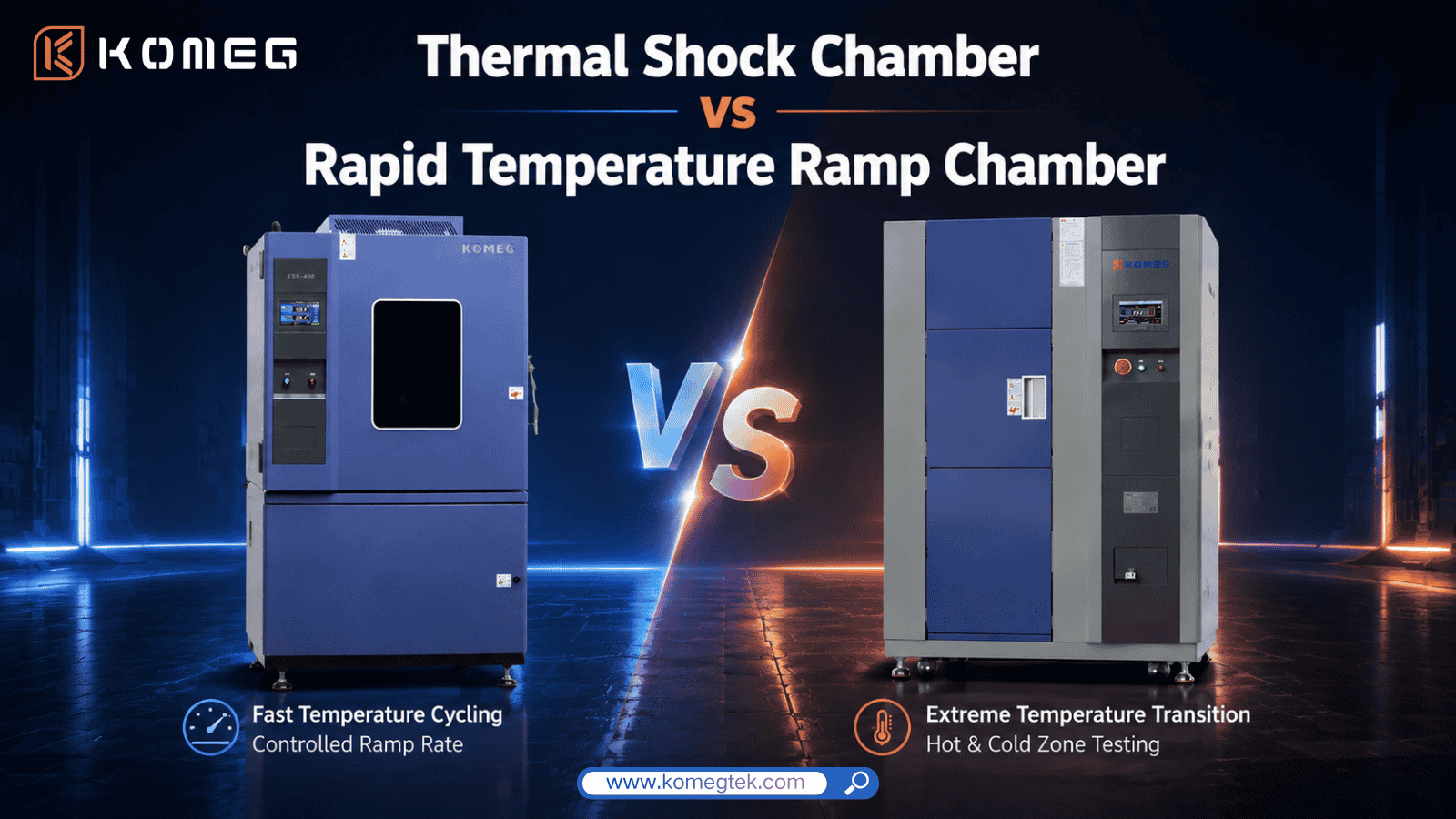
In environmental reliability testing, temperature change is one of the most important factors used to evaluate product durability and potential failure risks. However, not all temperature tests are designed for the same purpose. Two types of equipment that are often compared are Thermal Shock Chambers and Rapid Temperature Ramp Chambers.
Both systems are designed to expose products to rapid temperature changes, but their testing methods, stress levels, applications, and failure detection capabilities are different. Understanding these differences is important when selecting the right environmental test equipment for electronics, automotive components, semiconductors, batteries, and other reliability-critical products.
A thermal shock chamber focuses on exposing products to sudden extreme temperature transitions, while a rapid temperature ramp chamber focuses on applying controlled and repeated temperature changes at a high ramp rate. The right choice depends on the product requirements, testing standards, and reliability objectives.
What Is a Thermal Shock Chamber?
A thermal shock chamber is designed to test how products withstand sudden temperature changes between extreme hot and cold environments. The purpose of thermal shock testing is to create severe thermal stress within a short period of time and identify weaknesses that may not appear under normal operating conditions.
Most thermal shock chambers use a two-zone or three-zone design. In a typical two-zone thermal shock chamber, the test sample is transferred between a high-temperature zone and a low-temperature zone. This rapid movement creates a significant temperature difference that challenges the mechanical and electrical integrity of the product.
For example, a product may be exposed to:
- High temperature zone: +150°C or higher
- Low temperature zone: -40°C to -70°C
- Temperature transfer time: usually within seconds
This sudden temperature transition can reveal problems such as:
- Material expansion and contraction stress
- Solder joint cracking
- Internal component damage
- Seal and bonding failures
- Delamination between different materials
Thermal shock testing is commonly used for semiconductor packages, automotive electronics, aerospace components, military electronics, and other products where reliability under extreme conditions is critical.
What Is a Rapid Temperature Ramp Chamber?
A Rapid Temperature Ramp Chamber is designed to create fast and controlled temperature changes within a single test space. Unlike thermal shock chambers, the product remains in the same chamber while the temperature changes gradually at a programmed rate.
The key measurement for this type of testing is the temperature ramp rate, usually expressed as °C/min.
Common ramp rates include:
- 5°C/min
- 10°C/min
- 15°C/min
- 25°C/min or higher
Rapid temperature ramp testing is widely used in Environmental Stress Screening (ESS) and reliability validation programs. By repeatedly cycling products through temperature changes, manufacturers can identify early defects and improve product durability before mass production.
Typical applications include:
- Semiconductor reliability testing
- Electronic assemblies
- Automotive components
- Battery systems
- Communication equipment
- AI and data center hardware
Compared with thermal shock testing, rapid temperature ramp testing provides a more controlled thermal stress environment and is often used for longer-duration reliability screening.
Thermal Shock Chamber vs Rapid Temperature Ramp Chamber: Key Differences
1. Testing Method
The biggest difference is how temperature changes are created.
A thermal shock chamber uses separate hot and cold zones. The test sample moves between these zones, creating an immediate temperature change.
A rapid temperature ramp chamber uses one testing area. The chamber gradually increases or decreases temperature according to a predefined ramp rate.
In simple terms:
Thermal shock = sudden temperature transfer between extreme environments.
Rapid temperature ramp = controlled high-speed temperature change within one chamber.
2. Temperature Change Speed
Thermal shock chambers provide extremely fast temperature transitions because the product is physically transferred between hot and cold areas.
This creates stronger thermal stress and is suitable for detecting sudden failures.
Rapid temperature ramp chambers provide fast but controlled temperature changes. The transition speed is measured by ramp rate, such as 10°C/min or 20°C/min.
The temperature change is slower compared with thermal shock but allows repeated cycling for long-term reliability evaluation.
3. Testing Purpose
The main goal of thermal shock testing is to identify immediate damage caused by extreme temperature differences.
Typical failure modes include:
- Cracks
- Mechanical stress damage
- Material separation
- Electrical connection failures
Rapid temperature ramp testing focuses more on reliability improvement and early defect detection.
It helps identify:
- Manufacturing defects
- Design weaknesses
- Component reliability issues
- Long-term thermal fatigue problems
4. Stress Level
Thermal shock creates a more aggressive thermal environment because products experience sudden temperature changes.
This makes it suitable for applications requiring extreme reliability validation, especially aerospace, military, and semiconductor packaging.
Rapid temperature ramp testing applies controlled thermal stress over repeated cycles. It is commonly used when manufacturers need to evaluate product durability under realistic operating conditions.
Which One Should You Choose?
The choice between a thermal shock chamber and a rapid temperature ramp chamber depends on your testing objective.
If your goal is to identify whether a product can survive sudden extreme temperature changes, a thermal shock chamber is usually the better choice.
Typical applications:
- Semiconductor packages
- Aerospace electronics
- Automotive electronic components
- Military equipment
- High-reliability products
If your goal is to improve product reliability through repeated temperature cycling and detect hidden manufacturing defects, a rapid temperature ramp chamber may be more suitable.
Typical applications:
- ESS testing
- Electronic assemblies
- Automotive electronics
- Semiconductor reliability screening
- Battery-related products
In many advanced manufacturing industries, both testing methods are used together. Thermal shock testing provides severe stress evaluation, while rapid temperature ramp testing provides continuous reliability screening.
Testing Standards and Industry Applications
Thermal shock and rapid temperature change testing are commonly associated with international reliability standards, including:
- IEC 60068-2-14 Environmental Testing
- MIL-STD-883 Microelectronics Reliability Testing
- JESD22 Semiconductor Reliability Testing
- AEC-Q100 Automotive Component Qualification
The specific test method depends on the product type and industry requirements.
For example, semiconductor manufacturers may use thermal shock testing to evaluate package reliability, while automotive electronics suppliers may combine rapid temperature cycling with ESS testing to improve production quality.
How KOMEG Supports Thermal Reliability Testing
Selecting the correct environmental test equipment requires a clear understanding of product requirements and reliability goals.
KOMEG provides environmental reliability testing solutions including thermal shock chambers, rapid temperature change chambers, and customized ESS testing systems for industries such as semiconductor, automotive, electronics, and new energy.
With extensive experience in environmental test equipment design and manufacturing, KOMEG focuses on providing stable temperature control, reliable operation, and customized solutions according to different testing requirements.
Whether the requirement is extreme temperature shock testing or high-speed temperature cycling, choosing the appropriate chamber design helps engineers improve product reliability, reduce development risks, and accelerate validation processes.
Although thermal shock chambers and rapid temperature ramp chambers both evaluate product performance under temperature changes, they serve different testing purposes.
Thermal shock chambers create extreme and sudden temperature transitions to identify immediate failures caused by thermal stress. Rapid temperature ramp chambers provide controlled high-speed temperature cycling to evaluate long-term reliability and detect hidden defects.
Understanding the difference between these two technologies allows engineers to select the right testing method for their products and achieve more accurate reliability validation results.
For modern electronics, semiconductor devices, automotive systems, and advanced technologies, the correct environmental testing approach plays an important role in improving product quality and ensuring long-term performance.