

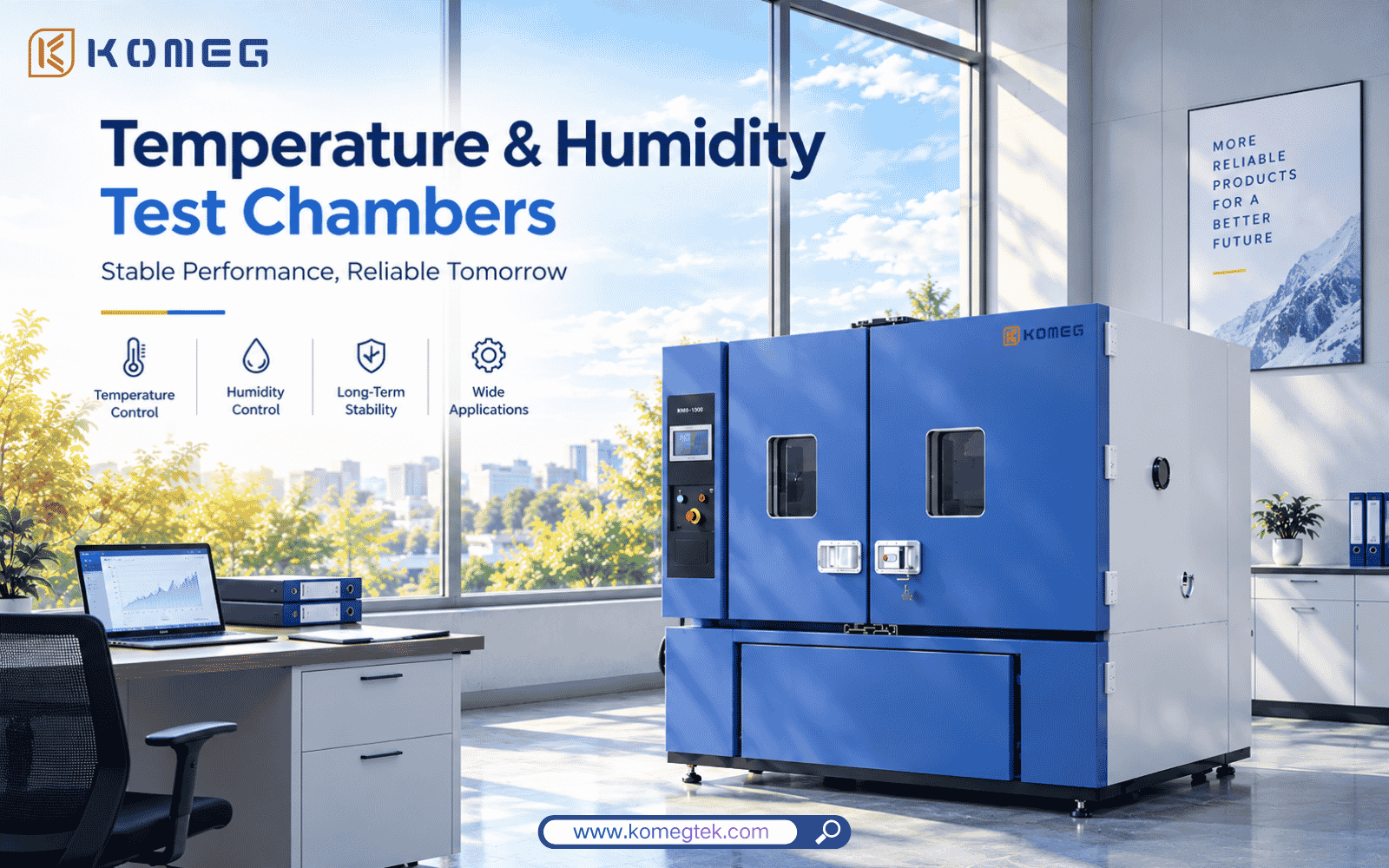
A temperature and humidity test chamber is used to expose products to controlled combinations of temperature and moisture. The purpose is not simply to see whether a product continues to work in a hot or humid environment. More importantly, the test can reveal how materials, electrical systems, interfaces, and mechanical structures respond to environmental stress over time.
This matters because many reliability problems do not appear during a short functional test. Corrosion, moisture absorption, insulation degradation, material swelling, delamination, and intermittent electrical problems may develop gradually. Temperature and humidity testing provides a controlled way to accelerate and observe these risks before a product reaches the field.
For this reason, temperature and humidity test chambers are widely used during product development, reliability verification, qualification, failure analysis, and environmental stress testing.
What Is Temperature and Humidity Testing Used For?
The basic idea is straightforward: control temperature and relative humidity inside the chamber and expose a product to a defined environmental condition for a specified period.
The test condition may remain relatively stable, or the temperature and humidity may change according to a programmed profile. The exact conditions depend on the product, test objective, and applicable standard.
The important point is that temperature and humidity are not independent concerns.
Temperature affects material properties, chemical reaction rates, expansion and contraction, and electrical behavior. Moisture can penetrate materials, interact with contaminants, accelerate corrosion, affect insulation, and change the properties of certain polymers, adhesives, and other materials.
When these stresses occur together, a product may behave differently from what would be expected from temperature-only testing.
That is why a temperature test chamber and a temperature and humidity test chamber are not interchangeable for every reliability program.
Why Is Humidity Important in Product Reliability Testing?
Temperature is usually easy to associate with environmental stress. Humidity is less obvious because moisture-related degradation may take longer to become visible.
A product may pass a high-temperature test and still develop problems when moisture is introduced.
Water can be absorbed by some materials or reach areas that are difficult to protect completely. In electronic products, moisture can contribute to corrosion, leakage current, insulation degradation, and changes in electrical performance. In mechanical or composite structures, moisture can affect dimensions, adhesion, interfaces, and material properties.
A useful way to think about the difference is this:
Temperature can accelerate degradation, while moisture can change the way degradation occurs.
This is one reason temperature and humidity testing is important for products expected to operate in uncontrolled outdoor or industrial environments.
What Failures Can a Temperature and Humidity Test Chamber Reveal?
The test does not produce one universal type of failure. What appears after environmental exposure depends on the product construction, materials, electrical design, contaminants, protection level, and test conditions.
Several failure mechanisms are particularly relevant.
Corrosion and Oxidation
Metal components can be affected by moisture, especially when contaminants or electrical potentials are also present.
Connectors, terminals, PCB traces, fasteners, shielding components, and other exposed or insufficiently protected metal parts may become vulnerable to corrosion.
The problem is not always visible rust. Corrosion can increase electrical resistance, weaken connections, change contact behavior, or eventually cause intermittent or permanent electrical failure.
Electrical Insulation Degradation
Moisture can affect insulation resistance and electrical isolation.
For products containing PCBs, connectors, cables, sensors, or high-voltage components, engineers may monitor insulation resistance, leakage current, dielectric performance, or functional behavior before and after environmental exposure.
A product that still powers on after the test is not necessarily unaffected. Small changes in electrical characteristics may indicate an early reliability problem.
Moisture Absorption
Some polymers, adhesives, encapsulation materials, and other non-metallic materials can absorb moisture.
Depending on the material, this may result in swelling, changes in mechanical properties, dimensional changes, or reduced adhesion.
For precision products, even relatively small dimensional changes can become important when components need to maintain tight mechanical tolerances.
Delamination and Interface Problems
Many modern products contain multiple materials joined together.
Examples include electronic packages, laminated structures, solar modules, bonded assemblies, and composite components.
Different materials respond differently to temperature and moisture. Repeated environmental exposure can place stress on the interfaces between them, potentially contributing to cracking, delamination, loss of adhesion, or other structural changes.
Functional and Intermittent Failures
Environmental degradation does not always result in an obvious catastrophic failure.
A sensor may become unstable. A connector may develop intermittent contact. A communication device may experience signal problems. An electronic assembly may show increased resistance or abnormal behavior only under certain environmental conditions.
These failures are particularly important because they can be difficult to reproduce under normal laboratory conditions.
Temperature and humidity testing provides a controlled environment in which engineers can investigate whether environmental exposure is contributing to the problem.
Is Constant Humidity Testing the Same as Humidity Cycling?
No.
The test profile should be selected according to what the engineer is trying to understand.
In a constant temperature and humidity test, the product remains under a relatively stable environmental condition for a defined period. This approach is useful when the objective is to investigate long-term exposure to a particular climatic condition.
Humidity cycling introduces changes in environmental conditions. Depending on the test method, temperature and humidity may rise and fall according to a programmed sequence.
This can produce a different stress response because the product is repeatedly moving between environmental states rather than remaining at one equilibrium condition.
The same distinction exists between steady high-temperature exposure and temperature cycling. A product that performs well during one type of exposure may behave differently when environmental conditions repeatedly change.
What Is Damp Heat Testing?
Damp heat testing exposes a product to elevated temperature and humidity for a defined period.
It is commonly used to evaluate the ability of materials and products to withstand prolonged exposure to humid conditions.
The purpose is not simply to check whether the product becomes wet. Engineers are looking for changes that may develop as a result of prolonged moisture and temperature exposure, including corrosion, insulation degradation, material changes, adhesion problems, and functional degradation.
Different standards define different test conditions and durations, so a chamber should always be configured according to the actual test method rather than assuming that one temperature and humidity combination applies to every product.
For example, IEC 60068 includes several environmental test methods involving temperature, humidity, and damp heat. Other industries use their own environmental qualification procedures and test profiles.
What Products Are Tested in Temperature and Humidity Test Chambers?
The application range is broad because temperature and humidity affect many different materials and product types.
Electronics and Electrical Products
Electronic devices are among the most common applications.
Testing may be performed on:
PCBs
Connectors
Sensors
Power supplies
Communication equipment
Displays
Electronic assemblies
Consumer electronics
The main concerns often include corrosion, insulation, electrical stability, moisture penetration, and long-term functional reliability.
Automotive Components
Automotive electronics and components may experience substantial changes in temperature and humidity during their service life.
Typical test samples include ECUs, sensors, connectors, lighting components, control modules, and other electronic or mechanical assemblies.
Temperature and humidity testing can be used as part of a broader environmental reliability program to identify weaknesses before vehicle integration or production.
Semiconductor and Electronic Packages
For semiconductor-related products, moisture can become particularly important because packages contain multiple materials and interfaces.
Environmental testing may be used alongside other reliability tests to investigate package integrity, moisture sensitivity, electrical performance, and interface degradation.
The appropriate test method depends heavily on the package technology and qualification requirements.
Batteries and Energy Storage Equipment
Temperature and humidity testing may also be used for battery-related components and electrical systems.
However, battery testing requires additional consideration of electrical energy, thermal behavior, safety protection, and the specific hazards associated with the product.
A standard climatic chamber should not automatically be assumed to be suitable for every battery application. The chamber design needs to match the battery type, test procedure, energy level, and required safety functions.
Solar Modules and Outdoor Products
Solar modules and other outdoor products are exposed to temperature and moisture throughout their service life.
Environmental testing can help evaluate materials, encapsulation, electrical connections, interfaces, and other components that must remain stable under prolonged outdoor exposure.
For large modules, chamber dimensions and airflow become important considerations because the test sample can have a significant effect on the chamber environment.
What Should Engineers Check After a Temperature and Humidity Test?
The chamber provides the environmental exposure. It does not by itself determine whether the product has passed or failed.
Post-test inspection is therefore an important part of the process.
Depending on the product, engineers may check:
Visual appearance
Corrosion
Cracks
Delamination
Discoloration
Moisture penetration
Dimensional changes
Insulation resistance
Electrical resistance
Leakage current
Mechanical performance
Functional performance
Communication stability
Changes in electrical output
For some products, electrical measurements should be taken before and after environmental exposure so that even relatively small changes can be identified.
For others, microscopic inspection, imaging, cross-section analysis, or additional functional testing may be required.
The important point is that environmental exposure should be connected to measurable product performance.
What Makes a Good Temperature and Humidity Test Chamber?
A chamber is only useful if it can create and maintain the required environmental conditions consistently.
Several characteristics deserve attention.
Temperature Control
The chamber needs sufficient heating and cooling capacity to reach the required test temperatures and maintain them within the specified tolerance.
Humidity Control
Humidity generation and control become particularly important during long-duration high-humidity testing.
The system needs to maintain the required relative humidity without excessive fluctuation.
Temperature and Humidity Uniformity
The sample should experience a reasonably consistent environment throughout the working space.
Poor airflow or an unsuitable sample arrangement can create local temperature or humidity differences that affect test results.
Airflow
Air circulation influences temperature distribution, humidity distribution, heat transfer, and recovery after the chamber door is opened.
Large or densely loaded samples can interfere with airflow, so the actual test load needs to be considered when evaluating chamber performance.
Condensation Management
Condensation can become a significant issue when temperature changes cause surfaces to fall below the local dew point.
Chamber design, door sealing, heating elements around the door frame, drainage, and the test profile all need to be considered when condensation is a concern.
Data Recording and Communication
Modern reliability programs often require test data to be recorded and reviewed after the test.
Interfaces such as USB, Ethernet, or RS485 can be useful when the chamber needs to communicate with external monitoring or data-management systems.
How Large Should a Temperature and Humidity Test Chamber Be?
Chamber size should be based on the actual test load rather than simply choosing the largest available model.
For laboratory testing of individual components or small assemblies, a compact chamber may be sufficient.
For larger assemblies or multiple samples, additional working space may be necessary to maintain adequate clearance and airflow.
The calculation should consider the sample dimensions, number of samples, fixtures, cable routing, thermal load, and required air circulation.
This is especially important when the sample itself generates heat.
An oversized chamber can increase the initial investment and operating requirements without necessarily improving the test. An undersized chamber can restrict sample arrangement and create airflow or thermal-load problems.
The practical goal is to select a chamber that provides enough usable space for the test configuration.
Temperature & Humidity Test Chambers for Laboratory Reliability Testing
For routine laboratory applications, a reach-in temperature and humidity chamber is often a practical solution.
KOMEG Temperature & Humidity Test Chambers are available in standard capacities from 64 L to 1000 L and can also be customized for non-standard requirements. The KMH series supports different temperature configurations, humidity ranges, programmable control, cable access, data interfaces, and other options depending on the model.
The equipment is designed for applications including electronics, electrical products, automotive components, communications equipment, medical products, aerospace-related testing, materials, and other industrial products.
For applications involving larger products or multiple samples, a conventional reach-in chamber may no longer provide enough usable space.
KOMEG walk-in environmental chambers are designed for large components, assemblies, finished products, and applications requiring significantly more internal capacity. Current KOMEG configurations include several standard chamber volumes, with customization based on sample size and quantity, temperature and humidity requirements, airflow, fixtures, and other application conditions.
Does Passing a Temperature and Humidity Test Mean the Product Will Last for Years?
Not necessarily.
Environmental testing is a controlled reliability assessment. It is not a simple calculator that converts a specific number of chamber hours into an exact number of years in the field.
Actual product life depends on many variables, including environmental conditions, material properties, product design, manufacturing quality, usage patterns, contamination, mechanical stress, and the combination of stresses experienced during service.
Accelerated testing can help expose weaknesses sooner, but the results still need to be interpreted in the context of the test method and the intended application.
This distinction is important when using environmental test results for reliability predictions.
Why Test Conditions Should Be Based on the Product
There is no single temperature and humidity profile that is appropriate for every product.
An electronic connector, a solar module, a medical device, and an automotive ECU may all require temperature and humidity testing, but their failure mechanisms and qualification requirements can be very different.
Before selecting the chamber, engineers should define:
The product and materials being tested
The expected service environment
Applicable test standards
Temperature range
Humidity range
Exposure duration
Cycling requirements
Number and arrangement of samples
Thermal load
Electrical monitoring requirements
Acceptance criteria
The chamber should then be selected around these requirements.
This is more reliable than starting with a chamber model and trying to adapt the test around its capabilities.
Temperature and Humidity Testing Is About More Than Heat and Moisture
A temperature and humidity test chamber is ultimately a tool for creating a controlled environmental stress.
The value of the test comes from what engineers can learn from the product’s response.
Corrosion, moisture absorption, insulation degradation, delamination, electrical instability, material changes, and intermittent failures may all provide information about weaknesses that are difficult to identify under normal operating conditions.
The chamber therefore needs to do more than reach a specified temperature and humidity. It needs to maintain those conditions consistently, provide suitable airflow and uniformity, accommodate the actual test load, and record the environmental history accurately.
For routine laboratory testing, a properly selected reach-in temperature and humidity chamber may provide sufficient capacity. For large products, multiple samples, or more complex environmental programs, a larger or customized system may be required.
The most useful temperature and humidity test is not necessarily the most severe one. It is the one that reproduces a meaningful environmental stress and produces reliable information about how the product will behave in its intended application.