

Choosing the right temperature and humidity chamber manufacturer is rarely as simple as comparing prices or selecting the company with the widest specification range.
A chamber may look similar from the outside, but the engineering behind temperature control, humidity generation, airflow distribution, refrigeration, insulation, safety protection, data recording, and long-term operation can be significantly different. For laboratories and manufacturers running reliability tests, these details directly affect test repeatability, operating cost, maintenance, and ultimately the quality of the test data.
This is why buyers searching for the best temperature and humidity chamber manufacturer should first define what “best” means for their application. A laboratory performing routine damp-heat testing may need a very different chamber from an automotive supplier testing large assemblies, a semiconductor company evaluating thermal reliability, or a battery manufacturer running long-duration environmental stress tests.
What Makes a Good Temperature and Humidity Chamber Manufacturer?
A capable manufacturer should provide more than a temperature-controlled cabinet. The real question is whether the manufacturer can consistently create and maintain the environmental conditions required by the test.
Temperature range is the first consideration. Common chambers may cover moderate high- and low-temperature conditions, while more demanding applications require extended low-temperature capability or higher upper-temperature limits. Humidity range is equally important. Some applications require conventional 20–98% RH control, while others may require lower humidity levels or specialized control at particular temperature points.
Control accuracy is another important factor. Buyers should look beyond the nominal temperature range and ask about temperature fluctuation, temperature uniformity, humidity fluctuation, humidity uniformity, recovery after door opening, and performance under actual loading conditions.
The chamber’s airflow design also deserves attention. Poor air circulation can create temperature gradients inside the working space, particularly when products generate heat or when shelves are heavily loaded. A manufacturer with strong environmental chamber engineering should be able to explain how air circulation, heater placement, refrigeration capacity, humidification, and dehumidification work together.
Finally, customization capability matters when the test does not fit a standard laboratory profile. Cable ports, special shelves, larger doors, additional sensors, special power supplies, remote monitoring, explosion-proof protection, unusual internal dimensions, and high heat-load configurations may all require engineering changes rather than simple accessories.
Which Temperature and Humidity Chamber Manufacturers Are Commonly Considered?
The global market includes manufacturers with very different backgrounds and product strategies. Some focus heavily on environmental simulation equipment, while others offer environmental chambers as part of a much broader portfolio.
KOMEG
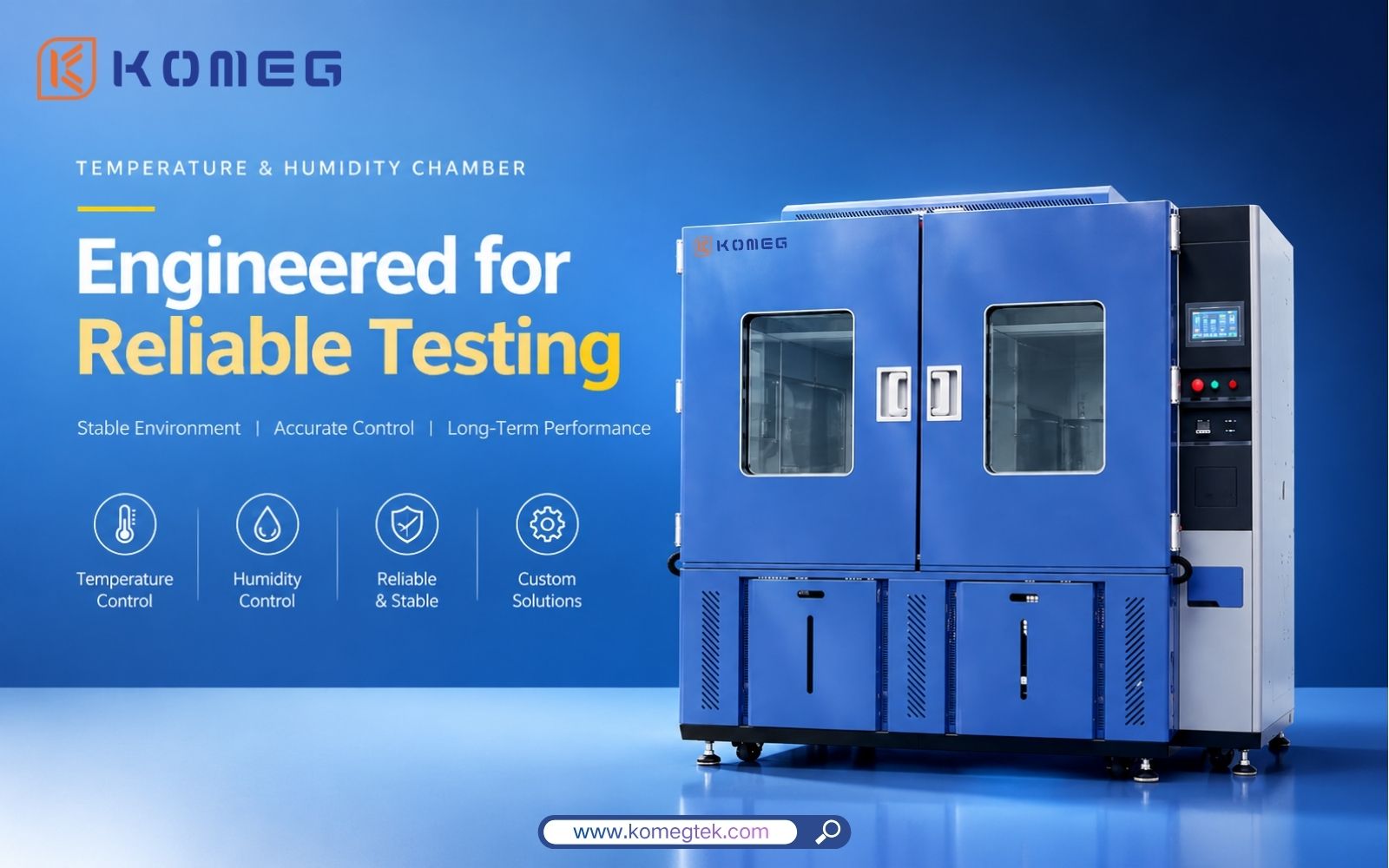
KOMEG is a China-based environmental test chamber manufacturer established in 1990. The company develops and manufactures standard and customized environmental test equipment, including temperature and humidity chambers, rapid-rate thermal cycle chambers, walk-in environmental chambers, battery test chambers, thermal shock chambers, HAST chambers, altitude chambers, industrial ovens, salt spray chambers, and other specialized systems. KOMEG states that its products are exported to more than 70 countries and regions and that the company operates with ISO 9001 and ISO 14001 certification.
For temperature and humidity testing specifically, KOMEG’s KMH series includes standard capacities from 64 L to 1000 L, with additional customized configurations available. Depending on the model, temperature configurations range from approximately -20°C to +150°C, -40°C to +150°C, or -70°C to +150°C, with higher-temperature options available. The standard product line also includes programmable touchscreen control, data interfaces, cable ports, adjustable shelves, casters, observation windows, drainage, and safety protection systems.
One notable point is the breadth of KOMEG’s environmental testing portfolio. A buyer that may eventually need rapid thermal cycling, thermal shock, altitude, HAST, battery testing, or walk-in environmental testing can work with a manufacturer that covers several related test technologies rather than purchasing every system from a different supplier.
Weiss Technik
Weiss Technik is a long-established environmental simulation equipment supplier with a broad international product portfolio. Its temperature and humidity product range includes reach-in chambers, walk-in and drive-in chambers, stability chambers, laboratory chambers, benchtop systems, and specialized environmental testing equipment. The company also offers thermal shock, battery, vibration, altitude, pharmaceutical, and other environmental simulation technologies.
Its product portfolio is particularly broad for companies operating large or sophisticated environmental test laboratories. Weiss Technik also provides specialized systems for industries such as automotive, aerospace, pharmaceuticals, electronics, and energy storage.
ESPEC
ESPEC is a Japanese manufacturer specializing in environmental test equipment and related reliability testing technologies. Its current product portfolio includes temperature and humidity chambers, rapid-rate thermal cycle chambers, walk-in chambers, HAST systems, thermal shock chambers, altitude chambers, ovens, battery-related testing equipment, and customized environmental test systems.
ESPEC also emphasizes energy efficiency and remote monitoring. Its current Platinous J Series, for example, includes temperature and humidity configurations and an ECO version designed to reduce energy consumption during operation below 0°C.
For larger facilities, ESPEC offers walk-in systems ranging from several cubic meters to much larger configurations, including high-power models intended for demanding automotive and other reliability applications.
Thermotron
Thermotron is another established environmental and vibration testing equipment manufacturer. Its environmental chamber portfolio includes temperature-only and temperature-humidity configurations, walk-in chambers, S/SM series chambers, and benchtop chambers. The company also supplies combined environmental and vibration systems as well as specialty equipment for applications such as battery, altitude, thermal shock, and solar-panel testing.
This type of portfolio can be relevant for companies whose environmental testing program extends beyond conventional temperature and humidity exposure.
Other Manufacturers and Regional Suppliers
The market also contains many regional manufacturers and specialized suppliers. Companies such as LIB, GESTER, TestEQ, Beier, Riukai, and other manufacturers offer environmental chambers covering different combinations of temperature, humidity, thermal cycling, walk-in testing, and customized applications.
The important point is that a longer manufacturer list does not automatically make the buying decision easier. Most established suppliers can provide a chamber that appears suitable on paper. The more useful comparison is whether the manufacturer’s actual engineering capabilities match the required test conditions.
How Should You Compare Temperature and Humidity Chamber Manufacturers?
Instead of asking which manufacturer is universally “the best,” buyers should compare manufacturers against the requirements of the test program.
1. Compare the Actual Temperature Range
Do not automatically choose the widest temperature range.
If the test specification requires -20°C to +85°C, purchasing a chamber capable of -70°C to +180°C may add cost and energy consumption without improving the test.
On the other hand, if future programs may require low-temperature cycling, battery testing, or automotive environmental testing, a wider range could provide useful flexibility.
The correct question is therefore not “Which chamber has the widest range?” but “Which range covers the current and reasonably foreseeable testing requirements?”
2. Look at Humidity Performance, Not Just the Maximum RH
A chamber advertised as reaching 95% or 98% RH does not tell the whole story.
Engineers should examine humidity fluctuation, uniformity, control stability, recovery time, condensation behavior, and the usable humidity range at different temperatures.
This becomes especially important for damp-heat and humidity-cycling tests where moisture exposure is part of the degradation mechanism rather than simply a background environmental condition.
3. Check Temperature Uniformity Under Real Test Conditions
A chamber can have excellent empty-chamber specifications but behave differently when heavily loaded.
Ask the manufacturer how the chamber is evaluated, whether specifications are measured under no-load conditions, and what happens when samples generate heat or restrict airflow.
For high-value reliability testing, it is worth discussing actual product dimensions, sample mass, heat generation, fixture design, shelf arrangement, and cable routing before selecting the chamber.
4. Evaluate Chamber Capacity and Loading
A 150 L chamber and a 1000 L chamber may both be described as temperature and humidity test chambers, but they serve very different applications.
Benchtop chambers are convenient for small samples and laboratory development. Reach-in chambers are suitable for routine component and product testing. Larger chambers may be required when several samples are tested simultaneously or when the DUT is physically large.
If the product is too large for a standard chamber, a walk-in or customized environmental chamber may be more appropriate than trying to modify a conventional unit.
5. Ask About Customization
Customization is not simply changing the external color or adding another cable port.
A serious custom environmental chamber may require changes to internal dimensions, refrigeration capacity, airflow, humidity generation, electrical interfaces, door configuration, safety systems, test fixtures, monitoring systems, or temperature change rates.
For this reason, buyers should talk with the manufacturer’s engineering team before assuming that a standard model can handle a non-standard test.
6. Consider Manufacturing and Engineering Capability
The difference between a manufacturer and a trading company can become obvious when something goes wrong.
Ask where the chamber is designed and manufactured, whether the company has its own engineering team, whether key components and control systems can be supported over the expected equipment life, and whether modifications can be handled directly by the manufacturer.
For custom projects, engineering communication can be just as important as the equipment itself.
7. Examine Service and Spare-Parts Support
Environmental chambers contain refrigeration systems, heaters, humidification components, sensors, controllers, fans, valves, electrical protection devices, and other components.
Even a well-designed chamber requires preventive maintenance over its service life.
Before purchasing, clarify warranty coverage, commissioning, installation requirements, remote technical support, spare-parts availability, troubleshooting procedures, calibration support, and expected response times.
A lower initial purchase price may not remain attractive if maintenance and service become difficult later.
Is a Chinese Temperature and Humidity Chamber Manufacturer Worth Considering?
The answer depends less on country of origin and more on the manufacturer itself.
China has a large environmental test equipment manufacturing sector, ranging from established manufacturers with their own engineering and production facilities to smaller trading companies that mainly resell equipment.
Buyers should therefore verify the actual manufacturer rather than relying on the country label.
A useful evaluation starts with the factory. Does the company have a physical production facility? Does it have dedicated R&D and engineering personnel? Does it manufacture multiple environmental testing systems? Can it provide customized designs? What certifications does it maintain? How many international markets does it serve? Can it provide technical documentation and long-term service?
KOMEG, for example, describes itself as a manufacturer and exporter involved in the R&D, production, sales, and service of environmental test chambers. Its official site states that the company was founded in 1990 and has more than 35 years of R&D and design experience, a production and R&D area exceeding 20,000 m², more than 100 granted and licensed patents, and customers in more than 70 countries and regions.
These points are more useful to a buyer than simply describing a supplier as a “top Chinese manufacturer.”
What Does KOMEG Offer for Temperature and Humidity Testing?
KOMEG’s temperature and humidity chambers are designed for applications ranging from routine laboratory reliability testing to more specialized industrial requirements.
The standard KMH series covers capacities from 64 L to 1000 L, with temperature configurations extending from moderate low-temperature ranges to -70°C and optional higher-temperature capability depending on configuration. The chambers provide programmable control, temperature and humidity monitoring, data interfaces, cable access, shelving, observation windows, drainage, and safety protection.
For buyers with more specialized requirements, KOMEG also provides customized environmental chambers. Its broader portfolio includes battery temperature and humidity chambers, walk-in environmental chambers, rapid-rate thermal cycle chambers, thermal shock chambers, HAST chambers, altitude chambers, and other specialized systems.
Explore KOMEG Temperature & Humidity Test Chambers
The advantage of this broader product capability is not that every customer needs multiple chamber types. Rather, it gives engineering teams more options when a basic temperature and humidity test eventually develops into a broader reliability test program.
For larger products, assemblies, or higher-volume testing, KOMEG also offers walk-in environmental chamber solutions. These systems can be configured around the size of the DUT, loading method, temperature and humidity requirements, and other application-specific conditions.
Explore KOMEG Walk-In Environmental Chambers
What Should You Ask a Temperature and Humidity Chamber Manufacturer Before Buying?
Before requesting a quotation, it is useful to prepare the test requirements rather than simply asking for a product catalog.
At minimum, provide the manufacturer with the required temperature range, humidity range, chamber working volume, DUT dimensions, sample quantity, sample mass, heat generation, test duration, ramp requirements, applicable standards, electrical connections, cable requirements, and laboratory power and cooling conditions.
Then ask the manufacturer:
What temperature and humidity range can the proposed model maintain under actual loading?
What are the temperature and humidity fluctuation and uniformity specifications?
Under what test conditions are those specifications measured?
What chamber capacity is recommended for the DUT?
Can the chamber accommodate the required fixtures and cable connections?
What happens if the DUT generates significant heat?
Can the manufacturer customize the chamber if the standard model does not fit?
What data interfaces and monitoring functions are available?
What installation, maintenance, calibration, and spare-parts support is provided?
Can the manufacturer provide references or application experience for similar testing?
These questions often reveal more about a manufacturer’s capability than a comparison based solely on purchase price.
Is There One “Best” Temperature and Humidity Chamber Manufacturer?
There is no single manufacturer that is automatically the best choice for every environmental testing application.
A pharmaceutical laboratory may prioritize stability and regulatory requirements. An automotive supplier may need large-volume chambers, rapid temperature changes, and high heat-load capability. A semiconductor company may focus on temperature uniformity, precise control, data integrity, and integration with other reliability equipment. A battery manufacturer may require additional safety systems and specialized chamber configurations.
The right manufacturer is therefore the one whose equipment, engineering capability, customization options, quality system, service network, and long-term support fit the actual testing program.
For buyers comparing temperature and humidity chamber manufacturers, the most reliable approach is to move beyond marketing terms such as “leading,” “professional,” or “best.” Define the test first, establish the technical requirements, compare manufacturers against the same criteria, and then evaluate total ownership cost and long-term service.
That approach produces a much more meaningful purchasing decision than choosing a chamber based on price, appearance, or the widest specification range alone.
FAQ: Temperature and Humidity Chamber Manufacturers
What is a temperature and humidity chamber manufacturer?
A temperature and humidity chamber manufacturer designs and produces environmental test equipment capable of controlling temperature and relative humidity around a test specimen. Manufacturers may offer standard laboratory chambers as well as customized reach-in, walk-in, or specialized environmental testing systems.
How do I choose the best temperature and humidity chamber manufacturer?
Start with your actual test requirements. Compare temperature and humidity range, stability, uniformity, chamber capacity, airflow, customization, manufacturing capability, certifications, service, spare parts, and total cost of ownership.
Are Chinese temperature and humidity chamber manufacturers reliable?
Some Chinese manufacturers have extensive engineering, manufacturing, certification, and international export experience, while others operate primarily as trading companies. Buyers should evaluate the individual manufacturer’s factory, engineering team, quality system, product portfolio, references, and after-sales support rather than judging reliability solely by country of origin.
What temperature and humidity range should I choose?
Choose a range based on the applicable test standard and actual product requirements. A wider range is not automatically better if the additional capability is never used.
Should I buy a standard or customized temperature and humidity chamber?
A standard chamber is usually appropriate when the product, test profile, capacity, and environmental requirements fit an existing model. Customization becomes more useful when the DUT is unusually large, generates substantial heat, requires special fixtures or connections, needs unusual temperature/humidity conditions, or has specific safety requirements.
What is the difference between a temperature chamber and a temperature and humidity chamber?
A temperature chamber controls temperature without necessarily controlling relative humidity. A temperature and humidity chamber adds controlled moisture conditions, allowing tests involving damp heat, humidity cycling, moisture absorption, corrosion, insulation degradation, and other environmental effects.
What industries use temperature and humidity test chambers?
Common applications include electronics, automotive components, batteries, semiconductors, telecommunications equipment, aerospace products, medical devices, pharmaceuticals, plastics, materials, renewable energy products, and general industrial components.
Final Consideration
The search for the best temperature and humidity chamber manufacturer should ultimately be treated as an engineering decision rather than a simple ranking exercise.
A reliable manufacturer should be able to understand the test objective, translate it into suitable chamber specifications, explain the limitations of the equipment, provide a configuration that matches the DUT, and continue supporting the system after installation.
For that reason, the most useful comparison is not simply manufacturer versus manufacturer. It is test requirement versus manufacturer capability.
That is the comparison that helps engineers purchase the right chamber—not merely the chamber with the most impressive specification sheet.