

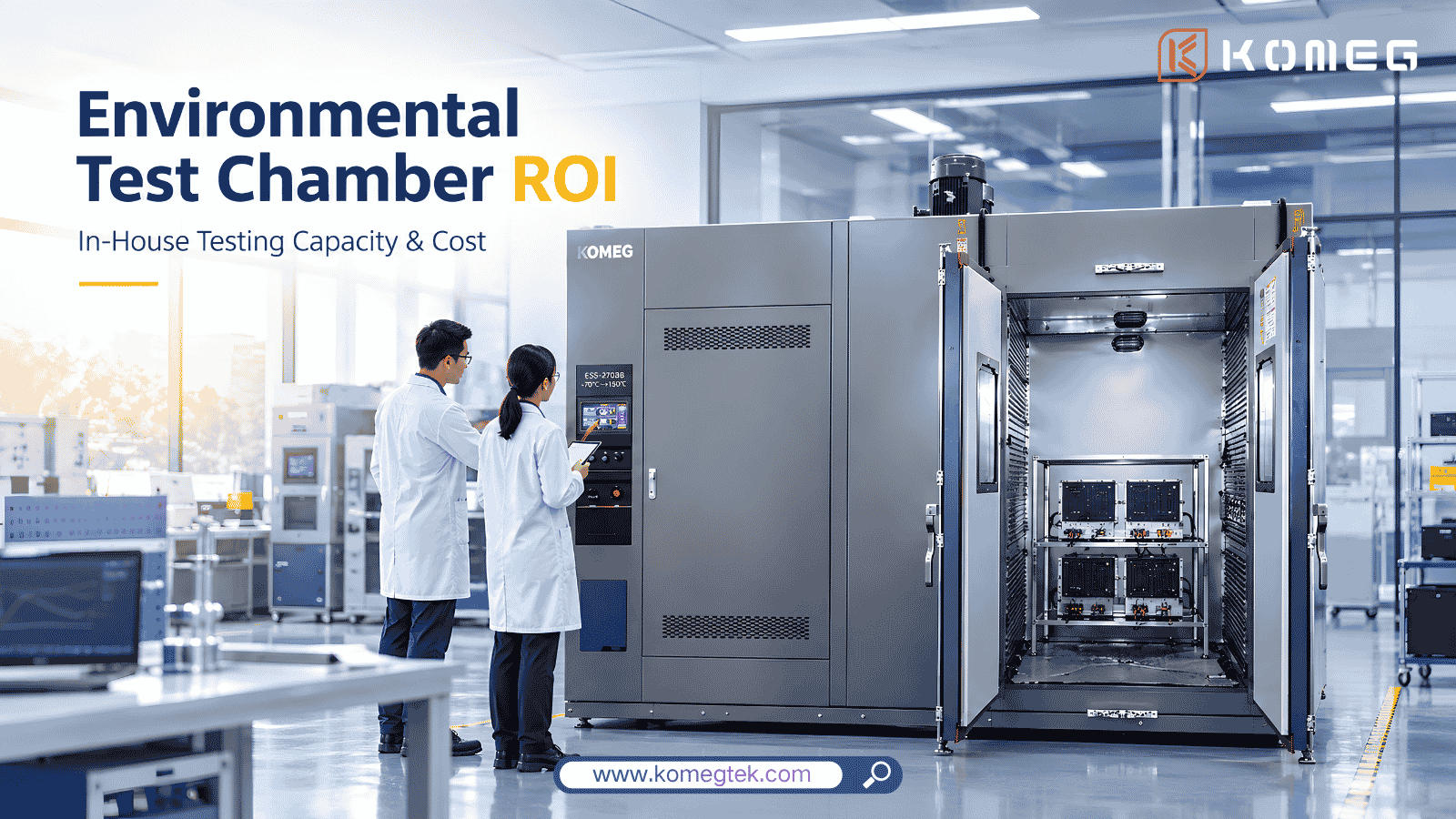
For companies that perform environmental reliability testing regularly, the decision to buy an environmental test chamber is rarely just a question of equipment price.
The real question is whether the company needs its own testing capacity.
Outsourcing environmental testing avoids the upfront cost of purchasing and installing a chamber, but it also introduces laboratory fees, scheduling constraints, sample transportation, and potential delays between design iterations. Buying a chamber requires capital investment and ongoing operating costs, but it gives engineers direct access to testing capacity whenever it is needed.
The right decision depends on testing frequency, test duration, sample size, utilization, engineering workload, and the value of faster product development.
Why Environmental Test Chamber ROI Is More Complicated Than the Purchase Price
A common mistake is to compare the purchase price of a chamber directly with the cost of an outsourced test.
That comparison is incomplete.
An in-house environmental chamber creates several types of costs, including equipment investment, installation, electricity, maintenance, calibration, facility requirements, and operator time. Outsourced testing has a different cost structure, including laboratory fees, shipping, scheduling, engineering coordination, and potentially longer development cycles.
The better approach is to compare the total cost of obtaining and using environmental testing capacity.
This is particularly important for companies that perform frequent reliability testing. A test that costs relatively little on an individual basis can become a significant annual expense when repeated dozens or hundreds of times.
At the same time, an expensive chamber can become an inefficient investment if it sits unused for most of the year.
Utilization is therefore just as important as purchase price.
How Much Environmental Testing Does Your Company Actually Need?
Before deciding whether to buy a chamber, determine how much testing your engineering team actually performs.
Occasional testing is usually easier to outsource. If a company needs environmental testing only a few times a year for certification, qualification, or a specific customer requirement, purchasing dedicated equipment may be difficult to justify.
The situation changes when testing becomes part of daily or weekly engineering work.
Product development teams may need environmental testing for prototype validation, design verification, component qualification, failure analysis, incoming quality control, and reliability improvement. These activities often require multiple test iterations rather than a single formal test.
The more frequently testing is repeated, the more valuable immediate access to a chamber becomes.
This leads to an important distinction:
Low-frequency testing is primarily a testing service requirement. High-frequency testing becomes a capacity requirement.
Once environmental testing becomes a capacity requirement, the economics of owning equipment deserve much closer analysis.
Why Test Frequency Matters More Than the Number of Projects
A company may have only a few major products under development but still require hundreds or thousands of chamber operating hours every year.
Consider a reliability test that takes 72 hours. Running only 20 such tests already represents 1,440 chamber hours.
This is why annual testing hours can be more useful than simply counting the number of test projects.
A practical starting point is:
Annual Testing Hours = Number of Tests × Average Test Duration
The calculation should also include setup, stabilization, sample loading, and other operating time where relevant.
Once annual testing hours are estimated, the company can compare them with the available operating capacity of the proposed chamber.
How Do You Calculate Environmental Chamber Utilization?
Chamber utilization provides a useful way to determine whether the equipment will actually be used enough to justify the investment.
A simple calculation is:
Chamber Utilization = Actual Testing Hours ÷ Available Operating Hours × 100%
For example, assume a chamber is theoretically available for 2,000 operating hours per year. If actual testing requires 1,000 hours, utilization is approximately 50%.
However, 100% utilization should never be treated as the target.
Environmental chambers require time for maintenance, calibration, sample loading, programming, cleaning, troubleshooting, and unexpected downtime. A chamber that is permanently booked can actually become a bottleneck rather than a solution.
The goal is to establish enough capacity for current testing while maintaining reasonable flexibility for future projects.
What Is the Hidden Cost of Outsourced Environmental Testing?
The biggest advantage of outsourcing is obvious: there is no major equipment investment.
The less obvious issue is that the laboratory invoice is only part of the total cost.
A typical outsourced testing process may involve sample preparation, packaging, transportation, laboratory scheduling, test setup, testing, data review, and sometimes retesting.
For international projects, transportation can add additional logistics and lead-time considerations.
More importantly, outsourced testing can affect the development schedule.
If an engineer discovers a design problem after a test, the product may need to be modified and sent back to the laboratory. The next available test slot may not be immediately available.
The financial impact is therefore not limited to the testing fee.
The real cost can include the time between one engineering decision and the next test result.
How Much Is Engineering Waiting Time Worth?
This is one of the most overlooked factors when evaluating in-house environmental testing.
Suppose an engineering team needs to test a prototype, review the results, modify the design, and repeat the test. If the chamber is available internally, this iteration can potentially be scheduled according to the engineering team’s priorities.
When testing is outsourced, every additional iteration may require another booking, shipment, setup, and waiting period.
For mature products with stable designs, this difference may have limited financial impact.
For products undergoing rapid development, however, testing availability can directly affect the development cycle.
This is particularly relevant to industries such as automotive, batteries, electronics, semiconductors, aerospace, and other products where environmental reliability testing is closely integrated with engineering validation.
In these cases, testing capacity can have value beyond the test itself.
What Costs Should Be Included When Buying an Environmental Chamber?
The purchase price should be only the starting point of an in-house ROI calculation.
A realistic analysis should consider:
Equipment investment: The initial cost of the chamber and required accessories.
Installation: Transportation, positioning, electrical connection, water supply, ventilation, drainage, and other facility requirements.
Energy: Electricity or other utility consumption during heating, cooling, and humidity control.
Maintenance: Preventive maintenance, replacement parts, refrigeration-system service, and unexpected repairs.
Calibration: Periodic temperature, humidity, or other performance verification according to the company’s quality system and test requirements.
Labor: Engineering or laboratory personnel required to operate, monitor, maintain, and manage the equipment.
Facility cost: Floor space, infrastructure, environmental conditions, and supporting utilities.
These costs form the basis of the equipment’s total cost of ownership.
A chamber with a lower purchase price is not automatically the lower-cost solution if it has insufficient capacity, excessive energy consumption, poor serviceability, or frequent downtime.
When Does Buying an Environmental Test Chamber Make Sense?
Buying becomes more attractive when several conditions occur at the same time.
The first is high testing frequency. If environmental testing occurs every week or even every day, recurring laboratory fees can accumulate quickly.
The second is long test duration. Long-duration tests occupy laboratory capacity for extended periods and make scheduling more difficult.
The third is frequent design iteration. When engineers need to test, modify, and retest products repeatedly, immediate access to equipment can significantly simplify the development process.
The fourth is customized testing. Companies may need unusual temperature profiles, specific ramp rates, special fixtures, cable access, large samples, or unique monitoring arrangements that are not readily available from every third-party laboratory.
The fifth is confidentiality. Some companies prefer to keep prototypes, new materials, battery systems, semiconductor hardware, or other sensitive products within their own facility.
When several of these factors apply, the question changes from “Can we afford a chamber?” to “Can we afford not to have the required testing capacity?”
When Is Outsourcing Still the Better Choice?
Buying an environmental chamber is not always the right answer.
Outsourcing can remain practical when testing is infrequent, highly specialized, or primarily required for formal qualification.
Third-party laboratories may also provide capabilities that would be expensive to establish internally, including specialized instrumentation, accredited testing services, experienced test personnel, and unusual environmental simulation systems.
For companies with low annual testing demand, outsourcing can avoid the capital commitment and operational responsibility associated with owning equipment.
There is also no requirement to choose only one model.
A company can use an in-house chamber for frequent R&D, design verification, screening, and failure analysis while using an independent laboratory for formal qualification or specialized testing.
In many cases, this hybrid approach provides greater flexibility than relying entirely on either internal or external testing.
How Much Chamber Capacity Do You Really Need?
Once a company decides that in-house testing makes sense, the next question is chamber size.
This is where another common purchasing mistake occurs: buying capacity based on the largest imaginable product rather than the actual testing program.
Chamber selection should consider:
Product dimensions
Number of samples
Fixture dimensions
Thermal load
Required temperature range
Humidity requirements
Temperature transition rate
Cable access
Airflow requirements
Future product development
Required testing throughput
The usable workspace is more important than the nominal chamber volume.
A chamber that is too small creates test limitations. A chamber that is significantly oversized may increase capital cost, floor-space requirements, and operating costs without providing meaningful additional value.
The objective is to select enough capacity for the current program while leaving a reasonable margin for future requirements.
Choosing the Right Environmental Chamber for In-House Testing
Not every in-house testing program requires the same type of equipment.
For components, electronic assemblies, materials, and smaller products, a conventional temperature chamber can provide a practical starting point. KOMEG’s temperature test chambers are available in different working volumes and temperature configurations for laboratory and reliability testing.
When testing requires both temperature and humidity control, a temperature and humidity chamber becomes more appropriate. This is relevant to applications involving moisture resistance, climatic exposure, reliability validation, and other combined environmental stresses.
For applications requiring rapid temperature transitions, a rapid-rate thermal cycle chamber can provide a different level of testing capability. The equipment should be selected according to the actual thermal profile, sample mass, ramp-rate requirement, and expected testing workload rather than simply choosing the fastest specification available.
When Does a Walk-In Environmental Chamber Make Financial Sense?
Large products create a different capacity problem.
Automotive assemblies, battery systems, large electronic equipment, solar modules, full racks, and other large products may exceed the working space of conventional reach-in chambers.
In these cases, purchasing several smaller chambers is not necessarily a better financial decision. The number of samples, test throughput, product dimensions, thermal load, and required environmental conditions need to be considered together.
A walk-in environmental chamber can provide substantially more usable testing space and can be configured around the actual application.
KOMEG offers walk-in environmental chambers with standard test spaces ranging from several cubic meters to much larger configurations, with customization available for sample dimensions, quantity, temperature and humidity requirements, airflow, fixtures, and other application-specific conditions.
For large-scale programs, customization can be particularly important because the chamber needs to accommodate not only the product but also the thermal load, access requirements, measurement equipment, and supporting infrastructure.
The Right ROI Model Is About Capacity, Not Just Cost
A useful environmental chamber ROI calculation should bring several factors together:
Annual Outsourcing Cost
This includes laboratory fees, transportation, additional test charges, and other external testing expenses.
Annual In-House Operating Cost
This includes energy, maintenance, calibration, labor, and other recurring expenses.
Capital Investment
This includes the chamber, installation, accessories, and required facility modifications.
Capacity Value
This represents the practical value of having testing available when engineers need it.
Schedule Value
This considers the development time potentially saved by reducing laboratory queues and transportation delays.
The purpose of the calculation is not to produce an artificially precise ROI number.
It is to determine whether the company’s actual testing workload justifies building internal capacity.
A Simple Decision Framework for Environmental Testing
Before requesting an environmental chamber quotation, ask five questions.
How often will we test?
If testing is occasional, outsourcing may remain practical. If testing is frequent, calculate the annual chamber hours.
How long does each test take?
Long-duration tests can quickly consume external laboratory capacity and make internal capacity more valuable.
How large are the samples?
Small components and assemblies may require only a laboratory-scale chamber, while large products may require a walk-in system.
How customized are the test conditions?
Standard qualification tests are easier to outsource. Customized profiles, fixtures, ramp rates, and monitoring requirements can make in-house testing more attractive.
How important is development speed?
If environmental testing directly affects design iterations and product launch schedules, testing availability becomes part of the investment calculation.
The key question is therefore not simply:
“Should we buy an environmental test chamber?”
A better question is:
“How much environmental testing capacity will our business need over the next three to five years?”
In-House Testing Is an Investment in Testing Capacity
The decision to purchase an environmental test chamber should not be based on equipment price alone.
For companies with occasional testing requirements, third-party laboratories can provide flexibility without the responsibility of owning and maintaining equipment.
For companies performing frequent reliability testing, however, environmental testing becomes an ongoing engineering activity. At that point, laboratory fees, scheduling delays, sample logistics, and engineering waiting time can become significant.
An in-house chamber does more than replace an outsourced testing invoice. It creates testing capacity that engineers can access according to the development schedule.
That capacity can be particularly valuable when products require repeated environmental exposure, rapid design iteration, customized test conditions, or large-scale testing.
The most defensible purchasing decision is therefore based on testing frequency, utilization, total cost of ownership, required capacity, and development priorities, rather than the chamber’s purchase price alone.
The right environmental chamber is not necessarily the largest or the least expensive. It is the one that provides the testing capacity your engineering program can actually use.