

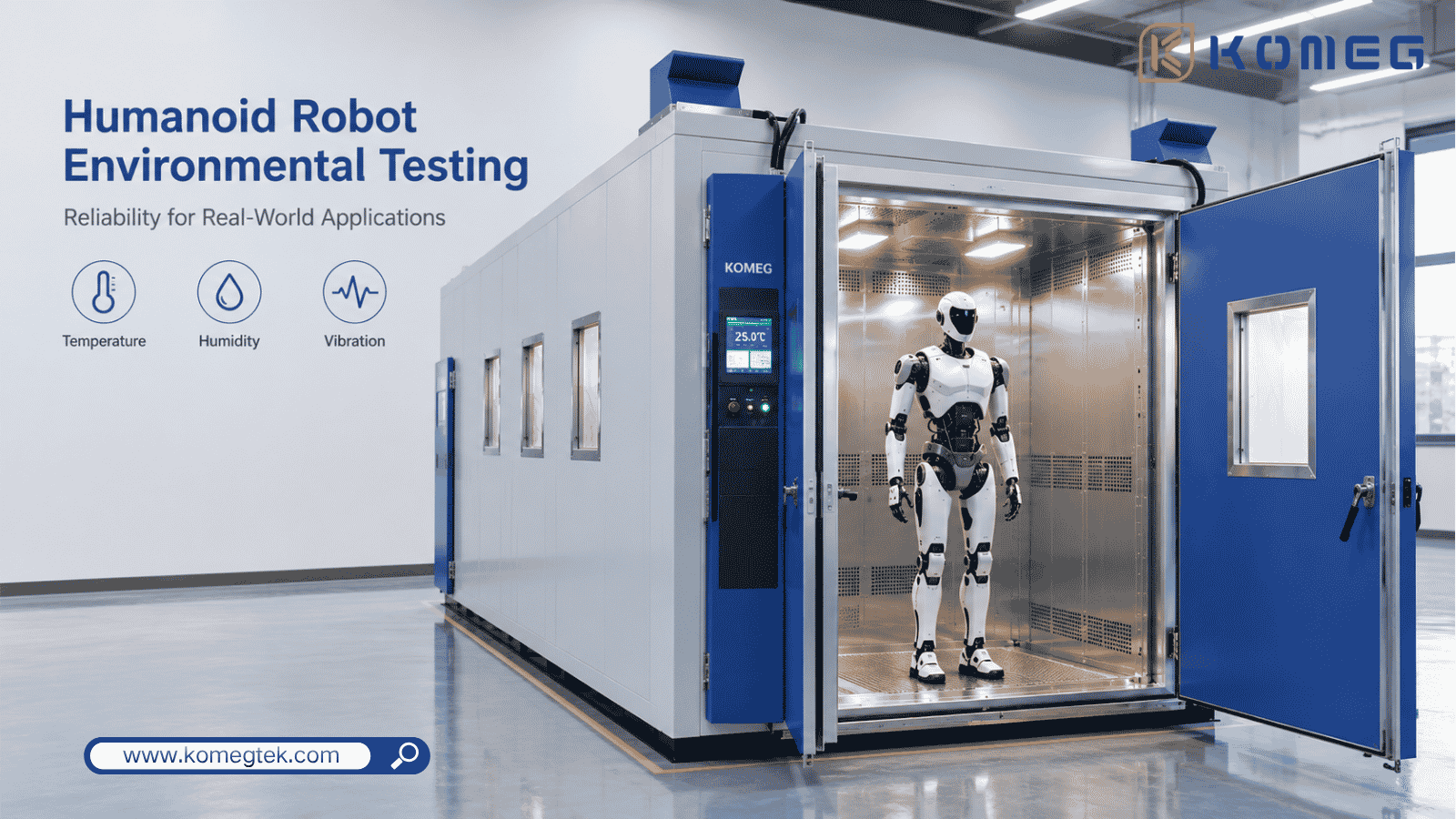
Humanoid robots are moving from controlled laboratory environments into factories, warehouses, commercial facilities, healthcare environments, and other real-world applications. As their operating conditions become more demanding, functional testing alone is no longer sufficient to verify long-term reliability.
A humanoid robot combines mechanical systems, electronics, sensors, actuators, batteries, control boards, wiring, communication modules, and structural components into a highly integrated platform. These components can respond differently to temperature, humidity, vibration, and repeated environmental changes. As a result, environmental testing has become an important part of humanoid robot reliability testing.
The objective is not simply to determine whether a robot can operate at a particular temperature. Engineers need to understand how environmental stress affects the robot’s performance, mechanical integrity, electrical connections, sensors, and power systems over time.
Why Environmental Testing Matters for Humanoid Robots
Unlike many conventional electronic products, humanoid robots operate through continuous movement. Walking, running, lifting objects, climbing stairs, and repetitive joint movements generate mechanical and thermal stresses during operation.
At the same time, the robot may be exposed to changing ambient conditions. A robot working in a cold warehouse may later operate in a heated building. Outdoor robots can experience sunlight, rain, humidity, and large daily temperature variations. Industrial robots may also operate near heat sources, dust, or other environmental stresses.
These conditions can interact with one another. Temperature changes can cause materials to expand and contract, while humidity can accelerate corrosion and reduce electrical insulation performance. Mechanical vibration can further increase stress on connectors, solder joints, sensors, and wiring.
For this reason, a practical environmental testing program should evaluate not only individual environmental conditions but also how those conditions affect the robot as an integrated system.
Temperature Testing for Humanoid Robots
Temperature is one of the fundamental environmental factors in robot reliability testing.
Low-temperature testing can reveal problems that may not appear under normal laboratory conditions. Battery output can decrease, lubricants can become more viscous, elastomeric materials can become less flexible, and electronic components may experience changes in electrical characteristics. Motors and actuators may also require more energy during startup or movement.
High-temperature testing presents a different set of challenges. Continuous operation can generate considerable internal heat around motors, motor controllers, batteries, power electronics, and control systems. When high ambient temperature is added to this self-heating effect, critical components may operate closer to their thermal limits.
A temperature test chamber allows engineers to reproduce controlled hot and cold conditions and monitor parameters such as startup behavior, actuator performance, sensor response, battery characteristics, and electronic system stability.
For general temperature testing, KOMEG Temperature Test Chambers provide controlled temperature environments across a wide ran
For general temperature testing, KOMEG temperature test chambers provide controlled temperature environments across a wide range, with programmable temperature profiles that can be adapted to different robot components and assemblies.
Humidity Testing and Moisture-Related Reliability
Humidity is another important consideration, particularly for robots expected to operate in outdoor, industrial, or high-moisture environments.
Moisture can gradually affect electronic and mechanical components. Long-term exposure to high relative humidity may contribute to corrosion, insulation degradation, leakage current, contact resistance changes, and deterioration of sensitive electronic assemblies.
Connectors and wiring deserve particular attention because small changes in contact resistance or insulation performance can eventually cause intermittent faults. Sensors may also become less stable when exposed to repeated humidity and temperature variations.
Temperature and humidity test chambers are therefore useful for evaluating the combined influence of heat and moisture rather than testing either condition independently. Engineers can program controlled temperature and relative-humidity profiles and monitor changes in electrical performance, communication, sensor accuracy, and system operation.
For more demanding accelerated environmental stress testing, high-temperature and high-humidity methods can also be considered when appropriate to the component, material, and applicable test requirements.
Thermal Cycling and Rapid Temperature Changes
A robot does not always experience a stable environment. Repeated transitions between hot and cold conditions can be particularly important for reliability evaluation.
Different materials inside a humanoid robot have different coefficients of thermal expansion. Metals, plastics, circuit boards, adhesives, seals, connectors, and structural materials therefore respond differently when temperature changes.
Repeated thermal cycling can contribute to:
- Solder joint fatigue
- Connector stress
- Material deformation
- Seal degradation
- Sensor drift
- Wiring stress
- Intermittent electrical failures
This is why thermal cycling testing should not simply be treated as another form of constant-temperature testing.
Rapid-rate thermal cycle chambers can create controlled temperature transitions at significantly higher rates than conventional environmental chambers. This makes them useful when engineers need to investigate the effects of repeated and accelerated temperature changes on electronic assemblies, sensors, control systems, and other robot components.
KOMEG rapid-rate thermal cycle chambers are designed for programmable temperature cycling, with configurations supporting different temperature transition requirements and sample sizes.
Vibration Testing for Moving Robots
Vibration is particularly relevant to humanoid robots because movement itself creates mechanical excitation.
Every step, change in direction, impact, and repeated joint movement can introduce vibration into the robot structure. Over time, these stresses may affect components that appear reliable during short-duration functional tests.
Potentially affected areas include circuit boards, connectors, wiring harnesses, sensors, fasteners, actuator assemblies, and structural interfaces.
External vibration testing can be used to evaluate whether components remain mechanically and electrically reliable under controlled vibration conditions. When vibration is combined with temperature and humidity, engineers can investigate more realistic multi-environment stress conditions.
For applications where thermal, humidity, and vibration conditions need to be evaluated together, KOMEG Agree chambers integrate environmental conditioning with vibration testing. This type of system can help engineers study how multiple stresses interact rather than evaluating each stress in complete isolation.
Battery and Power Electronics Testing
The battery is an important part of a humanoid robot, but it is not the only source of thermal and electrical reliability concerns.
Motors, servo drives, motor controllers, DC/DC converters, power modules, and other electronics can generate substantial heat during repeated movement. The actual thermal condition of a robot may therefore be very different from the ambient temperature measured around it.
Environmental testing should consider both the chamber environment and the robot’s internal heat generation.
For example, engineers may need to evaluate whether the robot can start reliably at low temperature, maintain stable operation at high temperature, or continue performing repeated movements without excessive thermal buildup.
This is especially important for robots designed for long operating cycles, where a small thermal or electrical weakness can become more significant after thousands of repeated operations.
Combined Environmental Testing
Real-world operating conditions rarely involve only one stress factor.
A humanoid robot may experience high temperature while motors are operating continuously. An outdoor robot may encounter high humidity while moving and generating vibration. A robot transported between different environments may experience repeated temperature transitions before being placed into operation.
This creates a strong engineering case for combined environmental testing.
Depending on the product design and test objectives, engineers may combine:
Temperature + Humidity
to investigate moisture-related electrical and material reliability.
Temperature Cycling + Functional Operation
to identify failures caused by repeated thermal expansion and contraction.
Temperature + Humidity + Vibration
to investigate multi-factor environmental stress on integrated systems.
The appropriate test profile depends on the robot’s intended application, component limitations, failure mechanisms, and applicable customer or industry requirements. There is no single environmental test profile suitable for every humanoid robot.
Choosing a Humanoid Robot Test Chamber
Selecting an environmental test chamber should begin with the actual test requirements rather than chamber size alone.
Engineers should consider the robot’s dimensions and weight, required temperature range, humidity range, temperature ramp rate, vibration requirements, cable connections, internal power requirements, monitoring equipment, and safety configuration.
For small components and electronic assemblies, a conventional temperature or temperature-and-humidity chamber may be sufficient. Larger robot assemblies may require a walk-in environmental chamber. If accelerated thermal cycling is important, a rapid-rate thermal cycle chamber may be more appropriate. For integrated environmental and vibration testing, an Agree chamber can provide a more comprehensive test platform.
For full-size humanoid robots, chamber volume is particularly important because sufficient internal space is needed for the robot to move, operate, and be monitored without unnecessarily restricting the test configuration.
KOMEG Environmental Testing Solutions for Humanoid Robots
Humanoid robot testing is becoming a multidisciplinary reliability challenge involving thermal, electrical, mechanical, and environmental stresses.
KOMEG provides several environmental testing platforms that can be configured for different stages of robot development. Temperature and humidity chambers can be used for controlled environmental exposure, while rapid-rate thermal cycle chambers support accelerated temperature transition testing. Agree chambers combine temperature, humidity, and vibration testing for more integrated reliability evaluation. For larger robotic systems, walk-in environmental chambers provide the internal volume required for full-system testing.
The most effective test strategy is not necessarily the most severe one. Instead, engineers should establish environmental profiles that reflect the robot’s expected operating and storage conditions, identify the most relevant failure mechanisms, and then build repeatable test procedures around those conditions.
As humanoid robots move from experimental platforms toward long-term commercial and industrial deployment, environmental testing will play an increasingly important role in demonstrating reliability beyond the laboratory.