

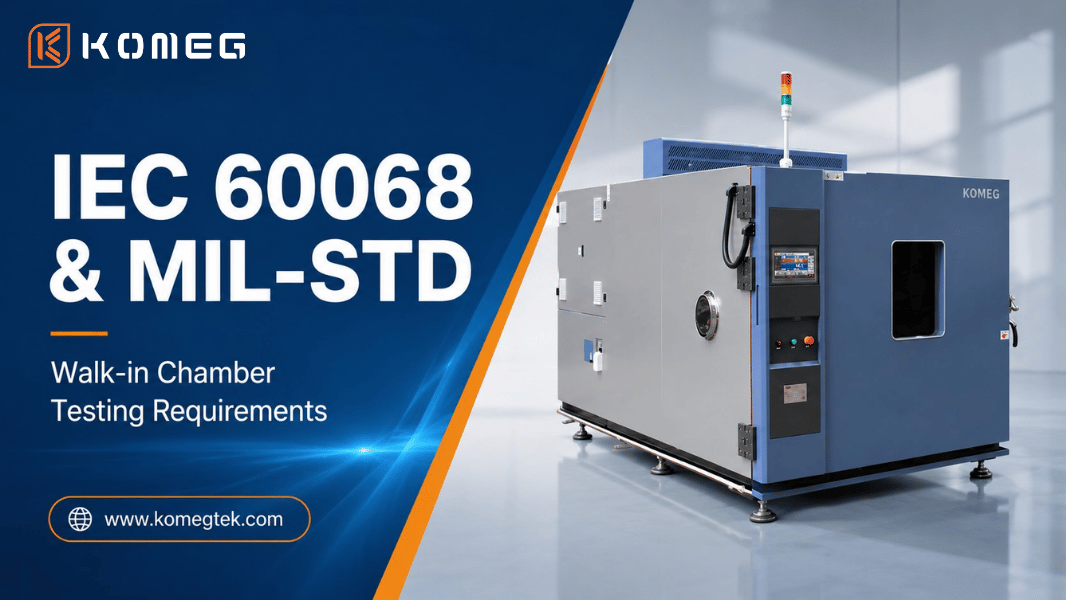
Environmental testing becomes more complicated as products become larger, more integrated, and more closely connected to their actual operating environment. A small electronic component may be tested in a conventional chamber with relatively simple loading, while a complete vehicle subsystem, battery system, telecom cabinet, or aerospace assembly can require a much larger controlled test space.
This is where a walk-in environmental test chamber becomes useful. However, selecting a walk-in chamber for IEC 60068 or MIL-STD-810 testing is not simply a matter of choosing a large chamber with a wide temperature range. The actual requirements depend on the test method, specimen, operating condition, environmental severity, and the way the product is expected to perform during its service life.
Understanding this distinction is important when designing a reliable environmental test program.
What Is a Walk-in Environmental Test Chamber?
A walk-in environmental test chamber is designed for environmental testing of products and systems that are too large, heavy, or complex for conventional floor-standing chambers. Instead of testing only individual components, engineers can place larger assemblies or complete systems inside the controlled environment and evaluate their behavior under specified temperature, humidity and other environmental conditions.
Typical applications include automotive electronics, battery systems, communication equipment, servers, power electronics, aerospace assemblies and industrial equipment. For these products, the test setup may also include fixtures, cables, monitoring equipment and external loads, all of which can affect the thermal behavior inside the chamber.
The larger test volume creates a different engineering challenge. Temperature uniformity, airflow distribution, humidity control, heat dissipation and recovery time become increasingly important as the specimen size and heat load increase. A chamber that performs well with a small electronic module may not deliver the same testing conditions when it is loaded with a large operating system.
For this reason, the chamber should be selected according to the actual test profile and specimen characteristics, rather than based only on its nominal temperature range.
How IEC 60068 Applies to Walk-in Chamber Testing
IEC 60068 is one of the most widely referenced international series for environmental testing. It covers a broad range of environmental conditions and provides specific test methods for evaluating the ability of components, equipment, and other products to withstand conditions encountered during use, transportation or storage.
For walk-in chamber applications, several parts of the series are particularly relevant.
IEC 60068-2-1: Cold Testing
IEC 60068-2-1:2025 defines low-temperature tests for heat-dissipating and non-heat-dissipating specimens. It can be applied to energized and non-energized products and considers both packed and unpacked conditions depending on the intended application.
For large equipment, the challenge is not simply reaching the required low temperature. The chamber must provide a stable and sufficiently uniform environment around the specimen, while the heat generated by an operating product can affect the actual conditions around the test item.
One important point is often overlooked: IEC 60068-2-1 is not intended to evaluate the effect of temperature changes themselves. When the purpose of the test is to determine how a product responds to changing temperature, IEC 60068-2-14 is the more appropriate reference.
IEC 60068-2-2: Dry Heat Testing
IEC 60068-2-2:2025 covers dry heat testing for products that need to withstand high-temperature conditions during use, transportation or storage. Like the cold test, it can be applied to both heat-dissipating and non-heat-dissipating specimens.
For a large walk-in chamber, high-temperature testing can become more demanding when the specimen is powered during the test. Electronics, batteries, motors and power systems can introduce significant internal heat loads, which means the chamber refrigeration and airflow system must work together to maintain the specified environmental conditions.
This is why temperature stability, airflow and heat-load capacity deserve as much attention as the maximum temperature listed in a chamber specification.
IEC 60068-2-14: Change of Temperature
Temperature change testing addresses a different failure mechanism. IEC 60068-2-14:2023 specifies tests using controlled changes in ambient temperature to analyze their effects on test specimens.
Rapid or repeated temperature changes can create differential expansion and contraction between materials with different coefficients of thermal expansion. In practical products, this may place additional stress on solder joints, seals, adhesives, connectors, coatings, and mechanical interfaces.
For applications where the transition rate is an important part of the test, a rapid temperature change test chamber may be more appropriate than a conventional temperature chamber designed primarily for stable high- or low-temperature exposure.
IEC 60068-2-30 and IEC 60068-2-78: Damp Heat Testing
Humidity testing is particularly relevant to products expected to operate in warm and humid regions or environments where condensation can occur.
IEC 60068-2-30 addresses cyclic damp heat testing, where temperature and humidity are varied cyclically, and condensation can form under specified conditions. IEC 60068-2-78, in contrast, addresses steady-state damp heat exposure under constant temperature and high humidity without condensation during the test. These methods therefore investigate different environmental stresses and should not simply be treated as interchangeable humidity tests.
For a walk-in chamber, humidity control becomes more challenging as chamber volume and specimen size increase. The chamber needs adequate circulation, moisture control, and recovery performance to maintain the intended test conditions throughout the usable test space.
IEC has also continued updating the 60068-2 series. The current IEC 60068-2:2026 series package includes, among others, the 2025 editions of IEC 60068-2-1, IEC 60068-2-2 and IEC 60068-2-30, while IEC 60068-2-14:2023 remains the relevant edition for change-of-temperature testing.
For any qualification or certification program, engineers should always verify the exact edition and test method referenced by the applicable product specification.
What Does MIL-STD-810 Require?
MIL-STD-810 is often described simply as a military environmental testing standard, but its actual approach is more flexible than that description suggests.
The U.S. Department of Defense’s official document description states that MIL-STD-810 provides environmental engineering considerations and laboratory test methods, but does not impose fixed design or test specifications. Instead, it uses an environmental tailoring process to develop realistic test conditions based on the performance requirements and intended service environment of the equipment.
This distinction matters when selecting a walk-in chamber.
A MIL-STD-810 test program may involve high temperature, low temperature, temperature shock, humidity, altitude, rain, vibration, shock, sand and dust or other environmental stresses. The appropriate combination and severity depend on the equipment and its intended operating environment rather than on a single universal MIL-STD-810 chamber specification.
In other words, MIL-STD-810 defines how environmental conditions can be evaluated; it does not mean that every MIL-STD-810 application requires the same chamber configuration.
This is also why the test plan should be defined before the chamber is specified.
Key Walk-in Chamber Requirements for IEC 60068 and MIL-STD-810
Once the applicable test methods have been identified, the next question is whether the chamber can reproduce the required conditions consistently across the test space.
Temperature Range and Stability
The temperature range needs to cover the actual test profile with sufficient operating margin. More importantly, the chamber should maintain stable conditions after the specimen has been loaded and brought to the required operating state.
For large equipment, the difference between an empty-chamber specification and actual loaded performance can be significant. Engineers should therefore consider the specimen’s thermal characteristics rather than evaluating the chamber from temperature range alone.
Temperature Uniformity
Temperature uniformity becomes increasingly important as chamber size increases. Poor airflow distribution can create temperature differences between different areas of the chamber, which may expose different parts of the specimen to different environmental conditions.
For qualification testing, this can make test results harder to interpret and reproduce. Chamber design, air circulation, and sensor placement all contribute to the final test environment.
Airflow and Heat Load
A large powered specimen may release substantial heat during operation. The chamber must be able to remove that heat while maintaining the required environmental conditions.
This is particularly relevant for battery systems, power electronics, servers, and automotive electronic assemblies. In these applications, the chamber’s cooling capacity and airflow design need to be considered together with the product’s expected operating load.
Humidity Control
Humidity testing requires more than simply adding moisture to the chamber. The system must control humidity accurately while maintaining the required temperature and air circulation.
For cyclic damp heat testing, condensation behavior is also important. Chamber design should therefore consider moisture recovery, drainage, insulation and the relationship between chamber temperature and specimen temperature.
Chamber Volume and Test Configuration
The usable test volume should be determined from the complete test setup rather than the product dimensions alone. Fixtures, cables, monitoring devices and safety clearances all occupy space.
A chamber that is technically large enough for the product may still be unsuitable if the specimen blocks airflow or leaves insufficient space for uniform environmental exposure.
Recovery Performance
After opening the door or introducing a large specimen, the chamber environment will temporarily move away from the target condition. Recovery performance determines how quickly the system can return to the required temperature or humidity conditions.
For production testing and repeated qualification cycles, this can have a direct impact on overall test time.
Why Walk-in Chamber Testing Is Different from Conventional Chamber Testing
The basic principle of environmental testing remains the same whether the specimen is a small electronic component or a complete system: create a controlled environment, expose the product to the specified conditions, and monitor its response.
The engineering difficulty changes significantly with size, however.
A conventional chamber may have relatively simple loading and a small internal heat load. A walk-in chamber can contain a large operating system, multiple fixtures and extensive instrumentation. Airflow can be obstructed, heat can accumulate around the specimen, and humidity can take longer to stabilize.
Consequently, a walk-in chamber should be evaluated as part of the complete test system. Chamber size, environmental control, airflow, specimen loading and monitoring strategy all influence the quality of the final test.
Applications in Automotive, Electronics and Aerospace
Walk-in environmental chambers are increasingly useful where reliability testing has moved from individual components toward complete assemblies and systems.
In the automotive sector, typical applications include battery systems, ECUs, ADAS components, sensors, power electronics and communication equipment. These products may need to operate under wide temperature and humidity conditions while powered, communicating or carrying a defined electrical load.
For electronics and telecommunications, larger equipment such as server systems, network equipment, power supplies and communication cabinets can require environmental validation at the system level. Temperature cycling and humidity exposure can help identify weaknesses in connectors, soldered interfaces, insulation, sealing systems and other critical structures.
In aerospace and defense, environmental conditions can vary significantly throughout the product lifecycle. Temperature extremes, humidity, altitude, vibration and other environmental stresses may need to be considered together, making test configuration and environmental tailoring particularly important.
How to Choose the Right Walk-in Environmental Test Chamber
The most reliable way to select a walk-in chamber is to begin with the test program rather than the equipment catalog.
Start by identifying the exact standard and test method that applies to the product. IEC 60068 and MIL-STD-810 contain multiple environmental tests, and each may have different requirements for temperature, humidity, transition conditions, exposure time, and specimen operation.
Next, define the actual temperature and humidity profile, including the operating condition of the specimen. A powered product with a high internal heat load can require a very different chamber configuration from a passive product of the same physical size.
The next step is to determine the required test volume and loading arrangement. Include fixtures, cables, monitoring equipment, and the space required for appropriate airflow around the specimen. For large systems, this is often where an apparently suitable chamber proves to be undersized.
Finally, evaluate temperature uniformity, stability, airflow, humidity control, and recovery performance under the expected load. These factors are more meaningful for an actual reliability program than simply comparing the maximum and minimum temperature numbers in different equipment brochures.
KOMEG Walk-in Environmental Test Chambers
KOMEG develops environmental test chambers for applications where conventional chambers are not sufficient for the size or configuration of the test specimen. Walk-in systems can be configured around factors such as chamber volume, temperature range, humidity requirements, specimen heat load and test methodology.
Applications include automotive components and systems, battery and energy storage equipment, telecommunications, electronics, aerospace and industrial products. Depending on the test program, KOMEG can provide environmental testing solutions covering temperature and humidity exposure as well as other controlled environmental conditions.
For engineers planning a new qualification program, the chamber should be treated as part of the overall test system rather than as an isolated piece of equipment. Defining the test method, specimen condition, and environmental profile first makes it much easier to determine the appropriate chamber configuration.
IEC 60068 and MIL-STD-810 both play important roles in environmental reliability testing, but they should not be interpreted as simple equipment specifications. IEC 60068 provides defined environmental test methods, while MIL-STD-810 uses an environmental tailoring approach to develop test conditions that reflect the intended service environment of the equipment.
For large products and system-level validation, a walk-in environmental test chamber can provide the controlled space required to reproduce these conditions. The key is not simply achieving an extreme temperature or humidity value, but maintaining a stable, uniform and repeatable environment around the actual test specimen.
As products become larger and more integrated across automotive, electronics, telecommunications and aerospace applications, the quality of environmental testing becomes increasingly dependent on the relationship between test method, specimen, chamber design and operating conditions.
Frequently Asked Questions
Can a walk-in chamber be used for IEC 60068 testing?
Yes. A walk-in environmental chamber can be used when the specimen or complete system is too large for a conventional chamber, provided that the chamber can reproduce the environmental conditions and performance requirements specified by the applicable IEC 60068 test method.
Does MIL-STD-810 specify a fixed temperature range for environmental chambers?
No. MIL-STD-810 does not prescribe one universal chamber temperature range. The appropriate environmental conditions are selected through the standard’s tailoring process according to the equipment, lifecycle, and intended service environment.
What is the difference between IEC 60068 and MIL-STD-810?
IEC 60068 is a series of standardized environmental test methods covering conditions such as cold, dry heat, temperature change, and damp heat. MIL-STD-810 provides a broader environmental engineering and tailoring framework for selecting appropriate laboratory and field tests according to the intended application.
What should be considered when selecting a walk-in environmental chamber?
Temperature range, humidity range, temperature uniformity, stability, airflow, recovery performance, chamber volume, specimen heat load, and test configuration should all be considered. The best chamber is the one that can reproduce the required test conditions under the actual specimen load, not simply the one with the widest nominal temperature range.
08/17/2026
This article references the latest editions available from IEC at the time of publication. Test programs should always be verified against the applicable specification and the latest edition of the relevant standard.