

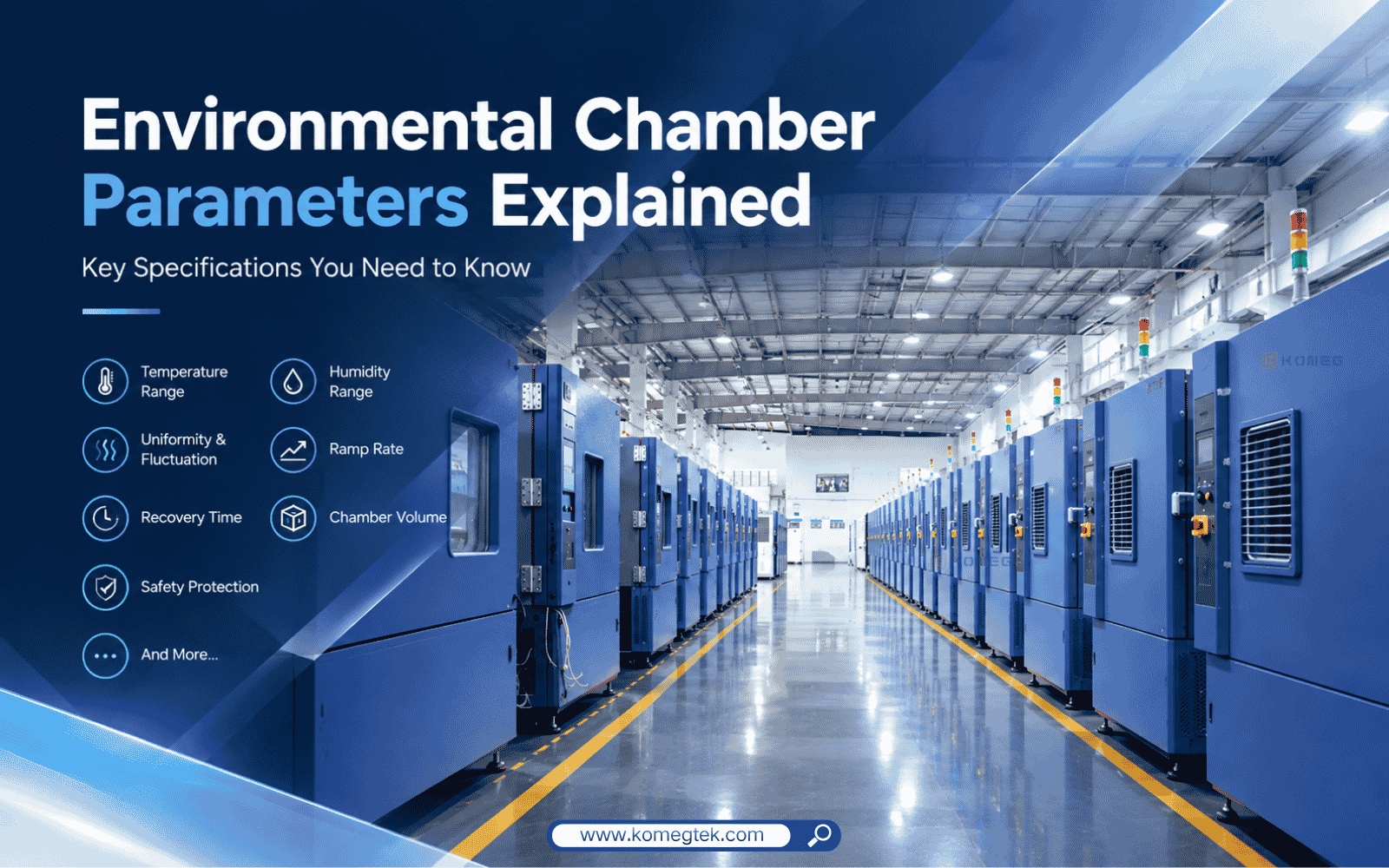
When selecting an environmental test chamber, temperature range is often the first specification engineers look at. However, it is rarely enough to determine whether a chamber is suitable for a particular test. Two chambers may offer the same temperature range but deliver very different performance in terms of temperature stability, uniformity, ramp rate, recovery time, airflow, or load capacity.
For this reason, understanding the key environmental chamber parameters is important before comparing equipment or requesting a quotation. The right chamber should not simply have impressive numbers on its specification sheet. It should be capable of reproducing the required environmental conditions accurately and consistently under the actual test load.
This article explains the major environmental test chamber specifications, what each parameter means, why it matters, and how engineers can use these specifications when selecting equipment for reliability testing, electronics, automotive, battery, semiconductor, aerospace, pharmaceutical, and other applications.
What Are the Main Environmental Chamber Parameters?
Environmental chamber specifications describe the chamber’s ability to create, control, and maintain specific environmental conditions. Depending on the chamber type and application, the specification sheet may include temperature range, temperature fluctuation, temperature uniformity, temperature deviation, humidity range, ramp rate, recovery time, chamber volume, airflow, refrigeration system, controller accuracy, power requirements, and safety features.
Not every application requires the highest specification in every category. A laboratory performing simple temperature storage tests has very different requirements from a battery laboratory performing rapid thermal cycling. Similarly, a chamber used for small electronic components may not need the same working volume or refrigeration capacity as a walk-in chamber used for automotive assemblies.
The first step, therefore, is to understand what each parameter actually represents rather than comparing specification numbers individually.
1. Temperature Range
The temperature range is normally the starting point when evaluating an environmental chamber. It defines the minimum and maximum temperatures that the chamber is designed to achieve and control under specified conditions. Depending on the model, common configurations may include -20°C to +150°C, -40°C to +150°C, or -70°C to +150°C, while some applications require temperatures up to +180°C or substantially lower temperatures.
The required range should be based on the actual environmental profile of the product and the applicable test standard. For example, electronic components used in automotive applications may require low-temperature and high-temperature exposure, while battery, semiconductor, aerospace, or advanced-material applications may require more extreme conditions.
However, a wider temperature range does not automatically mean a better environmental chamber. If a test only requires -20°C to +80°C, selecting a chamber capable of -70°C to +180°C may add cost and energy consumption without providing a meaningful testing advantage. At the same time, choosing a chamber whose limits are only slightly beyond the required test conditions may leave insufficient margin for recovery and future applications.
KOMEG offers temperature test chambers with different temperature-range configurations so that users can select equipment according to their actual testing requirements.
KOMEG Temperature Test Chambers
2. Temperature Fluctuation, Uniformity, and Deviation
Three specifications are frequently confused when reading an environmental chamber datasheet: temperature fluctuation, temperature uniformity, and temperature deviation. Although they are related, they describe different aspects of chamber performance.
Temperature fluctuation describes how much the temperature changes over time around a controlled setpoint at a particular measurement location. If a chamber is set to 85°C and the measured temperature continuously moves slightly above and below this value, that variation represents temperature fluctuation. Low fluctuation is particularly important for long-duration reliability and stability tests because large variations can introduce additional environmental stress that was not part of the intended test profile.
Temperature uniformity, on the other hand, describes how evenly temperature is distributed throughout the working space. A chamber may maintain a stable temperature at one sensor while having a temperature difference between different areas because of airflow, specimen placement, heat generation, or chamber loading. This is why uniformity becomes especially important when testing multiple specimens or large products.
Temperature deviation describes the difference between the actual temperature and the programmed setpoint. In simple terms, deviation answers the question: How close is the actual chamber temperature to the target temperature?
These three parameters should therefore be considered together:
Deviation tells you how close the chamber is to the setpoint, fluctuation tells you how stable it is over time, and uniformity tells you how consistent it is throughout the working space.
3. Humidity Range and Humidity Stability
For a temperature and humidity test chamber, humidity performance is just as important as temperature performance. The humidity range defines the relative humidity levels that the chamber can produce and control at specified temperatures. A typical configuration may cover approximately 20% to 98% RH, while specialized configurations may provide lower humidity levels.
Humidity testing is widely used to evaluate moisture absorption, corrosion, insulation performance, electronic reliability, material degradation, packaging performance, and pharmaceutical stability. In many cases, the temperature and humidity conditions must be controlled simultaneously because changes in temperature directly influence the chamber’s ability to maintain relative humidity.
Humidity fluctuation and humidity uniformity should also be considered. Humidity fluctuation describes changes in relative humidity over time, while humidity uniformity describes differences between different locations inside the chamber. These parameters become particularly important during long-duration damp heat or cyclic humidity testing, where inconsistent environmental conditions can affect test repeatability.
KOMEG temperature and humidity test chambers are available in multiple configurations for applications requiring controlled temperature and relative humidity.
KOMEG Temperature and Humidity Test Chambers
4. Temperature Change Rate or Ramp Rate
For conventional environmental exposure tests, the ability to reach and maintain a target temperature may be more important than how quickly the temperature changes. For thermal cycling, environmental stress screening, and accelerated reliability testing, however, temperature change rate or ramp rate can become one of the most important specifications.
Ramp rate is normally expressed in °C/min and describes how quickly the chamber temperature changes between two temperature conditions. Depending on the equipment and configuration, environmental chambers may offer rates such as 1°C/min, 3°C/min, 5°C/min, 10°C/min, or 15°C/min.
The required ramp rate should be determined by the actual test profile. A semiconductor package, electronic connector, battery module, automotive component, and large mechanical assembly can respond very differently to the same chamber temperature change because of differences in thermal mass and heat transfer.
KOMEG rapid-rate thermal cycle chambers are designed for applications requiring faster temperature transitions, with configurations offering ramp rates such as 5°C/min, 10°C/min, and 15°C/min depending on the model and operating conditions.
KOMEG Rapid-Rate Thermal Cycle Chambers
One important point should not be overlooked: chamber air ramp rate is not necessarily the same as specimen ramp rate. A heavy battery pack or metal assembly may require considerably more time to reach the same temperature as the surrounding air. Engineers should therefore consider thermal mass, fixture design, airflow, specimen geometry, and temperature measurement when a specific DUT temperature profile is required.
5. Recovery Time
Recovery time describes how quickly the chamber returns to its specified environmental condition after a disturbance. Common disturbances include opening the door, loading or unloading specimens, introducing a large thermal load, or changing the test configuration.
For example, a chamber operating at -40°C may experience a significant temperature increase when its door is opened and a large specimen is loaded. The chamber’s ability to return to -40°C quickly can have a direct impact on overall testing efficiency.
Recovery performance becomes increasingly important in production testing, battery testing, repetitive thermal cycling, and high-throughput laboratories. A chamber with a long recovery time may increase the total duration of a test program even when its basic temperature range and stability specifications appear adequate.
Therefore, when comparing environmental chamber specifications, recovery should be considered alongside cooling capacity, airflow, refrigeration design, specimen heat load, and chamber volume.
6. Chamber Volume and Working Space
Chamber volume determines how much usable space is available for specimens, fixtures, sensors, and other test equipment. Laboratory environmental chambers are commonly specified in liters, while larger systems are often specified in cubic meters.
KOMEG standard environmental chambers, for example, are available in configurations including 64 L, 150 L, 225 L, 408 L, and 1000 L, while walk-in environmental chambers provide substantially larger working spaces for large components and assemblies.
However, selecting chamber volume is not simply a matter of making sure the specimen can physically fit inside. Engineers also need to consider airflow clearance, fixture dimensions, the number of specimens, specimen heat generation, cable routing, shelf loading, and future testing requirements.
A chamber that is too small may restrict airflow and make loading difficult, while an unnecessarily large chamber may increase purchase and operating costs. The goal is to select enough usable working space for the complete test setup rather than simply matching the external dimensions of the product.
KOMEG Walk-In Environmental Chambers
7. Airflow and Air Circulation
Temperature uniformity and recovery performance are strongly influenced by air circulation inside the chamber. The refrigeration system and heater create the required thermal conditions, but the circulation system distributes conditioned air throughout the working space.
Airflow becomes particularly important when the chamber is heavily loaded, specimens generate heat, shelves restrict circulation, or large products occupy a significant portion of the working space. Poor airflow distribution can result in temperature gradients and slower recovery.
This is why environmental chamber performance should not be evaluated only under empty-chamber conditions. The actual specimen arrangement can change airflow patterns and thermal distribution significantly.
For critical applications, engineers should consider not only the specified temperature uniformity but also how the chamber is designed to maintain that uniformity under realistic loading conditions.
8. Refrigeration System and Cooling Method
The refrigeration system plays a major role in determining the chamber’s low-temperature capability, cooling rate, recovery performance, and energy consumption.
Different applications require different refrigeration configurations. Standard temperature chambers may use conventional refrigeration systems, while chambers designed for very low temperatures or high cooling rates may use cascade or auto-cascade refrigeration technology.
When comparing refrigeration specifications, engineers should look beyond the minimum temperature. Important factors include cooling rate, thermal load capacity, recovery time, ambient conditions, energy consumption, and long-term operating requirements.
This is particularly important for large specimens. A chamber may reach a very low temperature under no-load conditions but respond differently when a large thermal mass is introduced. The refrigeration system therefore needs to be evaluated according to the complete test condition rather than a single headline specification.
9. Controller and Control Accuracy
The controller is responsible for converting the programmed test profile into actual chamber operation. Modern environmental chambers typically control temperature, humidity, test cycles, alarms, data recording, and communication functions through an integrated control system.
For laboratory and industrial applications, communication interfaces can also be important. Depending on the chamber configuration, interfaces such as RS485, Ethernet, and USB may be available for communication, data transfer, or system integration.
A good controller should not only provide a convenient user interface but also maintain stable control throughout changing test conditions. Engineers should therefore consider programming capability, data logging, alarm management, communication interfaces, sensor configuration, and integration requirements when comparing controllers.
10. Power Supply and Installation Requirements
Environmental chambers can consume significant electrical power, particularly when operating at extreme temperatures or when large refrigeration and heating systems are involved. Large walk-in chambers may also require three-phase electrical power and additional facility infrastructure.
Before purchasing a chamber, engineers should confirm the required voltage, frequency, phase configuration, current, installed power, cooling method, ventilation, drainage, and available installation space.
These requirements are easy to overlook during equipment selection but can become major issues during installation. The chamber should be evaluated as part of the complete laboratory or production facility rather than as an isolated piece of equipment.
11. Safety Protection and Application-Specific Requirements
Safety requirements depend heavily on what is being tested. A conventional electronic component may only require standard electrical and over-temperature protection, while battery testing can involve significantly greater energy and safety risks.
Depending on the application, environmental chambers may incorporate features such as over-temperature protection, compressor protection, over-current protection, emergency shutdown, pressure relief, gas detection, fire detection, or fire suppression systems.
Battery testing is a particularly important example. A standard temperature chamber should not automatically be considered suitable for every lithium-ion battery safety test. The chamber configuration needs to reflect the battery chemistry, energy level, test procedure, foreseeable failure modes, and applicable safety requirements.
KOMEG offers dedicated battery thermal test chambers and walk-in battery test chambers with configurable safety systems for applications requiring additional protection.
KOMEG Battery Thermal Test Chambers
12. Noise and Operating Environment
Noise is not normally the first specification engineers consider, but it can become important when an environmental chamber operates continuously inside a laboratory or near working areas.
Compressors, fans, motors, and refrigeration systems all contribute to operating noise. A chamber installed in an industrial testing area may have different acoustic requirements from one installed in a laboratory environment.
Engineers should therefore consider not only the chamber’s performance but also where it will be installed, how long it will operate continuously, and whether noise or vibration could affect nearby equipment or personnel.
Does a Higher Specification Always Mean a Better Environmental Chamber?
Not necessarily.
This is an important point when comparing environmental test chamber specifications. It is easy to assume that a chamber offering -70°C to +180°C and a 15°C/min ramp rate is automatically better than one offering -40°C to +150°C and a 3°C/min ramp rate. In practice, the answer depends on the test.
If the actual application only requires -20°C to +120°C with a relatively slow temperature transition, the additional performance may provide little practical value. The higher-capacity chamber may instead result in higher purchase costs, greater energy consumption, and more complex installation requirements.
On the other hand, if the application involves aggressive thermal cycling, large temperature transitions, or demanding battery and semiconductor reliability testing, higher ramp rates and wider temperature capability may be essential.
The better question is therefore not “Which chamber has the highest specification?” but “Which specifications match the actual test requirements?”
Which Environmental Chamber Specifications Should You Compare?
When comparing different environmental chamber manufacturers, engineers should look at the complete specification rather than focusing on one or two headline numbers.
For temperature performance, compare the temperature range, fluctuation, uniformity, deviation, heating rate, cooling rate, and recovery performance. For humidity testing, review the humidity range together with humidity fluctuation, uniformity, and condensation behavior.
The mechanical configuration is equally important. Working volume, interior dimensions, shelf capacity, cable ports, door configuration, and airflow clearance all affect how effectively the chamber can be used in real testing.
Finally, consider the refrigeration system, controller, communication interfaces, power requirements, installation conditions, maintenance requirements, and safety features. A technically suitable chamber should provide the required environmental performance while remaining practical to operate and maintain.
What Information Should You Provide to an Environmental Chamber Manufacturer?
When requesting an environmental chamber quotation, providing only the desired temperature range usually does not give the manufacturer enough information to recommend the correct configuration.
Useful information includes the specimen name, material, dimensions, weight, quantity, fixture dimensions, operating condition, heat generation, required temperature and humidity range, ramp rate, test cycle, dwell time, applicable standard, monitoring requirements, and special safety considerations.
The specimen’s thermal characteristics are particularly important for rapid thermal testing. A chamber that can change its air temperature quickly may not necessarily produce the same temperature change rate at the DUT.
For large products, engineers should also provide information about loading arrangements and available installation space. This allows the manufacturer to determine whether a standard chamber, rapid-rate chamber, walk-in chamber, battery chamber, or customized system would be most appropriate.
For additional guidance, KOMEG also provides a detailed guide on how to choose an environmental test chamber.
Environmental Chamber Parameters and Testing Standards
Environmental chamber specifications should always be considered together with the applicable testing standard. Standards such as IEC 60068, MIL-STD-810, ISO 16750, AEC-Q100, JESD22, UN 38.3, IEC 62133, IEC 62619, and ICH Q1A may define different environmental conditions, exposure durations, temperature transitions, tolerances, or specimen configurations.
It is important to distinguish between the testing standard and the equipment used to perform the test. A chamber manufacturer may design equipment capable of reproducing the required environmental conditions, but listing a standard on a product page does not by itself mean that every test performed in that chamber automatically complies with the standard.
Actual compliance depends on the complete test procedure, specimen setup, environmental conditions, measurement methods, tolerances, and test execution.
How to Select the Right Environmental Chamber Parameters
A practical selection process starts with the test profile rather than the equipment. First define the minimum and maximum temperatures, humidity requirements, ramp rate, dwell time, number of cycles, and recovery requirements. Then determine the size, weight, quantity, thermal mass, heat generation, and fixture requirements of the specimens.
Next, identify the applicable testing standard or customer specification and translate those requirements into measurable chamber performance. At this stage, parameters such as temperature uniformity, fluctuation, ramp rate, recovery time, and working volume become much easier to evaluate.
Finally, confirm the installation environment and safety requirements, including electrical supply, ventilation, drainage, available space, cooling requirements, and application-specific protection. This process helps avoid a common purchasing mistake: selecting a chamber based on attractive specification numbers without considering how it will actually perform in the intended test.
KOMEG Environmental Test Chamber Solutions
KOMEG designs and manufactures environmental test chambers for applications ranging from laboratory component testing to large-scale product and assembly testing. Its product range includes temperature test chambers, temperature and humidity chambers, rapid-rate thermal cycle chambers, walk-in environmental chambers, battery test chambers, thermal shock chambers, HAST chambers, altitude chambers, industrial ovens, and customized environmental testing systems.
Different configurations can be selected according to temperature range, humidity requirements, specimen size, ramp rate, thermal load, working volume, safety requirements, and testing standards. This allows the chamber to be matched to the actual application instead of relying on a single standard configuration.
For engineers evaluating environmental chamber specifications, the goal should not simply be to find the chamber with the widest temperature range or fastest ramp rate. The more important objective is to select a system that can reproduce the required environmental profile accurately, repeatedly, efficiently, and safely under realistic test conditions.
Explore KOMEG Environmental Test Chambers
Frequently Asked Questions About Environmental Chamber Parameters
What are the most important environmental chamber parameters?
The most important parameters generally include temperature range, temperature uniformity, temperature fluctuation, temperature deviation, humidity range, humidity stability, ramp rate, recovery time, working volume, airflow, refrigeration performance, control accuracy, and safety protection. The relative importance of each parameter depends on the application and test standard.
What is the difference between temperature uniformity and temperature fluctuation?
Temperature uniformity describes temperature differences between different locations inside the chamber, while temperature fluctuation describes temperature changes over time at a specific measurement location. A chamber can therefore have good stability at one location but still have a temperature gradient across the working space.
What is environmental chamber ramp rate?
Ramp rate describes how quickly the chamber air temperature changes from one condition to another, normally expressed in °C/min. The actual temperature change rate of the test specimen may be slower because of its thermal mass, geometry, material, fixture, and heat-transfer conditions.
Is a wider temperature range always better?
No. A wider temperature range provides greater testing capability, but it may also increase equipment cost, energy consumption, and system complexity. The appropriate range should be based on the actual test profile and future testing requirements.
How important is chamber volume?
Chamber volume determines the available working space, but engineers should also consider specimen quantity, fixture dimensions, airflow clearance, thermal load, cable routing, and loading configuration. The objective is to provide enough usable space for the complete test setup without unnecessarily oversizing the chamber.
What specifications should I provide when requesting an environmental chamber?
Provide the specimen dimensions, weight, quantity, operating conditions, temperature and humidity requirements, test profile, ramp rate, applicable standards, fixture information, power requirements, and special safety considerations. For large or heat-generating products, thermal load information is particularly important.
Understanding environmental chamber parameters is essential when selecting equipment for reliable environmental testing. Temperature range may be the most visible specification, but it is only one part of overall chamber performance.
Temperature fluctuation determines how stable the environment remains over time, while uniformity describes how consistently conditions are distributed throughout the working space. Ramp rate becomes critical for thermal cycling, while recovery time affects testing efficiency after loading or door opening. Chamber volume, airflow, refrigeration capacity, control systems, power requirements, and safety features all influence how effectively the equipment performs in real-world applications.
The best environmental test chamber is therefore not necessarily the one with the highest numbers on its specification sheet. It is the chamber whose temperature, humidity, dynamic performance, working space, control system, and safety configuration are properly matched to the actual test requirements.
By evaluating these parameters as a complete system, engineers can make more informed equipment decisions, improve test repeatability, and avoid paying for performance that their application does not actually require.