

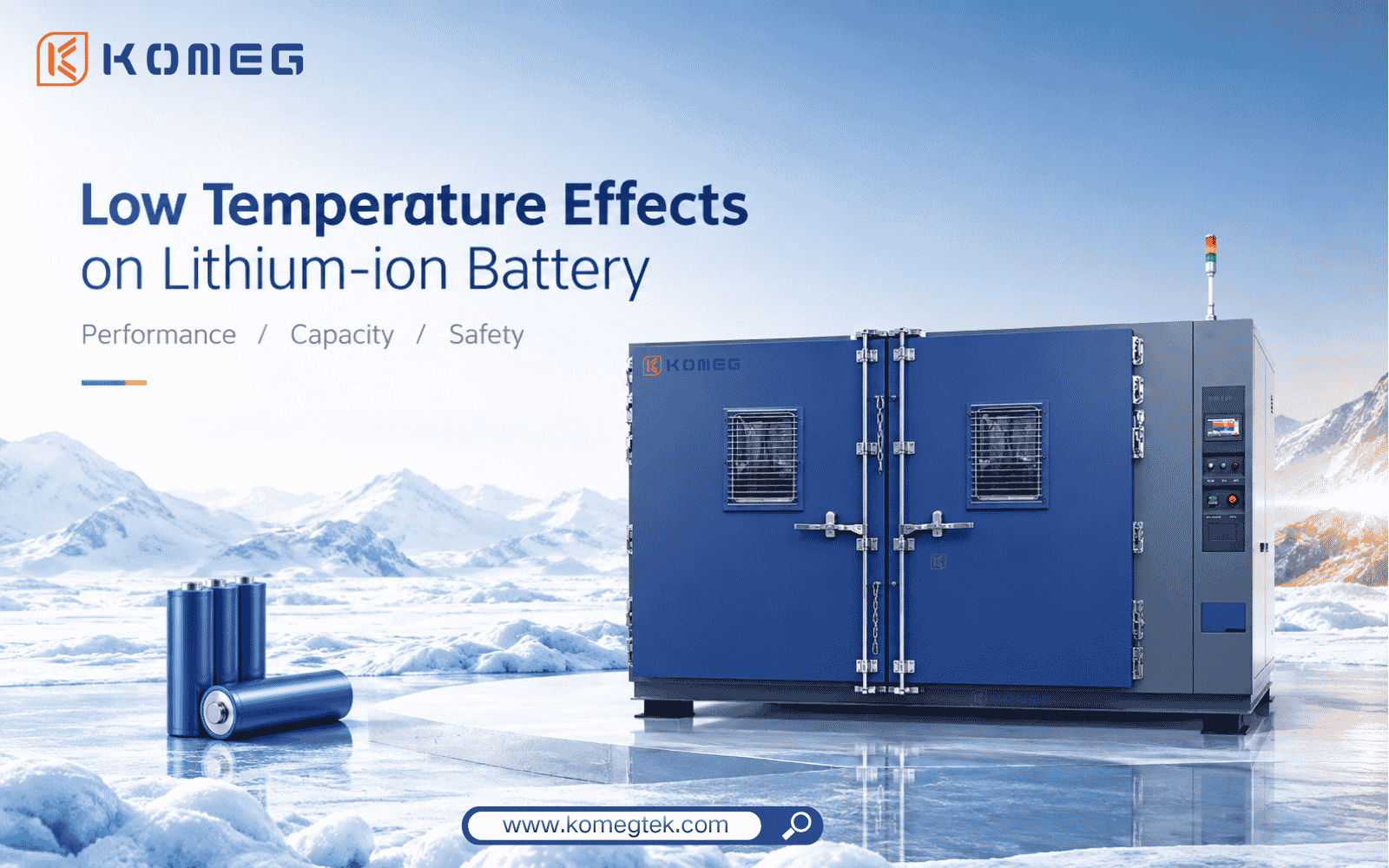
Lithium-ion batteries are widely used in electric vehicles, consumer electronics, energy storage systems, aerospace equipment, and other applications that may operate across a wide range of environmental conditions. However, battery performance can change significantly when temperatures fall below normal operating conditions.
The low-temperature effects on lithium-ion battery performance are not limited to a temporary reduction in capacity. Cold conditions can increase internal resistance, slow lithium-ion transport and electrochemical reactions, reduce available power, affect charging performance, and increase the risk of lithium plating when charging at an unsuitable temperature or rate.
For engineers developing or validating battery systems, understanding these effects is important for evaluating cold-weather performance, battery management strategies, thermal management systems, and long-term reliability.
What Happens to a Lithium-ion Battery at Low Temperature?
The electrochemical reactions inside a lithium-ion battery are strongly temperature-dependent. As temperature decreases, the movement of lithium ions and the kinetics of charge-transfer reactions become slower.
The electrolyte can also become more viscous, reducing ionic conductivity and making lithium-ion transport more difficult. At the electrode interfaces, slower desolvation and charge-transfer processes can further increase polarization and resistance. Research on low-temperature lithium-ion batteries has identified sluggish Li+ transport, increased resistance, and limitations at the electrode/electrolyte interface as major causes of performance degradation.
The result is a battery that may still contain substantial stored energy but cannot deliver or accept that energy as effectively as it does at moderate temperatures.
This distinction is important: low temperature does not necessarily mean that the battery has immediately lost all of its stored energy. Instead, the battery’s ability to access and transfer that energy is restricted.
1. Reduced Battery Capacity at Low Temperature
One of the most noticeable low-temperature effects on lithium-ion batteries is reduced available capacity.
When the temperature decreases, slower electrochemical kinetics and increased internal resistance make it more difficult for the cell to fully utilize its active materials during a discharge cycle. As a result, the measured discharge capacity can be significantly lower than the capacity obtained under standard temperature conditions.
This effect is particularly important in electric vehicles and energy storage systems. A battery that performs normally at room temperature may deliver substantially less usable energy in a cold environment.
However, it is important to distinguish between temporary available-capacity loss and permanent capacity degradation.
If a battery is simply discharged at a low temperature, part of the capacity reduction may be reversible after the cell returns to a suitable temperature. In contrast, repeated operation under unfavorable cold conditions—especially cold charging—can contribute to irreversible degradation mechanisms.
2. Increased Internal Resistance
Low temperatures generally increase the internal resistance of lithium-ion cells.
Several mechanisms contribute to this behavior, including reduced ionic conductivity in the electrolyte, slower lithium-ion diffusion, increased interfacial resistance, and slower charge-transfer kinetics.
Higher resistance means that more of the battery’s energy is dissipated internally during operation.
During high-current discharge, this can produce a larger voltage drop:
Lower temperature → higher resistance → greater voltage drop → lower usable power
This is one reason why an electric vehicle may experience reduced acceleration or limited regenerative braking capability in cold weather.
For battery engineers, measuring voltage, current, temperature, and resistance under controlled environmental conditions provides much more useful information than simply recording the nominal battery capacity.
3. Reduced Power Output
Capacity and power are not the same thing.
A battery may still have significant chemical energy available, but its ability to deliver high current can be reduced at low temperatures.
The increased internal resistance causes a greater voltage drop under load. At the same time, slower ion transport limits the rate at which electrochemical reactions can proceed.
This can affect applications that require high instantaneous power, including:
Electric vehicle acceleration
Cold-start operation
Regenerative braking
Power tools
Drones
Aerospace systems
Portable electronic equipment
Battery energy storage systems
Research has reported severe power loss in lithium-ion batteries below 0°C, which is one reason cold-weather battery operation remains an important engineering challenge.
4. Why Low-Temperature Charging Is More Challenging
Discharging a lithium-ion battery at low temperature and charging it at low temperature are not equivalent problems.
Low-temperature charging can be particularly challenging because of lithium plating.
During normal charging, lithium ions move through the electrolyte and are incorporated into the graphite anode. At sufficiently low temperatures, however, lithium-ion transport and charge-transfer kinetics become slower.
If the charging current is too high for the cell’s low-temperature condition, lithium ions may not be inserted into the graphite quickly enough. Metallic lithium can instead deposit on the anode surface.
This phenomenon is commonly referred to as lithium plating.
Lithium plating can reduce usable capacity, accelerate degradation, and under some conditions contribute to safety risks. Research has demonstrated that charging protocols that are acceptable at room temperature can trigger significant lithium plating when the same cell is charged at 0°C.
This is why battery management systems often restrict charging current or delay fast charging until the battery reaches a more suitable temperature.
5. Lithium Plating and Battery Safety
Lithium plating is one of the most important reasons why engineers need to pay attention to low-temperature charging.
Repeated plating can consume active lithium and contribute to irreversible capacity loss. Depending on the conditions and cell design, deposited lithium can also contribute to dendritic growth and other failure mechanisms.
This does not mean that every lithium-ion battery charged below 0°C will immediately become unsafe. The actual risk depends on many factors, including:
Cell chemistry
Anode and cathode materials
State of charge
Charging current
Temperature
Electrolyte formulation
Electrode design
Cell construction
Thermal management strategy
Charging control algorithm
Therefore, a meaningful low-temperature battery test should control more than temperature alone.
6. Low Temperature Can Affect Battery Life
Repeated exposure to unfavorable temperatures can accelerate battery degradation.
A battery may experience a combination of:
Increased polarization
Lithium plating
SEI-related changes
Reduced active lithium
Increased impedance
Reduced power capability
Capacity fade
The severity depends strongly on the operating and charging conditions.
For this reason, engineers should not evaluate low-temperature performance from a single capacity measurement. A more useful approach is to monitor performance over repeated cycles and compare changes in capacity, voltage behavior, resistance, and other electrical characteristics.
This helps distinguish a temporary cold-temperature performance limitation from permanent degradation.
7. The Effect of Low Temperature Depends on Battery Chemistry
Not all lithium-ion batteries behave identically at low temperatures.
Battery chemistry, electrode materials, electrolyte formulation, cell architecture, and manufacturing parameters all influence low-temperature performance.
For example, the graphite anode is particularly important when evaluating low-temperature charging because its lithium intercalation kinetics can become a limiting factor.
Research into extreme-temperature battery operation has shown that improving low-temperature performance requires attention to multiple components, including electrolyte properties, electrode materials, and solid-electrolyte interphase chemistry.
Therefore, engineers should avoid applying one universal “safe minimum temperature” to every lithium-ion battery.
The appropriate temperature limits should always be based on the specific cell, battery system, manufacturer’s specifications, charging strategy, and applicable test requirements.
8. How Low Temperature Affects EV Batteries
Electric vehicles are one of the most demanding applications for low-temperature lithium-ion battery performance.
Cold conditions can affect:
Driving range
Acceleration
Charging speed
Regenerative braking
Energy efficiency
Battery warm-up time
Thermal management energy consumption
The impact becomes more significant when the battery must deliver high power immediately after exposure to a cold environment.
For EV battery developers, the test objective is therefore not simply to determine whether a battery can operate at a particular temperature. Engineers need to understand how quickly performance changes, how the battery responds to load, how charging behavior changes, and how quickly the battery recovers after thermal conditioning.
9. Why Battery Preheating Is Important
Battery thermal management is one of the primary strategies used to address low-temperature limitations.
Preheating the battery before high-power operation or fast charging can help bring the cells into a more favorable temperature range.
Possible approaches include:
Liquid-based heating
Electrical resistance heating
Self-heating battery structures
Heat pump systems
Thermal interface materials
Insulation
Optimized battery pack thermal management
The goal is not necessarily to make the battery as hot as possible. Instead, the thermal management system should bring the battery to an appropriate temperature while maintaining temperature uniformity and minimizing unnecessary energy consumption.
Research has also demonstrated dedicated battery structures capable of self-heating under low-temperature conditions.
10. How Low-Temperature Battery Testing Works
To understand the real low-temperature behavior of a lithium-ion battery, engineers typically place the test specimen in a controlled environmental chamber and expose it to defined temperature conditions.
A basic test sequence may include:
Temperature conditioning → Stabilization → Charge/discharge → Electrical measurement → Recovery → Repeat cycling
Depending on the objective, engineers may monitor:
Discharge capacity
Charge capacity
Voltage
Current
Internal resistance
Energy efficiency
Power capability
Charging time
Temperature distribution
Cycle life
Recovery behavior
The environmental chamber provides a controlled thermal environment while a battery cycler or other electrical test system controls and records the electrical behavior.
This combination is important because temperature alone does not determine battery performance. The electrical load, charging rate, state of charge, thermal history, and test duration can all influence the result.
11. What Temperature Should Be Used for Low-Temperature Battery Testing?
There is no single temperature that represents all low-temperature lithium-ion battery tests.
The appropriate test temperature depends on the application and the purpose of the test.
For example, an engineer may need to evaluate:
Mild cold-weather performance
Sub-zero discharge performance
Cold-start capability
Low-temperature charging
Fast charging at low temperature
Extreme cold storage
Temperature cycling
Recovery after cold exposure
The test profile should therefore be developed from the actual application requirements and applicable standards rather than selecting an arbitrary low temperature.
For automotive cells, IEC 62660-1 provides standardized performance testing procedures for secondary lithium-ion cells used in electric and hybrid road vehicles, covering characteristics such as capacity, power density, energy density, storage life, and cycle life.
IEC 62660-2 addresses reliability and abuse testing of secondary lithium-ion cells and cell blocks used for vehicle propulsion.
For transportation-related lithium battery testing, the UN Manual of Tests and Criteria also includes thermal testing within Section 38.3. The current UN Manual Revision 8 and Amendment 1 provide the applicable framework and updates for lithium cells and batteries.
Importantly, these standards should not be treated as interchangeable. The required test temperature, duration, cycling profile, electrical condition, and acceptance criteria depend on the specific standard and test method.
12. Environmental Test Chambers for Low-Temperature Battery Testing
A suitable environmental test chamber provides a stable and repeatable thermal environment for evaluating battery performance under controlled conditions.
For lithium-ion battery testing, important chamber parameters can include:
Temperature Range
The chamber must cover the required minimum and maximum test temperatures with sufficient operating margin.
Temperature Uniformity
Uniform temperature distribution helps ensure that different parts of the test specimen are exposed to comparable conditions.
This becomes particularly important for larger battery modules and packs, where temperature gradients can develop between cells.
Temperature Stability
Temperature fluctuation should be controlled so that changes in battery performance can be attributed to the intended test condition rather than unstable chamber control.
Cooling and Heating Rate
The required ramp rate depends on the test method.
A faster temperature transition can be useful for thermal cycling or accelerated environmental testing, while other tests may require controlled conditioning and stabilization rather than maximum ramp speed.
Working Volume
The chamber must provide enough space for the battery, fixtures, sensors, electrical connections, and safety equipment while maintaining appropriate airflow.
Safety Protection
Battery testing can involve electrical, thermal, and chemical hazards. Depending on the battery type and test objective, additional safety provisions may include temperature monitoring, over-temperature protection, pressure relief, gas detection, fire detection or suppression, and other battery-specific protective systems.
A chamber should therefore be selected according to the actual battery test risk rather than temperature range alone.
13. KOMEG Battery Environmental Test Solutions
KOMEG provides environmental testing systems designed for battery cells, modules, packs, and other energy-storage components.
Depending on the application, KOMEG battery test chambers can be configured for controlled temperature and humidity testing, low-temperature testing, temperature cycling, and battery thermal testing.
For battery applications with higher safety requirements, KOMEG also offers battery thermal test chambers with configurable safety features such as pressure relief, gas detection, fire detection and suppression, and other protective functions.
For larger battery assemblies and production-scale testing, KOMEG Battery Walk-in Test Chambers can be configured according to battery size, quantity, temperature range, humidity requirements, and safety requirements.
KOMEG’s standard and customized environmental chamber solutions cover a range of battery testing requirements, allowing the test system to be matched to the specimen and intended test profile rather than relying on a one-size-fits-all configuration.
14. What Engineers Should Measure During Low-Temperature Battery Testing
A temperature chamber alone does not provide a complete picture of battery performance.
For a meaningful low-temperature evaluation, engineers should consider combining environmental conditioning with electrical and thermal measurements.
Depending on the test objective, the test plan may include:
Temperature: Actual battery temperature and chamber air temperature.
Voltage: Open-circuit voltage, operating voltage, voltage recovery, and voltage drop under load.
Current: Charge and discharge current throughout the test.
Capacity: Available charge capacity at different temperatures.
Power: Maximum or specified power output under controlled conditions.
Resistance: Changes in internal resistance or impedance after thermal exposure.
Temperature recovery: Battery behavior as the cell returns to a normal operating temperature.
Cycle performance: Changes after repeated low-temperature charge/discharge cycles.
This multi-parameter approach provides much more useful information than simply recording whether the battery continues to operate.
15. Low Temperature Does Not Affect Every Battery in the Same Way
One of the most important points in low-temperature battery testing is that there is no universal performance curve for every lithium-ion battery.
Two cells with the same nominal voltage and capacity can behave differently because of differences in:
Cathode chemistry
Anode material
Electrolyte
Electrode loading
Cell format
SEI characteristics
Manufacturing process
State of charge
Charging rate
Thermal management
This is why published temperature limits should be treated as application-specific rather than universal specifications.
For battery developers, controlled environmental testing provides a way to establish the actual operating envelope of a particular cell or battery system.
Frequently Asked Questions
Does cold weather permanently damage lithium-ion batteries?
Not necessarily. Some low-temperature effects, such as reduced available capacity and increased resistance, can be partially reversible when the battery returns to a suitable temperature. However, repeated operation under unfavorable conditions—particularly inappropriate low-temperature charging—can cause irreversible degradation such as lithium plating and capacity loss.
Can lithium-ion batteries be charged below 0°C?
Some lithium-ion batteries are designed for charging at sub-zero temperatures under specific conditions, but the allowable temperature and charging current depend on the cell chemistry and manufacturer specifications. Charging too aggressively at low temperature can increase the risk of lithium plating.
Why does lithium-ion battery capacity decrease in cold weather?
Low temperatures slow lithium-ion transport and electrochemical reactions while increasing internal resistance. These effects reduce the amount of energy that can be effectively extracted during discharge.
Why is low-temperature charging more dangerous than discharging?
Charging requires lithium ions to be incorporated into the anode. When low temperature slows this process, lithium can deposit on the anode surface instead of being properly intercalated. This lithium plating can accelerate degradation and create additional safety concerns.
What is lithium plating?
Lithium plating is the deposition of metallic lithium on the anode surface during charging. It can occur when charging conditions exceed the cell’s ability to safely accommodate lithium ions, with low temperature being one important contributing factor.
How do you test lithium-ion batteries at low temperature?
A typical test uses a controlled environmental test chamber to condition the battery at a specified temperature, followed by controlled charge/discharge cycles and measurement of voltage, current, capacity, power, resistance, and temperature. The exact profile should follow the relevant application requirements and test standard.
What is the best temperature for lithium-ion battery testing?
There is no single best temperature. The appropriate condition depends on the application, battery chemistry, intended operating environment, and applicable test method. Engineers should define the temperature profile according to the actual reliability or performance objective.
The low-temperature effects on lithium-ion battery performance involve much more than a simple reduction in capacity.
As temperature decreases, lithium-ion transport and electrochemical kinetics become slower, internal resistance increases, and available power can decline. Low-temperature charging introduces an additional concern because insufficient reaction kinetics can promote lithium plating on the anode.
For this reason, reliable cold-temperature battery evaluation should consider capacity, power, resistance, charging behavior, thermal recovery, and long-term cycling performance rather than relying on a single measurement.
Controlled environmental testing provides engineers with a repeatable way to determine how a specific battery performs across its intended temperature range. When combined with appropriate electrical measurement and battery safety systems, low-temperature testing can help identify performance limitations, validate thermal management strategies, and improve battery reliability before deployment.
For battery manufacturers and system developers, the objective is not simply to make a battery operate at a lower temperature. The real objective is to understand how temperature changes battery behavior, where performance begins to deteriorate, and how the battery responds to repeated exposure under realistic operating conditions.