

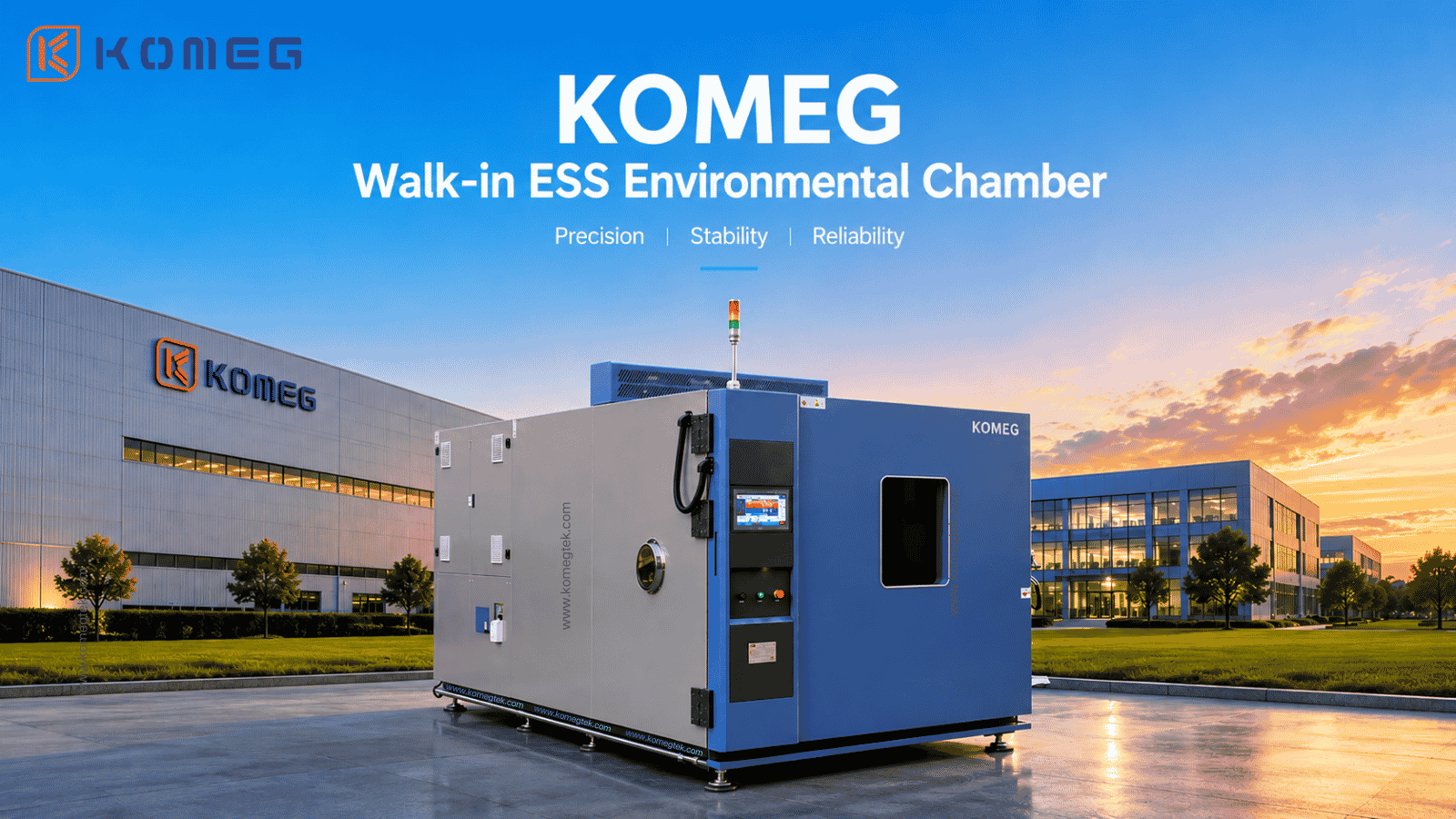
As the global transition toward renewable energy accelerates, Energy Storage Systems (ESS) have become one of the fastest-growing sectors in the power industry. From utility-scale battery farms and commercial energy storage cabinets to residential backup systems, ESS technology is reshaping how electricity is generated, stored, and distributed.
Behind every reliable energy storage system is one critical step that often goes unnoticed by end users—environmental reliability testing.
A battery energy storage system may spend more than 15 years operating outdoors. During that time, it will experience freezing winters, scorching summers, high humidity, heavy rain, dust, rapid temperature fluctuations, and continuous charging and discharging cycles. These environmental stresses gradually affect battery performance, electrical insulation, thermal management systems, communication modules, and structural components.
Manufacturers cannot simply wait years to determine whether an ESS product will survive these conditions. Instead, they must recreate them inside a laboratory.
This is where a Walk-in ESS Environmental Chamber becomes an essential part of product development and quality validation.
Unlike conventional environmental chambers designed for small electronic components, a walk-in ESS environmental chamber provides a large, precisely controlled testing space capable of accommodating complete battery cabinets, battery racks, power conversion systems (PCS), battery management systems (BMS), electrical control cabinets, or even integrated containerized energy storage systems. Engineers can expose these large assemblies to carefully controlled temperature and humidity conditions while monitoring their electrical and mechanical performance throughout the entire testing process.
For modern ESS manufacturers, environmental testing is no longer simply a certification requirement. It has become a strategic tool for improving product reliability, reducing warranty risks, shortening development cycles, and ensuring safe operation throughout the product’s service life.
What Is a Walk-in ESS Environmental Chamber?
A Walk-in ESS Environmental Chamber is a large-scale environmental simulation system specifically designed for testing battery energy storage equipment under controlled climatic conditions.
Unlike standard reach-in environmental chambers, which typically test individual cells, modules, or small electronic assemblies, walk-in chambers are engineered to accommodate complete energy storage products that cannot fit inside conventional equipment.
Typical test specimens include:
- Battery cabinets
- Battery racks
- Battery modules
- Power conversion systems (PCS)
- Battery management systems (BMS)
- Power distribution cabinets
- Energy storage control systems
- Containerized ESS equipment
- Integrated renewable energy storage systems
The chamber recreates real-world environmental conditions by accurately controlling parameters such as:
- High temperature
- Low temperature
- Temperature cycling
- Constant temperature
- Constant humidity
- Combined temperature and humidity
- Long-term storage environments
By exposing products to these controlled conditions for extended periods, engineers can evaluate how environmental stress affects system performance, structural integrity, electrical safety, communication stability, cooling efficiency, and overall reliability.
Rather than discovering failures after deployment, manufacturers can identify weak points during product development when improvements are significantly less expensive.
Why Environmental Testing Is Becoming More Important for ESS
The energy storage industry has changed dramatically over the past decade.
Early lithium-ion battery testing mainly focused on individual battery cells or small battery packs. Today’s systems are much larger and far more complex.
A modern energy storage system may contain thousands of battery cells working together with numerous subsystems, including:
Battery Management System (BMS)
Power Conversion System (PCS)
Thermal Management System
Fire Protection System
Communication Modules
High-voltage Wiring
Electrical Distribution Units
Cooling Equipment
Control Software
Every one of these components responds differently to environmental changes.
Consider a typical outdoor installation.
During winter, the battery cabinet may experience temperatures below -30°C before sunrise.
By midday in summer, direct sunlight can raise internal temperatures well above 60°C, even before the batteries begin charging.
Humidity levels fluctuate daily, causing condensation inside electrical enclosures. Coastal installations face salt-laden air that accelerates corrosion, while desert environments expose equipment to high temperatures and dust.
Over many years, these conditions slowly weaken electrical insulation, loosen mechanical fasteners, age sealing materials, and reduce cooling efficiency.
Without environmental validation, these issues often remain hidden until products are already operating in the field.
A walk-in ESS environmental chamber allows manufacturers to reproduce years of environmental exposure within weeks or months, dramatically improving confidence in product reliability before commercial deployment.
Why Standard Environmental Chambers Are No Longer Enough
Traditional environmental chambers have served laboratories well for decades, but the rapid growth of ESS technology has created new testing challenges.
The first limitation is physical size.
A battery cabinet can easily exceed two meters in height and weigh more than one metric ton. Utility-scale battery racks are even larger.
Clearly, these products cannot be tested inside a conventional laboratory chamber.
The second limitation is operational testing.
Many ESS products must remain powered during environmental testing.
Engineers often need to monitor:
Charging performance
Discharging efficiency
Cooling system operation
BMS communication
Power conversion efficiency
Internal temperature distribution
Electrical insulation
Alarm functions
Testing an operating battery system requires cable ports, high-current electrical connections, monitoring equipment, and sufficient workspace around the product—features that standard chambers cannot easily provide.
The third limitation involves heat generation.
Large battery systems produce considerable heat while charging and discharging.
A standard environmental chamber is designed to control ambient temperature, not continuously remove large amounts of internally generated heat.
Walk-in ESS environmental chambers are engineered with significantly higher refrigeration capacity and optimized airflow systems to compensate for these additional thermal loads while maintaining stable test conditions.
Finally, safety requirements are substantially different.
Testing a complete energy storage system involves much higher energy levels than testing individual battery cells.
Potential hazards include:
Thermal runaway
Smoke generation
Flammable gas release
Electrical faults
Arc flash
High-voltage risks
Therefore, ESS environmental chambers require specialized safety systems far beyond those used in conventional climatic chambers.
Typical Environmental Tests Performed on ESS Equipment
Environmental testing is not limited to simply heating or cooling a battery cabinet.
Manufacturers perform a wide range of tests depending on product requirements, application scenarios, and international standards.
One of the most common procedures is temperature cycling.
Repeated transitions between low and high temperatures place continuous mechanical stress on metal structures, welded joints, cable connections, electronic assemblies, sealing materials, and battery modules.
Although each temperature cycle may appear insignificant, thousands of cycles gradually reveal weaknesses caused by differences in thermal expansion between materials.
Another frequently performed test is constant temperature and humidity exposure.
High humidity can penetrate electrical enclosures, reduce insulation resistance, accelerate corrosion, and affect electronic reliability.
For ESS equipment intended for tropical or coastal regions, humidity testing is often as important as temperature testing.
Manufacturers also conduct low-temperature operational testing to verify whether batteries, control systems, displays, contactors, and cooling equipment continue operating correctly under winter conditions.
Similarly, high-temperature endurance testing evaluates long-term stability during prolonged exposure to elevated temperatures, ensuring batteries and electronic systems remain reliable during hot summer operation.
Many laboratories also perform storage testing, where products remain inside environmental chambers for days or weeks without operation, simulating transportation or warehouse storage before installation.
In addition to climatic testing, some manufacturers combine environmental exposure with charging and discharging cycles, allowing engineers to evaluate how battery performance changes under real operating conditions rather than static laboratory environments.
This integrated testing approach provides a much more accurate representation of field operation and has become increasingly common throughout the energy storage industry.
Designing a Walk-in ESS Environmental Chamber Around the Product
One of the biggest misconceptions about walk-in environmental chambers is that they are simply larger versions of standard chambers.
In reality, every custom ESS chamber begins with the product—not the chamber.
Before any engineering drawings are created, manufacturers must fully understand the customer’s testing objectives.
Questions typically include:
What type of ESS equipment will be tested?
What are the product dimensions and weight?
Will the system operate during testing?
What temperature and humidity ranges are required?
Will charging and discharging occur inside the chamber?
Are explosion protection or gas monitoring systems required?
How will the product enter the chamber—by forklift, pallet truck, or AGV?
Does the chamber need future expansion capability?
Only after these requirements are clearly defined can engineers begin designing the chamber structure, refrigeration system, airflow layout, electrical interfaces, safety systems, and control architecture.
This product-first approach ensures the environmental chamber supports both current testing needs and future product development, rather than becoming a limitation as equipment grows larger or testing requirements become more complex.
Key Design Considerations for a Walk-in ESS Environmental Chamber
Unlike standard environmental chambers that follow relatively fixed specifications, a Walk-in ESS Environmental Chamber is almost always engineered around the customer’s specific testing objectives. Every ESS product has unique dimensions, power ratings, heat generation characteristics, and safety requirements, making customization a critical part of the chamber design process.
One of the first considerations is internal chamber size. Engineers must account not only for the dimensions of the battery cabinet or energy storage container itself, but also for sufficient airflow clearance around the equipment. If the test specimen is placed too close to the chamber walls, airflow becomes uneven, resulting in temperature gradients that can compromise test accuracy. Additional space is often required for maintenance access, instrumentation, cable routing, and future product upgrades.
Temperature capability is another essential factor. Depending on the application, a chamber may need to simulate cold northern winters, hot desert climates, or rapid seasonal transitions. Typical ESS chambers operate between -40°C and +85°C, while some advanced systems extend to -70°C to +150°C for specialized reliability testing. Selecting the appropriate refrigeration and heating system depends on both the required temperature range and the thermal mass of the test specimen.
Humidity control is equally important. Outdoor energy storage equipment frequently operates in regions where relative humidity exceeds 90%, especially in tropical and coastal environments. Moisture ingress can reduce insulation resistance, accelerate corrosion, and affect electronic control systems. A high-performance environmental chamber must therefore maintain stable humidity conditions throughout long-duration testing without introducing excessive condensation that could distort results.
Airflow design is often overlooked but has a significant impact on test quality. Large battery cabinets generate substantial heat during charging and discharging, creating localized hot spots if air circulation is insufficient. Engineers use airflow simulations to optimize the placement of supply ducts, return air paths, and circulation fans so that conditioned air reaches every surface of the test specimen. Uniform airflow ensures that all parts of the ESS experience consistent environmental stress, producing more reliable and repeatable data.
Another important consideration is heat load compensation. Unlike passive test specimens, operating ESS equipment continuously generates heat through battery charging, power conversion, and cooling systems. The refrigeration capacity of the chamber must be carefully calculated to remove this internal heat while maintaining the target environmental conditions. Failure to account for equipment heat generation can result in unstable chamber temperatures and inaccurate testing.
Electrical integration is also becoming increasingly complex. Modern ESS testing often requires continuous operation of the battery system during environmental exposure. This means the chamber must incorporate high-current cable ports, insulated electrical feedthroughs, communication interfaces, and data acquisition systems without compromising thermal insulation or chamber sealing. Remote monitoring through Ethernet, Modbus, or other industrial communication protocols is now common, allowing engineers to supervise testing without entering the chamber.
Finally, long-term reliability and energy efficiency are becoming major design priorities. Since many laboratories operate environmental chambers around the clock, reducing power consumption while maintaining precise environmental control can significantly lower operating costs over the lifetime of the equipment.
Safety Is the Foundation of ESS Environmental Testing
Testing lithium-ion energy storage systems involves far greater risks than testing ordinary electronic products. As battery capacity increases, so does the amount of stored energy, making safety an essential consideration in environmental chamber design.
One of the most significant hazards is thermal runaway. Under abnormal conditions such as internal short circuits, overcharging, or mechanical damage, a battery cell may enter an uncontrollable self-heating process. Once thermal runaway begins, temperatures can rise rapidly, potentially triggering neighboring cells and resulting in smoke, fire, or even explosion.
While environmental chambers are not designed to intentionally trigger thermal runaway during standard climatic testing, they must be capable of responding safely if an unexpected failure occurs.
Modern Walk-in ESS Environmental Chambers therefore integrate multiple layers of protection.
Smoke detection systems continuously monitor the chamber interior for early signs of combustion. Gas detection sensors can identify combustible gases generated by failing lithium-ion batteries before dangerous concentrations develop. Automatic exhaust systems rapidly remove hazardous gases from the chamber, protecting both personnel and laboratory equipment.
Many customers also specify explosion relief panels or pressure venting systems. These features safely release excessive internal pressure while minimizing structural damage to the chamber.
Depending on customer requirements, additional fire protection systems may include water mist suppression, clean-agent fire suppression, CO₂ extinguishing systems, or interfaces for building fire protection networks.
Electrical safety is equally important. High-voltage battery systems require insulated cable feedthroughs, emergency shutdown functions, interlocked chamber doors, leakage protection, and redundant safety monitoring to prevent accidental exposure during testing.
KOMEG designs its custom ESS environmental chambers with a comprehensive safety philosophy, allowing customers to configure protection systems according to battery chemistry, testing standards, laboratory regulations, and project-specific risk assessments.
How KOMEG Designs Custom Walk-in ESS Environmental Chambers
Every testing project presents unique engineering challenges. Rather than offering a one-size-fits-all solution, KOMEG develops environmental chambers based on each customer’s actual application and testing objectives.
The design process begins with a detailed technical consultation, during which engineers evaluate the dimensions, weight, electrical characteristics, thermal output, and operating conditions of the equipment to be tested. Environmental requirements such as temperature range, humidity range, ramp rate, operating cycles, and safety functions are also reviewed.
Using this information, KOMEG engineers develop customized chamber layouts that optimize airflow, refrigeration performance, structural strength, maintenance accessibility, and operator safety. Advanced simulation tools are used to verify airflow distribution and temperature uniformity before manufacturing begins.
KOMEG offers a wide range of configurable options, including custom chamber dimensions, reinforced floor structures for heavy battery cabinets, large-access doors, forklift-compatible loading systems, cable ports, observation windows, LED lighting, remote monitoring, intelligent touchscreen controllers, and fully integrated data acquisition systems.
For high-energy battery testing, optional safety configurations include gas monitoring, smoke detection, explosion relief systems, emergency ventilation, fire suppression interfaces, and other protection measures designed to support demanding laboratory environments.
With more than 35 years of experience in environmental simulation technology, KOMEG has supplied customized testing solutions for customers in renewable energy, automotive, electronics, aerospace, telecommunications, and research institutions worldwide. Whether testing battery modules, complete ESS cabinets, or containerized energy storage systems, KOMEG provides reliable environmental chambers engineered for long-term laboratory operation.
Frequently Asked Questions
What is a Walk-in ESS Environmental Chamber?
It is a large environmental testing chamber specifically designed to evaluate complete energy storage systems, battery cabinets, battery racks, and related equipment under controlled temperature and humidity conditions.
What products can be tested?
Typical applications include battery cabinets, battery racks, battery modules, PCS units, BMS systems, electrical control cabinets, and integrated energy storage systems.
Why is a walk-in chamber necessary?
Large ESS equipment often exceeds the capacity of conventional environmental chambers. Walk-in chambers provide sufficient space for full-scale testing while allowing equipment to operate under realistic environmental conditions.
Can the battery operate during testing?
Yes. Most custom ESS chambers are designed to allow charging, discharging, communication monitoring, and performance evaluation throughout the testing process.
Can KOMEG customize chamber dimensions?
Yes. Chamber size, temperature range, humidity control, cable ports, safety systems, floor loading capacity, and control interfaces can all be customized according to customer requirements.
What safety systems are available?
Optional safety features include smoke detection, gas monitoring, explosion relief, emergency ventilation, fire suppression interfaces, leakage protection, over-temperature protection, and intelligent alarm systems.
Which industries use Walk-in ESS Environmental Chambers?
They are widely used in battery manufacturing, renewable energy, electric vehicles, power utilities, research laboratories, certification organizations, and energy storage system development.
As energy storage systems continue to grow in size, complexity, and strategic importance, environmental testing has become one of the most critical stages of product development. Laboratory validation under controlled temperature and humidity conditions enables manufacturers to identify potential reliability issues long before products are deployed in the field, reducing operational risks and improving long-term performance.
A Walk-in ESS Environmental Chamber is far more than a large climatic chamber—it is an integrated engineering platform that combines precise environmental simulation, intelligent control, advanced safety systems, and customized design to support the next generation of battery energy storage technologies.
Whether validating a single battery cabinet or a complete containerized energy storage solution, selecting the right environmental chamber is essential for obtaining accurate, repeatable, and internationally recognized test results.
With decades of experience in environmental simulation technology, KOMEG provides customized Walk-in ESS Environmental Chambers designed to meet the evolving needs of the global energy storage industry. From concept and engineering to manufacturing, installation, and technical support, KOMEG helps customers build reliable testing environments that accelerate innovation, improve product quality, and confidently bring safer energy storage solutions to market.