

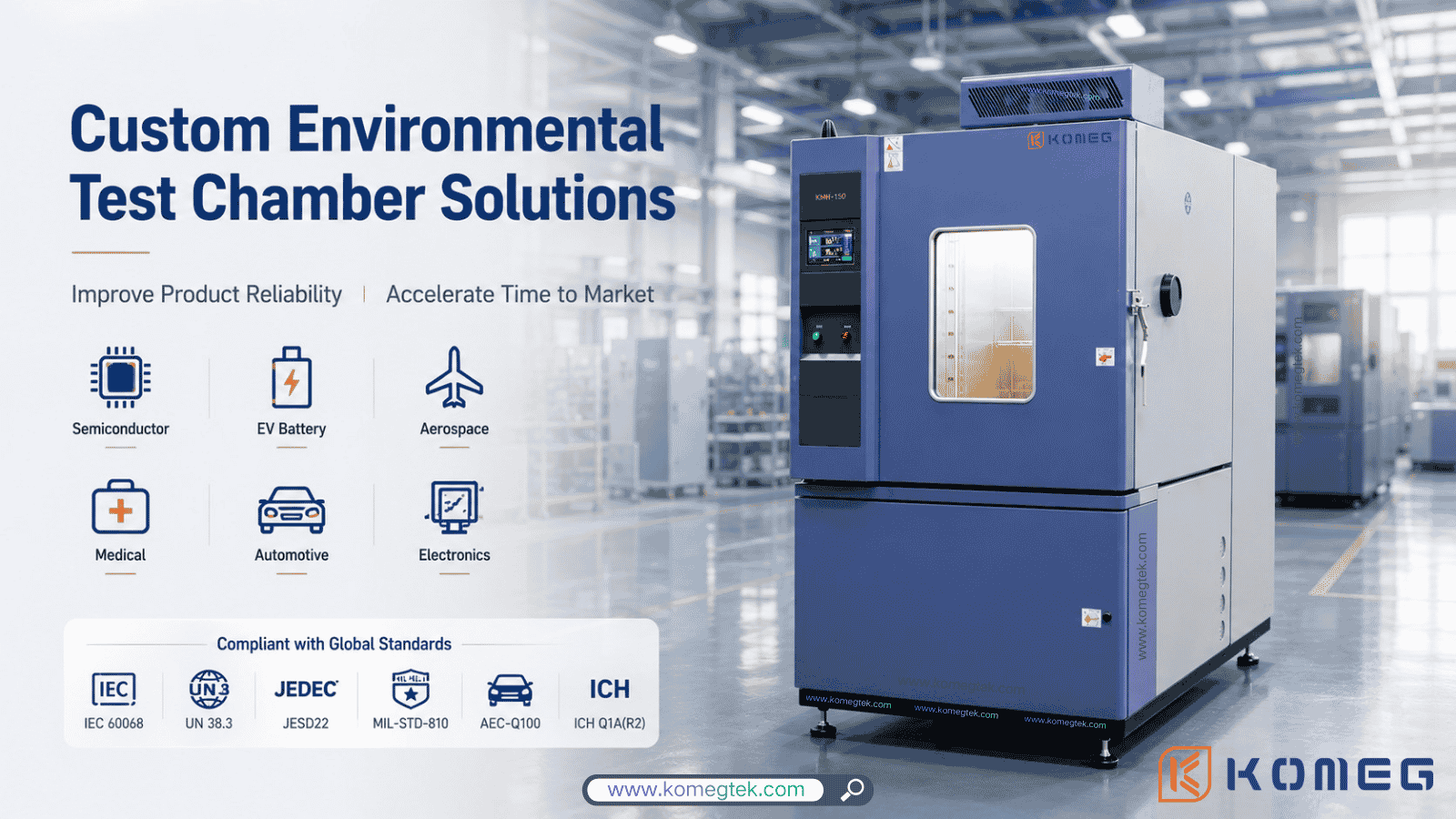
As product reliability standards continue to rise across industries, manufacturers face increasing pressure to verify product performance under extreme environmental conditions. Whether developing semiconductors, electric vehicle batteries, aerospace components, medical devices, or consumer electronics, environmental testing has become a critical part of product development and quality assurance.
Standard environmental chambers can meet many routine testing needs, but modern manufacturing often requires custom environmental test chamber solutions designed around specific products, international standards, testing procedures, and production workflows.
This article explores why customized climatic testing solutions are becoming the preferred choice for manufacturers worldwide and how they help improve product reliability while reducing development time and testing costs.
Why Standard Environmental Chambers Are Not Always Enough
Off-the-shelf environmental chambers are ideal for general laboratory testing. However, many industries require testing conditions that standard equipment cannot easily provide.
Examples include:
Extra-large test specimens requiring walk-in chambers
Rapid temperature change testing for semiconductor devices
Battery safety and abuse testing with explosion-proof protection
High-humidity corrosion testing
Multi-axis vibration combined with temperature and humidity
Customized cable ports, observation windows, or automation interfaces
Industry-specific testing standards requiring special configurations
A customized solution ensures the testing equipment matches the application instead of forcing the application to fit the equipment.
Industries That Benefit from Custom Environmental Test Chamber Solutions
Semiconductor Industry
Semiconductor devices must operate reliably for years despite frequent temperature fluctuations and harsh operating environments.
Typical testing applications include:
Temperature cycling
Rapid thermal change
Burn-in testing
High-temperature storage
Humidity resistance testing
Reliability verification
Common testing standards include:
JESD22
JEDEC
IEC 60068
AEC-Q100
Custom environmental chambers help semiconductor manufacturers evaluate package reliability, solder joint durability, and long-term component stability before mass production.
Electric Vehicle Battery Industry
Battery safety has become one of the most critical challenges in the EV industry.
Manufacturers perform extensive environmental testing throughout battery development, including:
Temperature cycling
Thermal shock
High-temperature aging
Low-temperature performance
Humidity testing
Storage testing
Applicable standards often include:
UN 38.3
IEC 62660
IEC 62133
ISO 16750
Customized battery test chambers can integrate explosion-proof systems, gas monitoring, pressure relief mechanisms, and advanced safety protection to ensure reliable testing under demanding conditions.
Aerospace and Defense
Aircraft and defense equipment operate in environments ranging from desert heat to arctic cold and high-altitude conditions.
Environmental testing typically includes:
High-altitude simulation
Temperature cycling
Humidity exposure
Thermal shock
Long-duration reliability testing
Common standards include:
MIL-STD-810
RTCA DO-160
IEC 60068
Custom-designed chambers allow engineers to simulate real-world operating environments with greater accuracy.
Pharmaceutical and Medical Devices
Medical products and pharmaceutical materials require highly controlled environmental conditions to ensure product stability and regulatory compliance.
Typical applications include:
Stability testing
Controlled temperature and humidity storage
Accelerated aging
Shelf-life evaluation
Frequently referenced standards include:
ICH Q1A(R2)
ASTM guidelines
GMP requirements
Customized climatic chambers help laboratories maintain precise environmental conditions throughout long-term testing programs.
Electronics Manufacturing
Consumer electronics, industrial control systems, telecommunications equipment, and PCB assemblies all require environmental verification before entering the market.
Common tests include:
High and low temperature testing
Damp heat testing
Thermal cycling
Corrosion resistance
Reliability validation
Customized chambers allow manufacturers to accommodate different product sizes, fixtures, and automated testing systems.
What Should a Custom Environmental Chamber Include?
Selecting a customized chamber involves much more than choosing a chamber size.
Key considerations include:
Temperature range
Humidity range
Heating and cooling rates
Chamber dimensions
Load capacity
Refrigeration system
Control software
Remote monitoring
Data logging
Safety protection
Energy efficiency
Automation integration
Maintenance accessibility
An experienced manufacturer can tailor these features to meet specific production and testing requirements.
Why Engineering Experience Matters
A custom environmental chamber is only as good as the engineering team behind it.
Experienced manufacturers begin by understanding:
Product characteristics
Testing objectives
International compliance requirements
Laboratory workflow
Future production expansion
Safety considerations
This engineering-first approach helps avoid unnecessary costs while ensuring the final system delivers accurate, repeatable, and reliable test results.
How KOMEG Delivers Custom Environmental Testing Solutions
With more than three decades of experience in environmental simulation technology, KOMEG designs and manufactures customized climatic test chambers for customers worldwide.
Its engineering team works closely with manufacturers to develop solutions tailored to specific testing requirements across industries including:
Semiconductor
Electric vehicles
Automotive
Aerospace
Renewable energy
Medical devices
Universities
Research laboratories
Consumer electronics
KOMEG’s product portfolio includes temperature and humidity chambers, walk-in environmental chambers, thermal shock chambers, rapid temperature change chambers, battery test chambers, HAST chambers, altitude chambers, industrial ovens, and other customized environmental testing systems.
From project consultation and engineering design to manufacturing, installation, commissioning, and after-sales support, KOMEG provides complete lifecycle services to help customers improve product reliability and accelerate product development.
Frequently Asked Questions
What is a custom environmental test chamber?
A custom environmental test chamber is a testing system specifically designed to meet unique application requirements that cannot be satisfied by standard equipment. Customization may include chamber size, temperature range, humidity control, safety features, automation, and specialized testing functions.
Which industries need customized environmental chambers?
Industries such as semiconductors, electric vehicles, aerospace, pharmaceuticals, medical devices, electronics, renewable energy, and research laboratories frequently require customized testing solutions.
Why are international testing standards important?
Standards such as IEC 60068, MIL-STD-810, UN 38.3, AEC-Q100, JESD22, and ICH Q1A define testing methods that help manufacturers verify product reliability, safety, and regulatory compliance.
Can a custom chamber improve testing efficiency?
Yes. A chamber designed specifically for the product under test can reduce setup time, improve testing accuracy, increase automation, and shorten overall product development cycles.
How do I choose the right environmental chamber manufacturer?
Look for a manufacturer with extensive engineering experience, proven customization capabilities, strong quality management systems, comprehensive after-sales support, and experience serving your industry.
As products become more sophisticated and global quality standards continue to evolve, customized environmental testing solutions are becoming an essential investment for manufacturers seeking long-term reliability and market competitiveness.
Rather than relying on one-size-fits-all equipment, companies are increasingly partnering with experienced manufacturers that can design testing systems around their products, testing standards, and production goals.
For organizations looking to improve product quality, accelerate validation, and meet international compliance requirements, custom environmental test chamber solutions provide a practical and future-ready approach to environmental testing.