

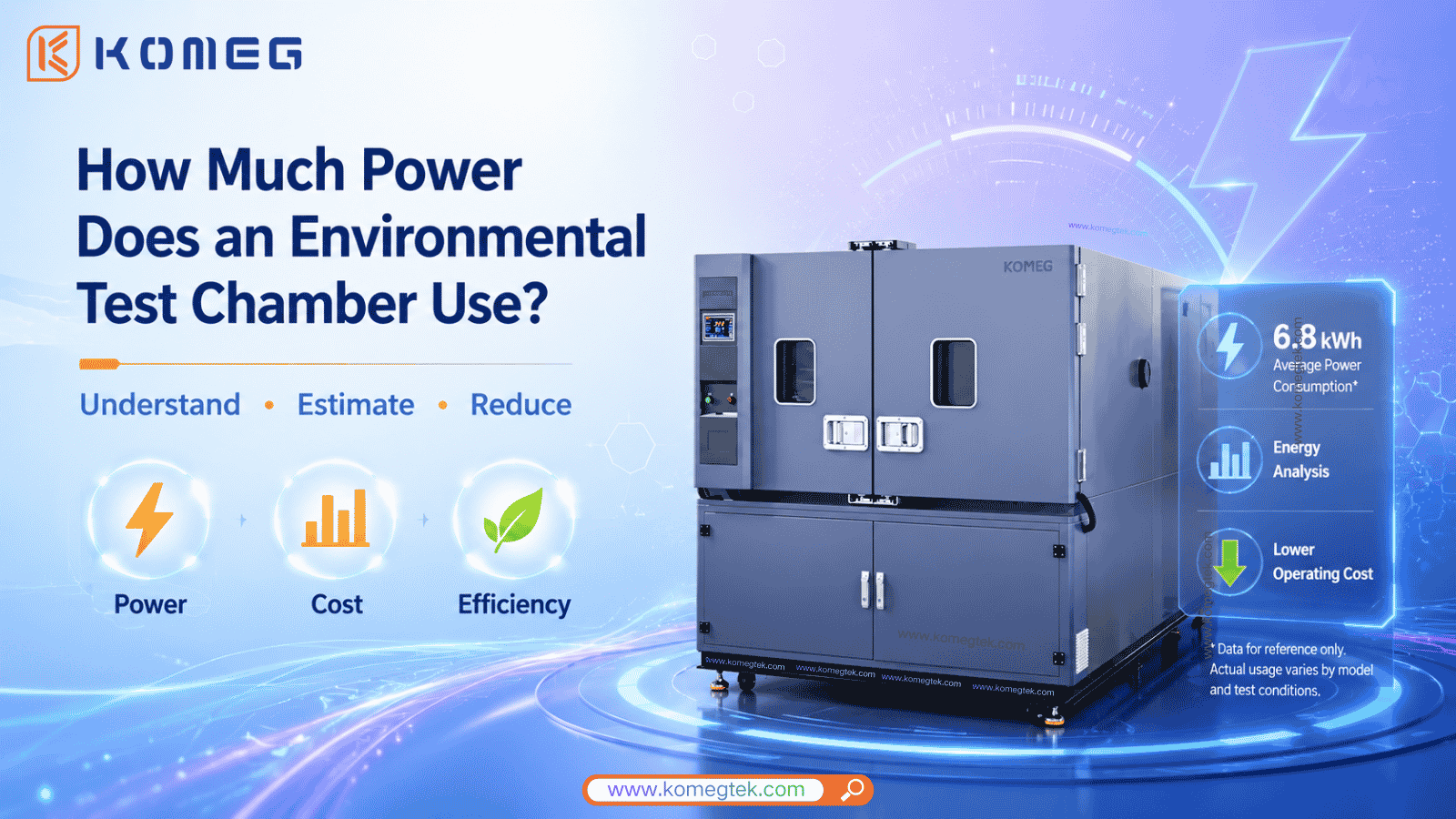
When purchasing an environmental test chamber, most buyers focus on specifications such as temperature range, chamber size, humidity control, or testing accuracy. While these factors are undoubtedly important, one question is often overlooked until after the equipment has been installed:
How much electricity will it actually consume?
The answer matters more than many people realize.
An environmental test chamber is typically expected to operate for 5 to 15 years, and in many laboratories it runs continuously for several hours—or even days—at a time. Over its lifetime, the total electricity cost can represent a significant portion of the equipment’s total cost of ownership (TCO). In some high-duty applications, the accumulated energy cost may even approach or exceed the initial purchase price.
This is particularly true for industries such as electronics, automotive, batteries, aerospace, semiconductors, and renewable energy, where environmental testing is performed daily to verify product reliability.
So, how much electricity does an environmental test chamber really use?
The short answer is:
It depends.
Unlike household appliances, environmental test chambers do not have a single fixed power consumption. Two chambers with the same internal volume can have noticeably different energy usage depending on their design, operating conditions, and testing requirements.
In this guide, we’ll explain what determines an environmental chamber’s electricity consumption, how to estimate operating costs, and what you can do to reduce long-term energy usage without compromising testing performance.
Is There a Standard Power Consumption for an Environmental Test Chamber?
Not really.
Many people expect manufacturers to provide a simple figure such as “8 kWh per hour” or “15 kWh per test.” Unfortunately, environmental testing doesn’t work that way.
The actual power consumption depends on several variables working together rather than a single specification.
For example, imagine two laboratories using identical 408-liter temperature and humidity chambers.
The first laboratory performs a constant 25°C / 50% RH storage test.
The second laboratory repeatedly cycles between -40°C and +150°C every hour.
Although both chambers are the same size, their electricity consumption will be completely different because the refrigeration system, heaters, circulation fans, and humidity control operate under very different conditions.
The same principle applies to a family car. Fuel consumption changes depending on whether you’re driving on a flat highway or climbing a mountain. Likewise, the energy required by an environmental chamber depends largely on how it’s being used, not simply on its rated power.
Instead of asking,
“How much electricity does an environmental chamber use?”
a better question is,
“What factors determine how much electricity my environmental chamber will consume?”
Once you understand those factors, estimating operating costs becomes much easier.
What Factors Affect Electricity Consumption?
Power consumption is influenced by several design and operating parameters, but some have a much greater impact than others.
Let’s examine them one by one.
1. Chamber Size: Bigger Doesn’t Always Mean Less Efficient
The most obvious factor is chamber size.
Larger chambers naturally require more energy because they contain more air that must be heated, cooled, and circulated.
Typical chamber capacities include:
64 L
80 L
150 L
225 L
408 L
800 L
1000 L
Walk-in environmental chambers ranging from several cubic meters to well over 100 m³
As chamber volume increases, manufacturers typically install:
Larger refrigeration systems
Higher-capacity heaters
More powerful circulation fans
Additional insulation
Stronger air distribution systems
All of these components consume electricity.
However, power consumption does not increase in direct proportion to chamber size.
For example, a 1000-liter chamber does not necessarily consume ten times as much electricity as a 100-liter chamber.
Why?
Because many energy losses are related to the chamber’s external surface area rather than its internal volume.
A larger chamber often benefits from a better surface-area-to-volume ratio, allowing it to retain temperature more efficiently once the desired conditions have been reached.
This is why two chambers with significantly different capacities may have surprisingly similar average operating costs during certain types of testing.
That said, selecting a chamber that is much larger than necessary is rarely a good idea.
A common mistake is purchasing extra capacity “just in case.” While planning for future expansion is sensible, an oversized chamber means you’re repeatedly heating and cooling unused air, which increases operating costs over the life of the equipment.
As a general guideline, the test specimen should occupy no more than 60–70% of the chamber’s usable space, leaving enough room for proper airflow while avoiding unnecessary energy consumption.
2. Temperature Range Has the Greatest Impact on Energy Consumption
If chamber size is the most obvious factor, temperature range is by far the most important one.
Lower temperatures require significantly more energy than most people expect.
Consider these two test programs:
Program A
Temperature: -20°C
Duration: 8 hours
Program B
Temperature: -70°C
Duration: 8 hours
Although both tests last the same amount of time, Program B will consume considerably more electricity.
The reason lies in how refrigeration systems work.
As the chamber temperature drops further below ambient conditions, the refrigeration system must remove increasingly larger amounts of heat while operating less efficiently. Compressors run longer, cascade refrigeration systems work harder, and the overall cooling process becomes more energy-intensive.
Ultra-low-temperature chambers operating at -86°C, -120°C, or even -165°C require sophisticated refrigeration technologies capable of maintaining these extreme conditions continuously. Unsurprisingly, they consume considerably more power than standard chambers designed for -40°C testing.
High-temperature operation also increases energy usage, although heating is generally more energy-efficient than deep refrigeration.
For most applications, maintaining +150°C requires less electrical energy than maintaining -70°C, simply because electric heaters convert electrical energy into heat with very high efficiency, while refrigeration systems must continuously transfer heat against a temperature gradient.
This is why understanding your actual testing requirements is so important.
If your products only need qualification down to -40°C, purchasing a chamber capable of -70°C may increase both equipment cost and long-term electricity consumption without providing any practical benefit.
3. Humidity Control Uses More Energy Than Many People Expect
When people think about environmental chamber power consumption, refrigeration is usually the first thing that comes to mind.
Humidity control, however, is often overlooked.
In reality, maintaining a stable humidity level can add a significant amount of energy consumption, especially during long-duration tests.
Think about what happens when you boil water at home. An electric kettle uses a considerable amount of electricity simply to convert water into steam. A temperature and humidity chamber works on a similar principle.
To increase humidity, the chamber must continuously generate water vapor. To reduce humidity, it must remove moisture from the air, either by cooling or using dedicated dehumidification systems. Both processes require additional energy beyond basic temperature control.
The higher the temperature, the more demanding humidity control becomes.
For example, maintaining a condition of 25°C / 50% RH is relatively easy because the air contains a moderate amount of moisture.
Now compare that with one of the most common reliability testing conditions:
85°C / 85% RH
At this point, the chamber is no longer just heating the air—it must also generate and maintain a large amount of water vapor while preventing condensation from affecting temperature stability.
This explains why long-term damp heat testing generally consumes more electricity than constant-temperature testing under the same temperature conditions.
Humidity control also depends on the surrounding environment.
A laboratory located in a humid coastal city naturally requires different humidity control effort than one located in a dry inland climate. Although modern chambers automatically compensate for these differences, they still influence overall energy consumption.
For laboratories that rarely perform humidity testing, a dedicated temperature test chamber may offer lower operating costs. On the other hand, if products are intended for outdoor use, marine environments, or tropical climates, humidity testing becomes essential despite the additional energy required.
The decision should always be based on testing requirements rather than electricity consumption alone.
4. Why Thermal Cycling Consumes More Electricity Than Constant Temperature Testing
Not all temperature tests place the same demand on an environmental chamber.
A chamber maintaining 25°C for eight hours operates very differently from one repeatedly cycling between -40°C and +150°C throughout the day.
Imagine driving a car.
Cruising at a steady speed on a highway is relatively fuel-efficient because the engine settles into a stable operating condition.
Now imagine driving in heavy city traffic, where you’re constantly accelerating, braking, and accelerating again.
Fuel consumption immediately increases.
An environmental test chamber behaves in much the same way.
During constant-temperature testing, the refrigeration system and heaters work mainly to compensate for small heat losses through the chamber walls and door seals. Once the desired temperature has been reached, the system spends much of its time maintaining stability rather than making large adjustments.
Thermal cycling is completely different.
Every transition from high temperature to low temperature—and back again—requires the chamber to remove a large amount of heat, then generate it again. Compressors, heaters, circulation fans, and control systems are all working much harder throughout the test.
The faster the programmed ramp rate, the greater the demand.
For example, a chamber performing 15°C/min temperature transitions will generally consume more power than one changing at 3°C/min, simply because the refrigeration and heating systems must deliver much higher output within a shorter period.
Rapid Temperature Change (ESS) chambers are specifically designed for this type of operation. They intentionally expose products to repeated thermal stress in order to reveal latent manufacturing defects, making energy efficiency an important consideration when selecting this type of equipment.
Thermal Shock Chambers push the concept even further.
Instead of gradually changing the chamber temperature, they rapidly transfer test specimens between independently controlled hot and cold zones. While this produces extreme thermal stress for the test samples, the chamber itself is engineered differently from a traditional temperature cycling chamber, and its energy consumption follows a different operating pattern.
Understanding your actual test profile is therefore just as important as understanding the chamber’s specifications.
A chamber running one constant-temperature storage test may consume far less electricity than another chamber with identical hardware performing aggressive thermal cycling every day.
5. Your Test Samples Also Affect Electricity Consumption
This is one factor that many buyers never consider.
People often assume that an environmental chamber is only heating or cooling the air inside the test space.
In reality, the test sample itself is often the largest thermal load.
Imagine placing an empty ceramic coffee mug into an oven.
It reaches the oven temperature fairly quickly.
Now replace the mug with a solid cast-iron skillet.
Even though the oven temperature remains the same, the skillet takes much longer to heat because it has much greater thermal mass.
Environmental chambers work exactly the same way.
A lightweight printed circuit board containing a few electronic components requires very little energy to change temperature.
A fully assembled automotive battery pack, large electric motor, or several hundred kilograms of metal components is a completely different story.
The chamber must not only heat or cool the surrounding air, but also transfer enough energy into the test specimen until the entire product reaches the target temperature.
This process naturally requires more time and more electricity.
The material itself also matters.
Aluminum, steel, copper, plastics, composite materials, and lithium-ion batteries all absorb and release heat differently.
Dense metal parts usually require more energy to heat and cool than lightweight plastic housings.
Large assemblies containing multiple materials may also experience uneven temperature distribution, causing the chamber to run longer before test conditions stabilize.
Proper sample placement is equally important.
Overloading the chamber or blocking air circulation forces the temperature control system to work harder while reducing temperature uniformity.
For this reason, experienced laboratories rarely fill every available inch of the chamber.
Leaving sufficient space around test specimens improves airflow, shortens stabilization time, and can even reduce energy consumption during long-term testing.
6. Your Laboratory Environment Also Influences Power Consumption
Many buyers spend a great deal of time comparing chamber specifications but overlook an equally important factor—the environment in which the chamber operates.
An environmental test chamber doesn’t work in isolation. It constantly exchanges heat with the surrounding room, which means laboratory conditions directly affect how hard the equipment has to work.
Think about the air conditioner in your home.
During spring, it cools the room quickly and then cycles on and off to maintain the desired temperature.
On a hot summer afternoon, however, it may run almost continuously because it has to remove much more heat from the room.
Environmental test chambers behave in much the same way.
For example, consider two identical temperature and humidity chambers operating under the same test program.
Laboratory A
Ambient temperature: 22°C
Air-conditioned room
Good ventilation
No direct sunlight
Laboratory B
- Ambient temperature: 35°C
- Poor ventilation
- Located near production equipment
- Exposed to afternoon sunlight
Although both chambers perform exactly the same test, the second chamber will almost certainly consume more electricity. The refrigeration system must remove additional heat entering from the surrounding environment, forcing compressors to operate longer and more frequently.
Humidity conditions also matter.
In regions with naturally high humidity, the chamber may require more energy to remove moisture during certain test programs. Conversely, in extremely dry climates, maintaining high humidity conditions can increase the workload of the humidification system.
Laboratory layout is another overlooked factor.
Placing multiple environmental chambers too close together can create localized heat buildup. Each chamber rejects heat into the room through its condenser, and without sufficient spacing or ventilation, neighboring equipment begins drawing in warmer air, reducing overall cooling efficiency.
Simple installation practices can make a noticeable difference over the equipment’s lifetime.
For example:
Maintain adequate clearance around the chamber.
Ensure unrestricted airflow around the condenser.
Keep the laboratory at a stable ambient temperature.
Avoid installing the chamber near ovens, furnaces, steam pipes, or direct sunlight.
Regularly clean condenser coils and ventilation filters.
These measures require very little investment but can help improve both cooling performance and energy efficiency.
7. Chamber Design Matters More Than Compressor Size
When comparing environmental test chambers, many buyers naturally focus on compressor specifications.
While the refrigeration system is certainly important, compressor power alone does not determine how much electricity a chamber consumes.
A well-designed chamber is similar to a well-insulated house.
A house with excellent insulation remains comfortable with less heating and cooling, while a poorly insulated building wastes energy regardless of how powerful the air-conditioning system is.
Environmental chambers follow the same principle.
Several engineering factors work together to determine overall efficiency.
High-Performance Insulation
Heat constantly flows between the chamber and its surroundings.
Thicker, higher-quality insulation reduces this heat transfer, allowing the refrigeration and heating systems to operate less frequently.
This becomes particularly important during long-duration tests at extreme temperatures.
Optimized Airflow Design
Air circulation affects far more than temperature uniformity.
Poor airflow creates localized hot and cold areas, forcing the control system to overcompensate.
Well-designed airflow allows the chamber to reach target temperatures more quickly while maintaining stable conditions with less energy.
Modern environmental chambers increasingly rely on computational fluid dynamics (CFD) during development to optimize air distribution before production begins.
Intelligent Temperature Control
Today’s environmental chambers are controlled by sophisticated PID algorithms rather than simple on-off thermostats.
Instead of constantly overshooting and correcting temperature, intelligent controllers continuously adjust refrigeration and heating output based on real-time operating conditions.
The result is:
Faster stabilization
Reduced compressor cycling
Lower energy consumption
Improved temperature stability
Refrigeration System Efficiency
The refrigeration system itself includes much more than the compressor.
Overall efficiency is influenced by:
Refrigerant selection
Heat exchanger design
Expansion valves
Condenser performance
Cascade refrigeration configuration
Refrigeration control strategy
These elements work together to determine how efficiently heat is transferred throughout the system.
At KOMEG, energy efficiency is considered throughout the chamber design process rather than relying on a single high-capacity compressor. Optimized airflow, high-performance insulation, intelligent temperature control, and carefully engineered refrigeration systems help reduce unnecessary energy consumption while maintaining stable testing performance across a wide range of operating conditions.
Rather than focusing solely on peak cooling capacity, the goal is to achieve reliable long-term operation with lower overall operating costs.
8. How to Estimate the Electricity Cost of an Environmental Test Chamber
One of the most common questions buyers ask is:
“Can I estimate my monthly electricity cost before purchasing a chamber?”
The answer is yes.
Although actual power consumption depends on operating conditions, a simple calculation can provide a useful estimate.
The basic formula is:
Electricity Cost = Average Power Consumption (kW) × Operating Hours × Electricity Price
For example, suppose an environmental test chamber has an average operating power of 5 kW during a typical temperature cycling program.
If the chamber operates:
- 8 hours per day
- 22 working days per month
Monthly electricity usage would be:
5 × 8 × 22 = 880 kWh
If local electricity costs US$0.15 per kWh, the estimated monthly operating cost would be:
880 × 0.15 = US$132
This example is intended only as a reference.
Actual power consumption may be significantly higher or lower depending on factors such as chamber size, temperature range, humidity control, laboratory conditions, and test profiles.
For facilities operating multiple chambers around the clock, understanding these calculations is valuable when planning annual operating budgets and evaluating total cost of ownership.
9. Practical Ways to Reduce Environmental Test Chamber Energy Consumption
While some factors—such as chamber size or required test temperatures—are determined by your application, many aspects of energy consumption can be reduced through proper operation and maintenance.
Here are several practical ways to improve energy efficiency without affecting test quality.
Choose the Right Chamber Size
A larger chamber isn’t always better.
If the chamber is much larger than your test samples, you’re paying to heat and cool a large volume of unused air during every test cycle.
Select a chamber that provides enough space for proper airflow while matching your current and future testing needs.
Avoid Opening the Door Unnecessarily
Every time the chamber door is opened, conditioned air escapes and is replaced by ambient air.
The refrigeration and heating systems must then work to restore the programmed conditions.
For long-term tests, planning inspections carefully and minimizing door openings can noticeably reduce energy consumption while improving temperature stability.
Keep the Condenser and Air Filters Clean
Dust buildup on condensers and air filters restricts airflow and reduces heat exchange efficiency.
As a result, compressors must run longer to achieve the same cooling performance.
Routine cleaning is one of the simplest and most cost-effective ways to reduce electricity consumption and extend equipment life.
Maintain a Stable Laboratory Environment
Environmental chambers operate more efficiently in climate-controlled laboratories.
Maintaining a moderate room temperature, ensuring good ventilation, and avoiding direct sunlight all help reduce the refrigeration system’s workload.
Load Samples Correctly
Avoid placing samples too close together or blocking air outlets.
Good airflow allows the chamber to reach target conditions more quickly and improves temperature uniformity, reducing unnecessary operating time.
Perform Preventive Maintenance
Regular inspections of refrigeration components, door seals, humidity systems, fans, sensors, and electrical connections help maintain peak operating efficiency.
Small issues such as worn door gaskets or partially blocked condensers may seem minor, but over time they can increase both energy consumption and operating costs.
Energy Efficiency Is About the Entire System—Not Just the Compressor
Many buyers compare environmental chambers by looking only at compressor brands or rated power.
However, long-term operating efficiency depends on the complete system.
Factors such as insulation quality, airflow design, controller algorithms, refrigeration configuration, and manufacturing quality all contribute to how efficiently the chamber performs over thousands of testing hours.
A well-engineered chamber may cost slightly more initially, but lower electricity consumption, fewer maintenance requirements, and higher reliability often result in a lower total cost of ownership throughout its service life.
This is one reason why many laboratories evaluate not only the purchase price, but also expected operating costs before selecting environmental testing equipment.
Frequently Asked Questions
Do environmental test chambers consume a lot of electricity?
It depends on the chamber size, temperature range, humidity requirements, and test program. Small laboratory chambers used for routine testing generally consume much less electricity than large walk-in environmental chambers or ultra-low-temperature systems.
What uses more electricity: cooling or heating?
In most applications, deep refrigeration requires more energy than heating. Maintaining temperatures such as -70°C demands continuous operation of the refrigeration system, while electric heating is generally more energy-efficient.
Does humidity testing increase electricity consumption?
Yes.
Humidity control requires additional energy to generate or remove moisture. High-temperature, high-humidity tests such as 85°C / 85% RH usually consume more electricity than temperature-only tests under similar conditions.
Does thermal cycling consume more electricity than constant temperature testing?
Generally, yes.
Repeated heating and cooling cycles require the chamber to continuously remove and add heat, increasing the workload on refrigeration and heating systems compared with maintaining a constant temperature.
Can proper maintenance reduce operating costs?
Absolutely.
Regular cleaning of condensers and filters, checking door seals, maintaining ventilation, and following preventive maintenance schedules can improve energy efficiency and help extend equipment life.
Should I choose the largest chamber available?
Not necessarily.
A chamber should be large enough to allow proper airflow around test samples, but excessive unused space increases the amount of air that must be heated and cooled, leading to higher operating costs.
There is no single answer to the question, “How much electricity does an environmental test chamber use?”
Power consumption depends on many factors, including chamber size, operating temperature, humidity control, test profiles, sample load, laboratory conditions, and overall system design.
Rather than focusing solely on the chamber’s purchase price, it’s worth considering the total cost of ownership—including electricity consumption, maintenance, reliability, and expected service life.
A well-designed environmental chamber not only delivers accurate and repeatable testing results but can also help reduce long-term operating expenses through efficient refrigeration, optimized airflow, intelligent temperature control, and high-quality insulation.
At KOMEG, we design environmental test chambers with these long-term considerations in mind. From compact laboratory units to large custom walk-in environmental chambers, our solutions combine reliable environmental simulation with energy-efficient engineering to help customers achieve accurate testing while controlling operating costs.
If you’re planning a new environmental testing laboratory or looking to upgrade existing equipment, choosing the right chamber today can help reduce operating expenses for many years to come.