

From electric vehicles and lithium-ion batteries to semiconductors, aerospace electronics, and industrial control systems, modern products are expected to operate reliably in increasingly demanding environments.
Yet many unexpected failures can often be traced back to a surprisingly simple cause:
Materials move when temperatures change.
Every material expands when heated and contracts when cooled. While this may sound harmless, the reality is that different materials expand by different amounts and at different rates. Over time, these tiny movements create internal stresses that can damage components, weaken connections, and ultimately lead to product failure.
This is why thermal cycling and thermal shock testing have become essential parts of modern reliability engineering.
When Temperature Makes Existing Problems Visible
Many engineers have encountered situations where a product behaves differently depending on temperature.
A control board may function normally in the morning but fail during the hottest part of the day.
A hard drive that refuses to start may temporarily work again after being cooled.
In many cases, the electronics themselves are not suddenly becoming defective.
Instead, temperature changes are causing microscopic cracks or weakened connections to open and close.
When materials heat up, they expand.
When they cool down, they contract.
If a damaged solder joint or electrical connection exists, even a tiny amount of movement can interrupt or restore the circuit.
The failure was already there—temperature simply exposed it.
This is one reason why temperature-related failures are often difficult to diagnose in the field.
The Hidden Physics Behind Temperature-Related Failures
At the heart of most temperature-induced failures is a phenomenon known as the Coefficient of Thermal Expansion (CTE).
Every material has its own thermal expansion behavior.
For example:
- Silicon expands at one rate.
- Copper expands at another.
- Aluminum behaves differently again.
- Plastics often expand much more than metals.
- Ceramics have their own unique expansion characteristics.
The challenge is that modern products combine many different materials into a single assembly.
A semiconductor package may contain silicon dies, copper interconnects, ceramic substrates, solder joints, adhesives, and mold compounds.
A battery system may contain metal casings, electrodes, separators, busbars, adhesives, and polymer components.
When temperatures change, every material wants to move according to its own physical properties.
Because these materials are mechanically bonded together, they cannot move freely.
The result is internal stress.
The larger the temperature difference, the greater the stress generated inside the product.
A Railroad Track Explains the Problem Perfectly
Thermal expansion is not unique to electronics.
Engineers have been managing it for centuries.
Consider a railroad track.
A steel rail can expand significantly between a cool morning and a hot summer afternoon. In fact, a long rail can change length by a surprisingly large amount due to normal daily temperature variations.
This is why rail systems include expansion gaps.
Without them, thermal stress could cause the rails to buckle.
Now imagine applying the same principle inside an electronic assembly.
Instead of a steel rail several kilometers long, you have solder joints and wire bonds measured in microns.
Instead of a 10°C or 20°C temperature change, products may experience environmental conditions ranging from:
- -40°C to +85°C
- -55°C to +125°C
- -70°C to +150°C
When temperatures swing across such extreme ranges, even microscopic structures experience significant mechanical stress.
At some point, something begins to weaken.
Eventually, something breaks.
How Thermal Cycling Gradually Damages Components
Thermal cycling refers to repeated exposure to alternating hot and cold temperatures.
A single cycle rarely causes immediate failure.
The problem develops over hundreds, thousands, or even tens of thousands of cycles.
Think of bending a paper clip.
One bend does not break it.
Neither do five bends.
But repeated bending eventually causes fatigue and fracture.
Thermal cycling works in a similar way.
Every heating and cooling cycle creates a small amount of stress.
Over time, those stresses accumulate.
Eventually, microscopic damage begins to form.
This damage can appear in several ways.
Solder Joint Fatigue
One of the most common thermal cycling failures is solder joint fatigue.
Solder joints connect components to printed circuit boards.
Because chips and circuit boards expand differently, solder joints absorb the resulting movement during every temperature cycle.
Over time, this can cause:
- Microcracks
- Increased electrical resistance
- Intermittent failures
- Complete circuit interruption
This failure mechanism is commonly observed in automotive electronics, power modules, communication equipment, and semiconductor devices.
Delamination
Many modern products contain multiple bonded layers.
Examples include:
- Semiconductor packages
- Battery cells
- Printed circuit boards
- Power modules
Repeated thermal stress can weaken these interfaces and eventually cause layers to separate.
Once delamination occurs, thermal performance, mechanical strength, and reliability can decline rapidly.
Connector and Contact Failures
Electrical connectors rely on precise mechanical contact pressure.
Repeated thermal expansion and contraction can gradually reduce contact force, leading to unstable electrical connections and intermittent performance issues.
Material Cracking
Plastics, ceramics, encapsulants, and structural materials can all develop cracks after prolonged exposure to thermal stress.
These cracks may begin at microscopic levels but can eventually grow large enough to affect product functionality.
Why Thermal Shock Can Be Even More Severe
While thermal cycling creates fatigue over time, thermal shock introduces a different type of stress.
The key difference is speed.
In thermal cycling tests, temperatures change gradually.
Materials have time to expand and contract in a relatively controlled manner.
In thermal shock testing, products are exposed to extremely rapid temperature transitions.
Different parts of the same component may be at different temperatures simultaneously.
As a result, some areas begin expanding while others remain unchanged.
This creates large internal stresses.
A simple everyday example is a glass cup.
A cold glass placed directly into boiling water may crack or shatter.
The glass does not fail simply because it became hot.
It fails because different parts of the glass expand at different rates, generating stresses beyond what the material can tolerate.
The same principle applies to:
- Semiconductor packages
- Power electronics
- Optical devices
- Battery components
- Electronic assemblies
Thermal shock testing is specifically designed to reveal these weaknesses before products reach the field.
Why Batteries and Semiconductors Are Especially Vulnerable
As technology advances, thermal reliability challenges become increasingly difficult.
Modern products are becoming:
- Smaller
- More powerful
- More densely integrated
This means there is less room for materials to move and less tolerance for stress.
Semiconductor Devices
A modern semiconductor package may contain multiple materials stacked together within a very small footprint.
Engineers carefully select intermediate materials to reduce thermal stress.
However, the stress can only be minimized—not eliminated.
Every thermal cycle still creates movement.
Every movement still contributes to fatigue.
Over time, failures can occur in solder layers, wire bonds, interfaces, and package structures.
Lithium-Ion Batteries
Lithium-ion batteries face additional challenges.
Battery cells experience:
- Environmental temperature changes
- Heat generated during charging
- Heat generated during discharging
- Repeated expansion and contraction during operation
Over time, thermal stress can contribute to:
- Capacity fade
- Internal resistance growth
- Cell swelling
- Seal degradation
- Reduced cycle life
This is one reason why battery manufacturers invest heavily in thermal reliability testing throughout product development.
Thermal Cycling vs Thermal Shock: What’s the Difference?
Although the terms are often confused, thermal cycling and thermal shock evaluate different failure mechanisms.
Thermal Cycling Testing focuses on long-term fatigue caused by repeated expansion and contraction.
It is commonly used to evaluate:
- Electronic assemblies
- Automotive electronics
- Battery systems
- Semiconductor devices
- Communication equipment
Thermal Shock Testing focuses on resistance to sudden temperature changes.
It is commonly used to evaluate:
- Semiconductor packaging
- Aerospace electronics
- Military equipment
- Power modules
- High-reliability industrial products
Many manufacturers perform both tests because each reveals different reliability risks.
How Environmental Testing Prevents Real-World Failures
The challenge with thermal-related failures is that they often take months or years to develop.
Waiting for failures to occur naturally is not practical during product development.
Environmental testing accelerates these failure mechanisms under controlled laboratory conditions.
By exposing products to extreme temperature conditions, engineers can identify weaknesses long before products reach customers.
Temperature cycle testing helps reveal:
- Solder fatigue
- Material degradation
- Long-term reliability issues
Thermal shock testing helps reveal:
- Structural weaknesses
- Material incompatibilities
- Rapid stress-related failures
This approach allows manufacturers to improve product reliability while reducing warranty costs and field failures.
KOMEG Solutions for Thermal Reliability Testing
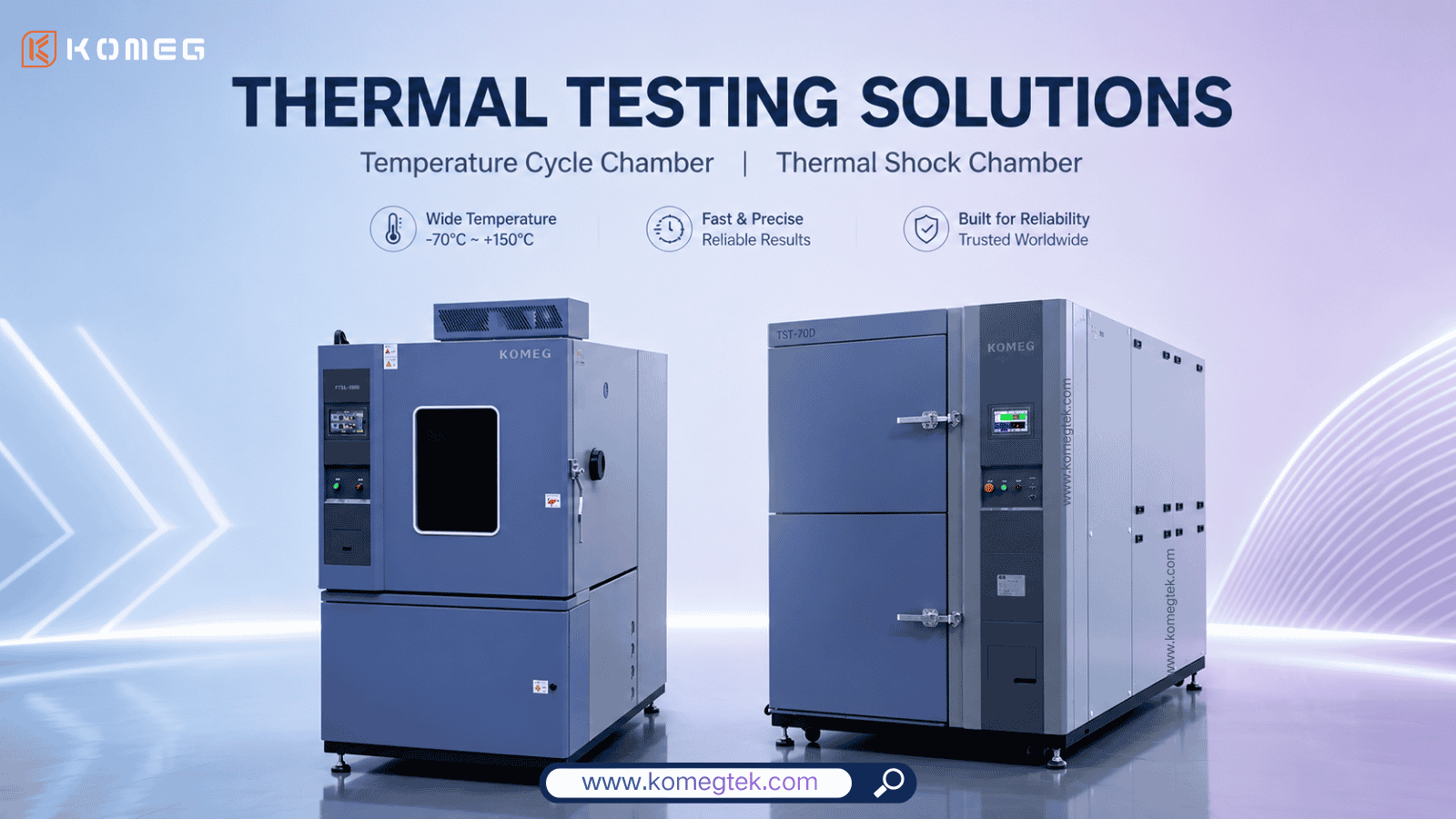
KOMEG provides advanced environmental testing equipment designed to evaluate product performance under extreme temperature conditions.
KOMEG Rapid Temperature Cycle Chambers
KOMEG Rapid Temperature Cycle Chambers are designed for accelerated thermal cycling and reliability validation.
Key features include:
- Temperature range from -70°C to +150°C
- Fast heating and cooling rates
- Chamber capacities from 80L to 1000L and larger
- High temperature uniformity
- Programmable touchscreen controllers
- USB, Ethernet, and RS485 communication interfaces
Applications include:
- EV battery testing
- Semiconductor reliability testing
- Automotive electronics validation
- Aerospace components
- Communication equipment
KOMEG Thermal Shock Chambers
KOMEG Thermal Shock Chambers simulate sudden temperature transitions to evaluate resistance to extreme thermal stress.
These systems help manufacturers identify structural weaknesses and improve product durability before market release.
Typical applications include:
- Semiconductor packaging
- Power modules
- Aerospace electronics
- Defense systems
- Industrial control equipment
Extreme temperature changes do not usually destroy products overnight.
Instead, they create countless cycles of expansion and contraction that gradually build stress inside materials, interfaces, and electrical connections.
Because different materials expand at different rates, thermal stress becomes unavoidable in modern products.
Over time, that stress can lead to solder fatigue, cracking, delamination, connector failures, battery degradation, and semiconductor package damage.
Understanding these mechanisms—and validating products through thermal cycling and thermal shock testing—is essential for improving reliability in today’s automotive, battery, semiconductor, aerospace, and electronics industries.
Frequently Asked Questions
Why do electronic components fail after repeated temperature changes?
Repeated heating and cooling create thermal stress that gradually damages solder joints, interfaces, connectors, and structural materials.
What is thermal fatigue?
Thermal fatigue is the progressive damage caused by repeated expansion and contraction during temperature cycling.
Why do solder joints crack during thermal cycling?
Solder joints connect materials with different thermal expansion rates. Repeated movement creates stress that eventually leads to crack formation.
What is the difference between thermal cycling and thermal shock?
Thermal cycling evaluates long-term fatigue caused by repeated temperature changes, while thermal shock evaluates resistance to rapid temperature transitions.
Why are lithium-ion batteries tested under temperature cycling conditions?
Temperature cycling helps evaluate battery durability, capacity retention, swelling behavior, and long-term reliability under realistic operating conditions.
Why is thermal shock testing important?
Thermal shock testing reveals weaknesses caused by sudden temperature changes that may not appear during normal thermal cycling tests.