

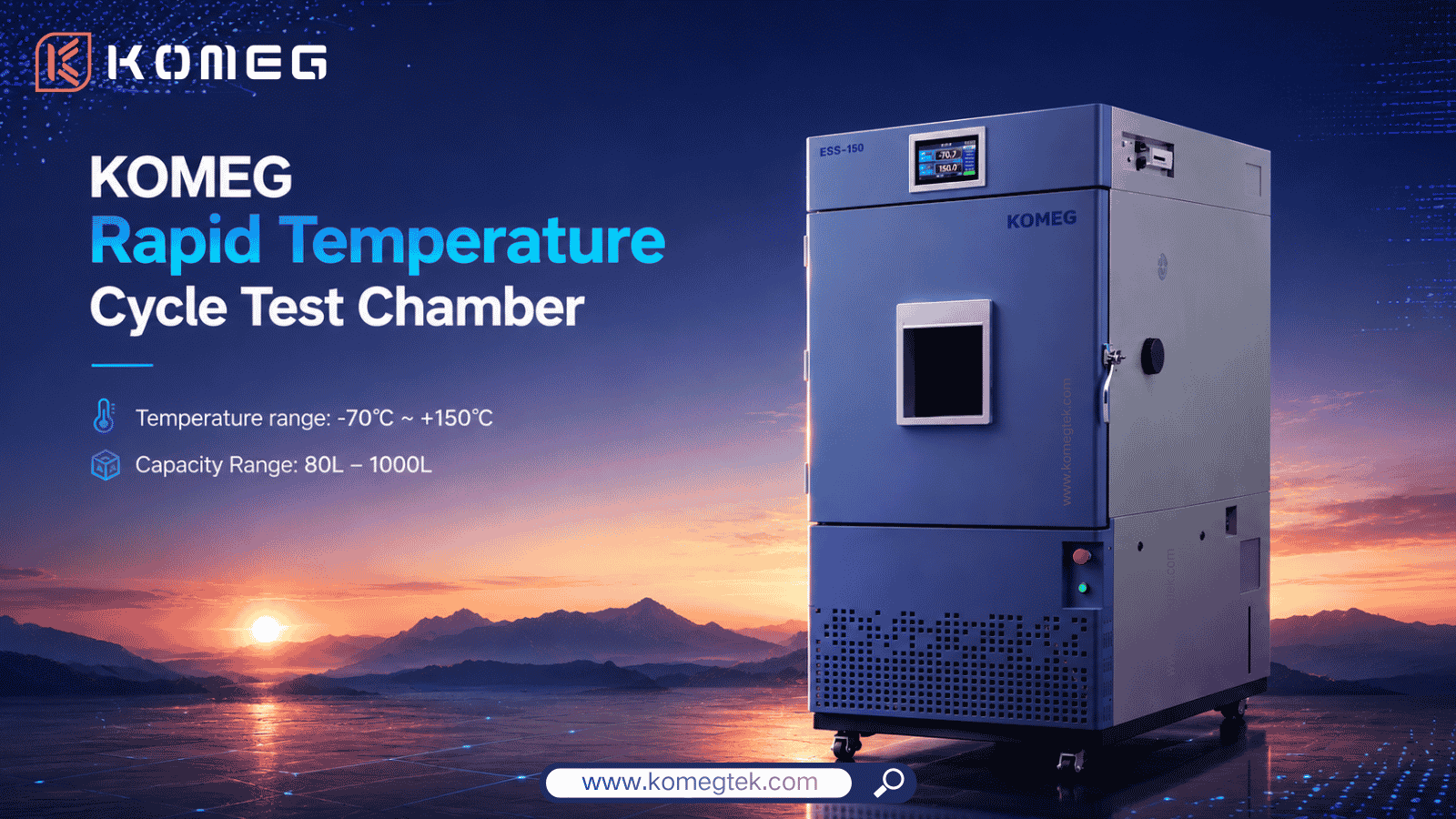
As products become smaller, more powerful, and expected to perform reliably in increasingly demanding environments, environmental testing has evolved far beyond conventional temperature cycling.
Today’s electric vehicle batteries, semiconductor devices, aerospace electronics, communication equipment, and energy storage systems experience rapid and repeated temperature changes throughout their operational life. These thermal transitions generate mechanical stress inside materials and assemblies, making the temperature change rate just as important as the temperature itself.
This is why many manufacturers are adopting Rapid Rate Thermal Cycle Test Chambers—advanced environmental testing systems designed to reproduce fast temperature transitions and evaluate how products respond to severe thermal stress.
In this guide, we’ll explain how rapid rate thermal cycle test chambers work, where they are used, their advantages, and how to choose the right system for your testing requirements.
What Is a Rapid Rate Thermal Cycle Test Chamber?
A Rapid Rate Thermal Cycle Test Chamber is a specialized environmental testing chamber capable of changing temperature significantly faster than a conventional temperature chamber.
Instead of simply reaching high or low temperatures, these chambers are engineered to move quickly between temperature setpoints, allowing engineers to evaluate the effects of rapid thermal expansion and contraction on products and materials.
Typical temperature change rates range from 5°C/min to 20°C/min, depending on chamber design, specimen load, and testing requirements.
Rapid temperature transitions help simulate real operating environments where electronic devices experience sudden heating or cooling, such as:
- Electric vehicle charging cycles
- Aircraft altitude changes
- Outdoor telecommunications equipment
- Semiconductor operation
- Battery charging and discharging
- Power electronics switching
Why Temperature Change Rate Matters
Many people focus only on the temperature range.
However, in reliability engineering, how quickly the temperature changes can be equally important.
When a product experiences rapid heating or cooling, different materials expand and contract at different rates.
This creates internal mechanical stress that may eventually lead to:
- Solder joint fatigue
- PCB cracking
- Delamination
- Seal failure
- Connector damage
- Material deformation
These failure mechanisms often develop long before the product reaches its design life.
Rapid thermal cycling accelerates these effects, allowing engineers to detect potential weaknesses during development rather than after deployment.
How Does a Rapid Rate Thermal Cycle Test Chamber Work?
Unlike conventional environmental chambers, rapid rate systems are designed with significantly higher heating and cooling capacities.
A typical chamber consists of:
- High-capacity refrigeration systems
- Powerful electric heating modules
- Optimized air circulation
- Intelligent PID temperature control
- High-performance insulation
- Precision temperature sensors
These components work together to achieve fast and uniform temperature transitions while maintaining excellent temperature stability throughout the testing process.
Many advanced systems also support continuous monitoring and programmable thermal cycling profiles for automated testing.
Rapid Rate Thermal Cycle vs Conventional Thermal Cycling
One common question is:
What is the difference between a rapid rate thermal cycle chamber and a standard temperature chamber?
| Feature | Standard Thermal Chamber | Rapid Rate Thermal Cycle Chamber |
|---|---|---|
| Temperature Range | Wide | Wide |
| Temperature Change Rate | Typically 1–3°C/min | Typically 5–20°C/min |
| Thermal Stress Simulation | Moderate | High |
| Product Development Testing | Suitable | Excellent |
| Accelerated Reliability Testing | Limited | Ideal |
| Time Efficiency | Lower | Higher |
While standard chambers remain appropriate for many qualification tests, rapid rate chambers provide a more realistic simulation of fast-changing operating environments.
Applications of Rapid Rate Thermal Cycle Testing
Rapid rate thermal cycling has become essential in many high-reliability industries.
Electric Vehicles
Battery packs, inverters, motor controllers, and charging systems experience frequent temperature changes during charging, discharging, and operation.
Rapid cycling helps validate long-term durability.
Semiconductor Industry
Power devices such as SiC and GaN components generate substantial heat during operation.
Thermal cycling helps evaluate package reliability and material stability.
Aerospace
Aircraft electronics experience rapid temperature variations during takeoff, high-altitude flight, and landing.
Environmental testing helps ensure operational reliability.
Telecommunications
Outdoor communication equipment must withstand changing weather conditions while maintaining stable performance.
Consumer Electronics
Smartphones, laptops, wearable devices, and portable electronics benefit from accelerated thermal reliability testing during product development.
Key Benefits of Rapid Rate Thermal Cycle Testing
Accelerated Reliability Validation
Rapid cycling compresses years of thermal fatigue into shorter laboratory testing periods.
Earlier Detection of Design Weaknesses
Potential reliability issues can be identified before mass production.
Reduced Development Time
Faster testing enables quicker design iterations.
Lower Warranty Costs
Products entering the market have greater confidence in long-term reliability.
Improved Product Quality
Manufacturers gain better insight into failure mechanisms and material behavior.
Common Test Standards
Rapid thermal cycling is commonly performed according to international reliability standards, including:
- IEC 60068
- MIL-STD-810
- JESD22
- ISO environmental testing standards
- Customer-specific validation protocols
The appropriate standard depends on the application and industry requirements.
How to Choose the Right Rapid Rate Thermal Cycle Test Chamber
Selecting the right chamber requires consideration of several factors.
Temperature Change Rate
Higher rates generally provide more aggressive accelerated testing but also require greater cooling capacity.
Chamber Volume
Choose a chamber that accommodates both current and future testing needs.
Temperature Range
Consider the operating conditions your products will encounter.
Test Load
Larger or heavier samples affect heating and cooling performance.
Control System
Modern touch-screen controllers, remote monitoring, and data logging improve testing efficiency.
Customization
Additional cable ports, observation windows, LN₂ cooling options, and automation interfaces may be required for specialized applications.
Why Manufacturers Are Investing in Rapid Rate Thermal Testing
As technologies continue to evolve, reliability expectations continue to increase.
Electric vehicles, renewable energy systems, AI infrastructure, and advanced electronics all require faster product development without compromising quality.
Rapid rate thermal cycle testing helps manufacturers:
- Shorten development cycles
- Improve product reliability
- Reduce field failures
- Support qualification testing
- Increase customer confidence
Rather than waiting for failures in the field, manufacturers can identify potential issues during development, when corrective actions are faster and less costly.
Why Choose KOMEG Rapid Rate Thermal Cycle Test Chambers?
At KOMEG, we understand that modern reliability testing requires more than simply reaching extreme temperatures—it requires precise control, repeatable performance, and fast thermal transitions that closely simulate real-world operating conditions.
KOMEG Rapid Rate Thermal Cycle Test Chambers are designed to support demanding reliability programs across industries including automotive, aerospace, electronics, semiconductors, energy storage, and telecommunications.
Our systems offer:
- Fast and stable temperature ramp rates
- Excellent temperature uniformity
- Intelligent touchscreen control
- Programmable thermal cycling profiles
- Reliable refrigeration performance
- Remote monitoring and data management
- Multiple chamber sizes and customization options
Whether you’re conducting product qualification, accelerated reliability testing, or R&D validation, KOMEG provides flexible solutions tailored to your testing requirements.
Temperature alone does not determine product reliability.
The speed at which temperature changes can significantly influence material fatigue, structural integrity, and long-term product performance.
Rapid Rate Thermal Cycle Test Chambers allow manufacturers to reproduce these demanding conditions in a controlled laboratory environment, providing valuable insights into product durability before products reach the market.
As reliability expectations continue to rise across industries, rapid thermal cycling is becoming an essential part of modern environmental testing.
If you’re looking to improve your environmental testing capabilities, explore KOMEG’s Rapid Rate Thermal Cycle Test Chambers and discover how advanced thermal simulation can support your next reliability testing program.