

As electric vehicles (EVs), energy storage systems (ESS), consumer electronics, and industrial battery applications continue to expand worldwide, battery safety has become one of the most critical challenges facing manufacturers and regulatory bodies.
While lithium-ion batteries offer exceptional energy density and performance, they also present potential risks under abnormal conditions such as overcharging, short circuits, thermal abuse, mechanical damage, or manufacturing defects. In severe cases, these failures can lead to thermal runaway, fire, or even explosion.
To better evaluate and classify battery failure severity, the European Council for Automotive Research and Development (EUCAR) developed the widely adopted EUCAR Hazard Level 0–7 Classification System. Today, EUCAR levels are extensively used by automotive OEMs, battery manufacturers, research institutions, and testing laboratories to assess battery safety performance and compare test results across different technologies.
This guide explains what EUCAR Hazard Levels are, how they are used in lithium-ion battery safety testing, and why environmental and abuse testing play a critical role in achieving safer battery systems.
What Is EUCAR?
The European Council for Automotive R&D (EUCAR) is an organization formed by major European automotive manufacturers to promote collaborative research and technology development.
As electric vehicle adoption accelerated, automotive engineers required a standardized method to evaluate battery safety hazards during abuse testing.
Rather than simply recording whether a battery passed or failed a test, EUCAR introduced a severity-based classification system that categorizes battery behavior from:
Level 0 (No Effect)
to
Level 7 (Explosion).
This framework allows engineers to quantify battery failure consequences and compare the safety performance of different battery chemistries, designs, and protection systems.
Why Are EUCAR Hazard Levels Important?
Traditional battery testing often focuses on whether a battery survives a test procedure.
However, in real-world applications, the severity of failure matters just as much as the occurrence of failure itself.
For example:
- A battery that slightly leaks electrolyte presents a different risk than one that ignites.
- A battery that vents gas differs significantly from one that explodes.
- A battery pack experiencing minor damage may still be acceptable, while sustained fire is unacceptable in most automotive applications.
The EUCAR classification system provides a common language for evaluating these outcomes.
Benefits include:
- Standardized battery safety assessment
- Easier comparison between battery technologies
- Improved product development
- Better communication between manufacturers and OEMs
- Enhanced regulatory compliance
- More effective risk analysis
EUCAR Hazard Levels 0–7 Explained
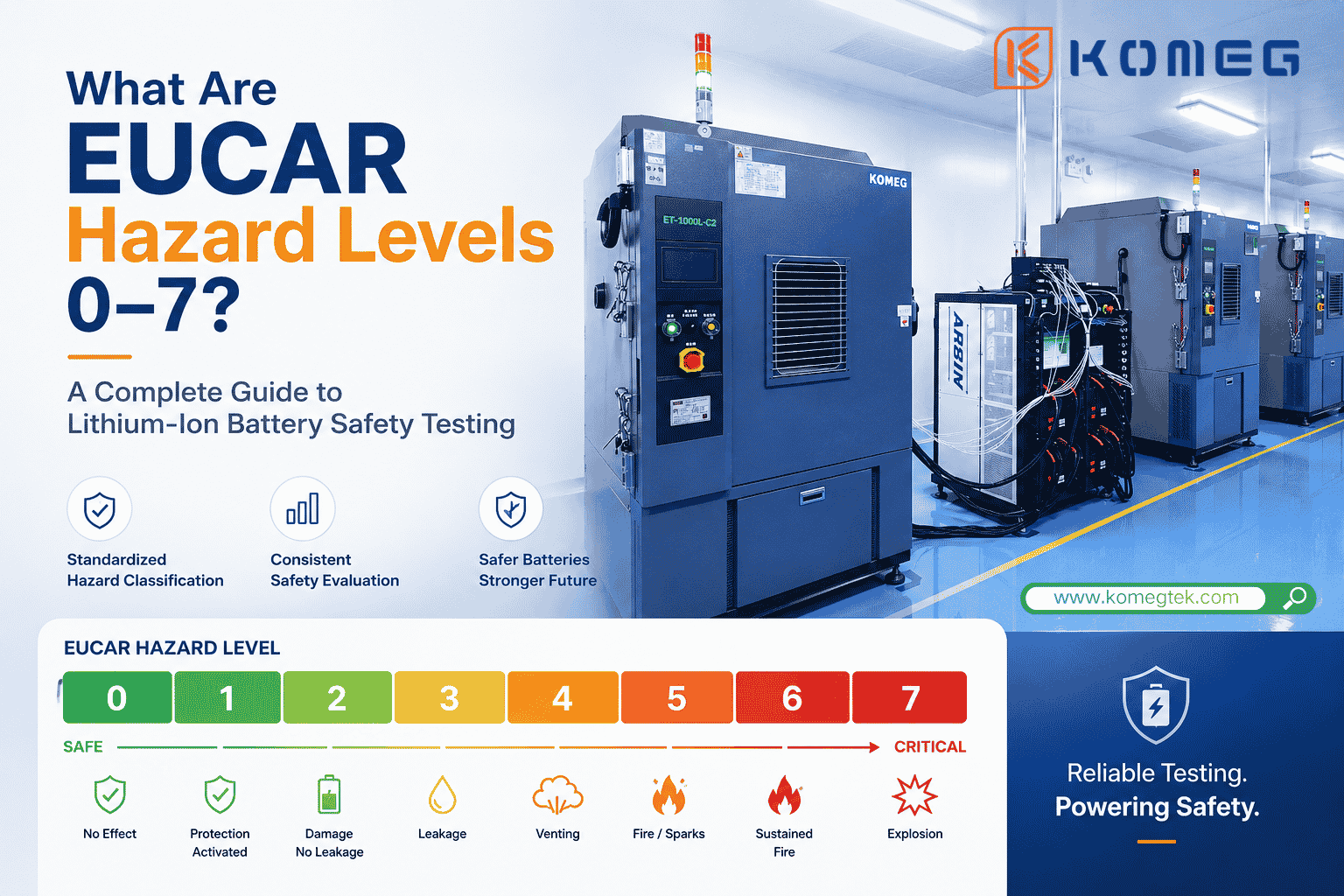
The EUCAR scale consists of eight hazard levels ranging from Level 0 to Level 7.
EUCAR Hazard Classification Table
| Level | Description | Typical Severity |
|---|---|---|
| Level 0 | No effect | Safe |
| Level 1 | Passive protection activated | Very Low |
| Level 2 | Defect or damage without leakage | Low |
| Level 3 | Leakage | Moderate |
| Level 4 | Venting | Significant |
| Level 5 | Fire or sparks | High |
| Level 6 | Sustained fire | Severe |
| Level 7 | Explosion | Critical |
Level 0 – No Effect
At Level 0, the battery shows no visible signs of damage.
Characteristics:
- No leakage
- No venting
- No swelling
- No performance degradation
- No temperature anomaly
This represents the ideal outcome during safety testing.
Level 1 – Passive Protection Activated
The battery remains safe, but internal protection mechanisms become active.
Examples include:
- Fuse activation
- Current interrupt devices
- Battery management system shutdown
- Protective circuitry engagement
The battery may stop functioning, but no safety hazard exists.
Level 2 – Damage Without Leakage
The battery experiences physical or functional damage but remains contained.
Examples:
- Cell deformation
- Internal damage
- Reduced performance
- Mechanical failure
No electrolyte leakage occurs.
Level 3 – Leakage
At this level, electrolyte escapes from the cell or battery pack.
Potential concerns include:
- Chemical exposure
- Corrosion
- Electrical hazards
Although leakage is undesirable, it generally does not pose the same immediate danger as fire or explosion.
Level 4 – Venting
Venting occurs when internal pressure forces gases out of the battery.
Characteristics:
- Release of gases
- Pressure relief activation
- Potential smoke generation
Many automotive manufacturers consider Level 4 the upper limit of acceptable failure behavior during certain abuse tests.
Level 5 – Fire or Sparks
At Level 5, ignition occurs.
Possible observations:
- Visible sparks
- Localized flames
- Brief combustion events
This level represents a significant safety concern and often triggers redesign efforts.
Level 6 – Sustained Fire
The battery continues burning after ignition.
Consequences may include:
- Extended flame duration
- Thermal propagation
- Damage to adjacent cells
Level 6 is considered a severe failure mode.
Level 7 – Explosion
Level 7 represents the most dangerous battery failure condition.
Characteristics:
- Violent rupture
- Explosion
- Fragment projection
- Extreme pressure release
This outcome is unacceptable for commercial battery systems and must be prevented through design, protection systems, and rigorous testing.
What Is Thermal Runaway?
Most severe EUCAR events are linked to thermal runaway.
Thermal runaway occurs when the heat generated inside a battery exceeds the system’s ability to dissipate it.
This creates a self-accelerating chain reaction involving:
- Electrolyte decomposition
- Separator failure
- Internal short circuits
- Gas generation
- Combustion
Thermal runaway can rapidly escalate from Level 3 or Level 4 events to Level 6 or Level 7 outcomes.
Understanding thermal runaway behavior is one of the primary objectives of modern battery safety testing.
Which Tests Use EUCAR Hazard Classification?
EUCAR levels are commonly used to evaluate outcomes in battery abuse and environmental testing.
Thermal Abuse Testing
The battery is exposed to elevated temperatures to determine thermal stability.
Typical objectives:
- Identify thermal runaway onset
- Evaluate fire resistance
- Assess safety margins
Temperature Cycling Testing
Repeated high- and low-temperature exposure evaluates:
- Material expansion and contraction
- Long-term durability
<li”>Seal integrity
Typical ranges:
-40°C to +85°C
or
-40°C to +100°C
Thermal Shock Testing
Thermal shock chambers expose batteries to rapid temperature transitions.
Example:
-40°C ↔ +150°C
Applications:
- Structural reliability
- Internal connection durability
- Thermal stress evaluation
Overcharge Testing
The battery is charged beyond specified limits.
Objectives:
- Evaluate protection systems
- Determine failure modes
- Assess fire risk
External Short-Circuit Testing
Simulates accidental short circuits.
Evaluates:
- Heat generation
- Protection response
- Thermal runaway resistance
Crush Testing
Mechanical force is applied to the battery.
Common for EV safety validation.
Used to assess:
- Internal short-circuit risk
- Mechanical robustness
Nail Penetration Testing
A conductive nail penetrates the cell.
Purpose:
- Simulate severe internal damage
- Evaluate thermal runaway behavior
Altitude Simulation Testing
Low-pressure chambers simulate transportation and high-altitude environments.
Common in:
- UN 38.3 testing
- Aerospace battery applications
Why EV Manufacturers Use EUCAR Levels
Electric vehicle batteries contain significantly more energy than batteries used in consumer electronics.
As a result, OEMs increasingly require EUCAR classification during:
- Cell qualification
- Module validation
- Battery pack testing
- Supplier approval
EUCAR levels provide a practical benchmark for determining whether battery failures remain within acceptable safety limits.
Many manufacturers aim for:
EUCAR Level 4 or below
during specific abuse testing scenarios.
Environmental Test Chambers Used in EUCAR Battery Testing
Accurate EUCAR assessment requires reliable environmental simulation equipment.
Several chamber types are commonly used.
Battery Temperature Cycle Chambers
Used for:
- Thermal cycling
- Aging studies
- Reliability evaluation
Thermal Shock Chambers
Used to create rapid temperature transitions and accelerate failure mechanisms.
Altitude Test Chambers
Used for:
- Low-pressure simulation
- Transportation safety testing
- High-altitude validation
Explosion-Proof Battery Chambers
Specially designed for hazardous battery testing.
Safety features may include:
- Explosion relief ports
- Pressure release systems
- Smoke detection
- Gas monitoring
- Fire suppression systems
Walk-In Battery Test Chambers
Suitable for:
- Large battery modules
- EV battery packs
- Energy storage systems
How KOMEG Supports Lithium-Ion Battery Safety Testing
As battery technologies continue evolving, testing requirements are becoming increasingly complex.
KOMEG provides comprehensive environmental testing solutions for:
- Electric vehicle batteries
- Energy storage systems
- Battery cells
- Battery modules
- Battery packs
Available solutions include:
Battery Temperature Cycle Chambers
For accelerated life and durability testing.
Thermal Shock Chambers
For rapid thermal transition testing.
Altitude Test Chambers
For transportation and low-pressure simulation.
Environmental Battery Test Chambers
For combined temperature and humidity testing.
Walk-In Battery Test Chambers
For large-format battery validation.
Customized Explosion-Proof Chambers
Featuring:
- Pressure relief systems
- Smoke detectors
- Gas monitoring
- Alarm systems
- CO₂ fire suppression integration
These systems help manufacturers perform battery testing safely while collecting accurate, repeatable data for EUCAR hazard evaluation.
Frequently Asked Questions (FAQ)
What is the highest EUCAR hazard level?
Level 7, which represents an explosion.
What EUCAR level is considered safe?
Levels 0–2 generally indicate minimal safety concerns, while many automotive applications aim to remain below Level 4 during abuse testing.
Is EUCAR mandatory?
EUCAR is not a legal requirement, but it is widely used throughout the automotive and battery industries as a recognized safety classification framework.
What causes a battery to reach EUCAR Level 7?
Common causes include:
- Severe thermal runaway
- Internal short circuits
- Overcharging
- Mechanical damage
- Manufacturing defects
Which test chambers are used for EUCAR-related testing?
Common equipment includes:
- Temperature cycle chambers
- Thermal shock chambers
- Altitude chambers
- Environmental chambers
- Explosion-proof battery test chambers
As lithium-ion batteries become increasingly important in electric vehicles, energy storage systems, and industrial applications, understanding battery failure behavior is essential for improving safety and reliability.
The EUCAR Hazard Level 0–7 classification system provides a standardized framework for evaluating battery safety outcomes, from minor damage to catastrophic failure. Combined with advanced environmental and abuse testing, EUCAR classifications help engineers identify risks, improve battery designs, and meet growing industry expectations.
By leveraging specialized testing equipment such as battery temperature cycle chambers, thermal shock chambers, altitude chambers, and explosion-proof environmental chambers, manufacturers can better understand battery behavior under extreme conditions and develop safer, more reliable energy storage solutions for the future.