

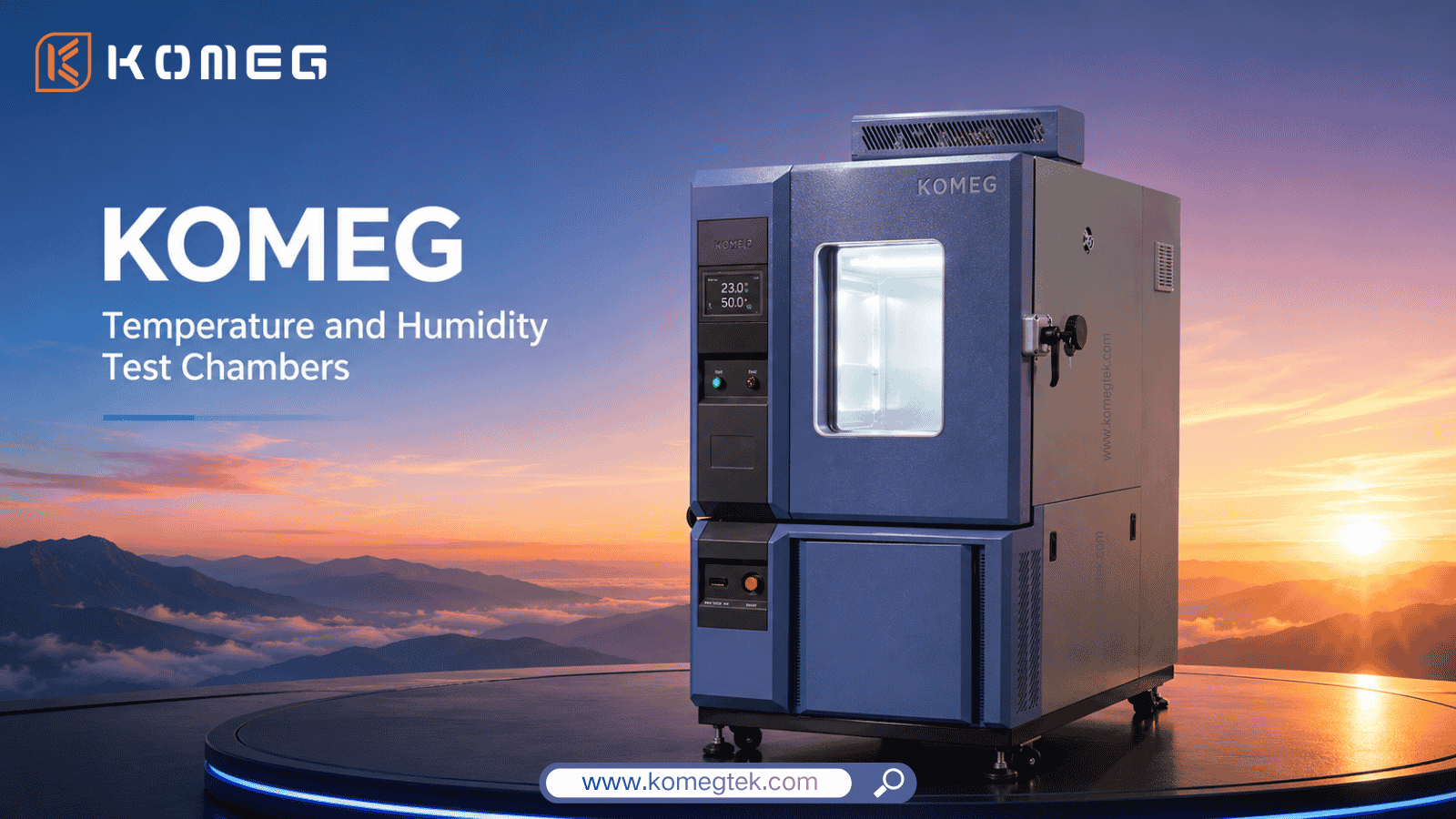
Selecting the right Temperature and Humidity Test Chamber is a critical decision for manufacturers, laboratories, and R&D teams. Whether you are testing electronic components, automotive parts, lithium batteries, semiconductors, medical devices, or aerospace products, the accuracy and reliability of your environmental testing equipment directly affect product quality, compliance, and market success.
A poorly matched climate chamber can result in inaccurate test results, longer development cycles, excessive operating costs, and even product failures after launch. On the other hand, a properly selected chamber ensures reliable environmental simulation, repeatable testing conditions, and compliance with international standards.
This guide explains the most important factors to consider when choosing a temperature and humidity test chamber and how KOMEG helps customers select the ideal solution for their specific applications.
Why Temperature and Humidity Testing Matters
Products are exposed to a wide range of environmental conditions throughout their lifecycle. High temperatures, freezing conditions, humidity, condensation, and rapid climate changes can all impact performance and reliability.
Environmental testing helps manufacturers evaluate:
- Product durability
- Reliability under extreme conditions
- Material stability
- Corrosion resistance
- Battery performance
- Electronic component reliability
- Packaging integrity
- Long-term aging characteristics
Industries commonly using temperature and humidity chambers include:
- Automotive
- Electric Vehicles (EV)
- Battery Manufacturing
- Semiconductor
- Consumer Electronics
- Aerospace & Defense
- Telecommunications
- Renewable Energy
- Medical Devices
- Research Laboratories
1. Define Your Testing Requirements First
Before comparing chamber models, clearly identify your testing objectives.
Key questions include:
What products will be tested?
Examples:
- Printed circuit boards (PCBs)
- Automotive ECUs
- Battery cells
- Battery modules
- Battery packs
- Semiconductor devices
- Communication equipment
What standards must be followed?
Common standards include:
- IEC 60068 Series
- MIL-STD-810H
- ISO 16750
- UN38.3
- SAE J2464
- JESD22 Standards
- ASTM Testing Standards
What environmental conditions are required?
Typical requirements:
| Parameter | Typical Range |
|---|---|
| Temperature | -70°C to +180°C |
| Humidity | 10%RH to 98%RH |
| Temperature Change Rate | 1°C/min to 20°C/min+ |
| Test Duration | Hours to Months |
Understanding these requirements helps avoid over-specification and unnecessary costs.
2. Select the Correct Chamber Size
One of the most common mistakes is choosing a chamber that is either too small or unnecessarily large.
Small Test Samples
Suitable for:
- IC packages
- Sensors
- Connectors
- Small electronic assemblies
Recommended:
- Benchtop chambers
- 64L to 225L chambers
Medium-Sized Products
Suitable for:
- Automotive modules
- Battery modules
- Power electronics
Recommended:
- 408L to 1000L chambers
Large Products
Suitable for:
- EV battery packs
- Energy storage systems
- Complete vehicles
Recommended:
- Walk-in environmental chambers
General Rule
The test specimen should typically occupy less than 60% of the chamber’s working volume to maintain proper airflow and temperature uniformity.
3. Evaluate Temperature Range Requirements
Not every application requires ultra-low temperatures.
Common temperature ranges include:
| Chamber Type | Temperature Range |
|---|---|
| Standard Climate Chamber | -40°C to +150°C |
| Extended Range Chamber | -70°C to +180°C |
| Battery Test Chamber | -40°C to +100°C |
| Semiconductor Testing Chamber | -70°C to +180°C |
For most automotive and electronics applications, a range of -40°C to +150°C is sufficient.
For aerospace, defense, and semiconductor testing, lower temperatures may be necessary.
4. Check Humidity Control Performance
Humidity testing is equally important as temperature testing.
A high-quality chamber should provide:
- Precise humidity control
- Fast humidity recovery
- Stable humidity generation
- Minimal condensation effects
Typical humidity range:
- 20%RH to 98%RH
- 10%RH to 98%RH (advanced systems)
Key specifications to compare:
- Humidity accuracy
- Humidity uniformity
- Recovery time
- Sensor stability
Advanced KOMEG chambers utilize intelligent humidity control systems and high-precision sensors to ensure accurate environmental simulation.
5. Consider Temperature Uniformity and Stability
Many buyers focus only on the temperature range while ignoring the chamber performance quality.
Two critical parameters are:
Temperature Uniformity
The variation between different points inside the workspace.
Example:
- ±0.5°C
- ±1.0°C
- ±2.0°C
Better uniformity ensures every sample experiences identical conditions.
Temperature Stability
The fluctuation of temperature over time.
Typical values:
- ±0.2°C
- ±0.3°C
- ±0.5°C
For semiconductor and battery testing, tight stability and uniformity specifications are especially important.
6. Evaluate Temperature Change Rate
Modern reliability testing often requires rapid temperature transitions.
Examples include:
- Thermal cycling
- Accelerated life testing
- Reliability screening
Typical ramp rates:
| Application | Ramp Rate |
|---|---|
| General Environmental Testing | 1°C/min to 3°C/min |
| Automotive Testing | 5°C/min to 10°C/min |
| Battery Testing | 5°C/min to 15°C/min |
| Semiconductor Testing | Up to 20°C/min |
KOMEG offers both standard climate chambers and rapid-rate thermal cycling chambers for demanding testing programs.
7. Review Safety Features Carefully
Safety becomes especially important when testing batteries, energy storage systems, and electronic products.
Essential protections include:
Standard Protection
- Over-temperature protection
- Compressor protection
- Water shortage protection
- Over-current protection
- Phase protection
Battery Testing Protection
- Explosion relief port
- Pressure relief system
- Smoke detector
- Fire suppression system
- Gas monitoring system
- Emergency shutdown
KOMEG battery test chambers can be equipped with customized safety systems tailored to customer risk assessments.
8. Assess Control System and Data Management
Modern environmental testing requires more than basic temperature control.
Look for:
- Touchscreen controller
- Programmable test profiles
- Multi-step programs
- Real-time monitoring
- Data logging
- Remote access
Communication interfaces may include:
- Ethernet
- RS485
- USB
- Modbus
- OPC-UA
These features improve productivity and simplify compliance documentation.
9. Verify Compliance with Environmental Regulations
Environmental regulations are becoming increasingly strict worldwide.
When selecting a chamber, evaluate:
Refrigerant Type
Traditional refrigerants:
- Higher Global Warming Potential (GWP)
Modern alternatives:
- CO₂ (R744)
- Low-GWP refrigerants
KOMEG’s new generation environmental chambers utilize CO₂ refrigeration technology, helping customers prepare for evolving environmental regulations while maintaining excellent cooling performance.
10. Choose a Manufacturer with Proven Experience
The chamber itself is only part of the investment.
Equally important is the manufacturer’s:
- Engineering capability
- Industry experience
- Customization expertise
- Global service network
- Technical support
- Spare parts availability
Questions to ask:
- How many years has the company specialized in environmental testing?
- Can they provide customized solutions?
- Do they support installation and commissioning?
- Can they provide calibration and maintenance services?
A reliable manufacturer becomes a long-term testing partner rather than simply an equipment supplier.
Why Many Customers Choose KOMEG
Founded in 1990, KOMEG has more than three decades of experience in environmental simulation technology.
KOMEG provides:
Comprehensive Product Portfolio
- Temperature and Humidity Test Chambers
- Rapid Thermal Cycling Chambers
- Thermal Shock Chambers
- Battery Test Chambers
- Walk-In Environmental Chambers
- HAST Chambers
- Altitude Test Chambers
- Salt Spray Chambers
- Industrial Ovens
Custom Engineering Capability
KOMEG designs customized solutions for:
- EV battery testing
- Energy storage systems
- Semiconductor reliability testing
- Aerospace applications
- Automotive component validation
Global Market Experience
Products are exported to more than 70 countries and regions worldwide, supporting customers in research laboratories, manufacturing facilities, certification centers, and testing organizations.
Sustainable Innovation
KOMEG latest CO₂ refrigerant environmental chambers help customers meet future environmental requirements while reducing operational impact.
Choosing the right temperature and humidity test chamber requires more than comparing price tags. Factors such as chamber size, temperature range, humidity performance, ramp rate, safety systems, controller functionality, and manufacturer expertise all play a crucial role in achieving accurate and reliable test results.
For companies involved in automotive, battery, semiconductor, aerospace, and electronics testing, investing in the right environmental chamber can significantly improve product quality, reduce development risk, and accelerate time-to-market.
With over 35 years of experience, comprehensive product offerings, and strong customization capabilities, KOMEG provides temperature and humidity testing solutions designed to meet the evolving needs of modern industries.
Looking for the ideal Temperature and Humidity Test Chamber for your application? Contact KOMEG engineering team to discuss your testing requirements and receive a customized solution tailored to your project.