

A product may pass temperature testing.
It may pass vibration testing.
It may even pass humidity testing.
Yet it can still fail in the field.
The reason is simple: real-world environments rarely expose products to a single stress factor at a time. Instead, temperature fluctuations, humidity, vibration, pressure changes, and operational loads often occur simultaneously, creating complex interactions that traditional testing methods may not fully reveal.
As products become smaller, more powerful, and more integrated, manufacturers face increasing pressure to validate reliability under realistic operating conditions. This challenge has led to growing adoption of Agree Chambers, a specialized environmental testing solution designed to evaluate products under multiple environmental stresses at the same time.
In this article, we’ll explore what Agree Chambers are, how they work, their advantages over conventional testing methods, and why they are becoming an essential tool for modern reliability engineering.
What Is an Agree Chamber?
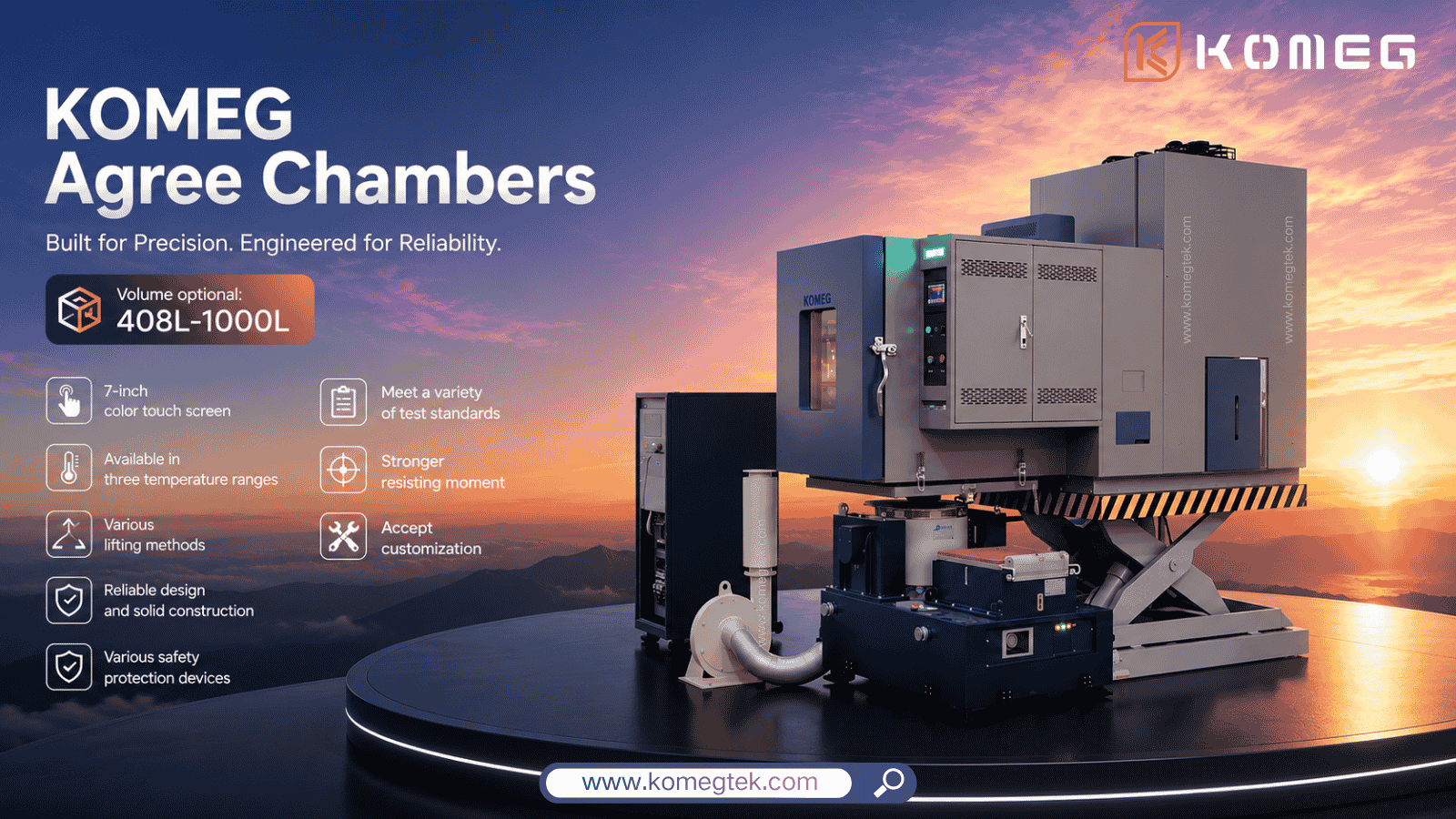
An Agree Chamber is a multi-stress environmental testing system that combines temperature, humidity, vibration, and sometimes pressure testing within a single integrated platform.
Unlike a standard environmental chamber that evaluates individual conditions separately, an Agree Chamber allows multiple environmental factors to be applied simultaneously. This creates a more realistic simulation of actual operating environments and helps engineers better understand how products will perform throughout their service life.
The term “AGREE” originated from the Advisory Group on Reliability of Electronic Equipment, which promoted more advanced reliability testing approaches for electronic systems. Today, Agree Chambers are widely used across industries requiring high levels of reliability and product validation.
How Does an Agree Chamber Work?
The core principle behind an Agree Chamber is synchronized environmental simulation.
A typical testing setup may include:
- Temperature cycling from extreme cold to high heat
- Controlled humidity exposure
- Random, sinusoidal, or shock vibration profiles
- Real-time monitoring of the device under test (DUT)
- Data acquisition and performance analysis
For example, an electronic module can be exposed to temperature cycling while simultaneously experiencing vibration and humidity. This allows engineers to observe how different stress factors interact and influence product performance.
Rather than evaluating environmental conditions independently, Agree Chambers provides a more comprehensive understanding of potential failure mechanisms.
Why Single-Stress Testing Is No Longer Enough
Traditional environmental testing remains valuable for product qualification and compliance verification. However, modern products often operate in environments where multiple stresses occur at the same time.
Consider a battery management system installed in an electric vehicle.
During operation, it may experience:
- High temperatures generated by power electronics
- Continuous vibration from road conditions
- Humidity exposure in varying climates
- Repeated thermal cycling during charging and discharging
Testing these conditions separately may not fully reveal how they interact over time.
This interaction between environmental factors is often referred to as stress coupling.
For example:
Temperature and Humidity
Repeated thermal expansion and contraction can create pathways for moisture intrusion, accelerating corrosion and material degradation.
Temperature and Vibration
Thermal stress can weaken solder joints and structural connections. When vibration is introduced simultaneously, fatigue failures may develop more quickly.
Pressure and Temperature
In aerospace and high-altitude applications, pressure variations combined with temperature changes can affect seals, enclosures, and sensitive components.
These interactions are often difficult to detect through conventional single-factor testing.
Key Benefits of Agree Chamber Testing
1. Earlier Detection of Latent Defects
Manufacturing defects and design weaknesses may remain hidden under normal operating conditions.
By applying multiple stresses simultaneously, Agree Chambers can help identify issues earlier in the development cycle.
2. Improved Product Reliability
Products that perform well under realistic environmental conditions are generally more likely to achieve long-term field reliability.
This is especially important for mission-critical applications where failures can result in high costs or operational disruptions.
3. Faster Product Validation
Multi-stress testing allows engineers to evaluate multiple environmental conditions within a single test program, improving testing efficiency and reducing development timelines.
4. Reduced Warranty and Service Costs
Identifying reliability issues before market launch helps manufacturers reduce product returns, warranty claims, and maintenance expenses.
5. Better Understanding of Failure Mechanisms
Agree Chambers provide valuable data that supports root-cause analysis and product improvement efforts.
Agree Chamber Applications Across Industries
Aerospace and Defense
Aircraft, satellites, and defense electronics operate under extreme environmental conditions where reliability is critical.
Agree Chambers help validate performance under combined thermal and mechanical stress conditions.
Semiconductor and Power Electronics
Technologies such as Silicon Carbide (SiC) and Gallium Nitride (GaN) enable higher power densities but also introduce greater thermal challenges.
Multi-stress testing supports package reliability evaluation and long-term durability assessment.
Electric Vehicles and Battery Systems
Battery packs, power control units, and charging systems must withstand vibration, temperature fluctuations, and environmental exposure throughout their lifecycle.
Agree Chambers help simulate these conditions during product development and validation.
Telecommunications
Outdoor communication equipment must remain reliable despite changing weather conditions and long-term environmental exposure.
Comprehensive environmental testing helps verify product durability before deployment.
AI Infrastructure and Data Centers
The growth of artificial intelligence has increased demand for high-performance computing systems.
Servers, power modules, cooling systems, and communication hardware require robust reliability validation to support continuous operation.
Agree Chamber vs Standard Environmental Chamber
One of the most common questions engineers ask is:
What is the difference between an Agree Chamber and a standard environmental chamber?
| Feature | Standard Environmental Chamber | Agree Chamber |
|---|---|---|
| Temperature Testing | Yes | Yes |
| Humidity Testing | Yes | Yes |
| Vibration Testing | Usually Separate | Integrated |
| Multi-Stress Testing | Limited | Comprehensive |
| Environmental Stress Screening (ESS) | Limited | Ideal |
| Real-World Simulation | Moderate | High |
While standard chambers remain suitable for many qualification tests, Agree Chambers provide a more realistic representation of actual operating environments by combining multiple stresses within a single testing system.
Emerging Trends in Reliability Testing
As product complexity continues to increase, environmental testing is evolving beyond traditional qualification methods.
Several trends are shaping the future of reliability engineering:
Data-Driven Reliability Analysis
Advanced data acquisition systems enable engineers to collect large volumes of testing data and gain deeper insights into product behavior.
Digital Twins
Manufacturers are increasingly using digital models alongside physical testing to improve reliability predictions and product optimization.
Accelerated Testing Methods
Environmental Stress Screening (ESS), Highly Accelerated Life Testing (HALT), and other accelerated methodologies are becoming more common across industries.
Greater Customization
Testing requirements vary significantly across applications. Modern Agree Chambers increasingly support customized configurations, specialized fixtures, and application-specific testing solutions.
Why Agree Chambers Matter in Modern Product Development
Reliability is no longer viewed as a final verification step.
Today, it is an essential part of the product development strategy.
Manufacturers are under pressure to launch innovative products faster while maintaining high levels of quality and performance. Achieving both objectives requires testing solutions that closely replicate real-world operating conditions.
Agree Chambers supports this goal by enabling engineers to evaluate products under multiple simultaneous environmental stresses, providing a more realistic picture of long-term performance.
Products rarely fail because of a single environmental factor.
More often, failures occur when multiple stresses interact over time, gradually affecting materials, components, and system performance.
This is why multi-stress environmental testing has become an increasingly important part of modern reliability engineering. By combining temperature, humidity, vibration, and other environmental conditions into a single test environment, Agree Chambers help engineers gain a more realistic understanding of product behavior before deployment.
As industries such as aerospace, semiconductors, energy storage, telecommunications, and AI infrastructure continue to push the boundaries of performance, the demand for more comprehensive reliability validation will only continue to grow.
At KOMEG, we design Agree Chambers to support these evolving testing requirements, helping manufacturers perform accurate and repeatable environmental stress screening under real-world conditions. From standard configurations to customized testing solutions, our systems are built to support reliability-focused product development and qualification programs.
If you’re exploring multi-stress testing solutions or looking to enhance your environmental testing capabilities, learn more about KOMEG Agree Chambers and discover how they can support your reliability validation goals.
Frequently Asked Questions About Agree Chambers
Q1: What is the main purpose of an Agree Chamber?
To evaluate product reliability by exposing test samples to multiple environmental stresses simultaneously, such as temperature, humidity, and vibration.
Q2: What industries commonly use Agree Chambers?
Aerospace, automotive, semiconductors, electronics, telecommunications, defense, energy storage, and AI infrastructure.
Q3: How is an Agree Chamber different from a standard environmental chamber?
A standard environmental chamber typically evaluates environmental conditions individually, while an Agree Chamber combines multiple stresses into a single test environment for more realistic reliability validation.
Q4: Can Agree Chambers be customized?
Yes. Depending on application requirements, systems can be configured with different chamber volumes, temperature ranges, vibration platforms, lifting mechanisms, and monitoring functions.