

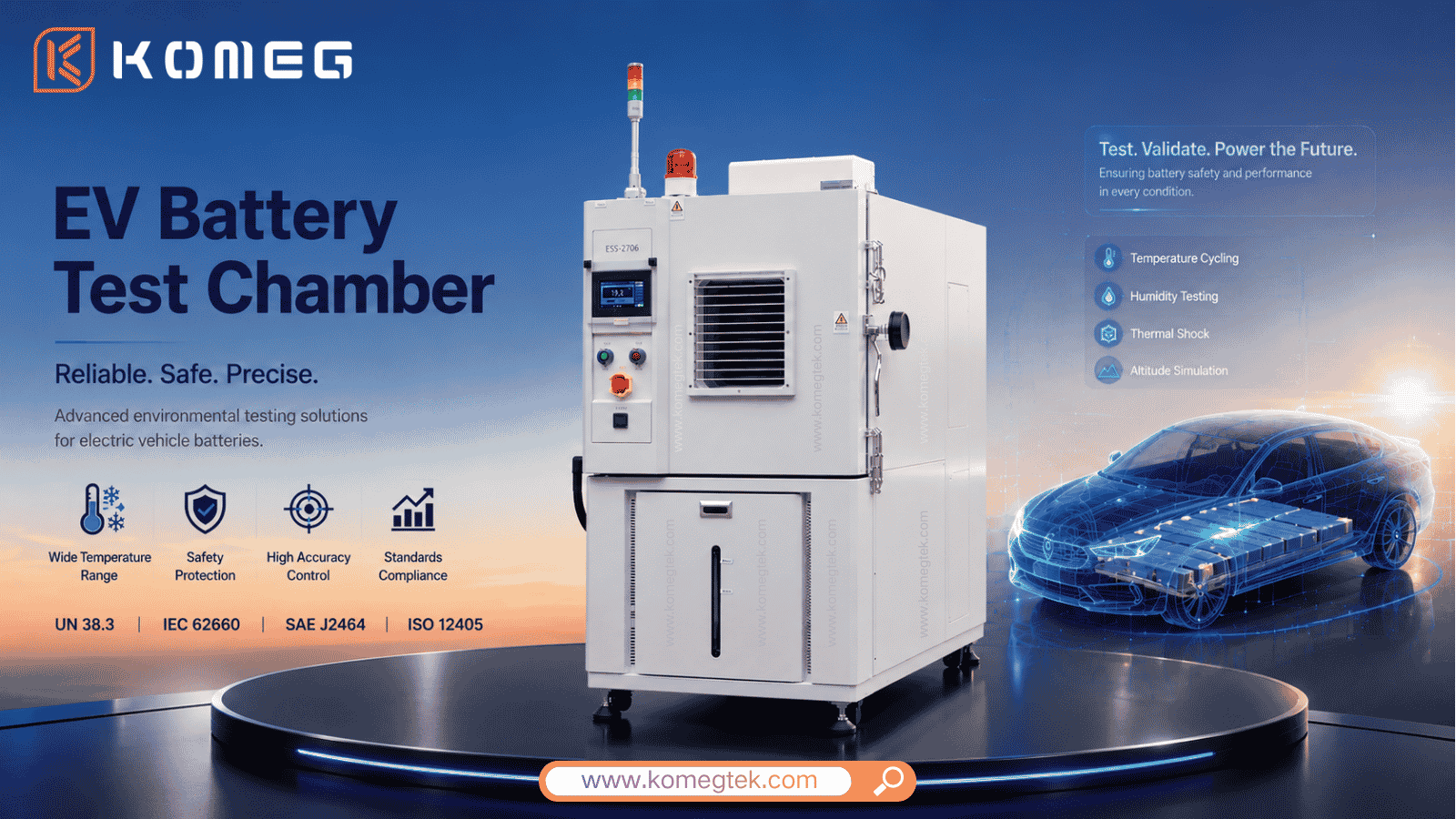
Electric vehicles (EVs) are transforming the global transportation industry. With EV sales expanding rapidly worldwide, the demand for high-performance, high-voltage lithium-ion batteries has reached unprecedented levels.
However, battery performance and electrochemical stability are highly sensitive to environmental variables. Extreme temperatures, fluctuating humidity, atmospheric pressure changes, vibration, and dynamic thermal stresses can significantly impact battery capacity, cycle life, charging efficiency, and structural safety.
To ensure batteries perform reliably throughout their design lifecycle, manufacturers rely on specialized EV Battery Test Chambers to simulate real-world environmental conditions within a controlled laboratory setting. From early-stage battery cell development to module validation and complete battery pack certification, environmental testing is now an indispensable phase of modern automotive engineering.
This comprehensive guide explains the core operational mechanics of EV battery test chambers, key international testing standards, critical validation methodologies, and strategic criteria for selecting the optimal testing equipment for your laboratory.
Why EV Batteries Require Environmental Testing
Unlike standard consumer electronics batteries, EV battery systems must operate safely and efficiently under far more punishing and unpredictable operating conditions. A battery system integrated into a modern electric vehicle will regularly encounter:
Sub-Zero Arctic Environments: Operating efficiently in temperatures falling below -40°C.
Arid Desert Thermal Stress: Withstanding ambient and operational temperatures exceeding +70°C.
High-Current Fast Charging: Managing massive internal heat dissipation during rapid charge/discharge cycling.
High-Altitude Low-Pressure Conditions: Maintaining seal integrity during transport or operation across high-mountain regions.
Prolonged Moisture Exposure: Resisting electrochemical corrosion under high humidity or tropical coastal conditions.
Without rigorous environmental simulation, unvalidated battery designs expose manufacturers to severe field risks, including:
Accelerated capacity fade and premature battery degradation
Internal micro-short circuits caused by lithium dendrite growth
Gasket embrittlement and housing seal failures
Moisture ingress leading to insulation breakdown and PCB corrosion
Thermal runaway events, fires, or catastrophic pack explosions
Extremely costly product recalls and brand damage
Advanced environmental simulation isolates these design flaws during the R&D prototype stage long before the products hit the mass market.
What Is an EV Battery Test Chamber?
An EV Battery Test Chamber is a highly engineered environmental simulation system designed to evaluate the performance, durability, and safety of batteries under precise temperature, humidity, altitude, and mechanical stress profiles.
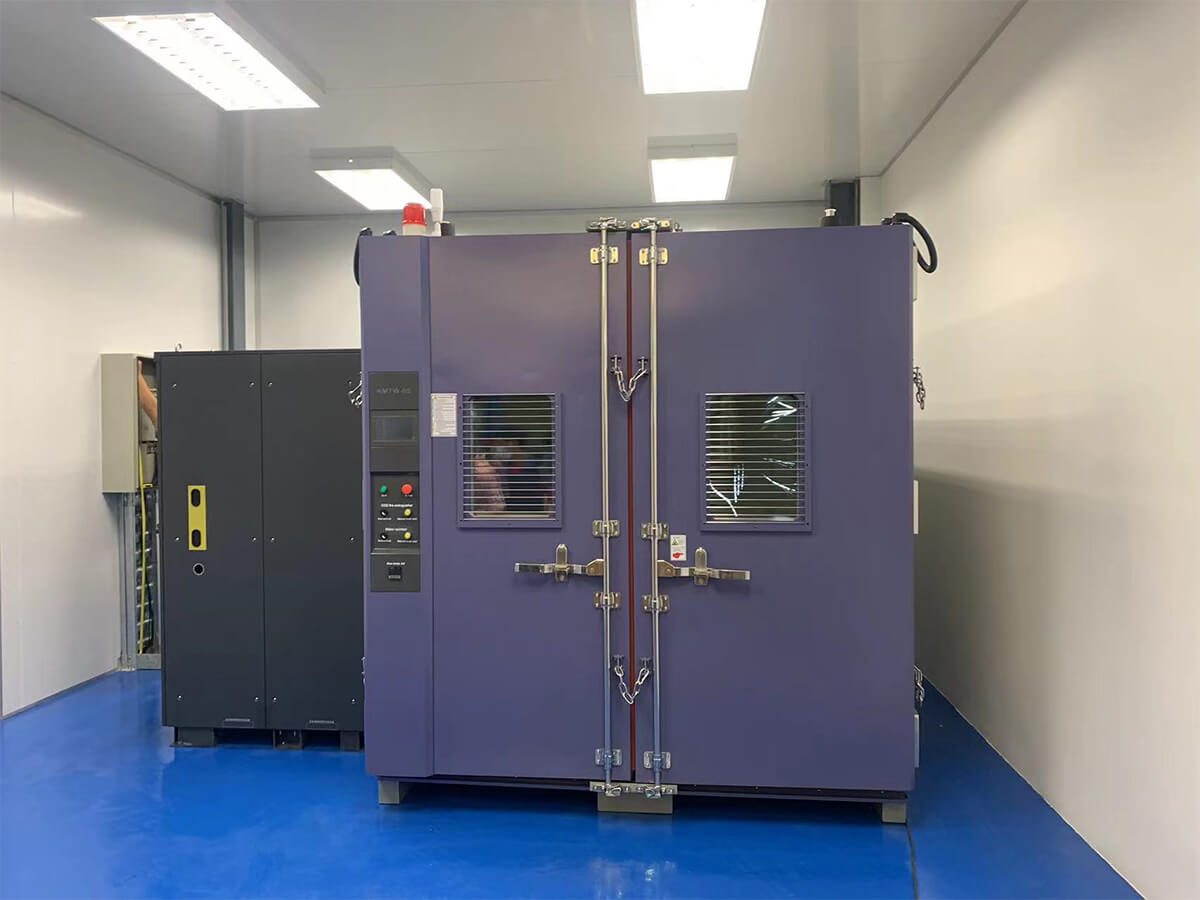
Walk‑In Climate Chamber for EV Battery Thermal Testing – Supplied to a University in Thailand
The chamber generates highly repeatable, synchronized testing environments that replicate real-world usage. Depending on the testing scope, modern chambers are built to accommodate multiple structural levels of energy storage:
Cell Level: Validating raw material formulations, anodes, cathodes, and electrochemistry.
Module Level: Testing series-parallel cell configurations, structural encasements, and localized BMS (Battery Management Systems).
Pack Level: Testing the complete, fully integrated vehicle battery pack, including thermal management plates, high-voltage wiring, and final enclosure seals.
Core Types of EV Battery Test Chambers
Temperature Cycling Test Chambers
Temperature cycling chambers repeatedly expose the battery specimens to rapid transitions between extreme hot and cold setpoints.
Testing Purpose: Evaluates differential thermal expansion/contraction of materials, detects weld and solder joint degradation, checks seal reliability, and accelerates physical aging mechanisms.
- <pTypical Test Profile: Cycling between -40°C and +100°C (or up to +150°C for advanced stress screening).
KOMEG Advantage: KOMEG engineers specialized battery temperature cycling chambers tailored for massive pack weights, featuring high-volume uniform airflow architectures to eliminate thermal dead zones.
Temperature Humidity Test Chambers
These systems combine precise thermal loads with relative moisture control to simulate tropical, coastal, or humid ambient environments.
Typical Test Profiles: Damp Heat testing at 85°C / 85% RH, or cyclic humidity testing up to 95% RH.
Testing Purpose: Evaluates moisture ingress vulnerability, galvanic corrosion resistance of busbars, electrical insulation degradation, and high-voltage leakages.
Thermal Shock Test Chambers
Thermal shock chambers subject battery components to near-instantaneous temperature shifts, usually via multi-zone pneumatic basket transfers or rapid damper controls.
Typical Transitions: Dropping from +150°C to -40°C in less than 10 seconds.
Testing Purpose: Validates the structural integrity of structural battery housings, connectors, coolant line seals, and thermal interface materials (TIMs).
Altitude (Low-Pressure) Test Chambers
Battery packs often experience major air pressure drops during international air freight or high-altitude mountain driving.
Testing Purpose: Combines altitude/vacuum simulation (from sea level down to 11.6 kPa / 15,000 meters) with precise temperature controls to verify that cell seals or pressure relief valves do not prematurely rupture or leak under reduced atmospheric pressure.
Explosion-Proof Battery Abuse Test Chambers
Battery abuse testing inherently carries high safety risks, especially when testing cells or modules to the point of structural failure.
To safeguard laboratory personnel and facility infrastructure, KOMEG explosion-proof chambers integrate comprehensive EUCAR Hazard Level (typically Levels 1 to 7) mitigation systems, including:
Heavy-duty explosion relief doors and pneumatic pressure-release vents
Continuous gas monitoring (detecting H₂, CO, CH₄, and volatile organics)
Integrated smoke detection linked to automated N₂ (Nitrogen) or water-mist fire suppression systems
Explosion-proof interior lighting, intrinsically safe wiring, and heavy-duty mechanical door chain locks
High-volume emergency exhaust blowers to purge toxic or combustible gases post-test
Key EV Battery Testing Standards
To clear regulatory hurdles for global market entry, testing profiles inside the chamber must adhere strictly to internationally recognized standards:
| Standard | Core Regulatory Focus | Key Chamber Requirements |
| UN 38.3 | Lithium Battery Transportation Safety | Demands synchronized altitude simulation, thermal cycling, vibration, and impact test capabilities. |
| IEC 62660 (1-3) | Reliability & Abuse Testing for EV Cells | Requires precise thermal stability, capacity verification, and high-temperature abuse testing. |
| ISO 16750 / 12405 | Environmental Conditions for Electrical/Pack Systems | Focuses on harsh temperature profiles, dynamic humidity cycles, and rigorous durability evaluation. |
| SAE J2464 / J2929 | EV Battery Abuse and Thermal Testing | Mandates advanced hazard mitigation features for thermal abuse, overcharge, and mechanical shock testing. |
| UL 2580 | Batteries for Use in Electric Vehicles | Requires comprehensive environmental durability validation, high-temperature structural integrity, and flammability testing. |
Critical Technical Features to Evaluate
When selecting an EV battery test chamber, engineering and procurement teams should evaluate several baseline performance and safety metrics:
Wide and Precise Temperature Ranges
A versatile laboratory chamber should provide a baseline operating range of -70°C to +180°C to support both standard automotive profiles and advanced military/aerospace-grade environmental stress screening.
Rapid Temperature Ramp Rates (Thermal Ramping)
Standard chambers heat or cool at 1°C to 2°C per minute, which is insufficient for accelerated testing. High-throughput EV validation typically requires fast-acting refrigeration compressors capable of:
3°C/min, 5°C/min, 10°C/min, or up to 15°C/min linear or non-linear ramp rates depending on the specific standard (e.g., Environmental Stress Screening / ESS).
Superior Temperature and Airflow Uniformity
Because battery packs are spatially large and thermally dense, the chamber’s internal airflow configuration must minimize spatial temperature gradients. KOMEG chambers utilize custom air plenum designs to achieve exceptional uniformity, ensuring every single cell within a large pack experiences identical thermal conditions.
Next-Gen Data Logging and Third-Party Cycler Integration
Modern Industry 4.0 laboratories require the test chamber to talk seamlessly with external battery charge/discharge cyclers (such as Digatron, AVL, Chroma, or Arbin). KOMEG chambers feature advanced programmable touchscreen controllers supporting:
Ethernet (TCP/IP), RS485, and USB interfaces
Comprehensive SCADA system integration
Real-time remote monitoring, automatic profiling, and digitized audit trails for compliance reporting
Why Choose KOMEG EV Battery Test Chambers?
Founded in 1990, KOMEG has established over three decades of engineering excellence in environmental simulation technology. We serve as a trusted Tier-1 equipment partner to automotive OEMs, battery cell manufacturers, energy storage developers, and independent global testing laboratories.
Comprehensive Turnkey Portfolio: From compact benchtop chambers for cell testing to massive walk-in/drive-in climate rooms for full-scale vehicle battery integration, we provide solutions across every production scale.
Advanced Custom Engineering: We don’t just sell off-the-shelf boxes. We custom-engineer interior dimensions, structural floor weight capacities, reinforced pass-through cable ports, multi-pane observation windows, and complex safety cross-interlocks based on your lab’s precise layouts.
Pioneering Sustainable Technology: To support global decarbonization and strict European F-Gas compliance, KOMEG leads the market with innovative CO₂ (R744) eco-friendly refrigeration systems, providing exceptional thermal efficiency with near-zero Global Warming Potential (GWP = 1).
Global Support Network: With a proven track record of installations across more than 70 countries, KOMEG offers professional commissioning, operator training, customized maintenance contracts, and rapid technical support to keep your testing schedules running smoothly.
As electric vehicle technology advances toward higher energy densities and faster charging speeds, battery reliability and safety remain absolute priorities. EV Battery Test Chambers are the frontline defense in validating performance under volatile real-world conditions—helping your team catch vulnerabilities early, meet strict international compliance standards, and protect your brand equity.
Whether you require a flexible cell-testing unit or a complex, explosion-proof walk-in battery pack testing system, KOMEG provides the precision engineering and safety architecture your lab needs to succeed.
Ready to upgrade your battery testing infrastructure? [Contact KOMEG Engineering Team Today] to discuss your testing profiles, review technical drawings, or request an initial commercial quotation for your facility.