

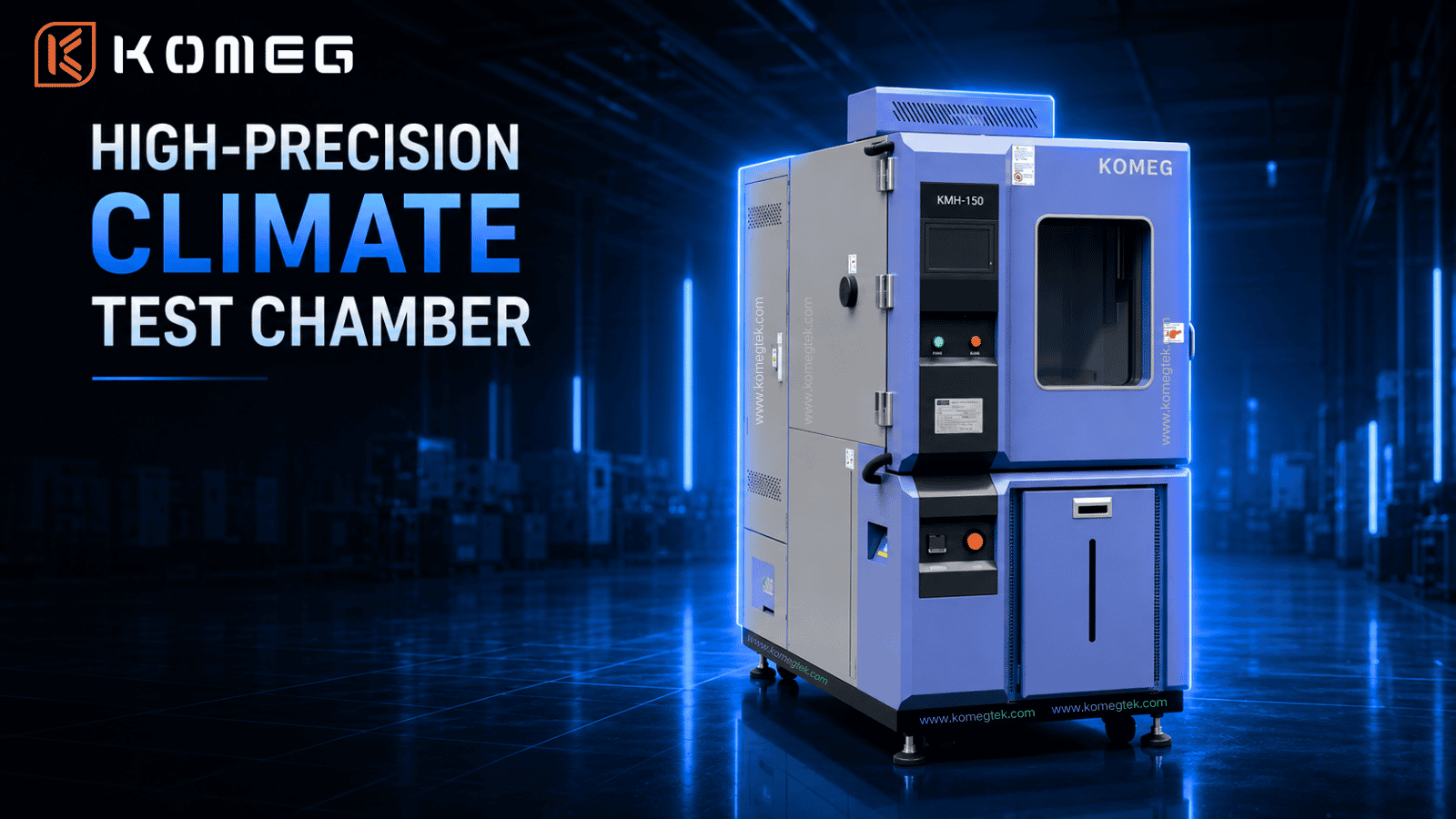
In today’s highly competitive manufacturing landscape, product reliability is no longer optional—it is a critical requirement for market success. Whether developing electric vehicle batteries, validating semiconductor devices, testing aerospace electronics, or qualifying telecommunications equipment, manufacturers must ensure their products can withstand a wide range of environmental conditions before deployment.
This is where a high-performance Climate Test Chamber becomes essential.
A climate test chamber enables engineers to simulate controlled temperature and humidity conditions, allowing products to be evaluated under real-world and accelerated environmental stresses. By identifying potential weaknesses during development, manufacturers can improve product quality, reduce warranty costs, and accelerate time-to-market.
As a leading environmental test chamber manufacturer, KOMEG provides advanced climate testing solutions engineered for precision, repeatability, reliability, and long-term laboratory performance.
What Is a Climate Test Chamber?
A Climate Test Chamber is a specialized environmental testing system designed to simulate various climatic conditions by controlling temperature, humidity, and environmental stability within a sealed test space.
These chambers are widely used to evaluate how products perform when exposed to:
High and low temperatures
High-humidity and ultra-low-humidity environments
Extreme temperature cycling and humidity profiling
Combined dynamic temperature and moisture stress
Climate testing helps manufacturers predict product behavior throughout its entire service life and verify compliance with strict international standards.
Why Is Climate Testing Important?
Products rarely operate under ideal laboratory conditions. Electronic devices may be exposed to tropical humidity. Automotive components experience harsh seasonal temperature fluctuations. Energy storage systems must operate reliably in deserts, coastal regions, and freezing sub-polar climates.
Without rigorous climate testing, manufacturers face catastrophic field risks such as:
Corrosion and electrochemical migration
Material degradation and embrittlement
Seal failure and ingress of moisture
Internal condensation damage and PCB short circuits
Sensor drift and calibration loss
Thermal runaway or reduced battery performance
Premature product aging
A precision climate test chamber allows these critical risks to be identified and mitigated long before products reach end consumers.
How Does a Climate Test Chamber Work?
Modern climate chambers integrate multiple advanced subsystems to engineer and maintain precise environmental configurations.
Temperature Control System
The refrigeration and heating systems work in seamless synchronization to achieve accurate temperature regulation. Typical industrial temperature ranges include:
-40°C to +150°C (Standard Industrial)
-70°C to +180°C (Extended/Aerospace Grade)
Advanced chambers support rapid temperature transition rates (thermal ramping) necessary for accelerated stress testing and reliability screening.
Humidity Control System
Moisture is generated through controlled steam or water vapor injection and is precisely monitored by high-accuracy electronic sensors.
Typical humidity range: 10% RH to 98% RH
Maintaining stable, non-condensing relative humidity is critical for valid corrosion testing, material aging studies, and electronic component validation.
Air Circulation System
An optimized, conditioned airflow design ensures consistent temperature and humidity distribution throughout the workspace. Proper conditioning minimizes thermal gradients and significantly improves test repeatability regardless of specimen load.
Intelligent Control System
Modern climate chambers utilize programmable microprocessors featuring:
Multi-step/profile test programming
Real-time data logging and export via USB/Ethernet
Remote monitoring and cloud network integration
Advanced alarm management and safety interlocks
Why Precision in Climate Testing Matters
The accuracy of a climate test chamber directly affects the validity of your testing data. Even minor environmental deviations can lead to inconsistent metrics and inaccurate product qualification.
KOMEG climate chambers are engineered to deliver:
Superior Temperature Uniformity: Advanced airflow engineering minimizes spatial temperature variances throughout the entire chamber volume.
Stable Humidity Profiling: Highly responsive psychrometric or capacitive sensors continuously adjust moisture levels to maintain target setpoints.
Repeatable Testing Results: Precise environmental control ensures that testing protocols can be identically reproduced across different laboratories worldwide.
Accelerated Reliability Validation: High-capacity refrigeration setups help engineers complete qualification programs efficiently without structural bottlenecks.
Key Technical Features of KOMEG Climate Test Chambers
1. Advanced Programmable Control Systems
KOMEG chambers feature intuitive, multi-lingual color touch-screen controllers that simplify complex test setups.
Connectivity: Fully supports Ethernet, RS485 communication, USB data export, and remote web-based operations to seamlessly integrate into Industry 4.0 laboratory environments.
2. Industrial-Grade Construction
Durability is critical for continuous, 24/7 laboratory operations. KOMEG climate chambers utilize:
SUS304 high-grade stainless steel interiors for superior corrosion resistance.
Heavy-duty structural frames paired with high-density polyurethane insulation to minimize thermal loss.
3. Comprehensive Safety Systems
Safety becomes paramount when conducting abusive testing on lithium-ion batteries, high-voltage electronics, and energy storage systems. Available safety features include:
Independent adjustable over-temperature protection
Multi-stage compressor overload and residual current protection
Automated pressure relief systems for rapid pressure equalization
Built-in smoke detection, gas sensors (CO, H₂), and active fire suppression integration (N₂ or water mist) for EUCAR hazard level compliance.
4. Eco-Friendly Refrigeration Technology
Tightening environmental regulations are driving the transition toward sustainable industrial solutions. KOMEG leads the industry by offering advanced CO₂ (R744) refrigeration technology that provides:
Ultra-low Global Warming Potential (GWP = 1)
Strict compliance with European F-Gas regulations and global environmental mandates
Exceptional cooling efficiency and reliable thermal ramp speeds without relying on harmful HFCs.
Common Applications of Climate Test Chambers
Electric Vehicle Batteries: Evaluating capacity retention, thermal stability, charging performance, and safety characteristics during intensive battery pack-level and module cycling.
Semiconductor Devices: Validating package reliability, moisture resistance, and long-term bias stability under accelerated stress conditions.
Automotive Components: Verifying the environmental ruggedness of Electronic Control Units (ECUs), sensors, ADAS cameras, connectors, and interior/exterior lighting systems.
Aerospace and Defense: Ensuring mission-critical components survive extreme thermal shocks and atmospheric pressure variations in compliance with military standards.
Telecommunications Equipment: Simulating decades of outdoor environmental exposure for 5G base stations, enclosures, and optical components within controlled laboratory setups.
Compliance with International Testing Standards
KOMEG Climate Test Chambers are fully optimized to execute testing profiles in strict compliance with globally recognized testing frameworks, including:
IEC 60068 Series (Environmental Testing for Electrical/Electronic Products)
MIL-STD-810H (Environmental Engineering Considerations for Defense)
ISO 16750 (Road Vehicles — Environmental Conditions for Electrical Equipment)
JEDEC Standards (Semiconductor Reliability Testing)
UN38.3 & SAE J2464 (Lithium Battery Transportation & Safety Testing)
RTCA DO-160 (Environmental Conditions for Airborne Equipment)
Tailored Solutions for Every Testing Requirement
Because every testing laboratory has distinct space and performance constraints, KOMEG offers highly customizable architectural options:
Chamber Formats: Benchtop units, floor-standing reach-in systems, rapid temperature change (ESS) chambers, specialized battery test enclosures, and massive walk-in/drive-in environmental rooms.
Customization Engineering: Fully customizable interior dimensions, tailored electrical configurations (e.g., 460V/480V 60Hz 3-Phase for North America), specialized multi-pane observation windows, additional cable access ports, and integrated data acquisition interfaces.
Why Choose KOMEG as Your Climate Test Chamber Manufacturer?
Founded in 1990, KOMEG brings over three decades of dedicated R&D and engineering heritage to the environmental simulation industry. Global OEMs and tier-1 suppliers choose KOMEG because of our:
Extensive technical engineering and customization expertise
Proven global project delivery and international commissioning experience
State-of-the-art advanced manufacturing facilities
Responsive, reliable global technical and after-sales support
Pioneering role in sustainable green refrigeration (CO₂/R744 systems)
Today, KOMEG environmental test chambers are trusted by market-leading brands across the automotive, battery, semiconductor, aerospace, telecommunications, and academic research sectors worldwide.
A premium Climate Test Chamber is one of the most critical investments a manufacturer can make toward robust product validation. Accurate temperature and humidity simulation empowers engineers to isolate hidden design weaknesses, certify compliance, and accelerate time-to-market with complete confidence.
Whether your laboratory requires a space-saving benchtop chamber or a custom-engineered walk-in testing facility, KOMEG delivers reliable, precise, and future-proof equipment designed for your long-term success.
Ready to enhance your environmental testing capabilities? [Contact KOMEG today] to consult with our application engineers, review technical datasheets, or request a customized commercial quotation for your project.