

In an increasingly globalized and technology-driven marketplace, products are expected to operate reliably across diverse environmental conditions. From extreme temperatures to high humidity and rapid environmental transitions, modern products must withstand conditions far beyond standard laboratory environments.
To address these challenges, the IEC established the IEC 60068 series—one of the most comprehensive and widely adopted environmental testing standards worldwide.
This guide provides a detailed, practical overview of IEC 60068, including its structure, key test methods, engineering considerations, and real-world applications.
What Is IEC 60068?
IEC 60068 is a series of international standards designed to evaluate the environmental durability of electrical, electronic, and mechanical components.
Rather than focusing on a single test, IEC 60068 defines a systematic framework that includes:
- Standardized test procedures
- Defined environmental conditions
- Controlled test durations
- Reproducible testing methodologies
The goal is to simulate real-world environmental stresses in a controlled and repeatable laboratory environment, ensuring that products meet reliability expectations before deployment.
Core Objectives of IEC 60068
IEC 60068 is designed to achieve several key objectives:
1. Reproducibility
Ensures that test results are consistent across different laboratories and geographic locations.
2. Comparability
Allows manufacturers and customers to compare product performance under standardized conditions.
3. Reliability Validation
Helps identify potential failure modes before products reach the market.
4. Risk Reduction
Minimizes the likelihood of field failures and associated costs.
Structure of the IEC 60068 Series
IEC 60068 is organized into multiple parts, each serving a specific role:
IEC 60068-1: General and Guidance
Provides an overview of testing principles and general requirements.
IEC 60068-2: Test Methods (Core Section)
Defines specific environmental test procedures.
IEC 60068-3: Supporting Documentation
Offers guidance on test execution and environmental conditions.
IEC 60068-4 and Beyond
Includes specialized tests and additional technical considerations.
Among these, IEC 60068-2 is the most widely applied in industrial testing.
Detailed Overview of Key Test Methods
1. Low Temperature Testing (IEC 60068-2-1)
This test evaluates product functionality and structural integrity under low-temperature conditions.
Typical test parameters:
- Temperature range: down to -70°C or lower
- Exposure duration: several hours to days
Failure risks identified:
- Material brittleness
- Reduced battery performance
- Mechanical contraction issues
2. High Temperature Testing (IEC 60068-2-2)
This method assesses product behavior under elevated temperatures.
Applications:
- Industrial electronics
- Power systems
- Automotive components
Potential failures:
- Thermal degradation
- Component overheating
- Insulation breakdown
3. Temperature Cycling (IEC 60068-2-14)
Temperature cycling simulates repeated expansion and contraction caused by alternating temperatures.
Key parameters:
- Temperature range (e.g., -40°C to +85°C)
- Number of cycles
- Dwell time at each extreme
Typical failure modes:
- Solder joint fatigue
- Seal failure
- Structural deformation
4. Humidity Testing (IEC 60068-2-78)
Humidity testing evaluates product resistance to moisture exposure.
Conditions:
- High humidity (up to 95–98% RH)
- Elevated temperature
Common issues:
- Corrosion
- Electrical leakage
- Insulation degradation
5. Thermal Shock Testing
Thermal shock involves rapid transitions between extreme temperatures, often within seconds.
Purpose:
- Identify material weaknesses under sudden stress
Typical effects:
- Cracking
- Delamination
- Mechanical stress failure
Engineering Considerations for IEC 60068 Testing
Successful implementation of IEC 60068 requires careful attention to engineering details.
Temperature Uniformity
Uneven temperature distribution can lead to inaccurate results.
Airflow Design
Proper airflow ensures consistent environmental exposure across all test samples.
Sensor Placement
Incorrect sensor positioning can distort measurements.
Test Repeatability
Precise control systems are required to ensure consistent results across multiple test cycles.
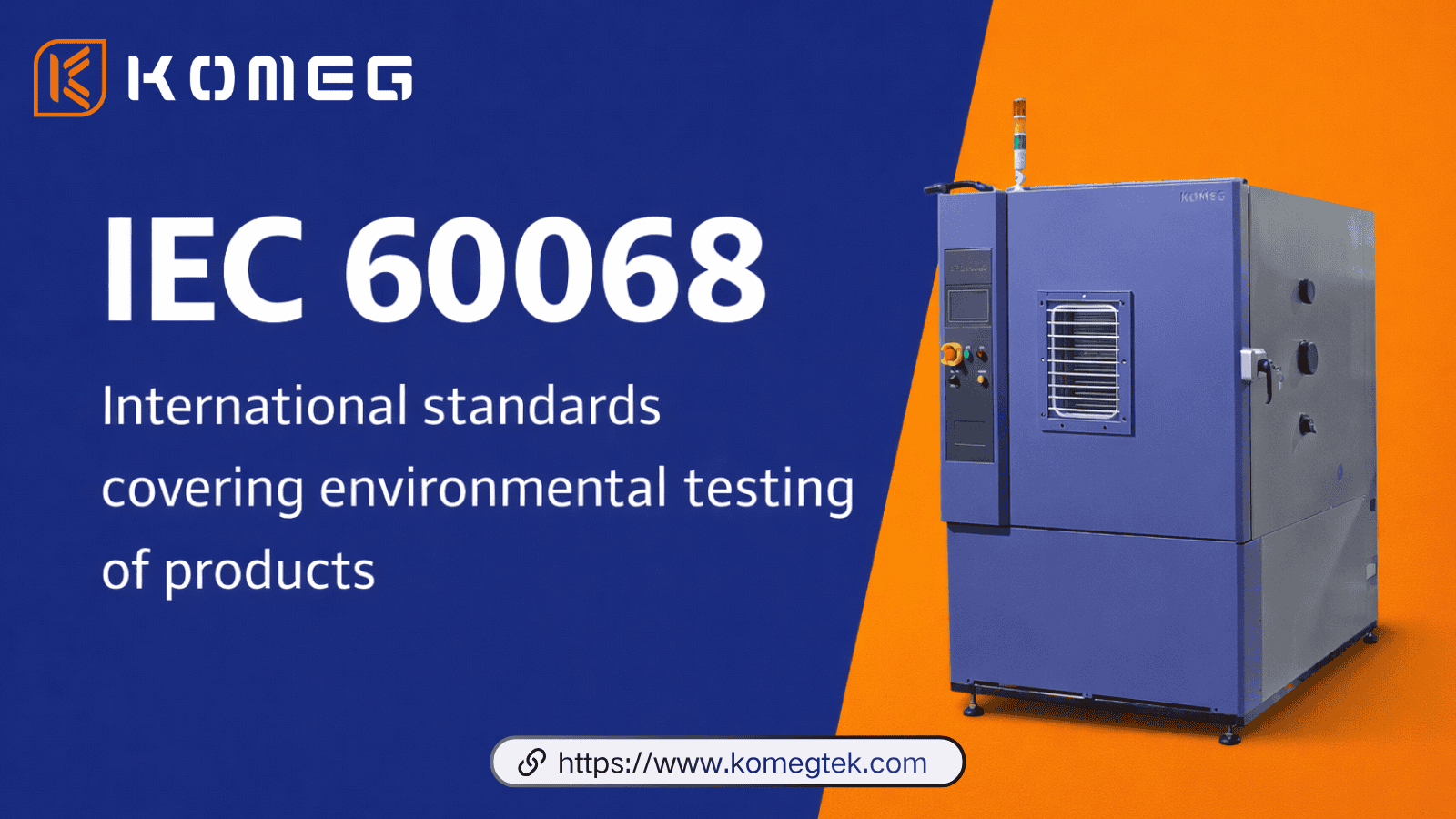
Environmental Test Chambers and IEC Compliance
To meet IEC 60068 requirements, environmental test chambers must provide:
- Precise temperature and humidity control
- High stability and uniformity
- Programmable test profiles
- Reliable long-duration operation
Applications Across Key Industries
Electronics and Semiconductors
Ensures circuit stability and long-term performance.
Automotive and Electric Vehicles
Validates battery systems, connectors, and control modules.
Aerospace and Defense
Simulates extreme altitude and environmental conditions.
Energy Storage Systems
Tests battery safety, efficiency, and durability.
Common Challenges in IEC 60068 Testing
Despite its standardized framework, several challenges remain:
- Maintaining environmental stability over long durations
- Managing complex multi-condition test cycles
- Balancing test accuracy with operational costs
- Scaling testing for large or complex products
Addressing these challenges requires both advanced equipment and experienced engineering teams.
Future Trends in Environmental Testing Standards
Environmental testing is evolving to meet new technological demands.
Key trends include:
- Integration of IoT and smart monitoring systems
- Increased use of eco-friendly refrigerants such as CO₂ (R744)
- More stringent testing requirements for EV batteries
- Greater emphasis on sustainability and energy efficiency
These developments will continue to shape the future of IEC-based testing.
In Closing
IEC 60068 remains a cornerstone of environmental testing, providing a globally recognized framework for evaluating product durability and reliability.
By applying its standardized methods and leveraging advanced testing equipment, manufacturers can significantly improve product performance, reduce failure risks, and meet international quality requirements.
As industries continue to innovate, adherence to IEC 60068 will be essential for ensuring long-term product success in increasingly demanding environments.