

Modern products are expected to operate reliably under increasingly demanding environmental conditions. Whether it is an electric vehicle driving through freezing winters and scorching summers, a semiconductor chip exposed to repeated thermal cycles, or an aerospace component experiencing extreme altitude changes, sudden temperature transitions can create significant stress on materials and assemblies.
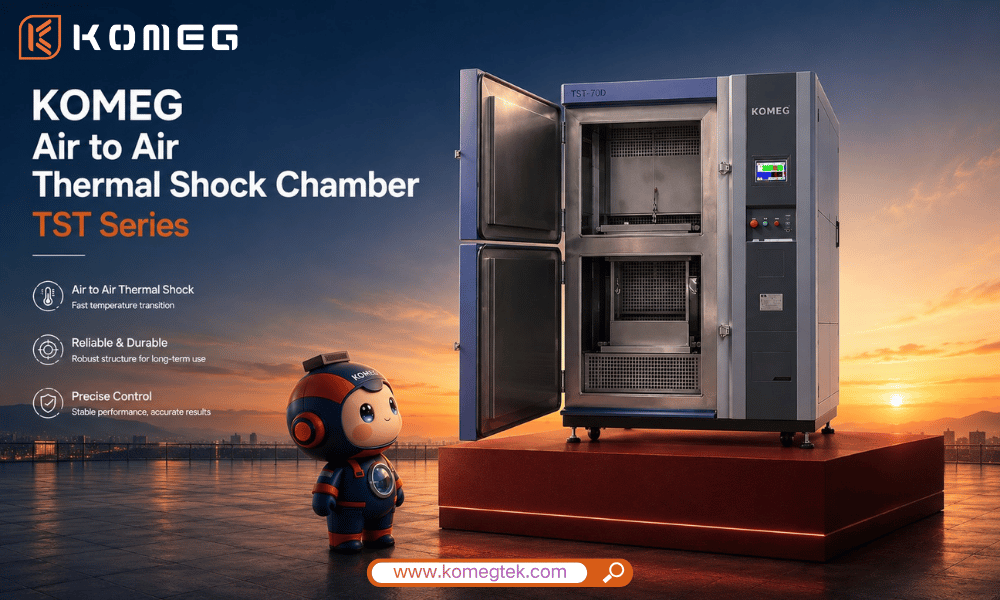
To evaluate product reliability under these conditions, manufacturers rely on the Thermal Shock Test Chamber, one of the most effective environmental testing systems for identifying potential design weaknesses and early-life failures. Understanding the working principles of a thermal shock test chamber helps engineers select the right testing solution and optimize product qualification processes. This article explains the five major working principles behind thermal shock testing and explores how modern Air-to-Air Thermal Shock Chambers deliver precise and repeatable results.
What Is a Thermal Shock Test Chamber?
A Thermal Shock Test Chamber is an environmental testing system designed to expose products to rapid transitions between extremely high and extremely low temperatures.
Unlike conventional temperature chambers that change temperature gradually, a thermal shock chamber forces products to experience sudden temperature changes within seconds, creating thermal stress that can reveal hidden defects in materials, solder joints, adhesives, electronic assemblies, and structural components.
Thermal shock testing is widely used in:
- Semiconductor testing
- Automotive electronics validation
- Aerospace component qualification
- Battery testing
- Consumer electronics reliability testing
- Military and defense applications
Why Is Thermal Shock Testing Important?
Rapid temperature changes cause materials to expand and contract at different rates.
When these thermal expansion coefficients vary between materials, stress accumulates within the product structure.
Over time, this can lead to:
- Cracked solder joints
- PCB delamination
- Material fatigue
- Seal failures
- Structural deformation
- Electrical performance degradation
Thermal shock testing accelerates these failure mechanisms, allowing manufacturers to identify potential reliability issues before products reach customers.
The 5 Major Working Principles of a Thermal Shock Test Chamber
1. Rapid Temperature Transfer Principle
The most fundamental principle of thermal shock testing is rapid temperature transition.
In an Air-to-Air Thermal Shock Chamber, products are moved between two independently controlled zones:
Hot Zone
Typically maintained between +60°C and +200°C
Cold Zone
Typically maintained between -40°C and -65°C
The test basket automatically transfers the specimen between chambers, creating a sudden thermal shock condition.
Typical transfer time:
≤ 10 seconds
This rapid transition simulates real-world temperature changes that products may encounter during operation or transportation.
2. Independent Hot and Cold Zone Control
Unlike traditional environmental chambers, thermal shock chambers use separate heating and cooling systems.
Each zone continuously maintains its target temperature before testing begins.
Benefits include:
- Faster testing cycles
- Improved temperature accuracy
- Reduced stabilization time
- Higher repeatability
Because both zones are already conditioned, the product experiences an immediate temperature change rather than waiting for the chamber itself to heat or cool.
3. Thermal Stress Acceleration Principle
Thermal shock chambers are designed to accelerate failure mechanisms.
When materials experience rapid temperature changes:
- Metals expand and contract
- Plastics deform differently
- Adhesives react to thermal strain
- Electronic components experience mechanical stress
These repeated cycles create accelerated aging effects that may otherwise take years to occur in actual service environments.
This allows engineers to evaluate long-term durability within days or weeks instead of years.
4. Temperature Recovery Principle
After specimen transfer, the chamber must quickly recover and stabilize its target temperature.
Recovery performance directly affects testing accuracy.
Modern thermal shock chambers typically achieve:
- Temperature transfer time ≤10 seconds
- Temperature recovery time ≤5 minutes
Fast recovery ensures that every thermal shock cycle remains consistent and complies with testing standards.
Poor recovery performance may lead to inaccurate test results and reduced repeatability.
5. Intelligent Control and Monitoring Principle
Modern thermal shock chambers rely on advanced control systems to maintain precise testing conditions.
Intelligent controllers continuously monitor:
- Chamber temperature
- Cycle count
- Transfer timing
- System performance
- Alarm conditions
Advanced systems provide:
- Touchscreen operation
- Real-time monitoring
- Data logging
- Network communication
- Remote control capability
These functions improve testing efficiency and ensure complete traceability of test data.
Air-to-Air Thermal Shock Chamber vs Conventional Temperature Chamber
Many users confuse thermal shock testing with standard temperature cycling.
However, they serve different purposes.
| Feature | Thermal Shock Chamber | Temperature Cycling Chamber |
|---|---|---|
| Temperature Change | Sudden | Gradual |
| Transfer Method | Sample transfer between zones | Chamber temperature changes |
| Stress Level | Very High | Moderate |
| Test Duration | Shorter | Longer |
| Reliability Screening | Excellent | Good |
For accelerated reliability testing, thermal shock chambers are often the preferred choice.
KOMEG Air-to-Air Thermal Shock Chamber TST Series
The KOMEG TST Series is engineered for demanding reliability verification applications.
Available Temperature Ranges
- -40°C to +150°C
- -55°C to +150°C
- -65°C to +150°C
Thermal Performance
- Hot zone temperature up to +200°C
- Transfer time ≤10 seconds
- Recovery time ≤5 minutes
- More than 1,000 thermal shock cycles supported
Intelligent Control
- Color touchscreen interface
- Real-time monitoring
- Ethernet connectivity
- Remote operation capability
- Data management functions
Energy-Efficient Design
The chamber automatically adjusts heating and cooling output based on testing requirements, reducing energy consumption while maintaining temperature stability.
Safety Protection
Integrated protection systems safeguard:
- Refrigeration units
- Heating systems
- Electrical circuits
- Power supply components
ensuring reliable long-term operation.
Applications of Thermal Shock Test Chambers
Thermal shock chambers are widely used across multiple industries.
Semiconductor Industry
Testing chip packaging reliability and solder joint integrity.
Automotive Electronics
Validating ECUs, sensors, battery management systems, and power electronics.
Aerospace Industry
Evaluating reliability under extreme altitude and temperature conditions.
Battery Testing
Assessing battery pack durability under rapid thermal transitions.
Consumer Electronics
Testing smartphones, wearables, and electronic assemblies.
Military and Defense
Qualifying mission-critical equipment exposed to harsh environmental conditions.
A Thermal Shock Test Chamber is one of the most powerful tools for accelerated reliability testing.
By applying rapid temperature transitions, independent hot and cold zone control, thermal stress acceleration, fast recovery systems, and intelligent monitoring technologies, thermal shock chambers help manufacturers identify weaknesses long before products enter the field.
For industries where reliability is critical, the KOMEG Air-to-Air Thermal Shock Chamber TST Series provides an efficient, precise, and dependable solution for thermal shock testing and product qualification.
Investing in proper thermal shock testing today can significantly reduce product failures, warranty costs, and reliability risks tomorrow.