

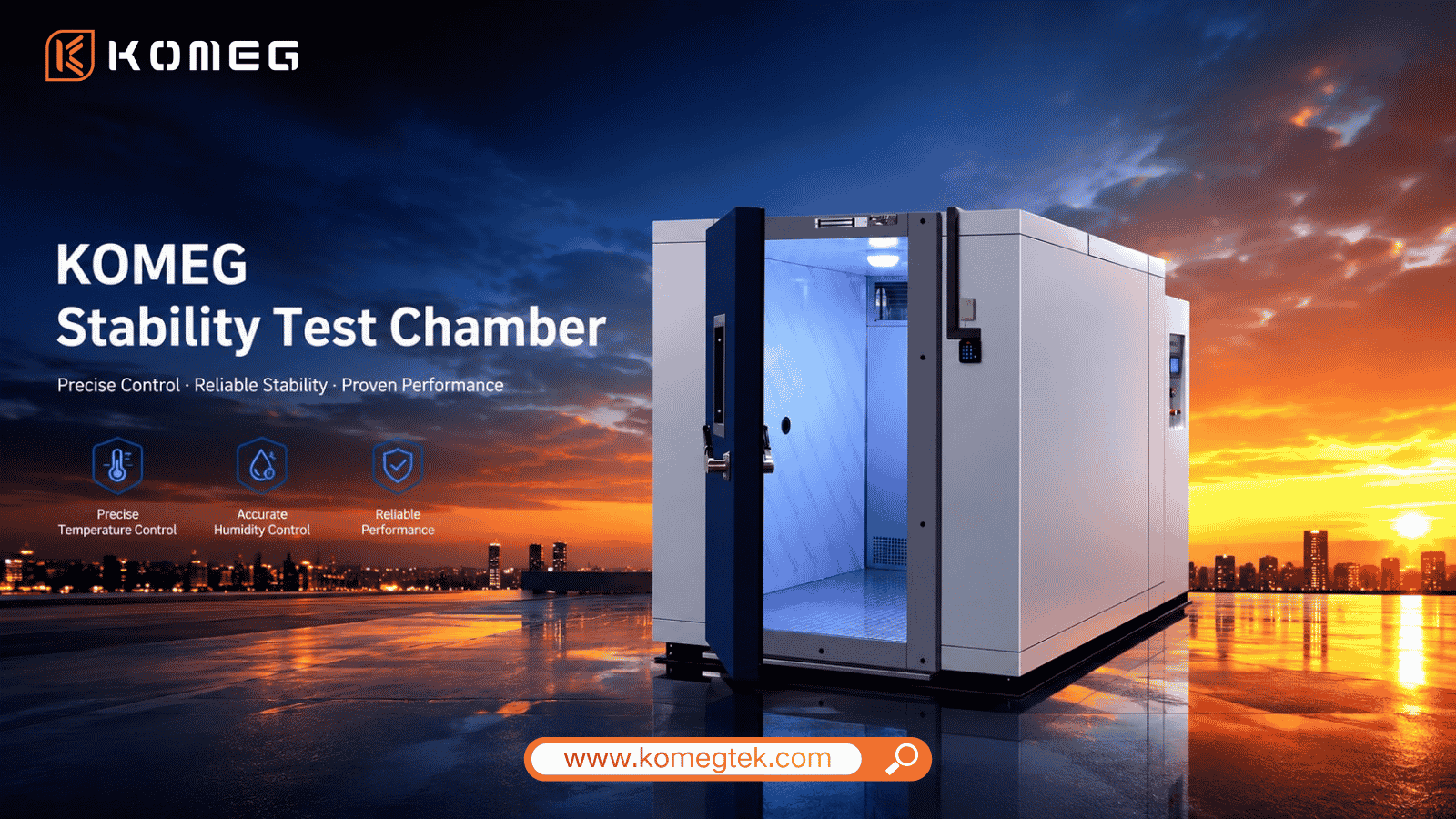
 Whether developing a new pharmaceutical product, validating cosmetic formulations, evaluating food packaging, or testing electronic materials, one question always arises before a product reaches the market:
Will it remain stable throughout its intended shelf life?
The answer cannot be determined simply by visual inspection or short-term testing. Instead, manufacturers rely on stability chambers to recreate controlled environmental conditions that simulate months—or even years—of real-world storage within a laboratory setting.
A stability chamber is much more than a temperature and humidity cabinet. It is a precision environmental testing system designed to maintain tightly controlled climatic conditions over extended periods, allowing researchers and quality engineers to evaluate how products respond to environmental exposure over time.
Today, stability chambers are widely used in pharmaceuticals, biotechnology, medical devices, cosmetics, food and beverage, packaging, chemicals, and many other industries where product quality and regulatory compliance are essential.
In this guide, we’ll explain what a stability chamber is used for, how it works, which industries depend on it, and how to choose the right chamber for your application.
What Is a Stability Chamber?
A stability chamber is a specialized environmental test chamber designed to maintain constant temperature and relative humidity for long periods with exceptional accuracy and uniformity.
Unlike conventional environmental chambers that are often used for rapid temperature cycling or accelerated stress testing, stability chambers focus on long-term environmental simulation. Their purpose is to provide stable storage conditions that allow manufacturers to observe gradual changes in product quality over time.
Typical stability studies may last several weeks, months, or even years, depending on regulatory requirements and product type. During this period, the chamber continuously maintains programmed environmental conditions while recording temperature, humidity, alarms, and operating data to ensure reliable and traceable test results.
Most modern stability chambers include features such as:
Precise temperature and humidity control
Uniform airflow distribution
Programmable operating profiles
Continuous data logging
Remote monitoring capabilities
Alarm and safety protection systems
Long-term operational stability
These features enable laboratories to perform repeatable testing while meeting international quality standards.
What Is a Stability Chamber Used For?
The primary purpose of a stability chamber is to determine how environmental conditions affect a product throughout its expected storage life.
Almost every product changes over time.
Some materials absorb moisture from the surrounding air.
Others gradually lose volatile compounds.
Certain polymers become brittle after prolonged exposure to heat.
Electronic materials may experience oxidation, while pharmaceutical ingredients slowly degrade due to temperature and humidity.
Without controlled stability testing, manufacturers would have no reliable way to predict these changes before products reach customers.
A stability chamber provides a controlled environment where these aging processes can be observed, measured, and documented under repeatable laboratory conditions.
Instead of waiting several years to evaluate product performance, accelerated stability studies allow manufacturers to collect valuable data within a much shorter timeframe by exposing products to elevated temperature and humidity conditions that simulate long-term storage.
The information obtained from stability testing supports numerous business and engineering decisions, including:
Determining product shelf life
Establishing recommended storage conditions
Comparing packaging materials
Evaluating formulation stability
Validating manufacturing consistency
Supporting regulatory submissions
Improving product quality and reliability
By identifying potential problems before commercialization, stability testing reduces development risks and helps manufacturers avoid costly product failures in the marketplace.
Why Is Stability Testing Important?
Imagine purchasing medication that loses effectiveness before its expiration date.
Or food packaging that deteriorates after several months in storage.
Or an adhesive that no longer bonds properly after prolonged exposure to humidity.
These failures rarely happen overnight.
Most occur gradually as environmental factors slowly affect the product’s physical or chemical properties.
Temperature accelerates many chemical reactions.
Humidity can promote hydrolysis, corrosion, swelling, or microbial growth.
Light exposure may degrade pigments or active ingredients.
Even oxygen present inside packaging can slowly alter product composition.
Because these changes occur over long periods, they cannot be accurately evaluated through short-term functional testing alone.
This is why stability testing has become a standard requirement across many industries.
It allows manufacturers to predict product behavior before products enter distribution, ensuring that customers receive products meeting the required quality standards throughout their intended shelf life.
For regulated industries such as pharmaceuticals and medical devices, stability testing is not merely good engineering practice—it is often a regulatory requirement before products can be approved for commercial distribution.
Common Stability Testing Conditions
Different industries require different storage conditions, but several environmental profiles are commonly used worldwide.
Examples include:
25°C / 60% RH — Long-term storage
30°C / 65% RH — Intermediate stability testing
40°C / 75% RH — Accelerated stability testing
5°C — Refrigerated products
-20°C — Frozen storage applications
These conditions are selected according to product characteristics, intended markets, and applicable regulatory guidelines.
The chamber must maintain these conditions continuously with minimal fluctuation, often for months without interruption.
Even small deviations in temperature or humidity can influence test results, which is why chamber stability, airflow uniformity, and control accuracy are critical factors when selecting equipment.
Industries That Use Stability Chambers
Although stability chambers are most closely associated with the pharmaceutical industry, their applications extend far beyond drug development. Any product that may change over time due to temperature or humidity can benefit from stability testing.
Pharmaceutical Industry
The pharmaceutical industry is one of the largest users of stability chambers.
Before a new medicine can be approved for sale, manufacturers must demonstrate that it remains safe, effective, and chemically stable throughout its intended shelf life. Stability chambers provide the controlled environmental conditions required for these studies, allowing researchers to monitor changes in potency, appearance, moisture content, dissolution rate, and packaging integrity over time.
Long-term and accelerated stability studies performed in accordance with ICH Q1A(R2) guidelines form an essential part of the drug approval process in many countries.
Biotechnology
Biological products are often more sensitive to environmental conditions than conventional pharmaceuticals.
Vaccines, enzymes, proteins, antibodies, and other biological materials can lose activity if exposed to excessive heat or humidity. Stability chambers help researchers evaluate storage conditions, transportation requirements, and long-term product stability while ensuring compliance with regulatory standards.
Medical Devices
Medical devices must remain reliable throughout storage and transportation before they are used by healthcare professionals or patients.
Manufacturers use stability chambers to evaluate:
Packaging performance
Sterile barrier integrity
Material aging
Adhesive durability
Plastic component stability
These tests help verify that medical devices continue to meet safety and performance requirements throughout their expected shelf life.
Cosmetics and Personal Care Products
Consumers expect cosmetics to maintain their color, texture, fragrance, and performance throughout their storage period.
Stability chambers allow manufacturers to evaluate products such as:
Skin creams
Lotions
Shampoos
Sunscreens
Makeup products
Perfumes
By exposing products to elevated temperature and humidity, manufacturers can quickly identify formulation instability, color changes, ingredient separation, or packaging compatibility issues before products reach the market.
Food and Beverage Industry
Food manufacturers use stability chambers to determine how storage conditions influence product quality and shelf life.
Common evaluations include:
Packaging durability
Moisture migration
Texture changes
Flavor stability
Color retention
Storage recommendations
The data obtained helps manufacturers establish expiration dates and optimize packaging materials for different distribution environments.
Electronics and Electrical Components
Although electronic products are commonly tested using environmental chambers, stability chambers also play an important role in evaluating materials that remain in storage for extended periods.
Examples include:
Adhesives
Encapsulation materials
Coatings
Insulation materials
Packaging components
These materials may slowly degrade under elevated temperature and humidity, affecting long-term product reliability.
How Does a Stability Chamber Work?
At first glance, a stability chamber may appear similar to a standard temperature and humidity chamber. However, its internal design is optimized for long-term environmental consistency rather than rapid temperature changes.
A typical stability chamber consists of several key systems working together.
The refrigeration system maintains low-temperature conditions when required, while electric heaters provide precise heating. A humidification system adds moisture to the chamber, and a dehumidification system removes excess humidity to maintain the programmed relative humidity level.
Meanwhile, circulation fans continuously distribute conditioned air throughout the chamber to ensure excellent temperature and humidity uniformity.
Multiple high-accuracy sensors monitor environmental conditions in real time. The controller compares these measurements with the programmed settings and automatically adjusts heating, cooling, humidification, or dehumidification as necessary.
Unlike rapid temperature change chambers or thermal shock chambers, stability chambers operate with minimal fluctuation over very long periods.
The emphasis is not on changing temperature quickly, but on maintaining an exceptionally stable environment day after day, week after week, and sometimes even year after year.
Stability Chamber vs. Environmental Chamber
This is one of the most common questions asked by buyers.
Although both types of equipment can control temperature and humidity, they are designed for different testing objectives.
An environmental test chamber is primarily used to simulate a wide range of environmental conditions, including extreme temperatures, rapid temperature changes, thermal cycling, thermal shock, and humidity. These chambers are commonly used to evaluate product durability, identify design weaknesses, and accelerate reliability testing.
A stability chamber, on the other hand, focuses on maintaining highly stable climatic conditions over long periods. Instead of stressing the product with rapid environmental changes, it evaluates how products naturally age under controlled storage conditions.
In simple terms:
Environmental chambers answer the question: Can this product withstand extreme environmental conditions?
Stability chambers answer the question: Will this product remain stable throughout its intended shelf life?
Many manufacturers use both types of chambers during product development because they serve complementary purposes.
International Standards for Stability Testing
Stability testing is closely linked to regulatory compliance, particularly in highly regulated industries.
One of the most widely recognized standards is ICH Q1A(R2), which defines stability testing requirements for new pharmaceutical products. It specifies recommended storage conditions, testing durations, and study protocols used by regulatory authorities around the world.
Depending on the application, manufacturers may also follow:
FDA guidance for pharmaceutical stability studies
GMP (Good Manufacturing Practice) requirements
WHO stability testing recommendations
ISO quality management standards
Industry-specific customer specifications
Compliance with these standards requires not only accurate environmental control but also reliable data logging, alarm systems, calibration, and documentation.
For this reason, stability chambers used in regulated laboratories are typically equipped with advanced controllers, continuous monitoring functions, user management, and secure data recording to support audits and quality assurance.
How to Choose the Right Stability Chamber
Selecting the right stability chamber involves more than simply comparing chamber size or temperature range. Since stability studies often run continuously for months, the chamber’s long-term performance, reliability, and control accuracy are just as important as its technical specifications.
Before making a purchase, consider the following factors.
Define Your Testing Requirements
Start by understanding the environmental conditions your products require.
Questions to consider include:
What temperature and humidity conditions are required?
Will the chamber be used for long-term, intermediate, or accelerated stability studies?
How many samples need to be tested simultaneously?
Are there future testing requirements that may require additional capacity?
Choosing a chamber that matches your actual application helps optimize both laboratory space and operating costs.
Temperature and Humidity Stability
One of the most important specifications is not simply temperature range, but temperature and humidity stability.
A chamber capable of maintaining 25°C ±0.3°C continuously for several months is often more valuable than one offering a wider temperature range but poorer stability.
Consistent environmental control improves data repeatability and ensures compliance with industry standards.
Uniform Airflow Distribution
Temperature and humidity should remain consistent throughout the entire workspace.
An optimized airflow system minimizes temperature gradients between shelves, ensuring that every sample experiences nearly identical environmental conditions.
Poor airflow can result in inconsistent testing, especially when the chamber is fully loaded.
<h2″>Reliable Data Logging and Monitoring
Many stability studies last hundreds or even thousands of hours.
During this time, environmental data must be continuously recorded and easily retrievable for quality audits and regulatory inspections.
Modern stability chambers should provide:
Continuous temperature and humidity recording
USB or Ethernet data export
Remote monitoring
Alarm notifications
User access management
Historical trend analysis
These functions improve laboratory efficiency while supporting compliance with pharmaceutical and quality management requirements.
Energy Efficiency
Because stability chambers operate continuously for extended periods, energy efficiency has a direct impact on operating costs.
Factors affecting electricity consumption include:
Refrigeration system efficiency
High-performance insulation
Intelligent controller algorithms
Airflow optimization
Compressor operating strategy
Choosing an energy-efficient chamber can significantly reduce electricity costs over many years of operation.
Manufacturer Experience and Technical Support
Stability testing often supports critical product development and regulatory submissions. Equipment reliability is therefore essential.
When selecting a supplier, consider:
Manufacturing experience
Customization capabilities
Calibration services
Installation support
Technical training
Global after-sales service
Availability of spare parts
Reliable technical support helps minimize downtime and ensures uninterrupted testing.
Frequently Asked Questions
What is the difference between a stability chamber and a temperature humidity chamber?
A stability chamber is specifically designed for long-term environmental testing under highly stable temperature and humidity conditions. A standard temperature and humidity chamber is typically used for a wider variety of environmental simulations, including product reliability and environmental performance testing.
What products require stability testing?
Many products benefit from stability testing, including:
Pharmaceuticals
Vaccines
Medical devices
Cosmetics
Food products
Nutritional supplements
Packaging materials
Chemicals
Electronic materials
How long does a stability test last?
Testing duration depends on the application and applicable standards.
Some accelerated studies may last several weeks, while long-term stability studies commonly continue for 12, 24, or even 36 months.
What temperature is used for stability testing?
Common conditions include:
- 25°C / 60% RH
- 30°C / 65% RH
- 40°C / 75% RH
Other conditions may be required depending on regulatory requirements and product characteristics.
Why is humidity control important?
Humidity can significantly influence product performance.
Excess moisture may cause corrosion, hydrolysis, microbial growth, swelling, or packaging degradation, while insufficient humidity may lead to drying, cracking, or material shrinkage.
Maintaining precise humidity control ensures reliable and repeatable stability testing.
Why Choose KOMEG Stability Chambers?
With more than three decades of experience in environmental testing technology, KOMEG designs and manufactures high-performance stability chambers for laboratories, research institutions, pharmaceutical manufacturers, and industrial testing facilities worldwide.
KOMEG stability chambers are engineered for long-term reliability and precise environmental control, offering stable temperature and humidity performance for demanding applications.
Key features include:
Temperature range from 0°C to +70°C (custom ranges available)
Precise temperature and humidity control
Excellent chamber uniformity
Intelligent touchscreen controller with programmable operation
USB, RS-485, and Ethernet communication options
Continuous data logging and remote monitoring
Multiple chamber capacities for laboratory and production environments
Custom-designed solutions for specialized applications
In addition to standard models, KOMEG also provides customized stability chambers tailored to customer requirements, including chamber dimensions, shelving configurations, control systems, and industry-specific testing needs.
A stability chamber is an essential tool for evaluating how products respond to long-term environmental exposure under controlled temperature and humidity conditions.
From pharmaceuticals and biotechnology to cosmetics, food, medical devices, and advanced materials, stability testing helps manufacturers determine shelf life, improve product quality, support regulatory compliance, and reduce the risk of product failures after launch.
Choosing the right stability chamber requires careful consideration of environmental control accuracy, airflow uniformity, monitoring capabilities, energy efficiency, and long-term reliability. Investing in a well-designed chamber not only improves testing accuracy but also reduces operating costs and supports consistent, repeatable results throughout the product development process.
Whether you are establishing a new laboratory or upgrading an existing testing facility, selecting a reliable stability chamber is an investment in product quality and long-term success.
If you’re looking for dependable stability testing solutions, KOMEG offers a comprehensive range of stability chambers designed to deliver accurate environmental simulation, reliable long-term operation, and flexible customization to meet the needs of modern laboratories and manufacturers worldwide.