

Lithium batteries have become the foundation of modern technology, powering everything from smartphones and laptops to electric vehicles (EVs), medical devices, aerospace systems, and large-scale energy storage solutions. As battery energy density continues to increase, ensuring battery safety has become one of the industry’s highest priorities.
One of the most recognized international safety standards is UL 1642, which evaluates the safety performance of lithium cells under various electrical, mechanical, and environmental abuse conditions. Among these evaluations, temperature cycling is one of the most critical because it simulates repeated thermal expansion and contraction that batteries experience throughout their lifecycle.
However, many manufacturers focus heavily on battery design while overlooking another equally important factor—the test chamber itself.
A battery can only pass UL 1642 testing when the testing environment is accurate, stable, and repeatable. Even a high-quality battery may produce inconsistent or unreliable results if the environmental chamber cannot precisely control temperature or maintain uniform conditions.
This article explains how to choose the right UL 1642 Battery Temperature Cycle Test Chamber, what technical specifications matter most, and how the right equipment improves both certification success and long-term testing reliability.
What Is UL 1642 and Why Does Temperature Cycling Matter?
UL 1642 is an internationally recognized safety standard developed by Underwriters Laboratories for lithium cells used in consumer and industrial applications.
The standard includes a series of abuse tests intended to verify that batteries remain safe under extreme operating conditions.
Temperature cycling is designed to expose batteries to repeated transitions between high and low temperatures. These thermal changes create internal mechanical stress due to differences in material expansion coefficients.
The objective is to identify potential defects before batteries reach the market, including:
- Internal short circuits
- Electrolyte leakage
- Cell swelling
- Seal failure
- Capacity degradation
- Structural deformation
- Thermal instability
If temperature changes inside the chamber are inconsistent or poorly controlled, the resulting data may not accurately represent the battery’s real performance.
For this reason, the environmental chamber plays a direct role in the credibility of UL 1642 certification.
Why the Test Chamber Is Just as Important as the Battery
A common misconception is that any programmable environmental chamber can perform UL 1642 testing.
In reality, battery safety testing places much higher demands on chamber performance than general environmental testing.
Consider a chamber loaded with multiple battery samples.
If one shelf is operating at 68°C while another reaches 72°C, the batteries are no longer experiencing identical thermal conditions. Differences in airflow, temperature recovery, or sensor accuracy can significantly influence the final results.
This is why professional battery laboratories place greater emphasis on:
Temperature uniformity
Temperature stability
Repeatability
Safety protection
Long-term reliability
Choosing the right chamber is not simply about meeting specifications—it is about ensuring that every test produces trustworthy, repeatable data.
Key Features to Look for in a UL 1642 Battery Temperature Cycle Test Chamber
1. High Temperature Uniformity
Temperature uniformity is arguably the most important specification for battery testing.
A well-designed airflow system distributes conditioned air evenly throughout the chamber, ensuring every battery experiences the same thermal environment.
Poor airflow can create localized hot or cold spots, introducing unwanted variability into the test.
When comparing chambers, pay close attention to verified temperature uniformity rather than temperature range alone.
2. Stable Temperature Control
Fast heating and cooling are valuable, but stability is even more important.
The chamber should maintain target temperatures with minimal fluctuation throughout long testing cycles.
Stable control helps laboratories obtain repeatable results while reducing unnecessary thermal stress caused by overshoot or oscillation.
Advanced PID control algorithms and high-quality temperature sensors contribute significantly to long-term stability.
3. Fast Temperature Recovery
Opening the chamber door or loading new samples inevitably disturbs the internal environment.
A high-performance chamber should quickly recover to the programmed temperature without prolonged stabilization periods.
This improves testing efficiency while maintaining compliance with test procedures.
4. Reliable Refrigeration System
Temperature cycling places continuous demand on refrigeration components.
An industrial-grade refrigeration system should provide:
- Stable cooling performance
- High energy efficiency
- Low failure rate
- Long service life
- Continuous operation over extended testing periods
Reliable refrigeration reduces maintenance costs while minimizing unexpected laboratory downtime.
5. Comprehensive Safety Protection
Unlike ordinary environmental testing, lithium battery testing introduces potential risks such as smoke, fire, gas release, or explosion.
A dedicated battery temperature cycle chamber should include multiple safety mechanisms, including:
Independent over-temperature protection
Explosion-proof chamber structure
Pressure relief vent
Explosion-proof observation window
Smoke detection system
Fire suppression interface
Emergency stop system
Automatic power shutdown
These protections safeguard both laboratory personnel and valuable test samples.
6. Intelligent Data Logging and Connectivity
Certification testing requires complete traceability.
Modern environmental chambers should automatically record:
Temperature history
Alarm records
Test profiles
Equipment status
User operations
Ethernet communication, USB export, and remote monitoring further improve laboratory management and documentation.
Chamber Size: Bigger Is Not Always Better
Many buyers assume that purchasing the largest available chamber provides maximum flexibility.
In reality, oversized chambers often lead to:
Longer temperature recovery times
Increased power consumption
Larger airflow variations
Higher operating costs
Instead, select a chamber that matches your testing volume while allowing adequate airflow around each battery sample.
Proper chamber loading has a greater influence on testing quality than simply choosing a larger model.
Common Mistakes When Purchasing a UL 1642 Test Chamber
Choosing Based Only on Price
Lower initial cost often results in higher maintenance expenses and reduced testing reliability.
When evaluating equipment, consider the total cost of ownership rather than purchase price alone.
Ignoring Airflow Design
Many buyers compare only temperature range.
However, airflow design largely determines chamber uniformity and repeatability.
A well-designed circulation system is essential for consistent battery testing.
Focusing Only on Current Requirements
Many laboratories begin with UL 1642 testing but later expand into additional battery standards such as:
UL 2054
UL 2580
UN 38.3
IEC 62133
IEC 62660
Choosing a flexible chamber with programmable test profiles and scalable hardware reduces future investment costs.
Overlooking Service Support
Even the most advanced environmental chamber requires periodic calibration and preventive maintenance.
Before making a purchase, evaluate:
Technical support availability
Spare parts supply
Calibration services
Software updates
Warranty coverage
Reliable after-sales support often determines long-term equipment performance.
Future Trends in Battery Safety Testing
As battery technologies continue to evolve, testing equipment is becoming increasingly intelligent.
Today’s leading laboratories are adopting chambers with:
Remote monitoring
Cloud-based data storage
Predictive maintenance
Intelligent diagnostics
Automated reporting
Energy-efficient refrigeration systems
These innovations improve operational efficiency while supporting increasingly demanding certification requirements.
Recommended Equipment for UL 1642 Battery Temperature Cycle Testing
Selecting the right equipment is about more than meeting temperature specifications—it is about ensuring testing accuracy, laboratory safety, and long-term reliability.
For manufacturers and laboratories performing UL 1642 Battery Safety Certification, the test chamber should deliver precise temperature control while incorporating safety features specifically designed for lithium battery testing.
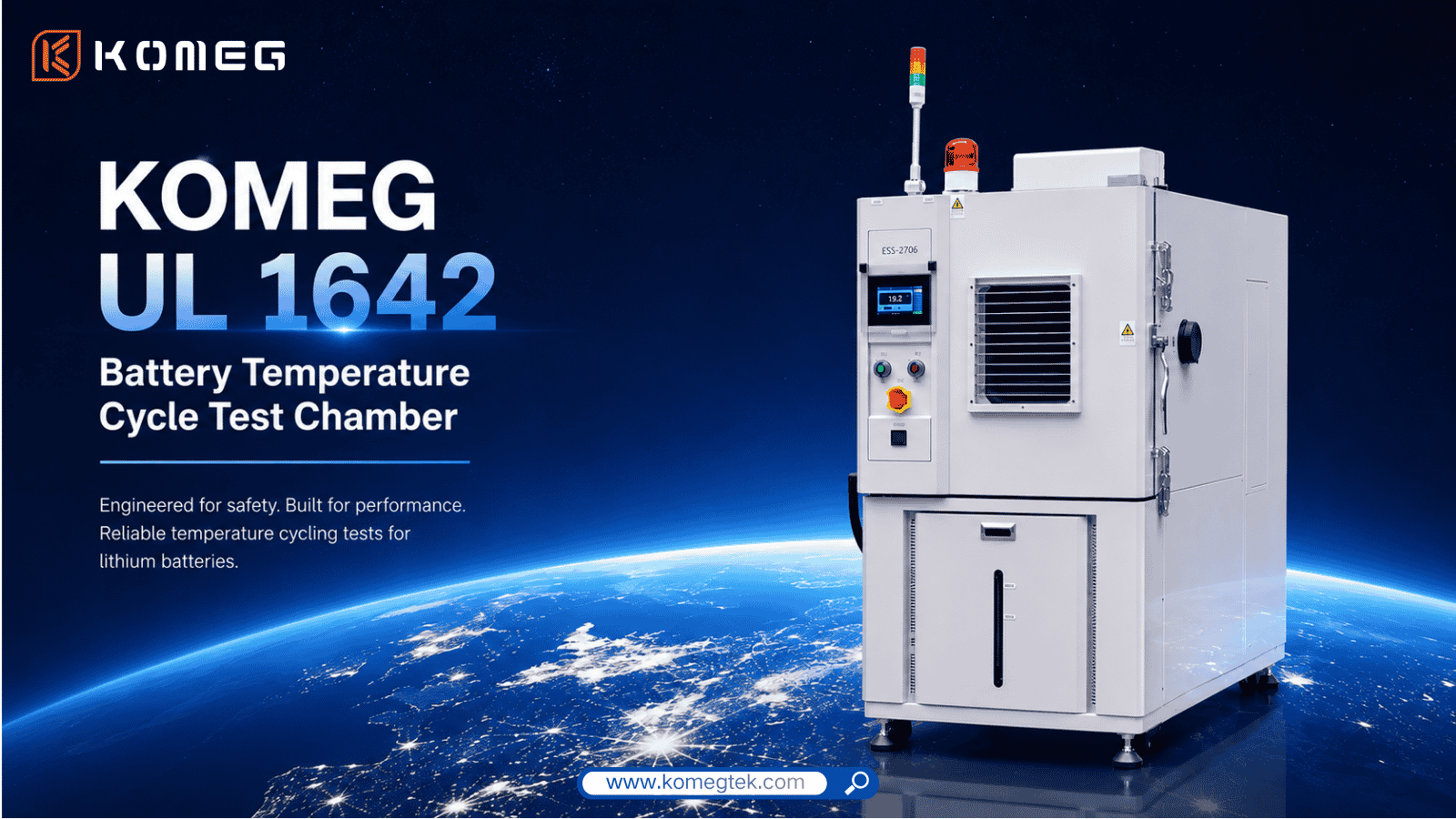
The KOMEG Battery Temperature Cycle Test Chamber is engineered to meet these demanding requirements. Designed for lithium battery manufacturers, third-party testing laboratories, research institutions, and EV battery developers, it combines precise environmental control with comprehensive explosion-proof protection to support reliable and repeatable testing.
Key features include:
Temperature range up to -70°C to +150°C (depending on model)
High temperature control accuracy and excellent chamber uniformity
Programmable temperature cycling profiles suitable for UL 1642 and other battery testing standards
Industrial-grade refrigeration system for continuous operation
Reinforced explosion-proof chamber construction
Pressure relief vent and explosion-proof observation window
Smoke detection and optional fire suppression system
Multi-level safety protection for personnel and equipment
Intelligent touchscreen controller with data logging, USB export, Ethernet, and remote communication
Multiple chamber sizes and customized configurations for battery cells, modules, and battery packs
Unlike general-purpose environmental chambers, KOMEG’s battery testing solutions are specifically developed to address the unique challenges of lithium battery safety testing. The optimized airflow system, precise temperature control, and integrated safety design work together to deliver consistent testing performance while protecting operators and laboratory assets.
Beyond UL 1642, the chamber can also support a wide range of international battery testing standards, including:
UL 2054
UL 2580
UN 38.3
IEC 62133
IEC 62660
UNECE R100
This flexibility allows laboratories to perform multiple certification programs using a single testing platform, reducing equipment investment while increasing testing efficiency.
Selecting a UL 1642 Battery Temperature Cycle Test Chamber should never be based solely on temperature range or purchase price.
The true value of a test chamber lies in its ability to provide accurate, stable, repeatable, and safe testing conditions throughout thousands of temperature cycles. Temperature uniformity, intelligent control, refrigeration reliability, comprehensive safety protection, and long-term operational stability all contribute directly to the quality of battery certification results.
As lithium battery applications continue expanding into electric vehicles, renewable energy storage, aerospace, and consumer electronics, testing requirements will only become more stringent. Investing in a purpose-built battery temperature cycle test chamber not only improves the likelihood of passing UL 1642 certification but also helps manufacturers identify potential product weaknesses earlier, reduce development risks, and accelerate time to market.
Whether you are establishing a new battery testing laboratory or upgrading existing environmental testing equipment, choosing a professional solution designed specifically for lithium battery safety testing is a decision that will deliver value throughout the entire product development lifecycle.