

As semiconductor devices become smaller, more powerful, and more densely integrated, reliability challenges continue to increase. Moisture ingress, corrosion, dielectric degradation, electrochemical migration, and package failures can significantly impact long-term product performance.
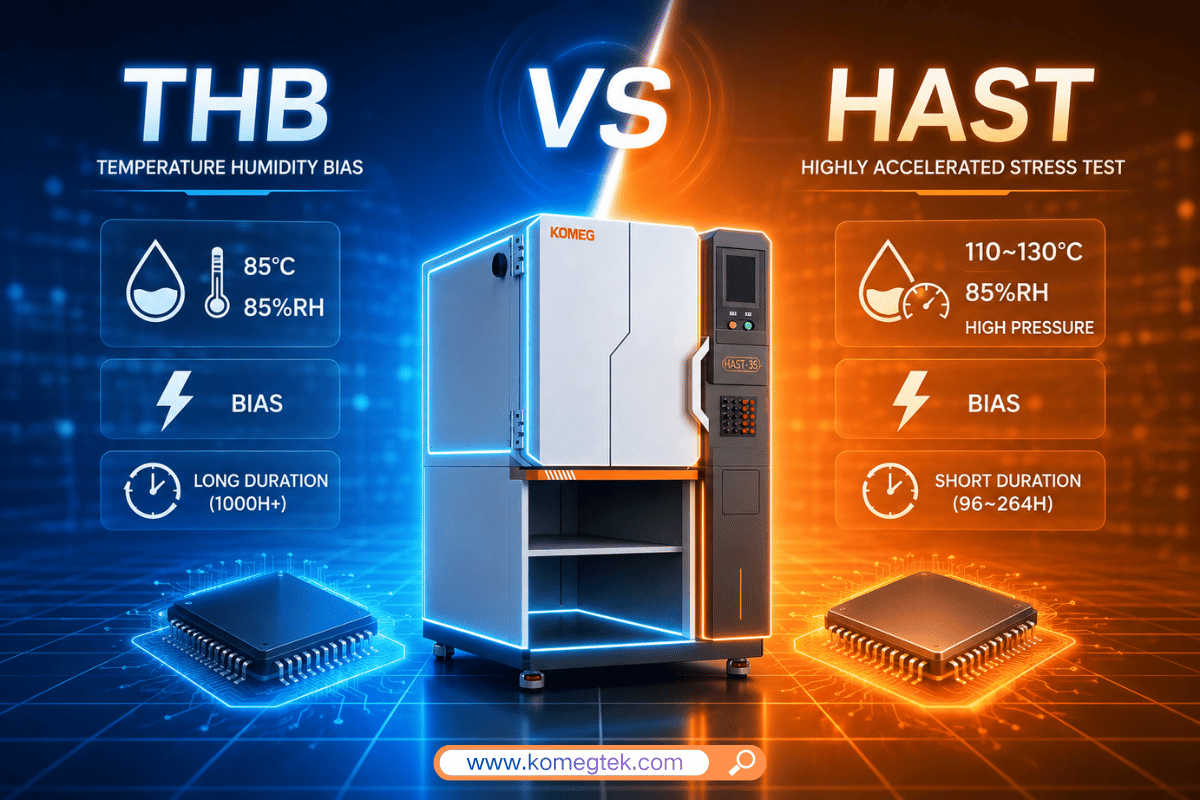
To identify these failure mechanisms before products enter the market, manufacturers rely heavily on accelerated reliability testing methods. Among the most widely used tests are:
- HAST (Highly Accelerated Stress Test)
- THB (Temperature Humidity Bias Test)
Both methods expose devices to elevated temperature, humidity, and electrical bias conditions to accelerate moisture-related failure mechanisms. However, they differ significantly in test duration, stress levels, acceleration factors, and application scenarios. Understanding when to use HAST versus THB can dramatically reduce qualification time while maintaining confidence in product reliability.
What Is THB (Temperature Humidity Bias)?
THB is one of the oldest and most widely accepted reliability tests in the semiconductor industry.
The test subjects’ electronic devices to:
- Elevated temperature
- High humidity
- Continuous electrical bias
Typical THB conditions include:
- 85°C
- 85%RH
- Electrical bias applied
- 1,000-hour test duration
For decades, the famous “85/85 Test” has served as a benchmark for evaluating moisture resistance.
Purpose of THB Testing
THB primarily evaluates:
- Corrosion resistance
- Package sealing effectiveness
- Insulation degradation
- Electrochemical migration
- Long-term operational reliability
The test closely simulates real-world environmental exposure over extended periods.
How THB Accelerates Failure Mechanisms
Moisture can penetrate semiconductor packages through microscopic pathways.
Over time, moisture exposure may lead to:
Metal Corrosion
Bond pads, lead frames, and interconnects can oxidize or corrode.
Leakage Current Increase
Moisture creates conductive pathways that increase current leakage.
Dendritic Growth
Electrochemical migration can form conductive filaments between conductors.
Dielectric Breakdown
Long-term humidity exposure can weaken insulating materials.
Because these failures often develop slowly in actual service conditions, THB accelerates the process under controlled laboratory conditions.
What Is HAST (Highly Accelerated Stress Test)?
HAST was developed to reduce the lengthy testing time associated with traditional THB testing.
Rather than relying solely on elevated temperature and humidity, HAST introduces pressurized saturated humidity conditions.
Typical HAST conditions include:
- 110°C to 130°C
- 85%RH
- Pressurized chamber
- Electrical bias
- 96 to 264 hours duration
By significantly increasing temperature and vapor pressure, HAST accelerates moisture diffusion and corrosion mechanisms.
Why HAST Is Faster Than THB
The acceleration effect primarily comes from:
Higher Temperature
Chemical reactions accelerate exponentially as temperature increases.
Increased Vapor Pressure
Pressurization forces moisture deeper into materials and interfaces.
Faster Moisture Absorption
Higher humidity combined with elevated pressure reduces moisture penetration time.
As a result:
A 96-hour HAST test may provide reliable insights comparable to hundreds or even thousands of hours of THB exposure.
This allows manufacturers to make qualification decisions much faster.
HAST vs THB: Key Differences
Environmental Conditions
THB
- 85°C
- 85%RH
- Atmospheric pressure
HAST
- 110°C to 130°C
- High humidity
- Elevated pressure
HAST subjects devices to much more aggressive environmental stress.
Test Duration
THB
Common durations:
- 500 hours
- 1,000 hours
- 2,000 hours
HAST
Typical durations:
- 96 hours
- 130 hours
- 264 hours
HAST can reduce qualification cycles by several weeks.
Acceleration Factor
THB provides moderate acceleration.
HAST provides significantly higher acceleration because of:
- Higher temperature
- Pressurized moisture environment
Acceleration factors can exceed 10× compared with conventional THB testing.
Correlation to Real-World Conditions
THB generally offers a closer correlation to actual field conditions.
HAST introduces more aggressive stresses that may occasionally activate failure mechanisms not encountered during normal operation.
Therefore, engineers often use both methods strategically.
Industry Standards for HAST and THB
Several JEDEC standards govern moisture reliability testing.
THB Standards
Commonly referenced:
- JESD22-A101
- AEC-Q100
- IEC reliability requirements
Typical condition:
- 85°C / 85%RH / Bias
HAST Standards
Commonly referenced:
- JESD22-A110 (Biased HAST)
- JESD22-A118 (Unbiased HAST)
Typical condition:
- 130°C
- 85%RH
- Pressurized environment
These standards are widely accepted throughout the semiconductor supply chain.
Applications of THB Testing
THB remains valuable for:
Automotive Electronics
Long-term environmental durability validation.
Industrial Electronics
Harsh environment reliability verification.
Power Modules
Insulation system evaluation.
Medical Electronics
Extended service-life assessment.
Because automotive products often require long operational lifetimes, THB remains an important qualification tool.
Applications of HAST Testing
HAST has become increasingly important for:
Advanced Semiconductor Packaging
- Flip-chip devices
- BGA packages
- CSP packages
Optical Communication Devices
- Silicon photonics
- Optical transceivers
- CPO modules
AI Accelerators
High-density packaging increases moisture sensitivity.
Consumer Electronics
Rapid product development cycles demand faster reliability feedback.
HAST and CPO: A Growing Testing Requirement
Co-Packaged Optics (CPO) is emerging as a critical technology for next-generation AI data centers.
CPO architectures integrate:
- Optical engines
- Photonic integrated circuits
- High-performance ASICs
Within extremely compact packages.
Because optical interfaces and advanced packaging structures are highly sensitive to moisture-induced degradation, HAST testing has become increasingly important during qualification.
Many CPO developers now use:
- HAST
- THB
- Thermal Cycling
- Thermal Shock
As part of comprehensive reliability programs.
How to Choose Between HAST and THB
The best approach depends on project objectives.
Choose THB when:
- Long-term reliability data is required
- Automotive qualification is needed
- Real-world environmental simulation is important
Choose HAST when:
- Development schedules are tight
- Rapid failure screening is needed
- Early qualification decisions are required
- New package technologies are being evaluated
In many cases, HAST is used early in development while THB is performed later for final qualification.
How Environmental Chambers Influence Test Quality
The accuracy of reliability testing depends heavily on chamber performance.
Critical chamber characteristics include:
- Temperature stability
- Humidity stability
- Pressure control
- Uniformity
- Bias integration capability
- Data logging accuracy
Even small deviations can significantly affect acceleration models and test repeatability.
For semiconductor reliability programs, selecting a chamber that complies with JEDEC requirements is essential.
Both HAST and THB play indispensable roles in modern reliability qualification programs.
THB remains the industry benchmark for evaluating long-term moisture resistance under realistic environmental conditions. HAST, meanwhile, offers dramatically shorter test durations and faster reliability feedback, making it ideal for today’s rapidly evolving semiconductor and electronics markets.
Rather than viewing HAST and THB as competing methods, leading manufacturers often use them together—leveraging HAST for accelerated screening and development, while relying on THB for final qualification and long-term reliability validation.
As semiconductor packaging technologies continue to evolve, especially in AI, high-performance computing, silicon photonics, and CPO applications, the importance of advanced moisture reliability testing will only continue to grow.